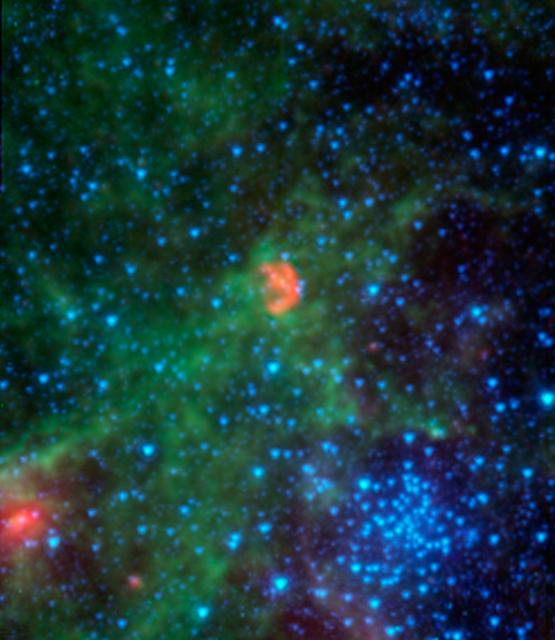
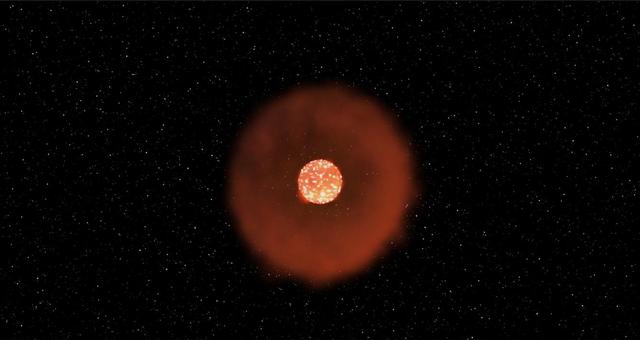
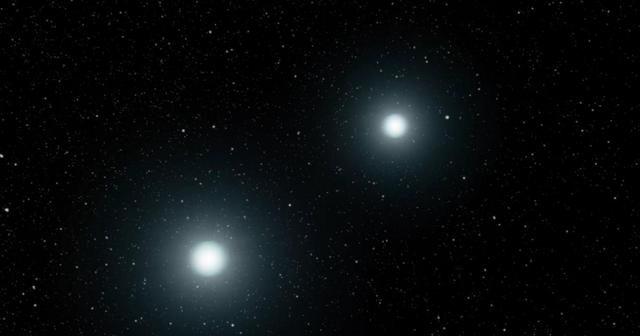
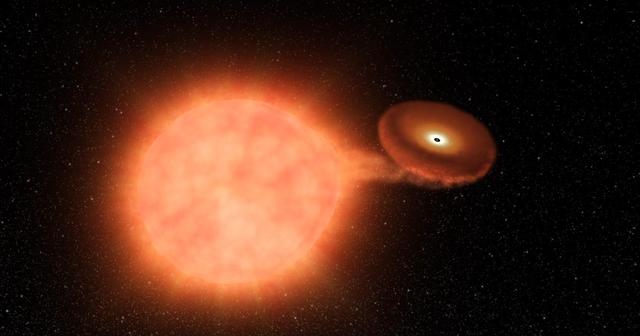
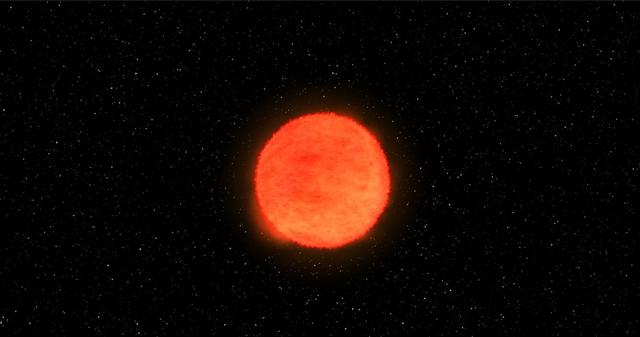
This image from an animation shows a gigantic star exploding in a "core collapse" supernova. As atoms fuse inside the star, eventually the star can't support its own weight anymore. Gravity makes the star collapse on itself. Core collapse s…
Kepler Beyond Planets: Finding Exploding Stars (Core Collapse Supernova)
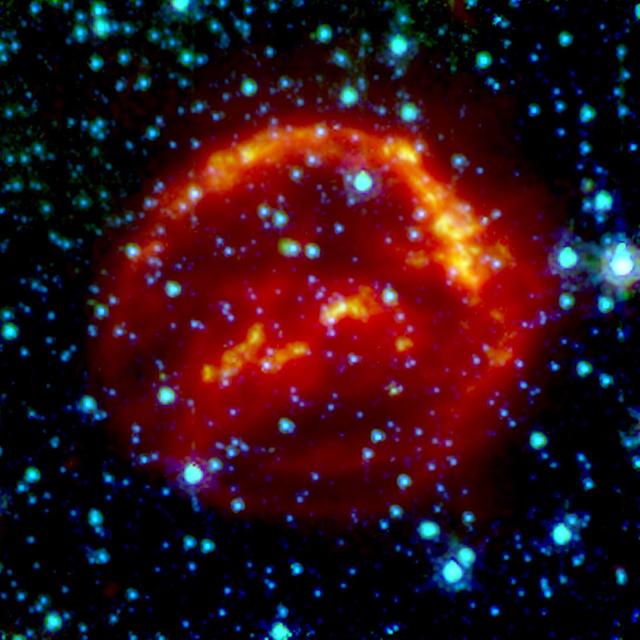
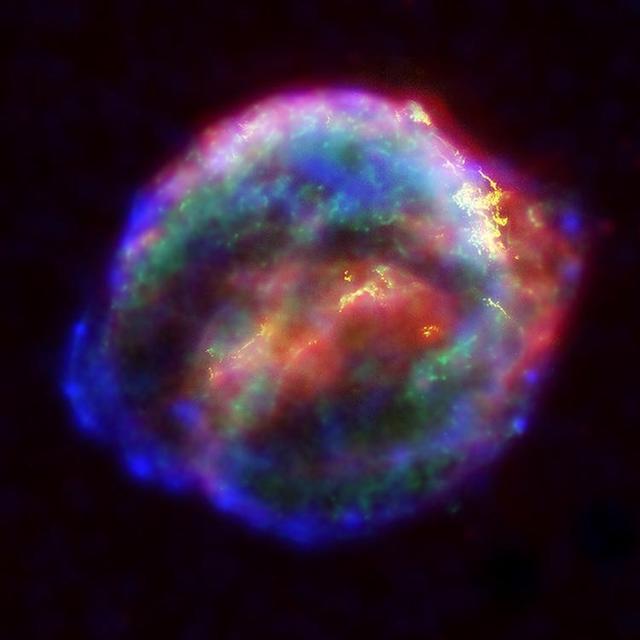
This Spitzer false-color image is a composite of data from the 24 micron channel of Spitzer's multiband imaging photometer (red), and three channels of its infrared array camera: 8 micron (yellow), 5.6 micron (blue), and 4.8 micron (green).…
Kepler Supernova Remnant: A View from Spitzer Space Telescope
The images indicate that the bubble of gas that makes up the supernova remnant appears different in various types of light. Chandra reveals the hottest gas [colored blue and colored green], which radiates in X-rays.  http://photojournal.jpl…
Kepler Supernova Remnant: A View from Chandra X-Ray Observatory
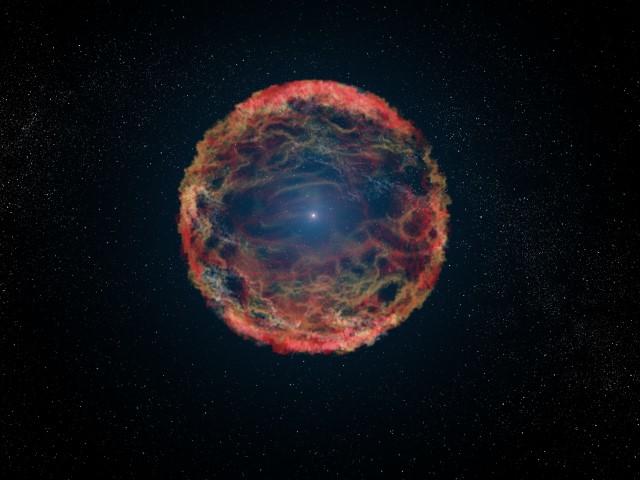
This is an artist's impression of supernova 1993J, an exploding star in the galaxy M81 whose light reached us 21 years ago. The supernova originated in a double-star system where one member was a massive star that exploded after siphoning m…
Hubble Finds Supernova Companion Star after Two Decades of Searching
Release date Dec. 30, 2009  In the supernova remnant W49B, Suzaku found another fossil fireball. It detected X-rays produced when heavily ionized iron atoms recapture an electron. This view combines infrared images from the ground (red, gre…
Supernova Remnant W49B
Image release September 2, 2010   ABOUT THIS IMAGE:  This image shows the entire region around supernova 1987A. The most prominent feature in the image is a ring with dozens of bright spots. A shock wave of material unleashed by the stellar…
New Hubble Observations of Supernova 1987A Trace Shock Wave
These delicate wisps of gas make up an object known as SNR B0519-69.0, or SNR 0519 for short. The thin, blood-red shells are actually the remnants from when an unstable progenitor star exploded violently as a supernova around 600 years ago.…
Hubble Sees the Remains of a Star Gone Supernova
Supernovas are often thought of as the tremendous explosions that mark the ends of massive stars' lives. While this is true, not all supernovas occur in this fashion. A common supernova class, called Type Ia, involves the detonation of whit…
New Suspect Identified in Supernova Explosion
Four hundred years ago, sky watchers, including the famous astronomer Johannes Kepler, best known as the discoverer of the laws of planetary motion, were startled by the sudden appearance of a new star in the western sky, rivaling the brill…
Space Science
NASA's Fermi Closes on Source of Cosmic Rays  New images from NASA's Fermi Gamma-ray Space Telescope show where supernova remnants emit radiation a billion times more energetic than visible light. The images bring astronomers a step closer…
Cassiopeia A supernova
This is a Hubble Space Telescope composite image of a supernova explosion designated SN 2014J in the galaxy M82. At a distance of approximately 11.5 million light-years from Earth it is the closest supernova of its type discovered in the pa…
Hubble Monitors Supernova In Nearby Galaxy M82
This image is a color composite of the supernova remnant E0102-72: x-ray (blue), optical (green), and radio (red). E0102-72 is the remnant of a star that exploded in a nearby galaxy known as the Small Magellanic Cloud. The star exploded out…
History of Chandra X-Ray Observatory
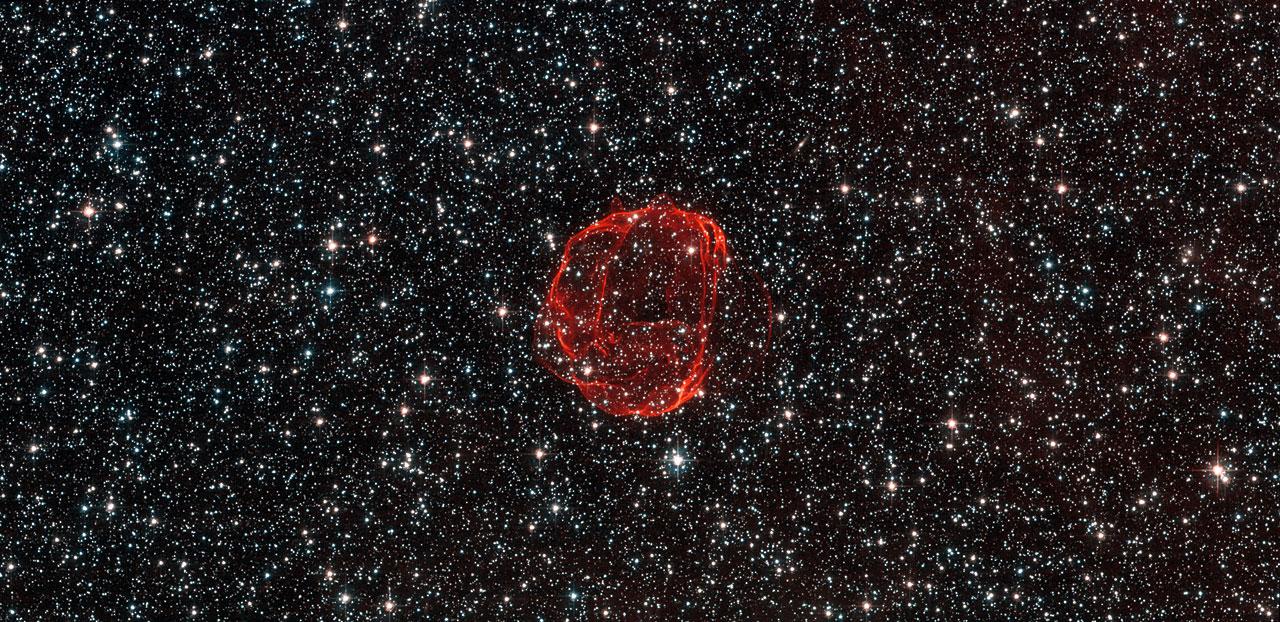
Of all the varieties of exploding stars, the ones called Type Ia are perhaps the most intriguing. Their predictable brightness lets astronomers measure the expansion of the universe, which led to the discovery of dark energy. Yet the cause…
Hubble snap a beautiful supernova explosion some 160,000 light-years from Earth
This frame from an animation shows a kind of stellar explosion called a Fast-Evolving Luminous Transient. In this case, a giant star "burps" out a shell of gas and dust about a year before exploding. Most of the energy from the supernova tu…
Kepler Beyond Planets: Finding Exploding Stars (Type Felt Supernova)
This frame from an animation shows the merger of two white dwarfs. A white dwarf is an extremely dense remnant of a star that can no longer burn nuclear fuel at its core. This is another way that a "type Ia" supernova occurs.  Stellar explo…
Kepler Beyond Planets: Finding Exploding Stars (Type Ia Supernova from a White Dwarf Merger)
This image represents a view of NASA Kepler supernova remnant taken in X-rays, visible light, and infrared radiation, indicating that the bubble of gas that makes up the supernova remnant appears different in various types of light.  http:/…
Kepler Supernova Remnant: A View from Hubble Space Telescope
Three decades ago, astronomers spotted one of the brightest exploding stars in more than 400 years. The titanic supernova, called Supernova 1987A (SN 1987A), blazed with the power of 100 million suns for several months following its discove…
The Dawn of a New Era for Supernova 1987a
NASA image release January 11, 2012  Using NASA's Hubble Space Telescope, astronomers have solved a longstanding mystery on the type of star, or so-called progenitor, that caused a supernova in a nearby galaxy. The finding yields new observ…
Hubble Solves Mystery on Source of Supernova in Nearby Galaxy
Suzaku Finds "Fossil" Fireballs from Supernovae  In a supernova remnant known as the Jellyfish Nebula, Suzaku detected X-rays from fully ionized silicon and sulfur -- an imprint of higher-temperature conditions immediately followi…
Suzaku Finds "Fossil" Fireballs from Supernovae
NASA's three Great Observatories -- the Hubble Space Telescope, the SpitzerSpace Telescope, and the Chandra X-ray Observatory -- joined forces to probe theexpanding remains of a supernova, called Kepler's supernova remnant, first seen 400 y…
Three Great Eyes on Kepler Supernova Remnant
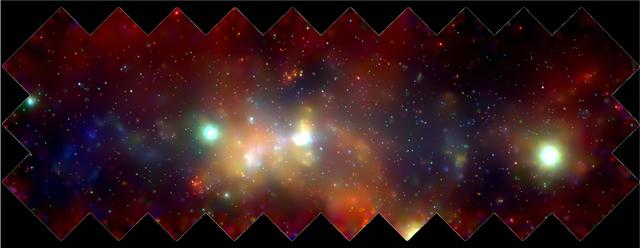
The Chandra X-Ray Observatory (CXO) has made a sturning, high-energy panorama of the central regions of our Milky Way galaxy. The findings are an important step toward understanding the most active area of the Milky Way as well as other gal…
History of Chandra X-Ray Observatory
This image shows a part of the Cygnus loop supernova remnant, taken by the Ultraviolet Imaging Telescope (UIT) on the Astro Observatory during the Astro-1 mission (STS-35) on December 5, 1990. Pictured is a portion of the huge Cygnus loop,…
Spacelab
NASA image release December 14, 2010  A delicate sphere of gas, photographed by NASA's Hubble Space Telescope, floats serenely in the depths of space. The pristine shell, or bubble, is the result of gas that is being shocked by the expandin…
Hubble Supernova Bubble Resembles Holiday Ornament
This x-ray photograph of the Supernova remnant Cassiopeia A, taken with the High Energy Astronomy Observatory (HEAO) 2/Einstein Observatory, shows that the regions with fast moving knots of material in the expanding shell are bright and cle…
High Energy Astronomy Observatory (HEAO)
The Crab Nebula is a supernova remnant, all that remains of a tremendous stellar explosion. Observers in China and Japan recorded the supernova nearly 1,000 years ago, in 1054.  Credit: NASA, ESA, J. Hester and A. Loll (Arizona State Univer…
Crab Nebula
This NASA/ESA Hubble Space Telescope image captures the remnants of a long-dead star. These rippling wisps of ionized gas, named DEM L316A, are located some 160,000 light-years away within one of the Milky Way’s closest galactic neighbors —…
Hubble views a spectacular supernova with interstellar material over 160,000 light-years away
The CTB 1 supernova remnant resembles a ghostly bubble in this image, which combines new 1.5 gigahertz observations from the Very Large Array (VLA) radio telescope (orange, near center) with older observations from the Dominion Radio Astrop…
CTB 1 supernova remnant
This frame from an animation shows a gigantic star exploding in a "core collapse" supernova. As atoms fuse inside the star, eventually the star can't support its own weight anymore. Gravity makes the star collapse on itself. Core collapse s…
Kepler Beyond Planets: Finding Exploding Stars (Type Ia Supernova from a White Dwarf Stealing Matter)
This Chandra image reveals, in detail, the turbulent debris created by a supernova explosion that was observed by the Danish Astronomer Tycho Brahe in the year 1572. The colors show different x-ray energies, with red, green, and blue repres…
History of Chandra X-Ray Observatory
Astronomers combined observations from three different observatories (Atacama Large Millimeter/submillimeter Array, red; Hubble, green; Chandra X-ray Observatory, blue) to produce this colorful, multiwavelength image of the intricate remain…
The Dawn of a New Era for Supernova 1987A
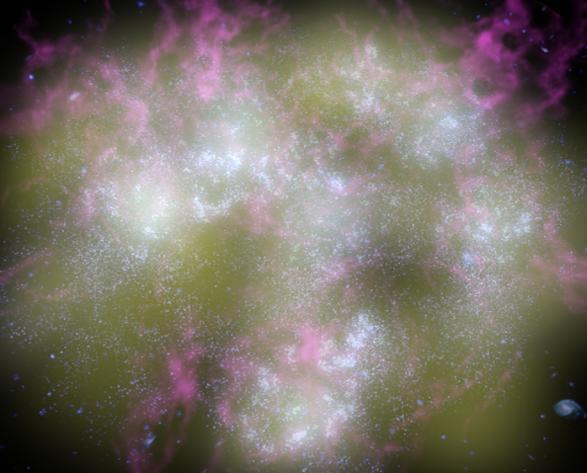
This artist's animation shows a typical young galaxy, teeming with hot, newborn stars and exploding supernovas. The supernovas are seen as white flashes of light.  NASA's Galaxy Evolution Explorer spotted three-dozen young galaxies like the…
Fires of Galactic Youth Artist Animation
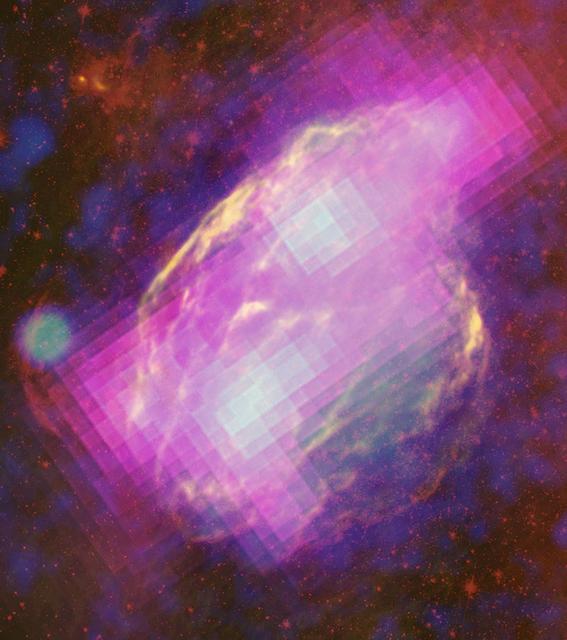
The W44 supernova remnant is nestled within and interacting with the molecular cloud that formed its parent star. Fermi's LAT detects GeV gamma rays (magenta) produced when the gas is bombarded by cosmic rays, primarily protons. Radio obser…
NASA's Fermi Proves Supernova Remnants Produce Cosmic Rays
NASA image release June 10, 2011  Astronomers using NASA's Hubble Space Telescope are witnessing the unprecedented transition of a supernova to a supernova remnant, where light from an exploding star in a neighboring galaxy, the Large Magel…
NASA's Hubble Sees A New Supernova Remnant Light Up
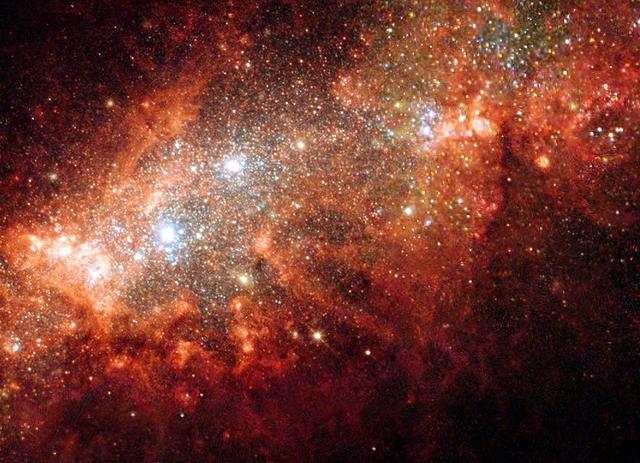
The nearby dwarf galaxy NGC 1569 is a hotbed of vigorous star birth activity, which blows huge bubbles that riddle the galaxy main body. The image was taken by the WPF2 camera, designed and built by JPL, on NASA Hubble.
Supernova Blast Bonanza in Nearby Galaxy
This image of SN 1987A, taken November 28, 2003 by the Advanced Camera for Surveys aboard NASA's Hubble Space Telescope (HST), shows many bright spots along a ring of gas, like pearls on a necklace. These cosmic pearls are being produced as…
History of Hubble Space Telescope (HST)
The colorful streamers that float across the sky in this photo taken by NASA's Hubble Space Telescope (HST) were created by the universe's biggest firecracker, the titanic supernova explosion of a massive star. The light from the exploding…
Space Science
Supernova Supernovae can occur one of two ways. The first occurs when a white dwarf—the vestigial ember of a dead star—passes so close to a living star that its matter leaks into the white dwarf. This causes a catastrophic explosion.  Howev…
Preview of a Forthcoming Supernova
This supernova in the constellation Cassiopeia was observed by Tycho Brahe in 1572. In this x-ray image from the High Energy Astronomy Observatory (HEAO-2/Einstein Observatory produced by nearly a day of exposure time, the center region app…
High Energy Astronomy Observatory (HEAO)
NASA image relase December 13, 2011  Gamma-rays detected by Fermi's LAT show that the remnant of Tycho's supernova shines in the highest-energy form of light. This portrait of the shattered star includes gamma rays (magenta), X-rays (yellow…
Tycho's Star Shines in Gamma Rays
Like the Crab Nebula, the Vela Supernova Remnant has a radio pulsar at its center. In this image taken by the High Energy Astronomy Observatory (HEAO)-2/Einstein Observatory, the pulsar appears as a point source surrounded by weak and diffu…
High Energy Astronomy Observatory (HEAO)
No more images