
Blazar 3C 279's historic gamma-ray flare can be seen in this image from the Large Area Telescope (LAT) on NASA's Fermi satellite. Gamma rays with energies from 100 million to 100 billion electron volts (eV) are shown; for comparison, visibl…

CAPE CANAVERAL, Fla. -- Inside the mobile service tower on Launch Pad 17-B at Cape Canaveral Air Force Station, NASA's Gamma-Ray Large Area Space Telescope, or GLAST, is ready for encapsulation in the payload fairing. The fairing is a mold…

These two images show tacked Chandra images for two different classes of distant, massive galaxy detected with NASA Spitzer. Image stacking is a procedure used to detect emission from objects that is too faint to be detected in single image…

KENNEDY SPACE CENTER, FLA. - The engines of a Boeing Delta II expendable launch vehicle ignite to blast NASA's Swift spacecraft on its way at Complex 17A, Cape Canaveral Air Force Station, on Nov. 20 at 12:16:00.611 p.m. EST. Swift is a…

KENNEDY SPACE CENTER, FLA. - Clouds of exhaust form around a Boeing Delta II expendable launch vehicle as it blasts NASA's Swift spacecraft on its mission at Complex 17A, Cape Canaveral Air Force Station, on Nov. 20 at 12:16:00.611 p.m. E…

KENNEDY SPACE CENTER, FLA. - The engines of a Boeing Delta II expendable launch vehicle ignite to blast NASA's Swift spacecraft on its way at Complex 17A, Cape Canaveral Air Force Station, on Nov. 20 at 12:16:00.611 p.m. EST. Swift is a…

KENNEDY SPACE CENTER, FLA. - NASA's Swift spacecraft blasts off from Complex 17A into the beautiful blue sky above Cape Canaveral Air Force Station on Nov. 20 at 12:16:00.611 p.m. EST aboard a Boeing Delta II expendable launch vehicle. S…

CAPE CANAVERAL, Fla. -- The first half of the payload fairing is moved into place around NASA's Gamma-Ray Large Area Space Telescope within the mobile service tower on Launch Pad 17-B at Cape Canaveral Air Force Station. The fairing is a…
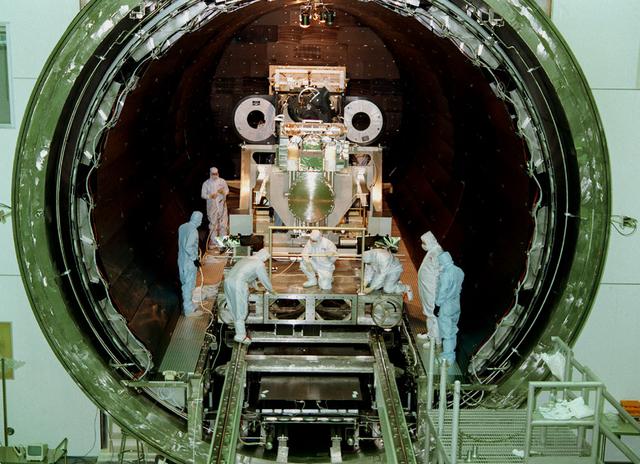
This photo shows the High Resolution Camera (HRC) for the Chandra X-Ray Observatory (CXO), formerly Advanced X-Ray Astrophysics Facility (AXAF), being integrated with the High Resolution Mirror Assembly (HRMA) in Marshall Space Flight Cente…

KENNEDY SPACE CENTER, FLA. - In Hangar AE at Cape Canaveral Air Force Station, Spectrum Astro workers remove the final pieces of protective cover on the Swift spacecraft. Swift is a first-of-its-kind, multi-wavelength observatory dedicated…

A massive star left, which has created elements as heavy as iron in its interior, blows up in a tremendous explosion middle, scattering its outer layers in a structure called a supernova remnant right.

The images indicate that the bubble of gas that makes up the supernova remnant appears different in various types of light. Chandra reveals the hottest gas [colored blue and colored green], which radiates in X-rays. http://photojournal.jpl…
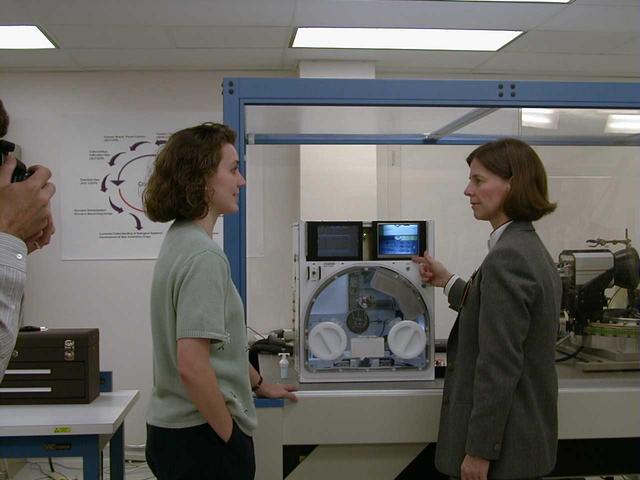
University of Alabama engineer Stacey Giles briefs NASA astronaut Dr. Bornie Dunbar about the design and capabilities of the X-ray Crystallography Facility under development at the Center for Macromolecular Crystallography of the University…

KENNEDY SPACE CENTER, FLA. - - In Hangar AE at Cape Canaveral Air Force Station, the Swift spacecraft waits for final removal of the protective cover (at top). Swift is a first-of-its-kind, multi-wavelength observatory dedicated to the stu…

S65-28699 (17 Aug. 1965) --- Astronaut Charles Conrad Jr. (dark shirt), pilot for the Gemini-5 spaceflight, discusses x-rays with members of the medical team at Cape Kennedy. Left to right are Dr. Eugene Tubbs; astronaut Conrad; Dr. Charles…
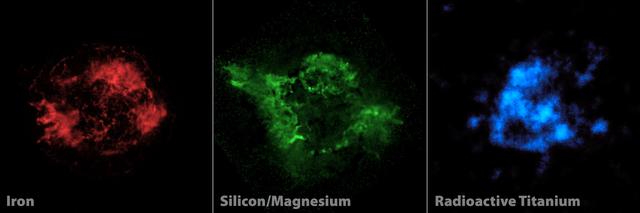
NASA NuSTAR is complementing previous observations of the Cassiopeia A supernova remnant red and green by providing the first maps of radioactive material forged in the fiery explosion blue.

This view of the gamma-ray sky constructed from one year of Fermi LAT observations is the best view of the extreme universe to date. The map shows the rate at which the LAT detects gamma rays with energies above 300 million electron volts -…

This is a computer rendering of the fully developed Chandra X-Ray Observatory (CXO), formerly Advanced X-Ray Astrophysics Facility (AXAF). In 1999, the AXAF was renamed the CXO in honor of the late Indian-American Novel Laureate Subrahmanya…

This composite image contains the deepest X-ray image ever made of the spectacular star forming region called 30 Doradus. By combining X-ray data from NASA’s Chandra X-ray Observatory (blue and green) with optical data from NASA’s Hubble Sp…

CAPE CANAVERAL, Fla. -- Inside the mobile service tower on Launch Pad 17-B at Cape Canaveral Air Force Station, workers help guide one section of the payload fairing into place around NASA's Gamma-Ray Large Area Space Telescope, or GLAST.…

KENNEDY SPACE CENTER, FLA. - NASA's Swift spacecraft lifts off from Complex 17A into the beautiful blue sky above Cape Canaveral Air Force Station on Nov. 20 at 12:16:00.611 p.m. EST aboard a Boeing Delta II expendable launch vehicle. Sw…

KENNEDY SPACE CENTER, FLA. - Clouds of exhaust form around a Boeing Delta II expendable launch vehicle as it blasts NASA’s Swift spacecraft on its mission from Complex 17-A, Cape Canaveral Air Force Station, at 12:16:00.611 p.m. EST Nov.…

CAPE CANAVERAL, Fla. -- Inside the mobile service tower on Launch Pad 17-B at Cape Canaveral Air Force Station, workers help guide one section of the payload fairing into place around NASA's Gamma-Ray Large Area Space Telescope, or GLAST.…

CAPE CANAVERAL, Fla. -- Inside the mobile service tower on Launch Pad 17-B at Cape Canaveral Air Force Station, workers connect the two sections of the payload fairing into place around NASA's Gamma-Ray Large Area Space Telescope, or GLAS…

CAPE CANAVERAL, Fla. -- Inside the mobile service tower on Launch Pad 17-B at Cape Canaveral Air Force Station, workers secure the top of the payload fairing into place around NASA's Gamma-Ray Large Area Space Telescope, or GLAST. The fa…

KENNEDY SPACE CENTER, FLA. - NASA's Swift spacecraft lifts off from Complex 17A, Cape Canaveral Air Force Station in sunny Florida, on Nov. 20 at 12:16:00.611 p.m. EST aboard a Boeing Delta II expendable launch vehicle. Swift is a first-…
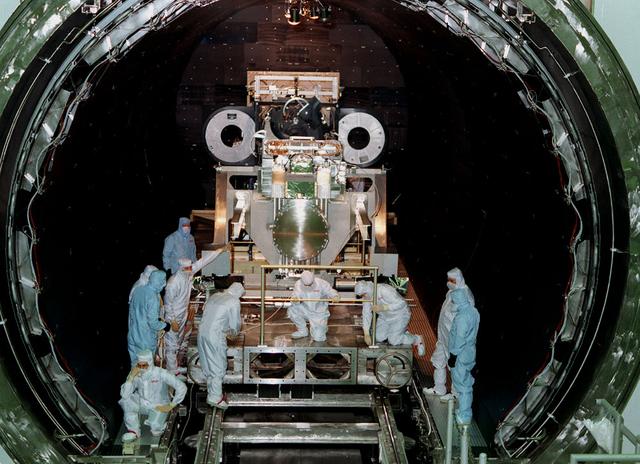
This photo shows the High Resolution Camera (HRC) for the Chandra X-Ray Observatory (CXO), formerly Advanced X-Ray Astrophysics Facility (AXAF), being integrated with the High Resolution Mirror Assembly (HRMA) in Marshall Space Flight Cente…
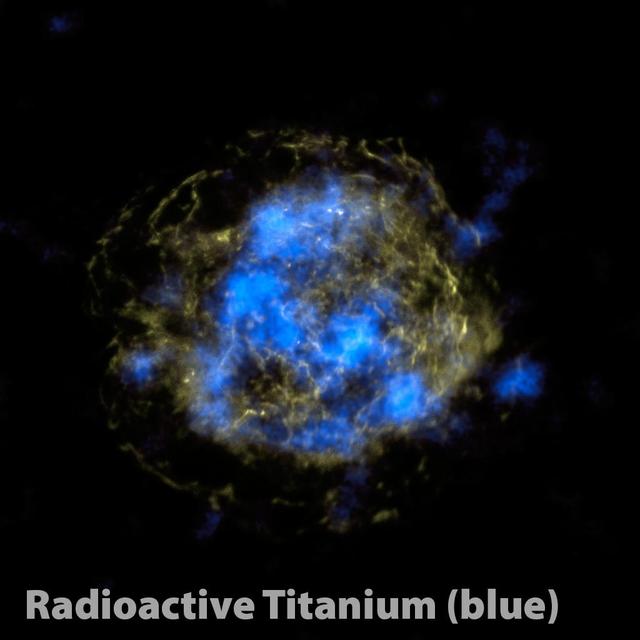
NASA NuSTAR has, for the first time, imaged the radioactive guts of a supernova remnant, the leftover remains of a star that exploded. The NuSTAR data are blue, and show high-energy X-rays.

KENNEDY SPACE CENTER, FLA. - The Swift spacecraft is being unwrapped in Hangar AE at Cape Canaveral Air Force Station. Swift is a first-of-its-kind, multi-wavelength observatory dedicated to the study of gamma-ray burst (GRB) science. Its…

KENNEDY SPACE CENTER, FLA. - In Hangar AE at Cape Canaveral Air Force Station, Spectrum Astro workers look over the Swift spacecraft while removing its protective cover. Swift is a first-of-its-kind, multi-wavelength observatory dedicated t…

KENNEDY SPACE CENTER, FLA. - The Swift spacecraft is being unwrapped in Hangar AE at Cape Canaveral Air Force Station. Swift is a first-of-its-kind, multi-wavelength observatory dedicated to the study of gamma-ray burst (GRB) science. Its…
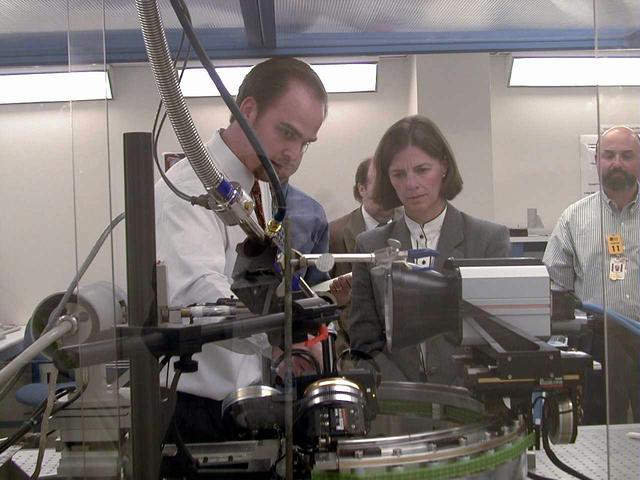
University of Alabama engineer Lance Weiss briefs NASA astronaut Dr. Bornie Dunbar about the design and capabilities of the X-ray Crystallography Facility under development at the Center for Macromolecular Crystallography of the University…

KENNEDY SPACE CENTER, FLA. - In Hangar AE at Cape Canaveral Air Force Station, Spectrum Astro workers look at the final pieces of protective cover on the Swift spacecraft that must be removed. Swift is a first-of-its-kind, multi-wavelength…

This photograph depicts the Solar X-Ray Imager (SXI) being installed in the X-Ray Calibration Facility (XRCF) vacuum chamber for testing at the Marshall Space Flight Center (MSFC). The XRCF vacuum chamber simulates a space environment with…

KENNEDY SPACE CENTER, FLA. - Seen from a distance, NASA's Swift spacecraft lifts off from Complex 17A, Cape Canaveral Air Force Station, on Nov. 20 at 12:16:00.611 p.m. EST aboard a Boeing Delta II expendable launch vehicle. Swift is a f…

KENNEDY SPACE CENTER, FLA. - The engines of a Boeing Delta II expendable launch vehicle ignite to blast NASA’s Swift spacecraft on its way from Complex 17-A, Cape Canaveral Air Force Station, at 12:16:00.611 p.m. EST Nov. 20 . Swift is a…

CAPE CANAVERAL, Fla. -- Inside the mobile service tower on Launch Pad 17-B at Cape Canaveral Air Force Station, NASA's Gamma-Ray Large Area Space Telescope, or GLAST, is ready for encapsulation in the payload fairing, which is seen behind…

CAPE CANAVERAL, Fla. -- Inside the mobile service tower on Launch Pad 17-B at Cape Canaveral Air Force Station, NASA's Gamma-Ray Large Area Space Telescope, or GLAST, is ready for encapsulation in the payload fairing. The fairing is a mold…

CAPE CANAVERAL, Fla. -- Inside the mobile service tower on Launch Pad 17-B at Cape Canaveral Air Force Station, workers help guide the second section of the payload fairing into place around NASA's Gamma-Ray Large Area Space Telescope, or…

CAPE CANAVERAL, Fla. -- Inside the mobile service tower on Launch Pad 17-B at Cape Canaveral Air Force Station, workers help guide one section of the payload fairing into place around NASA's Gamma-Ray Large Area Space Telescope, or GLAST.…

CAPE CANAVERAL, Fla. -- The first half of the payload fairing is ready to be moved around NASA's Gamma-Ray Large Area Space Telescope, or GLAST, within the mobile service tower on Launch Pad 17-B at Cape Canaveral Air Force Station. The f…
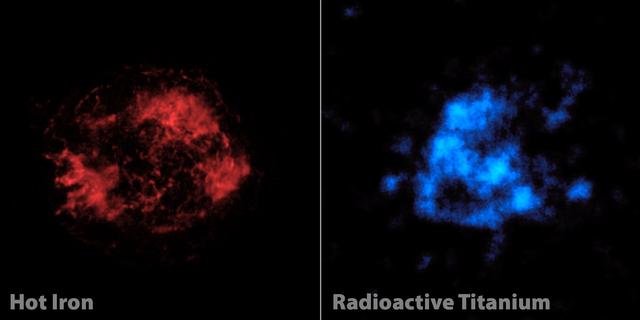
When astronomers first looked at images of a supernova remnant called Cassiopeia A, captured by NASA NuSTAR. The mystery of Cassiopeia A Cas A, a massive star that exploded in a supernova more than 11,000 years ago continues to confound sci…

This is the first map of radioactivity in a supernova remnant, the blown-out bits and pieces of a massive star that exploded. The blue color shows radioactive material mapped in high-energy X-rays using NASA NuSTAR.

The blue dot in this image marks the spot of an energetic pulsar -- the magnetic, spinning core of star that blew up in a supernova explosion. NASA NuSTAR discovered the pulsar by identifying its telltale pulse.

KENNEDY SPACE CENTER, FLA. - The Swift spacecraft is being unwrapped in Hangar AE at Cape Canaveral Air Force Station. Swift is a first-of-its-kind, multi-wavelength observatory dedicated to the study of gamma-ray burst (GRB) science. Its…

KENNEDY SPACE CENTER, FLA. - In Hangar AE at Cape Canaveral Air Force Station, the Swift spacecraft is revealed. Swift is a first-of-its-kind, multi-wavelength observatory dedicated to the study of gamma-ray burst (GRB) science. Its three i…

The images at the top of this graphic represent two popular models describing how stars blast apart. The models point to different triggers of the explosion. Jet-driven models are illustrated with an artist concept shown at left.

This is an artist's concept of the Chandra X-Ray Observatory (CXO), formerly Advanced X-Ray Astrophysics Facility (AXAF), fully developed in orbit in a star field with Earth. In 1999, the AXAF was renamed the CXO in honor of the late Indian…