
Pluto has long been a mystery, a dot at our solar system’s margins. The best images, even with NASA’s Hubble Space Telescope, were fuzzy and pixelated. In July 2015, NASA’s New Horizons spacecraft flew past Pluto and captured the sharpest v…

In this extended color image of Pluto taken by NASA New Horizons spacecraft, rounded and bizarrely textured mountains, informally named the Tartarus Dorsa, rise up along Pluto's day-night terminator and show intricate but puzzling patterns…

This image contains the initial, informal names being used by NASA's New Horizons team for the features on Pluto's Sputnik Planum (plain). Names were selected based on the input the team received from the Our Pluto naming campaign. Names ha…
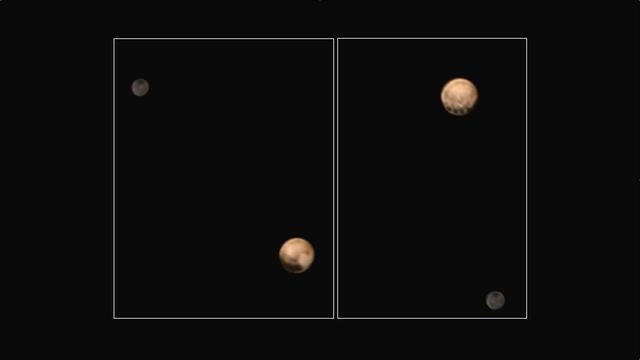
Pluto shows two remarkably different sides in these color images of the planet and its largest moon, Charon, taken by NASA New Horizons on June 25 and June 27, 2015. http://photojournal.jpl.nasa.gov/catalog/PIA20292

NASA's New Horizons spacecraft took this stunning image of Pluto only a few minutes after closest approach on July 14, 2015. The image was obtained at a high phase angle -- that is, with the sun on the other side of Pluto, as viewed by New…

KENNEDY SPACE CENTER, FLA. - In the Payload Hazardous Servicing Facility, clean-suit garbed workers secure the fairing sections around the New Horizons spacecraft for encapsulation. The fairing protects the spacecraft during launch and flig…

A pair of small moons photographed by NASA Hubble Space Telescope discovered orbiting Pluto in 2005 now have official names: Nix and Hydra.

This image-based surface map of Pluto was assembled by computer image processing software from four separate images of Pluto disk taken with the European Space Agency Faint Object Camera aboard NASA Hubble Space Telescope.

KENNEDY SPACE CENTER, FLA. - At their consoles in the Atlas V Spaceflight Operations Center on Cape Canaveral Air Force Station, members of the New Horizons team take part in a dress rehearsal for the launch scheduled in mid-January. New H…

Most inner moons in the solar system keep one face pointed toward their central planet; this frame from an animation by NASA New Horizons shows that certainly isnt the case with the small moons of Pluto, which behave like spinning tops. Plu…

This image of haze layers above Pluto limb was taken by NASA New Horizons spacecraft. About 20 haze layers are seen.

Pluto nearly fills the frame in this image from NASA New Horizons spacecraft, taken on July 13, 2015. This is the last and most detailed image sent to Earth before the spacecraft closest approach to Pluto on July 14.

This cylindrical projection map of Pluto, in enhanced, extended color, is the most detailed color map of Pluto ever made by NASA New Horizons. It uses recently returned color imagery from the New Horizons Ralph camera, which is draped onto…

KENNEDY SPACE CENTER, FLA. - In the Payload Hazardous Servicing Facility, the New Horizons spacecraft waits for encapsulation within the fairing sections waiting nearby. The fairing protects the spacecraft during launch and flight through t…

Pluto nearly fills the frame in this image from the Long Range Reconnaissance Imager (LORRI) aboard NASA’s New Horizons spacecraft, taken on July 13, 2015, when the spacecraft was 476,000 miles (768,000 kilometers) from the surface. This is…
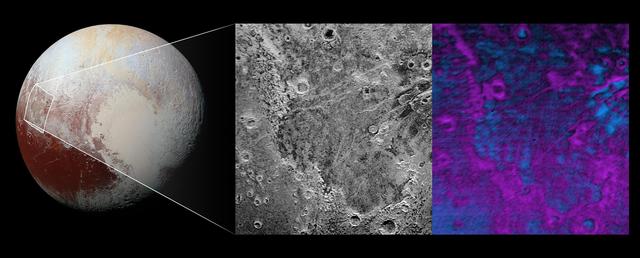
Scientists on NASA's New Horizons mission have discovered what looks like a giant bite-mark on the planet's surface. In this image, north is up. The southern portion of the left inset above shows the cratered plateau uplands informally nam…

This highest-resolution image from NASA's New Horizons spacecraft shows how erosion and faulting has sculpted this portion of Pluto's icy crust into rugged badlands. The prominent 1.2-mile-high cliff at the top, running from left to upper r…
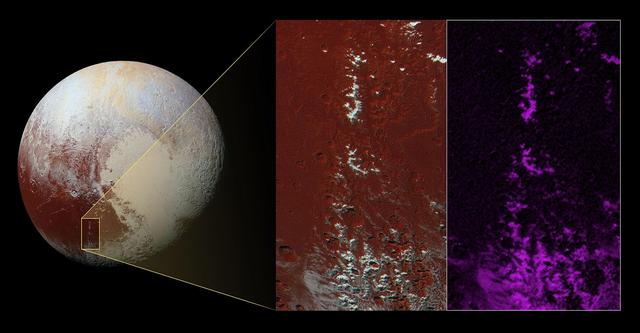
NASA New Horizons spacecraft captured this image of a chain of snow-capped mountains stretching across the dark expanse on Pluto informally named Cthulhu Regio.

This frame from a movie is composed of the sharpest views of Pluto that NASA's New Horizons spacecraft obtained during its flyby of the distant planet on July 14, 2015. The pictures are part of a sequence taken near New Horizons' closest ap…

This enhanced color mosaic combines some of the sharpest views of Pluto that NASA's New Horizons spacecraft obtained during its July 14 flyby. The pictures are part of a sequence taken near New Horizons' closest approach to Pluto, with reso…

This is the most detailed view to date of the entire surface of the dwarf planet Pluto, as constructed from multiple NASA Hubble Space Telescope photographs taken from 2002 to 2003.

This image contains the initial, informal names being used by NASA's New Horizons team for the features and regions on the surface of Pluto. Names were selected based on the input the team received from the Our Pluto naming campaign. Names…

KENNEDY SPACE CENTER, FLA. - In the Payload Hazardous Servicing Facility, the two fairing sections close in around the New Horizons spacecraft to encapsulate it. The fairing protects the spacecraft during launch and flight through the atmos…

NASA New Horizons mission science team has produced this updated panchromatic black-and-white global map of Pluto. The map includes all resolved images of Pluto surface acquired between July 7-14, 2015.

Since its discovery in 2005, Pluto's moon Hydra has been known only as a fuzzy dot of uncertain shape, size, and reflectivity. Imaging obtained during NASA's New Horizons' historic transit of the Pluto-Charon system and transmitted to Earth…
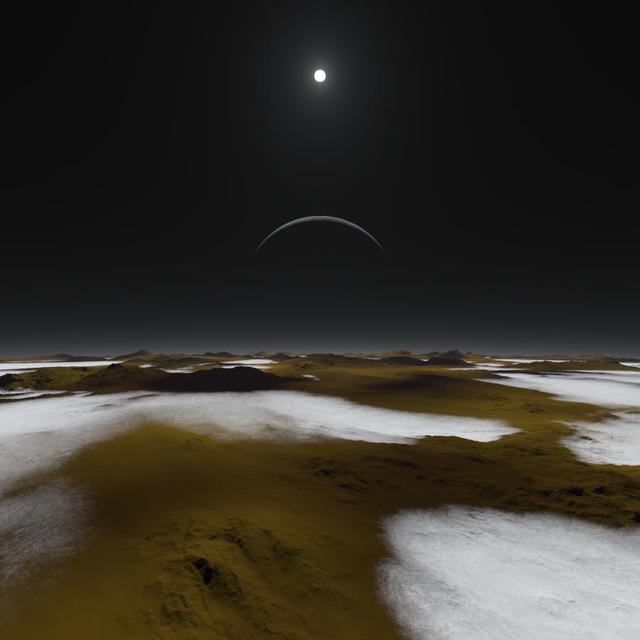
Just how dim is the sunlight on Pluto, some three billion miles away? This artist concept of the frosty surface of Pluto with Charon and our sun as backdrops illustrates that while sunlight is much weaker than it is here on Earth, it isnt a…

Mosaic of high-resolution images of Pluto, transmitted by NASA's New Horizons spacecraft from Sept. 5 to 7, 2015. The image is dominated by the informally-named icy plain Sputnik Planum, the smooth, bright region across the center. This ima…

This image of Pluto from NASA's New Horizons spacecraft, processed in two different ways, shows how Pluto's bright, high-altitude atmospheric haze produces a twilight that softly illuminates the surface before sunrise and after sunset, allo…
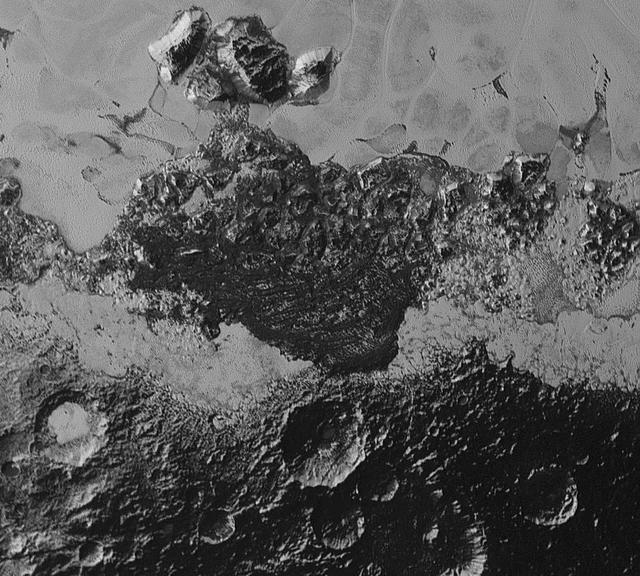
This 220-mile (350-kilometer) wide view of Pluto from NASA's New Horizons spacecraft illustrates the incredible diversity of surface reflectivities and geological landforms on the dwarf planet. The image includes dark, ancient heavily crate…

This is a frame from the first movie created by New Horizons to reveal color surface features of Pluto and its largest moon, Charon. "It's a bit unusual to see so much surface detail at this distance," said New Horizons co-investigator Will…

Within Pluto informally named Vega Terra region is a field of eye-catching craters that looks like a cluster of bright halos scattered across a dark landscape as seen by NASA New Horizons.

NASA's New Horizons spacecraft flew within 8,000 miles of dwarf planet Pluto on 14 July 2015. Our view of this cold, previously unexplored world, 4.67 billion miles from Earth, has evolved since its discovery by Clyde W. Tombaugh in 1930.…

This high-resolution image captured by NASA's New Horizons spacecraft combines blue, red and infrared images taken by the Ralph/Multispectral Visual Imaging Camera (MVIC). The bright expanse is the western lobe of the "heart," informally ca…

This shaded relief view from NASA New Horizons of the region surrounding the left side of Pluto heart-shaped feature, informally named Sputnik Planum, shows that the vast expanse of its icy surface.

This high-resolution swat of Pluto sweeps over the cratered plains at the west of the New Horizons' encounter hemisphere and across numerous prominent faults, skimming the eastern margin of the dark, forbidding region informally known as Ct…

NASA New Horizons data indicates that at least two and possibly all four of Pluto small moons may be the result of mergers between still smaller moons. If this discovery is borne out with further analysis, it could provide important new clu…

These two images of Pluto and Charon were collected separately by NASA New Horizons during approach on July 13 and July 14, 2015. The relative reflectivity, size, separation, and orientations, and colors are approximated in this composite i…
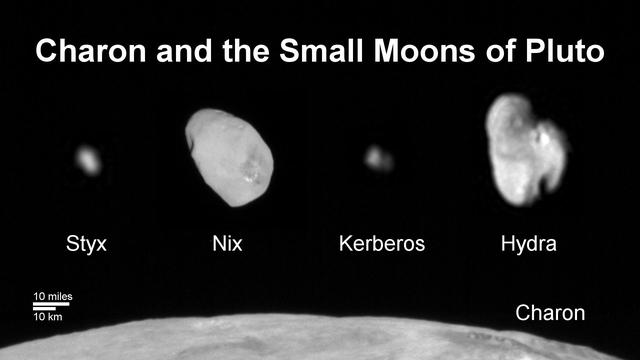
This composite image shows a sliver of Pluto large moon, Charon, and all four of Pluto small moons, as resolved by the Long Range Reconnaissance Imager (LORRI) on the New Horizons spacecraft. All the moons are displayed with a common intens…

In September, NASA's New Horizons team released a stunning but incomplete image of Pluto's crescent. Thanks to new processing work by the science team, New Horizons is releasing the entire, breathtaking image of Pluto. This image was made…

This image of Pluto is part of series of New Horizons Long Range Reconnaissance Imager LORRI photos taken May 8-12, 2015; the image at left shows LORRI view of Pluto just one month earlier.

As one NASA spacecraft sailed past the distant ice world of Pluto, collecting never-before-seen vistas and invaluable science data, another spacecraft turned its gaze in that direction from its outpost at Saturn. NASA's Cassini spacecraft t…

This geological map from NASA New Horizons covers a portion of Pluto surface and includes the vast nitrogen-ice plain informally named Sputnik Planum and surrounding terrain.

NASA New Horizons scientists have spotted an expanse of terrain they describe as fretted bright plains divided into polygon-shaped blocks by a network of dark, connected valleys in Pluto informally named Venera Terra region.

This image of Pluto and its largest moon, Charon, was taken by the Ralph color imager aboard NASA New Horizons spacecraft on April 9 and downlinked to Earth the following day.
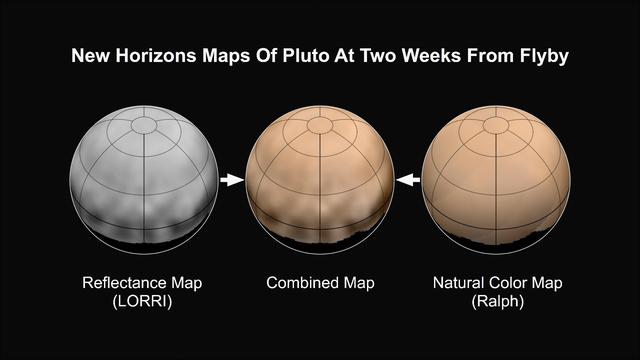
What color is Pluto? The answer, revealed in the first maps made from New Horizons data, turns out to be shades of reddish brown. The mission's first map of Pluto is in approximate true color -- that is, the color you would see if you were…

In this highest-resolution image from NASA's New Horizons spacecraft, great blocks of Pluto's water-ice crust appear jammed together in the informally named al-Idrisi mountains. Some mountain sides appear coated in dark material, while othe…
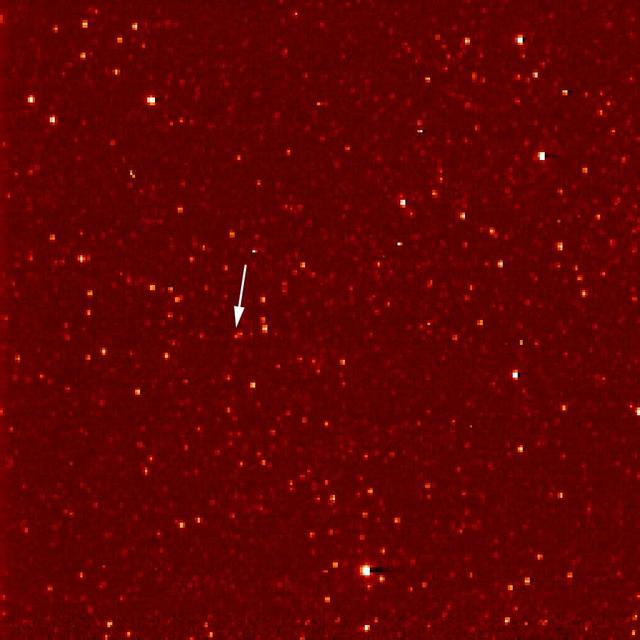
A white arrow marks Pluto in this NASA New Horizons Long Range Reconnaissance Imager picture taken Sept. 21, 2006. Pluto is little more than a faint point of light among a dense field of stars.

New Horizons' Long Range Reconnaissance Imager (LORRI) obtained these three images of Pluto between July 1-3 ,2015, as the spacecraft closed in on its July 14 encounter with the dwarf planet and its moons. The left image shows, on the right…