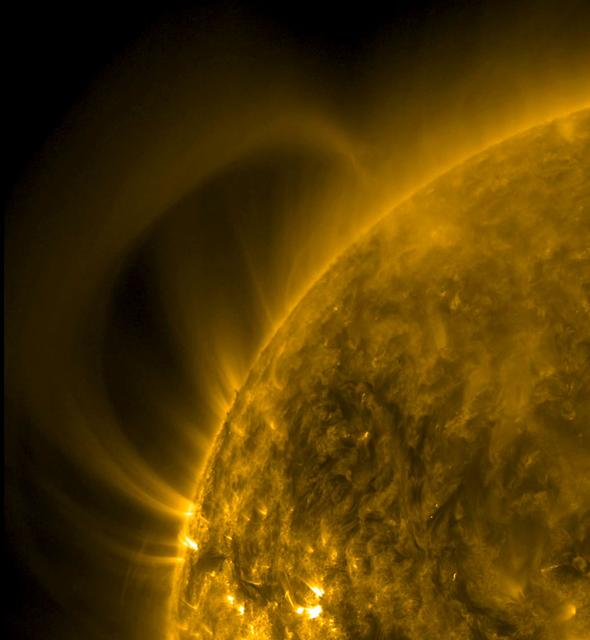
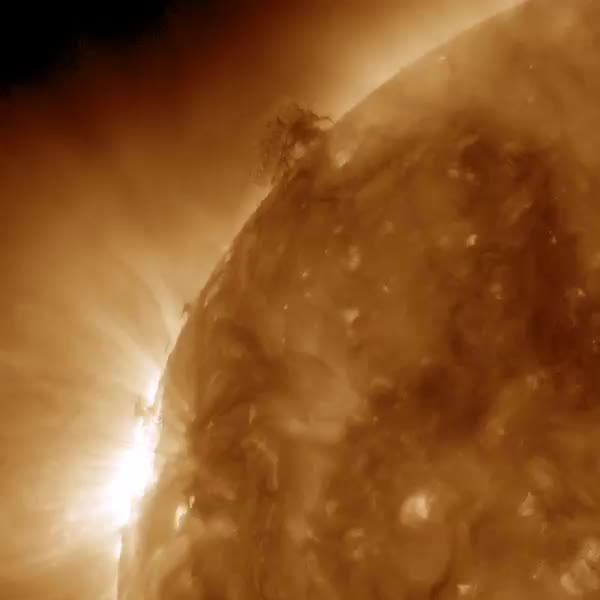
Strands and arches of plasma streamed above the edge of the Sun for over a day, pulled by powerful magnetic forces (Aug. 11-12, 2016). The tug and pull of material heated to about 60,000 degrees C. was viewed in extreme ultraviolet light. T…
Playing Along the Edge
Strands of solar material at the sun's edge shifted and twisted back and forth over a 22-hour period in this footage captured May 2-3, 2017, by NASA’s Solar Dynamics Observatory. In this close-up, the strands are being manipulated by strong…
Shifting Plasma
Strands of plasma at the sun edge shifted and twisted back and forth over a 22-hour period, May 2-3, 2017. In this close-up from NASA Solar Dynamics Observatory, the strands are being manipulated by strong magnetic forces associated with ac…
Shifting Plasma
The Plasma Spray-Physical Vapor Deposition (PS-PVD) Rig at NASA Glenn Research Center. The rig helps develop coatings for next-generation aircraft turbine components and create more efficient engines.
Vapor Deposition Rig
A pair of relatively small (but frenetic) active regions rotated into view, spouting off numerous small flares and sweeping loops of plasma (May 31-June 2, 2017). At first, only the one active region was observed, but mid-way though the vid…
Energized Active Regions
A giant arch of plasma rose up out of the Sun and then stretched itself until it had reached back to a point behind our view of the Sun (Sept, 17-18, 2014). Since it emerged from a magnetically intense active region, the arch is likely conn…
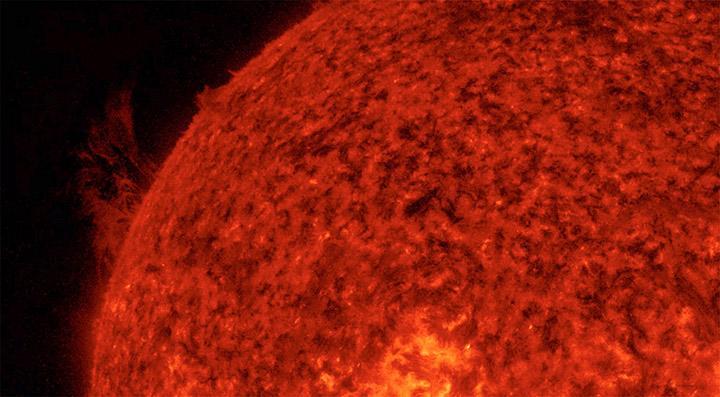
Extensive Arch
Dr. Tom Markusic, a propulsion research engineer at the Marshall Space Flight Center (MSFC), adjusts a diagnostic laser while a pulsed plasma thruster (PPT) fires in a vacuum chamber in the background. NASA/MSFC's Propulsion Research Center…
Research Technology
High Pressure Plasma-assisted Combustion
From left, Dr. Jennifer Williams, a NASA research chemical engineer, and Gerard Moscoso, a mechanical engineer technician, inspect specimens prepared forthe Plasma Rapid Oxidation Technique for Extending Component Tenability (PROTECT) exper…
Plasma Rapid Oxidation Technique for Extending Component Tenabil
Gerard Moscoso, a mechanical engineer technician with NASA, handles a sample that is being prepared for fatigue and corrosion testing for the Plasma Rapid Oxidation Technique for Extending Component Tenability (PROTECT) project inside the P…
Plasma Rapid Oxidation Technique for Extending Component Tenabil
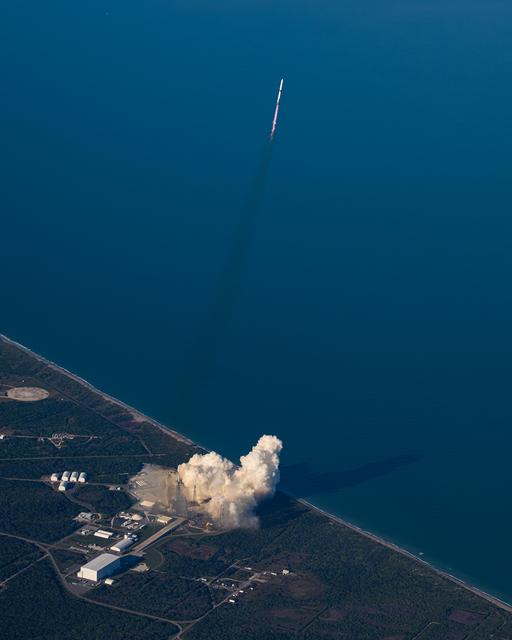
Blue Origin’s New Glenn rocket carrying NASA’s twin ESCAPADE (Escape and Plasma Acceleration and Dynamics Explorers) spacecraft launches at 3:55 p.m. EST, Thursday, Nov. 13, 2025, from Launch Complex 36 at Cape Canaveral Space Force Station…
NASA's ESCAPADE Launch on Blue Origin's NG-2
Blue Origin’s New Glenn rocket carrying NASA’s twin ESCAPADE (Escape and Plasma Acceleration and Dynamics Explorers) spacecraft launches at 3:55 p.m. EST, Thursday, Nov. 13, 2025, from Launch Complex 36 at Cape Canaveral Space Force Station…
NASA's ESCAPADE Launch on Blue Origin's NG-2
Blue Origin’s New Glenn rocket carrying NASA’s twin ESCAPADE (Escape and Plasma Acceleration and Dynamics Explorers) spacecraft launches at 3:55 p.m. EST, Thursday, Nov. 13, 2025, from Launch Complex 36 at Cape Canaveral Space Force Station…
NASA's ESCAPADE Launch on Blue Origin's NG-2
Blue Origin’s New Glenn rocket carrying NASA’s twin ESCAPADE (Escape and Plasma Acceleration and Dynamics Explorers) spacecraft launches at 3:55 p.m. EST, Thursday, Nov. 13, 2025, from Launch Complex 36 at Cape Canaveral Space Force Station…
NASA's ESCAPADE Launch on Blue Origin's NG-2
NASA’s ESCAPADE (Escape and Plasma Acceleration and Dynamics Explorers) identical dual spacecraft are inspected and processed on dollies in a high bay of the Astrotech Space Operations Facility near the agency’s Kennedy Space Center in Flor…
ESCAPADE Unboxed at Astrotech
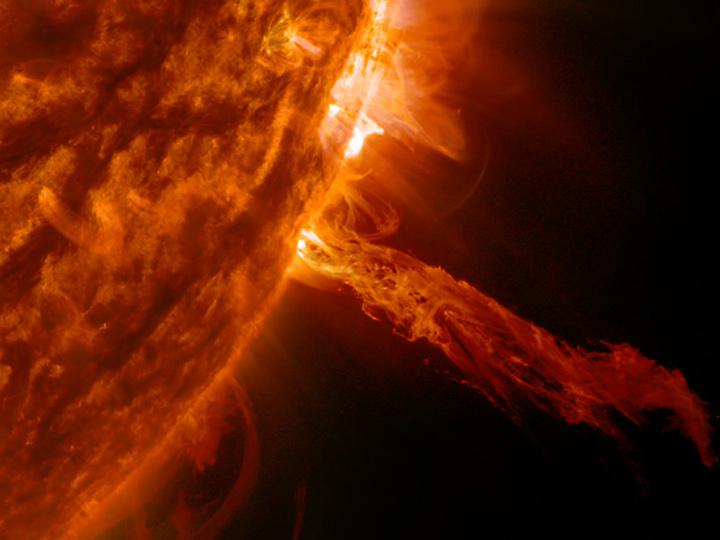
A stream of plasma burst out from the sun, but since it lacked enough force to break away, most of it fell back into the sun (May 27, 2014).  This eruption was minor and such events occur almost every day on the sun and suggest the kind of…
Spurting Plasma
A twisted blob of solar material – a hot, charged gas called plasma – can be seen erupting off the side of the sun on Sept. 26, 2014. The image is from NASA's Solar Dynamics Observatory, focusing in on ionized Helium at 60,000 degrees C.…
Twisting Blob of Plasma
BLDG. 4605 PLASMA ENVIRONMENT TEST LABORATORY. VACUUM CHAMBER FROM REAR
1301128
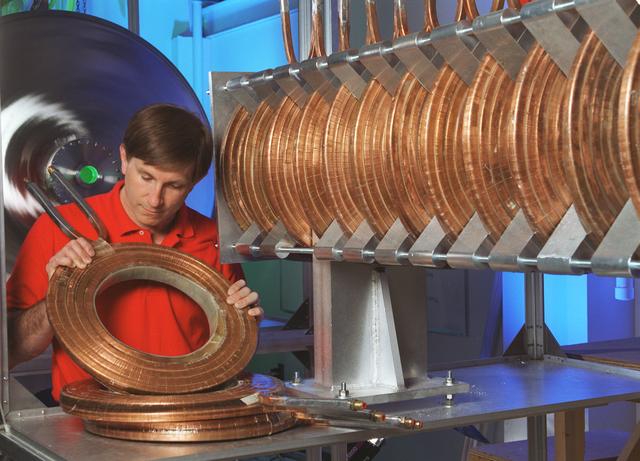
The Gasdynamic Mirror, or GDM, is an example of a magnetic mirror-based fusion propulsion system. Its design is primarily consisting of a long slender solenoid surrounding a vacuum chamber that contains plasma. The bulk of the fusion plasma…
Research Technology
BLDG. 4605 PLASMA ENVIRONMENT TEST LABORATORY. VACUUM CHAMBER OPEN WITH SAMPLE SETUP
1301127
A smallish solar filament looks like it collapsed into the sun and set off a minor eruption that hurled plasma into space (June 20, 2017). Then, the disrupted magnetic field immediately began to reorganize itself, hence the bright series of…
Coils of Magnetic Field Lines
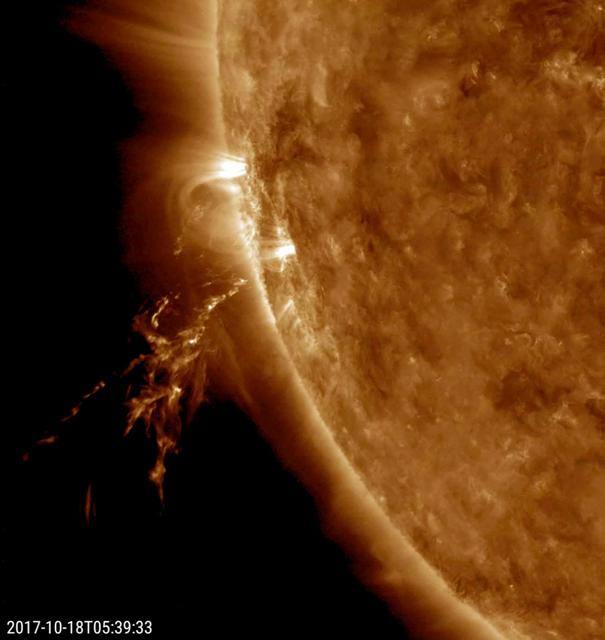
A small eruption blew a bright, disjointed stream of plasma into space (Oct. 18, 2017). The source of the blast was just out of sight beyond the edge of the sun. Images from SOHO's coronagraph instruments show a bright loop of material head…
Quick Solar Outburst
On Jan. 20, 2017, NASA Solar Dynamics Observatory captured a small area of the sun highlighted three active region. Over half a day this active region sent dark swirls of plasma and bright magnetic arches twisting and turning above it. All…
Gyrating Active Region
STS003-21-080 (22-30 March 1982) --- Plasma Diagnostics Package (PDP) grappled by remote manipulator system (RMS) end effector is positioned above payload bay (PLB) at sunrise. Photo credit: NASA
PDP grappled by RMS is positioned above payload bay (PLB) at sunrise
Gerard Moscoso, a mechanical engineer technician with NASA, prepares a sample for testing for the  Plasma Rapid Oxidation Technique for Extending Component Tenability (PROTECT) project inside the Prototype Development Laboratory at NASA’s K…
Plasma Rapid Oxidation Technique for Extending Component Tenabil
Testing of the Plasma Rapid Oxidation Technique for Extending Component Tenability (PROTECT) experiment is underway inside the Prototype Development Laboratory at NASA’s Kennedy Space Center in Florida on Nov. 2, 2022. Plasma electrolytic o…
Plasma Rapid Oxidation Technique for Extending Component Tenabil
Dr. Jennifer Williams, a NASA research chemical engineer, displays two fatigue samples that will be tested  in the Plasma Rapid Oxidation Technique for Extending Component Tenability (PROTECT) experiments  inside the Prototype Laboratory at…
Plasma Rapid Oxidation Technique for Extending Component Tenabil
Gerard Moscoso, a mechanical engineer technician with NASA, prepares the Plasma Rapid Oxidation Technique for Extending Component Tenability (PROTECT) specimens for testing inside the Prototype Development Laboratory at NASA’s Kennedy Space…
Plasma Rapid Oxidation Technique for Extending Component Tenabil
Blue Origin’s New Glenn rocket carrying NASA’s twin ESCAPADE (Escape and Plasma Acceleration and Dynamics Explorers) spacecraft launches at 3:55 p.m. EST, Thursday, Nov. 13, 2025, from Launch Complex 36 at Cape Canaveral Space Force Station…
NASA's ESCAPADE Launch on Blue Origin's NG-2
Near Cape Canaveral Lighthouse, Blue Origin’s New Glenn rocket carrying NASA’s twin ESCAPADE (Escape and Plasma Acceleration and Dynamics Explorers) spacecraft launches at 3:55 p.m. EST, Thursday, Nov. 13, 2025, from Launch Complex 36 at Ca…
NASA's ESCAPADE Launch on Blue Origin's NG-2
Blue Origin’s New Glenn first stage rocket successfully lands for the first time on a drone ship in the Atlantic Ocean following the launching of NASA’s twin ESCAPADE (Escape and Plasma Acceleration and Dynamics Explorers) spacecraft at 3:5…
NASA's ESCAPADE Launch on Blue Origin's NG-2
Two small spacecrafts satellites that make up NASA’s ESCAPADE (Escape and Plasma Acceleration and Dynamics Explorers) mission to Mars arrived at Astrotech Space Operations in Titusville, near NASA’s Kennedy Space Center in Florida on Sunday…
ESCAPADE Unloading
PLASMA TORCH TEST FACILITY
Plasma Torch Test Facility
PLASMA TORCH TEST FACILITY
Plasma Torch Test Facility
TODD SCHNEIDER PREPARES A PLASMA CHAMBER IN BUILDING 4605 AT MSFC FOR AN UPCOMING TEST. SCHNEIDER IS A PHYSICIST IN THE MATERIALS AND PROCESSES DEPARTMENT AT MSFC.
PLASMA CHAMBER
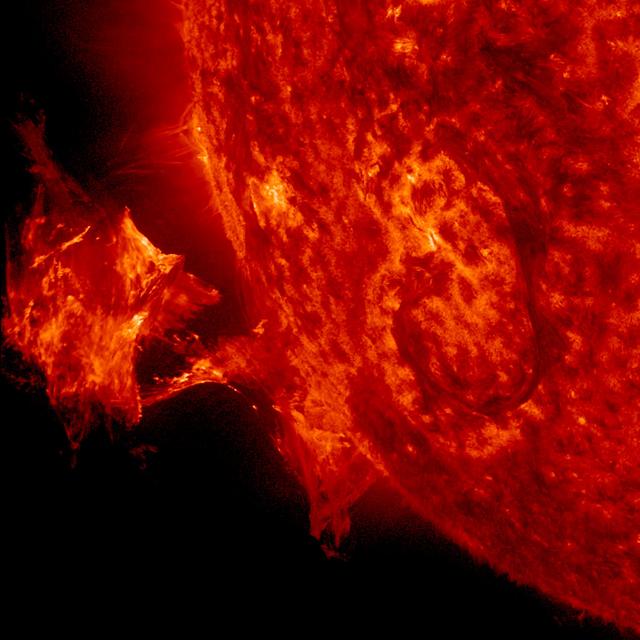
A sheet of plasma blasted out into space from just behind the edge of the sun (July 28, 2017). While some material escaped into space, a portion of it was unable to break the pull of gravity and the magnetic forces nearby and can be seen fa…
Sheet of Plasma
Dark strands of plasma hovering above the sun's surface began to interact with each other in a form of tug of war over two and a half days on June 28-30, 2015. At times, strands of plasma extended a tenuous connection between one area and t…
Plasma Push and Pull
Several short stalks of cooler, darker plasma spun and twisted as they interacted with each other at the sun's edge (June 14-15, 2017). The row of strands, which together form a prominence, were being pulled back and forth by magnetic force…
Twisting Plasma Interactions
A solar prominence at the sun's edge put on quite a display of plasma being pushed and pulled by unstable magnetic fields (May 22-24, 2017). We call them hedgerow prominences because they look somewhat like a hedge of bushes. This is one of…
Hedgerow Prominence
High Pressure Plasma-assisted Combustion
STS003-09-444 (22-30 March 1982) --- The darkness of space provides the backdrop for this scene of the plasma diagnostics package (PDR) experiment in the grasp of the end effector or ?hand? of the remote manipulator system (RMS) arm, and ot…
View of the Columbia's remote manipulator system
Dr. Jennifer Williams, a NASA research chemical engineer, is inside the Prototype Development Laboratory at NASA’s Kennedy Space Center in Florida to begin testing on the Plasma Rapid Oxidation Technique for Extending Component Tenability (…
Plasma Rapid Oxidation Technique for Extending Component Tenabil
Testing of the Plasma Rapid Oxidation Technique for Extending Component Tenability (PROTECT) experiment is underway inside the Prototype Development Laboratory at NASA’s Kennedy Space Center in Florida on Nov. 2, 2022. Plasma electrolytic o…
Plasma Rapid Oxidation Technique for Extending Component Tenabil
Blue Origin’s New Glenn rocket carrying NASA’s twin ESCAPADE (Escape and Plasma Acceleration and Dynamics Explorers) spacecraft launches at 3:55 p.m. EST, Thursday, Nov. 13, 2025, from Launch Complex 36 at Cape Canaveral Space Force Station…
NASA's ESCAPADE Launch on Blue Origin's NG-2
This STS-51F mission onboard Photograph shows some of the Spacelab-2 instruments in the cargo bay of the Orbiter Challenger. The Plasma Diagnostics Package (PDP). shown at the end of the Remote Manipulator System (RMS), used instruments on…
Spacelab
Blue Origin’s New Glenn rocket carrying NASA’s twin ESCAPADE (Escape and Plasma Acceleration and Dynamics Explorers) spacecraft launches at 3:55 p.m. EST, Thursday, Nov. 13, 2025, from Launch Complex 36 at Cape Canaveral Space Force Station…
NASA's ESCAPADE Launch on Blue Origin's NG-2
Blue Origin’s New Glenn rocket carrying NASA’s twin ESCAPADE (Escape and Plasma Acceleration and Dynamics Explorers) spacecraft launches at 3:55 p.m. EST, Thursday, Nov. 13, 2025, from Launch Complex 36 at Cape Canaveral Space Force Station…
NASA's ESCAPADE Launch on Blue Origin's NG-2
Two small spacecrafts satellites that make up NASA’s ESCAPADE (Escape and Plasma Acceleration and Dynamics Explorers) mission to Mars arrived at Astrotech Space Operations in Titusville, near NASA’s Kennedy Space Center in Florida on Sunday…
ESCAPADE Unloading