
Nebula Containerized Server at the NASA Ames Research Center.

Nebula Containerized Server at the NASA Ames Research Center. Overhead exterior with Mahendran Kadannapalli.

This planetary nebula's simple, graceful appearance is thought to be due to perspective: our view from Earth looking straight into what is actually a barrel-shaped cloud of gas shrugged off by a dying central star. Hot blue gas near the ene…

This side-by-side comparison shows observations of the Southern Ring Nebula in near-infrared light, at left, and mid-infrared light, at right, from NASA’s Webb Telescope. This scene was created by a white dwarf star – the remains of a star…

Cassini briefly turned its gaze from Saturn and its rings and moons to marvel at the Carina Nebula, a brilliant region 8,000 light years from our solar system and more than 200 light years across

What look like giant twisters are spotted by the Hubble Space Telescope (HST). These images are, in actuality, pillars of gases that are in the process of the formation of a new star. These pillars can be billions of miles in length and may…

This colourful bubble is a planetary nebula called NGC 6818, also known as the Little Gem Nebula. It is located in the constellation of Sagittarius (The Archer), roughly 6000 light-years away from us. The rich glow of the cloud is just over…

NASA Spitzer Space Telescope surveyed the danger zones around five O-stars in the Rosette nebula. This artist animation illustrates how this process works.

This image from NASA Spitzer Space Telescope is of the Rosette nebula, a turbulent star-forming region located 5,000 light-years away in the constellation Monoceros.

This infrared image from NASA Spitzer Space Telescope shows the Rosette nebula, a pretty star-forming region more than 5,000 light-years away in the constellation Monoceros.

Astronomers using NASA Hubble Space Telescope have found a bow shock around a very young star in the nearby Orion nebula, an intense star-forming region of gas and dust.

The Twin Jet Nebula, or PN M2-9, is a striking example of a bipolar planetary nebula. Bipolar planetary nebulae are formed when the central object is not a single star, but a binary system, Studies have shown that the nebula’s size increase…

This image composite compares visible-light and infrared views from NASA's Spitzer Space Telescope of the glowing Trifid Nebula, a giant star-forming cloud of gas and dust located 5,400 light-years away in the constellation Sagittarius. Vi…

The Cat's Eye Nebula, one of the first planetary nebulae discovered, also has one of the most complex forms known to this kind of nebula. Eleven rings, or shells, of gas make up the Cat's Eye. The full beauty of the Cat's Eye Nebula is rev…

The Crab Nebula is a supernova remnant, all that remains of a tremendous stellar explosion. Observers in China and Japan recorded the supernova nearly 1,000 years ago, in 1054. Credit: NASA, ESA, J. Hester and A. Loll (Arizona State Univer…

This NASA/ESA Hubble Space Telescope image shows a planetary nebula named NGC 6153, located about 4,000 light-years away in the southern constellation of Scorpius (The Scorpion). The faint blue haze across the frame shows what remains of a…

A panoramic view of a vast, sculpted area of gas and dust where thousands of stars are being born has been captured by NASA's Hubble Space Telescope. The image, taken by Hubble's Wide Field and Planetary Camera 2, is online at http://hubbl…

Nebula Containerized Server at the NASA Ames Research Center. Interior with Mahendran Kadannapalli.

Caption: In this composite image, visible-light observations by NASA’s Hubble Space Telescope are combined with infrared data from the ground-based Large Binocular Telescope in Arizona to assemble a dramatic view of the well-known Ring Nebu…

Some 5,000 light years (2,900 trillion miles) from Earth, in the constellation Puppis, is the 1.4 light years (more than 8 trillion miles) long Calabash Nebula, referred to as the Rotten Egg Nebula because of its sulfur content which would…

This image is of the Crab Nebula in visible light photographed by the Hale Observatory optical telescope in 1959. The faint object at the center had been identified as a pulsar and is thought to be the remains of the original star. It had b…

This colorful image shows a nebula – a cloud of gas and dust in space – captured by NASA's now-retired Spitzer Space Telescope located is in the constellation Sagittarius, along the plane of the Milky Way, which was as part of Spitzer's GLI…

The Crab Nebula is one of the most intricately structured and highly dynamical objects ever observed. The new Hubble image of the Crab was assembled from 24 individual exposures taken with the NASA/ESA Hubble Space Telescope

This image from NASA Hubble Space Telescope image of a celestial object called the Ant Nebula may shed new light on the future demise of our Sun.

Rising from a sea of dust and gas like a giant seahorse, the Horsehead nebula is one of the most photographed objects in the sky. NASA Hubble Space Telescope took a close-up look at this heavenly icon, revealing the cloud intricate structur…

The nearby intense star-forming region known as the Great Nebula in the Orion constellation reveals a bow shock around a very young star as seen by NASA's Hubble Space Telescope (HST). Named for the crescent-shaped wave made by a ship as it…

The Dumbbell nebula, also known as Messier 27, pumps out infrared light in this image from NASA Spitzer Space Telescope. Planetary nebulae are now known to be the remains of stars that once looked a lot like our sun.

These false-color image taken by NASA Spitzer Space Telescope shows the South Pillar region of the star-forming region called the Carina Nebula.

Artist impression of Herschel is set against an image captured by the observatory, showing baby stars forming in the Rosette nebula. The bright spots are dusty cocoons containing massive forming stars, each one up to ten times the mass of o…

A star's spectacular death in the constellation Taurus was observed on Earth as the supernova of 1054 A.D. Now, almost a thousand years later, a superdense neutron star left behind by the stellar death is spewing out a blizzard of extremely…

NASA image release April 27, 2012 The NASA/ESA Hubble Space Telescope has been at the cutting edge of research into what happens to stars like our sun at the ends of their lives. One stage that stars pass through as they run out of nuclear…

This sturning image, taken by the newly installed Advanced Camera for Surveys (ACS) aboard the Hubble Space Telescope (HST), is an image of the center of the Omega Nebula. It is a hotbed of newly born stars wrapped in colorful blankets of g…

Nebula Containerized Server at the NASA Ames Research Center.

Nebula Containerized Server at the NASA Ames Research Center.

In this sturning image provided by the Hubble Space Telescope (HST), the Omega Nebula (M17) resembles the fury of a raging sea, showing a bubbly ocean of glowing hydrogen gas and small amounts of other elements such as oxygen and sulfur. Th…

Image released April 19, 2013. Astronomers have used NASA's Hubble Space Telescope to photograph the iconic Horsehead Nebula in a new, infrared light to mark the 23rd anniversary of the famous observatory's launch aboard the space shuttle…

What looks much like craggy mountains on a moonlit evening is actually the edge of a nearby, young, star-forming region NGC 3324 in the Carina Nebula. Captured in infrared light by the Near-Infrared Camera (NIRCam) on NASA’s James Webb Spac…

This NASA Hubble Space Telescope (HST) image of the Trifid Nebula reveals a stellar nursery being torn apart by a nearby massive star. Embryonic stars are forming within an ill-fated cloud of dust and gas, which is destined to be eaten away…

This infrared image from NASA Spitzer Space Telescope shows the Helix nebula, a cosmic starlet often photographed by amateur astronomers for its vivid colors and eerie resemblance to a giant eye.

Resembling the hair in Botticelli famous portrait of the birth of Venus, an image from NASA Hubble Space Telescope has captured softly glowing filaments streaming from hot young stars in a nearby nebula.

This image composite compares the well-known visible-light picture of the glowing Trifid Nebula (left panel) with infrared views from NASA's Spitzer Space Telescope (remaining three panels). The Trifid Nebula is a giant star-forming cloud o…

NASA Spitzer Space Telescope, formerly known as the Space Infrared Telescope Facility, has captured in stunning detail the spidery filaments and newborn stars of theTarantula Nebula, a rich star-forming region also known as 30 Doradus. This…

NASA Spitzer Space Telescope finds a delicate flower in the Ring Nebula, as shown in this image. The outer shell of this planetary nebula looks surprisingly similar to the delicate petals of a camellia blossom.

A newly expanded image of the Helix nebula lends a festive touch to the fourth anniversary of the launch of NASA Spitzer Space Telescope

The Helix nebula exhibits complex structure on the smallest visible scales. It is composed of gaseous shells and disks puffed out by a dying sun-like star.

Image release date September 22, 2010 To view a video of this image go here: <a href="http://www.flickr.com/photos/gsfc/5014452203">www.flickr.com/photos/gsfc/5014452203</a> Caption: A spectacular new NASA/ESA Hubble Space Telescope image…
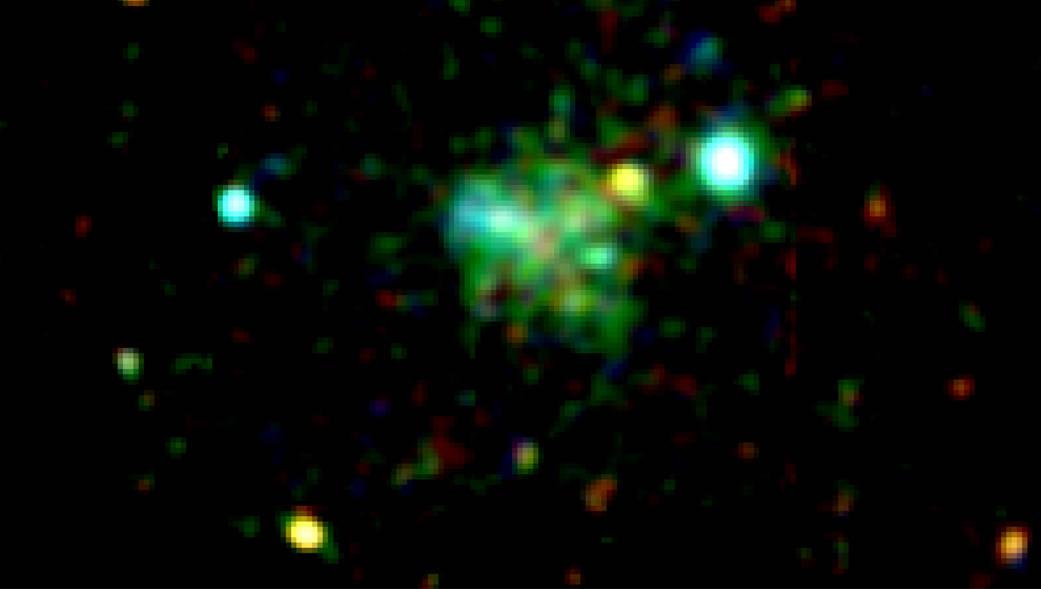
Astronomers have discovered a vast cloud of high-energy particles called a wind nebula around a rare ultra-magnetic neutron star, or magnetar, for the first time. The find offers a unique window into the properties, environment and outburst…

Huge waves are sculpted in this two-lobed nebula called the Red Spider Nebula, located some 3,000 light-years away in the constellation of Sagittarius. This warm planetary nebula harbors one of the hottest stars known and its powerful stell…