The Paresev 1-A (Paraglider Research Vehicle) and the tow airplane, 450-hp Stearman sport Biplane, sitting on Rogers dry lakebed, Edwards, California. The control system in the Paresev 1-A had a more conventional control stick position and…
Pilot and Paresev 1 preparing for a landing on the Rogers dry lakebed in 1962 at Edwards Air Force Base, California. The flight program began with ground tow tests. Several tows were made before liftoff was attempted to check the control ri…
After completing it's first orbital mission with a landing at Edwards Air Force Base on April 14, 1981, Space Shuttle Columbia received a humorous sendoff before it's ferry flight atop a modified 747 back to the Kennedy Space Center in Flor…
The HL-10 Lifting Body is seen here in flight over Rogers Dry lakebed. Like the other lifting bodies, the HL-10 made a steep descent toward the lakebed, followed by a high-speed landing. This was due to the vehicle's low lift-over-drag rati…
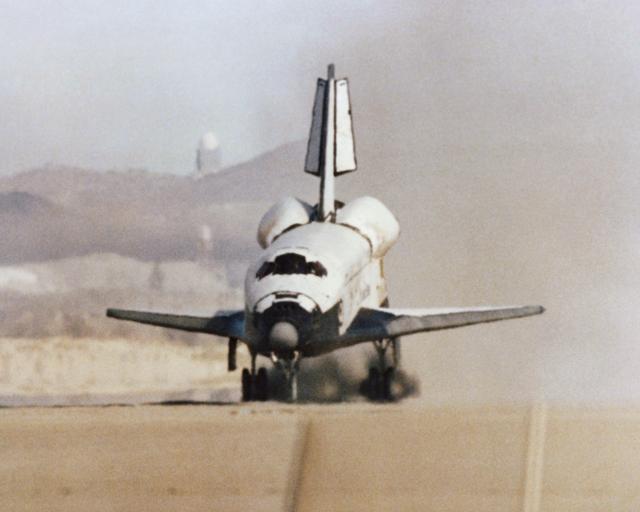
The Space Shuttle Columbia on Rogers Dry lakebed at Edwards AFB after landing to complete its first orbital mission on April 14, 1981. Technicians towed the Shuttle back to the NASA Dryden Flight Research Center for post-flight processing a…
This photograph shows NASA's 3/8th-scale remotely piloted research vehicle landing on Rogers Dry Lakebed at Edwards Air Force Base, California, in 1975.
After the grounding of the M2-F1 in 1966, it was kept in outside storage on the Dryden complex. After several years, its fabric and plywood structure was damaged by the sun and weather. Restoration of the vehicle began in February 1994 unde…
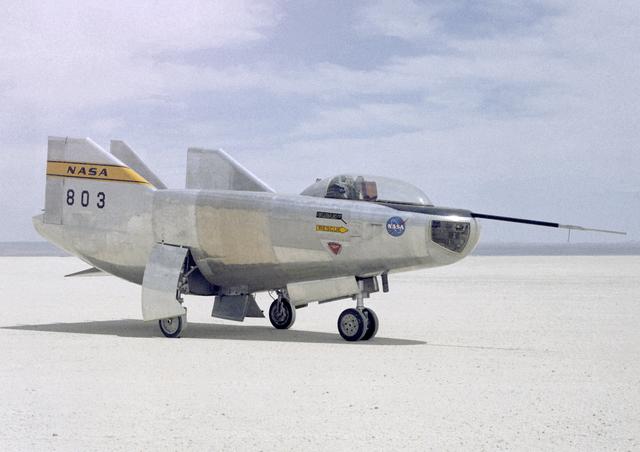
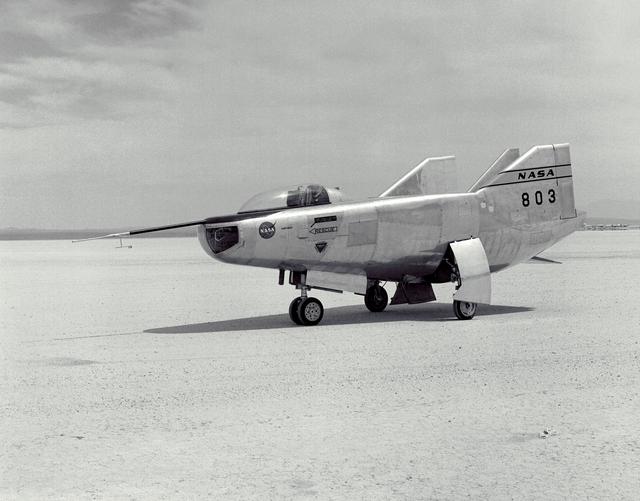
NASA Flight Research Pilot Milt Thompson, shown here on the lakebed with the M2-F1 lifting body, was an early backer of R. Dale Reed's lifting-body proposal. He urged Flight Research Center director Paul Bikle to approve the M2-F1's constru…
In this photo of the M2-F1 lifting body and the Paresev 1B on the ramp, the viewer sees two vehicles representing different approaches to building a research craft to simulate a spacecraft able to land on the ground instead of splashing dow…
Boeing's X-48B Blended Wing Body technology demonstrator shows off its unique lines at sunset on Rogers Dry Lake adjacent to NASA's Dryden Flight Research Center. (Boeing photo # SMF06_F_KOEH_X48B-0955)
Puffy white clouds and a flooded lakebed form a backdrop as a T-38 support aircraft taxies across the ramp in front of NASA's Boeing 747 Shuttle Carrier Aircraft.
NASA's specially modified 747 with the Space Shuttle Columbia atop takes off to ferry the Shuttle back to Kennedy Space Center in Florida. Columbia had recently completed its first orbital mission with a landing at Edwards Air Force Base in…
The Space Shuttle Columbia on Rogers Dry lakebed at Edwards AFB after landing to complete its first orbital mission on April 14, 1981. Technicians towed the Shuttle back to the NASA Dryden Flight Research Center for post-flight processing a…
The M2-F3 Lifting Body is seen here on the lakebed next to the NASA Flight Research Center (FRC--later Dryden Flight Research Center), Edwards, California. The May 1967 crash of the M2-F2 had torn off the left fin and landing gear. It had a…
The Space Shuttle Columbia on Rogers Dry lakebed at Edwards AFB after landing to complete its first orbital mission on April 14, 1981. Technicians towed the Shuttle back to the NASA Dryden Flight Research Center for post-flight processing a…
The HL-10 was one of five heavyweight lifting-body designs flown at NASA's Flight Research Center (FRC--later Dryden Flight Research Center), Edwards, California, from July 1966 to November 1975 to study and validate the concept of safely m…
The M2-F3 Lifting Body is seen here on the lakebed next to the NASA Flight Research Center (later the Dryden Flight Research Center), Edwards, California. Redesigned and rebuilt from the M2-F2, the M2-F3 featured as its most visible change…
After initial ground-tow flights of the M2-F1 using the Pontiac as a tow vehicle, the way was clear to make air tows behind a C-47. The first air tow took place on 16 August 1963. Pilot Milt Thompson found that the M2-F1 flew well, with goo…
Boeing's X-48B Blended Wing Body technology demonstrator shows off its unique lines at sunset on Rogers Dry Lake adjacent to NASA's Dryden Flight Research Center. (Boeing photo # SMF06_F_KOEH_X48B-0900a)
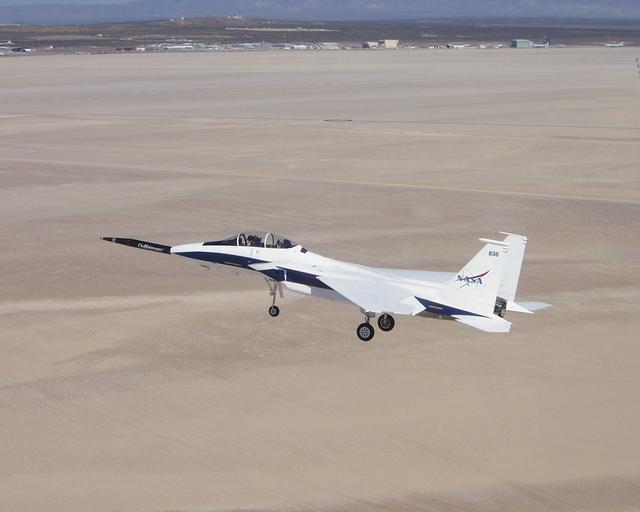
Approaching the runway after the first evaluation flight of the Quiet Spike project, NASA's F-15B testbed aircraft cruises over Roger's Dry Lakebed near the Dryden Flight Research Center. The Quiet Spike was developed by Gulfstream Aerospac…
The Space Shuttle Columbia touches down on lakebed runway 23 at Edwards Air Force Base, Calif., to conclude the first orbital shuttle mission. (JSC photo # S81-30734)
The Space Shuttle Columbia on Rogers Dry lakebed at Edwards AFB after landing to complete its first orbital mission on April 14, 1981. Technicians towed the Shuttle back to the NASA Dryden Flight Research Center for post-flight processing a…
The Space Shuttle Columbia glides down over Rogers Dry Lake as it heads for a landing at Edwards Air Force Base at the conclusion of its first orbital mission on April 14, 1981.
The Space Shuttle Columbia on Rogers Dry lakebed at Edwards AFB after landing to complete its first orbital mission on April 14, 1981. Technicians towed the Shuttle back to the NASA Dryden Flight Research Center for post-flight processing a…
The HL-10 lifting body is seen here in flight over Rogers Dry Lake at Edwards AFB. After the vehicle's fins were modified following its first flight, the HL-10 proved to be the best handling of the heavy-weight lifting bodies flown at Edwar…
The M2-F3 Lifting Body is seen here on the lakebed at the NASA Flight Research Center (FRC--later the Dryden Flight Research Center), Edwards, California. After a three-year-long redesign and rebuilding effort, the M2-F3 was ready to fly. T…
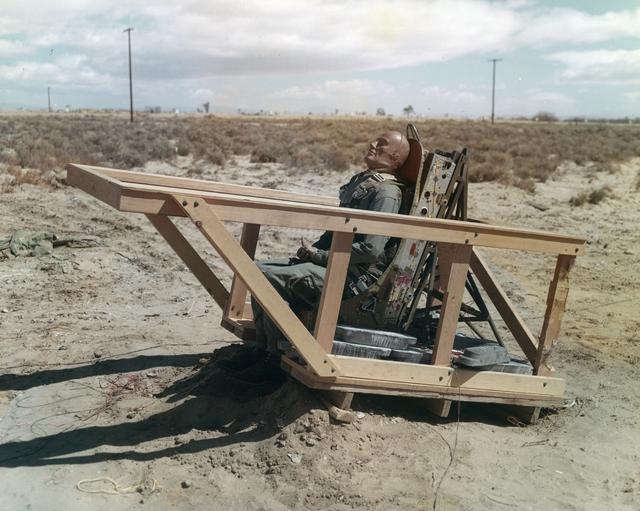
The M2-F1 was fitted with an ejection seat before the airtow flights began. The project selected the seat used in the T-37 as modified by the Weber Company to use a rocket rather than a ballistic charge for ejection. To test the ejection se…
This photo shows the cockpit configuration of the M2-F1 wingless lifting body. With a top speed of about 120 knots, the M2-F1 had a simple instrument panel. Besides the panel itself, the ribs of the wooden shell (left) and the control stick…
Following the first M2-F1 airtow flight on 16 August 1963, the Flight Research Center used the vehicle for both research flights and to check out new lifting-body pilots. These included Bruce Peterson, Don Mallick, Fred Haise, and Bill Dana…