SCI2017_0003: The column of material at and just below the surface of dwarf planet Ceres (box) – the top layer contains anhydrous (dry) pyroxene dust accumulated from space mixed in with native hydrous (wet) dust, carbonates, and water ice.…
SOFIA Science Imagery
This high-dynamic range (HDR) photo of the Stratospheric Observatory for Infrared Astronomy (SOFIA) was captured just before sunset at the Christchurch International Airport in Christchurch, New Zealand while aircraft crews were preparing f…
ED15-0187-236
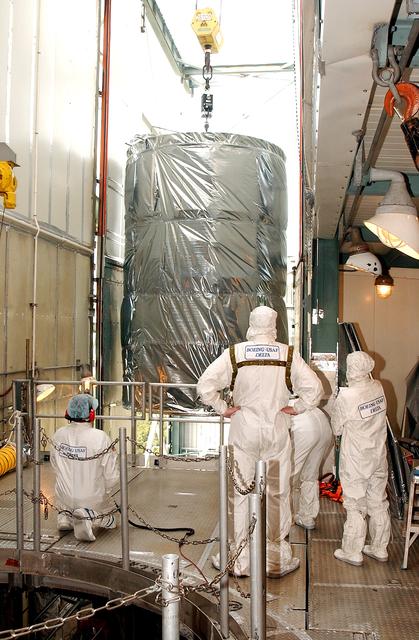
SOFIA's primary mirror is placed in the telescope cavity for reinstallation prior to telescope adjustments preparing SOFIA for first science.
SOFIA's primary mirror is placed in the telescope cavity for reinstallation prior to telescope adjustments preparing SOFIA for first science
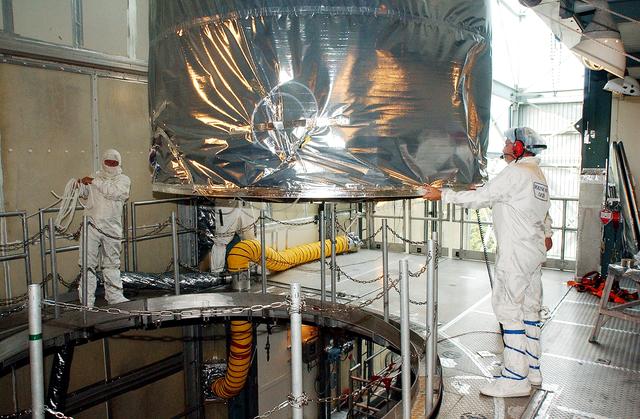
echnicians lift SOFIA's primary mirror assembly above NASA's 747SP airborne astronomy aircraft just prior to installation in the telescope cavity.
echnicians lift SOFIA's primary mirror assembly above NASA's 747SP airborne astronomy aircraft just prior to installation in the telescope cavity
A technician guides SOFIA's primary mirror assembly into the aircraft's telescope cavity completing the mirror reinstallation following its initial coating.
A technician guides SOFIA's primary mirror assembly into the aircraft's telescope cavity completing the mirror reinstallation following its initial coating
SOFIA’s 9-foot mirror is lowered into the cavity and attached to a structure sitting on a thin layer of oil for stability and vibration-free operation.
Slow and Steady
The flight crew of NASA's SOFIA airborne observatory includes (from left), flight engineer Marty Trout and pilots Bill Brockett and Frank Batteas.
SCI2016_0006: Map of Cepheus E emphasizing the jets of material flowing to the upper left and lower right from the protostar. The protostar itself is the central yellow-red 'blob" in the colored background map of hydrogen emission made at a…
SOFIA Science Imagery
SOFIA’s flight crew prepare to takeoff from the U.S. Antarctic Program facility   at Christchurch International Airport in Christchurch, New Zealand, to observe the Southern Hemisphere’s skies. Pilot: Manny Antimisiaris, Co-Pilot: Jim Less,…
SOFIA Prepares For Take-Off
SOFIA’s telescope mirror is seen as it appears during a science mission.
Through the Eyes of SOFIA
NASA's freshly painted Stratospheric Observatory for Infrared Astronomy (SOFIA) 747SP aircraft sits outside a hangar at L-3 Communications Integrated Systems' facility in Waco, Texas. The observatory, which features a German-built 100-inch…
NASA's newly painted Stratospheric Observatory for Infrared Astronomy 747SP is pushed back from L-3 Communications' Integrated Systems hangar in Waco, Texas
NASA Dryden Flight Research Center's two T-38A Talon mission support aircraft flew together for the first time on Sept. 26, 2007 while conducting pitot-static airspeed calibration checks during routine pilot proficiency flights. The two air…
NASA Dryden's two T-38A mission support aircraft fly in tight formation while conducting a pitot-static airspeed calibration check near Edwards Air Force Base
Researchers using NASA Stratospheric Observatory for Infrared Astronomy SOFIA have captured infrared images of the last exhalations of a dying sun-like star. This image is of the planetary Nebula M2-9.
NASA SOFIA Captures Images of the Planetary Nebula M2-9
In this image of PSR B1509-58 about 170,000 light-years from Earth, X-rays from NASA Chandra in gold are seen along with infrared data from NASA Wide-field Infrared Survey Explorer WISE telescope in red, green and blue.
Face Illusion in the Cosmic Clouds
Engineers and technicians prepare SOFIA's German-built primary mirror assembly for reinstallation into NASA's 747SP airborne observatory.
Engineers and technicians prepare SOFIA's German-built primary mirror assembly for reinstallation into NASA's 747SP airborne observatory
Technicians introduce liquid nitrogen to an instrument linked to SOFIA’s telescope. Detection of infrared wavelengths is greatly enhanced by removing as much heat from the telescope as possible.
Cooling Off SOFIA’S Telescope
Astronomers smile while looking at data from SOFIA’s telescope.
Astronomers Smile at SOFIA’s Data
James De Buizer, Senior Scientist at SOFIA Science Center, conducting observations onboard SOFIA facing the telescope’s Naysmith foci “eyepiece.”
Studying on SOFIA
NASA’s Stratospheric Observatory for Infrared Astronomy, SOFIA, takes off from its base of operations at NASA’s Armstrong Flight Research Center’s Building 703 in Palmdale, California. The aircraft is on its way to Fa’a’ā, French Polynesia…
SOFIA deployment to French Polynesia
Scientists onboard SOFIA watch data come in from Pluto’s atmosphere as SOFIA flies into the shadow the dwarf planet cast on Earth’s surface during an eclipse-like event called an occultation. (Left to right standing): Holger Jakob, Thomas R…
SOFIA Studies Pluto’s Atmosphere
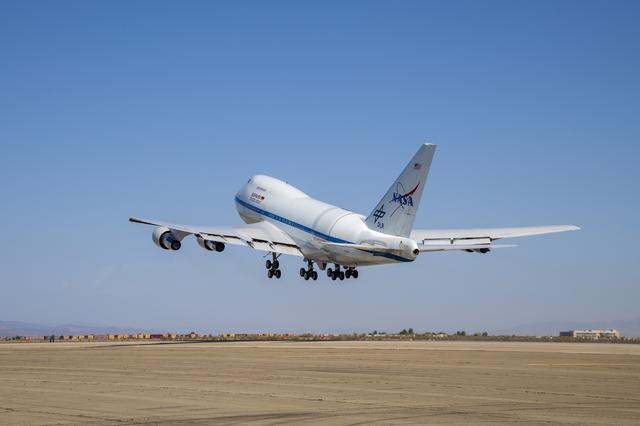
NASA's SOFIA flying infrared observatory banks over the Dryden Aircraft Operations Facility upon arrival at its new base of operations on Jan. 15, 2008.
An aircraft tug tows NASA's SOFIA infrared observatory 747SP into Hangar 703 upon arrival at its base, the Dryden Aircraft Operations Facility in Palmdale, Calif.
An aircraft tug tows NASA's SOFIA infrared observatory 747SP into Hangar 703 upon arrival at its base, the Dryden Aircraft Operations Facility in Palmdale, CA.
The launch gantry, surrounding the United Launch Alliance Delta II rocket with the Orbiting Carbon Observatory-2 (OCO-2) satellite onboard, is seen in this black and white infrared view at Space Launch Complex 2, Friday, June 27, 2014, Vand…
Orbiting Carbon Observatory-2 (OCO-2)
Dryden Aircraft Operations Facility - aircraft fleet on ramp
ED08-0292-2
SCI2016_0001: SOFIA/GREAT [O I] spectrum at 4.7 THz (63 μm) superimposed on a picture of Mars. Absorption line depth is approximately 10% of the continuum. The abundance of atomic oxygen computed from the data is less than expected from the…
SOFIA Science Imagery
In this composite image of the Omega Nebula, SOFIA detected the blue areas (20 microns) near the center, revealing gas as it's heated by massive stars located at the center, near the bend, and the green areas (37 microns) that trace dust as…
SOFIA Reveals How the Swan Nebula Hatched
SCI2012_0003: SOFIA mid-infrared image of the planetary nebula Minkowski 2-9 (M2-9), also known as the Butterfly Nebula, compared with a visual-wavelength Hubble Space Telescope image at the same scale and orientation. The nebula is compose…
SOFIA Science Imagery
SOFIA's primary mirror assembly is lifted above wing level prior to its reinstallation in the telescope cavity of NASA's 747 airborne observatory Oct. 8, 2008.
SOFIA's primary mirror assembly is lifted above wing level prior to its reinstallation in the telescope cavity of NASA's 747 airborne observatory Oct. 8, 2008
SOFIA's primary mirror assembly rests in its transportation cradle prior to reinstallation in NASA's airborne laboratory on Oct. 8, 2008.
SOFIA's primary mirror assembly rests in its transportation cradle prior to reinstallation in NASA's airborne laboratory on Oct. 8, 2008
Technicians fill SOFIA’s instrument with liquid nitrogen and helium to keep the detectors cold. The now retired instrument was called the First Light Infrared Test Experiment Camera, or FLITECAM. When SOFIA lands after each flight its instr…
FLITECAM at Work
NASA’s Stratospheric Observatory for Infrared Astronomy, SOFIA, takes off from its base of operations at NASA’s Armstrong Flight Research Center’s Building 703 in Palmdale, California. The aircraft is on its way to Fa’a’ā, French Polynesia…
SOFIA deployment to French Polynesia
This new image of the Orion Nebula produced using previously released data from three telescopes shows two enormous caverns carved out by unseen giant stars that can release up to a million times more light than our Sun. All that radiation…
Orion Nebula in Infrared
NASA’s Stratospheric Observatory for Infrared Astronomy, SOFIA, takes off from its base of operations at NASA’s Armstrong Flight Research Center’s Building 703 in Palmdale, California. The aircraft is on its way to Fa’a’ā, French Polynesia…
SOFIA deployment to French Polynesia
A rainbow frames the Stratospheric Observatory for Infrared Astronomy 747SP during its first Southern Hemisphere deployment in Christchurch, New Zealand, in July 2013.
NASA Armstrong Celebrates 70 Years of Flight Research
NASA’s Stratospheric Observatory for Infrared Astronomy, SOFIA, takes off from its base of operations at NASA’s Armstrong Flight Research Center’s Building 703 in Palmdale, California. The aircraft is on its way to Fa’a’ā, French Polynesia…
SOFIA deployment to French Polynesia
NASA’s Stratospheric Observatory for Infrared Astronomy, SOFIA, takes off from its base of operations at NASA’s Armstrong Flight Research Center’s Building 703 in Palmdale, California. The aircraft is on its way to Fa’a’ā, French Polynesia…
SOFIA deployment to French Polynesia
Technicians installing the tertiary mirror onto the SOFIA telescope.
Piecing Together SOFIA’s Telescope
NASA's freshly painted Stratospheric Observatory for Infrared Astronomy (SOFIA) 747SP is shown at L-3 Communications Integrated Systems' facility in Waco, Texas, where major modifications and installation was performed. The observatory, whi…
NASA's Stratospheric Observatory for Infrared Astronomy 747SP shows off its new blue-and-white livery at L-3 Communications' Integrated Systems in Waco, Texas