
Illustration Preliminary Volcanic Terrain Map of Mars Regional Chart
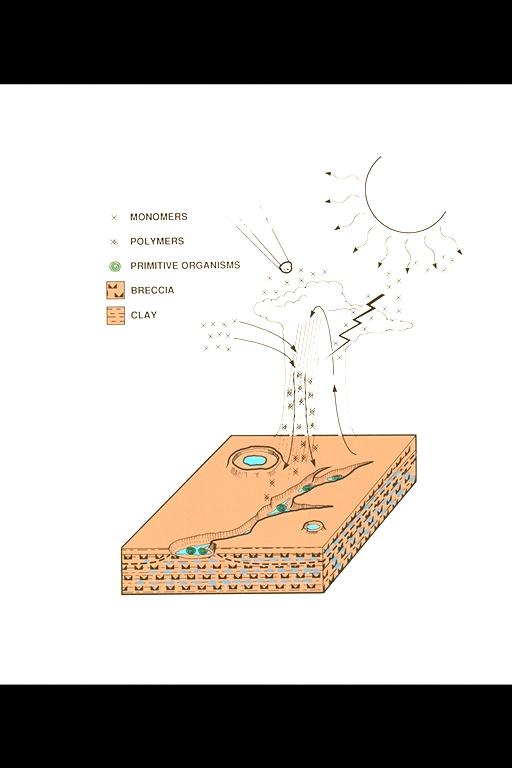
Illustration Origin of Life: Oberbeck, Marshall and Schwartz Theory for Chemical Evolution

This illustration shows a close-up of Saturn's rings. These rings are thought to have formed from material that was unable to form into a Moon because of tidal forces from Saturn, or from a Moon that was broken up by Saturn's tidal forces.

This is a cutaway illustration of the Saturn V command module (CM) configuration. The CM was crammed with some of the most complex equipment ever sent into space at the time. The three astronaut couches were surrounded by instrument panels,…

A cutaway illustration of Saturn 1 launch vehicle mission. The Saturn I, first of the Saturn launch vehicles' family, is a two-stage vehicle with a low-earth-orbit payload capability of approximately 25,000 pounds. The research and developm…

Named for the Greek god associated with Mars, the NASA developed Ares launch vehicles will return humans to the moon and later take them to Mars and other destinations. This is an illustration of the Ares I with call outs. Ares I is an inl…

This illustration, with callouts, is of the Saturn V SII (2nd Stage) developed by the Space Division of North American Aviation under the direction of the Marshall Space Flight Center. The 82-foot-long and 33-foot-diameter S-II stage utiliz…

The Apollo Telescope Mount (ATM) served as the first marned astronomical observatory in space. It was designed for solar research from Earth orbit aboard the Skylab. This image is a cutaway illustration of the ATM canister with callouts and…

The Apollo 11 mission launched from the Kennedy Space Center (KSC) in Florida via the Marshall Space Flight Center (MSFC) developed Saturn V launch vehicle on July 16, 1969 and safely returned to Earth on July 24, 1969. Aboard the space cra…

This cutaway drawing details the internal design of the Skylab Multiple Docking Adapter (MDA). The MDA, built under the direction of the Marshall Space Flight Center, housed various Skylab control and experiment units, and provided a dockin…

Shown is an illustration of the Ares I concept. The first stage will be a single, five-segment solid rocket booster derived from the space shuttle programs reusable solid rocket motor. The first stage is managed by NASA's Marshall Space Fli…

The Apollo 11 mission launched from the Kennedy Space Center (KSC) in Florida via the Marshall Space Flight Center (MSFC) developed Saturn V launch vehicle on July 16, 1969 and safely returned to Earth on July 24, 1969. Aboard the space cra…

THIS CONCEPT IMAGE SHOWS NASA'S NEXT GENERATION LAUNCH VEHICLE SYSTEMS STANDING SIDE BY SIDE. ARES I, LEFT, IS THE CREW LAUNCH VEHICLE THAT WILL CARRY THE ORION CREW EXPLORATION VEHICLE TO SPACE. ARES V IS THE CARGO LAUNCH VEHICLE THAT WILL…

The Apollo 11 mission launched from the Kennedy Space Center (KSC) in Florida via the Marshall Space Flight Center (MSFC) developed Saturn V launch vehicle on July 16, 1969 and safely returned to Earth on July 24, 1969. Aboard the space cra…

Shown is a concept illustration of the Ares I crew launch vehicle, left, and Ares V cargo launch vehicle. Ares I will carry the Orion Crew Exploration Vehicle to space. Ares V will serve as NASA's primary vehicle for delivery of large-scale…

Illustration of the SpaceX Crew Dragon and Falcon 9 rocket during the company’s uncrewed In-Flight Abort Test for NASA’s Commercial Crew Program. This demonstration test of Crew Dragon’s launch escape capabilities is designed to provide val…

Illustration of the SLS Exploration Upper Stage, or EUS. This configuration of the rocket, with the Exploration Upper Stage, will provide in-space propulsion to send astronauts in NASA’s Orion spacecraft and heavy cargo on a precise traje…

Illustration Origin of Life, Chemical Evolution on Mars: Mars Evolution Layers

This image illustrates the deployment of the Skylab parasol thermal shield. Skylab lost its thermal protection shield during its launch on May 14, 1973. The Skylab-2 crew deployed a parasol thermal shield to protect the workshop from overhe…

This is a cutaway illustration of the Saturn V service module configuration. Packed with plumbing and tanks, the service module was the command module's constant companion until just before reentry. All components not needed during the last…

This is a cutaway illustration of the Apollo Spacecraft configuration and data summary.
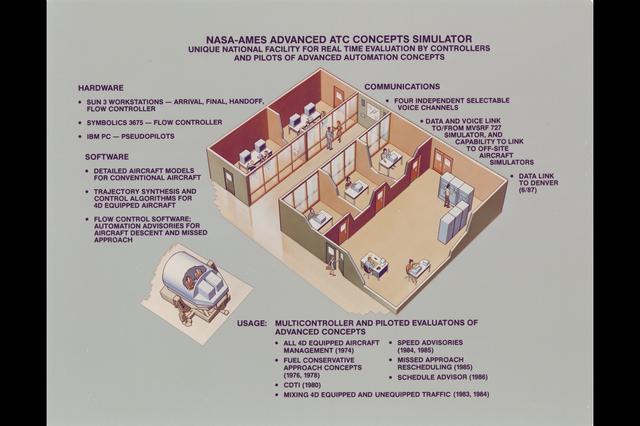
Illustration N-257 Advanced ATC Concepts simulator: unicqu national facility for treal time evalation by controllers and pilots of advanced automation concepts (Cutaway artwork)

This image illustrates the deployment of the Skylab parasol thermal shield. Skylab lost its thermal protection shield during its launch on May 14, 1973. The Skylab-2 crew deployed a parasol thermal shield to protect the workshop from overhe…

This illustration of the Comet-Shoemaker/Levy collision shows the first piece of the remains of the comet crashing into Jupiter. This event occurred in 1994 after tidal forces from Jupiter caused the comet to break up into 21 separate piece…

The NASA developed Ares rockets, named for the Greek god associated with Mars, will return humans to the moon and later take them to Mars and other destinations. This is an illustration of the Ares V with call outs. The Ares V is a heavy li…

Shown is a concept illustration of Ares I which is an in-line, two-stage rocket that will transport the Orion Crew Exploration Vehicle to low earth orbit. Orion will accommodate as many as six astronauts. The first stage will consist of the…

This illustration shows a red dwarf star orbited by a hypothetical exoplanet. Red dwarfs tend to be magnetically active, displaying gigantic arcing prominences and a wealth of dark sunspots. Red dwarfs also erupt with intense flares that co…

This cutaway drawing details the major characteristics of the Skylab Multiple Docking Adapter (MDA). The MDA, built under the direction of the Marshall Space Flight Center, housed the control units for the Apollo Telescope Mount (ATM), Eart…

Under the goals of the Vision for Space Exploration, Ares I is a chief component of the cost-effective space transportation infrastructure being developed by NASA's Constellation Program. This transportation system will safely and reliably…

The Apollo 11 mission launched from the Kennedy Space Center (KSC) in Florida via the Marshall Space Flight Center (MSFC) developed Saturn V launch vehicle on July 16, 1969 and safely returned to Earth on July 24, 1969. Aboard the space cra…

The Apollo 11 mission launched from the Kennedy Space Center (KSC) in Florida via the Marshall Space Flight Center (MSFC) developed Saturn V launch vehicle on July 16, 1969 and safely returned to Earth on July 24, 1969. Aboard the space cra…

Illustration of the SLS Exploration Upper Stage, or EUS. The Exploration Upper Stage will be used on the second configuration of the SLS rocket, known as Block 1B, and will provide in-space propulsion to send astronauts in NASA’s Orion spac…

This graphic compares the size of Earth and Kepler-1649c, an exoplanet only 1.06 times larger than Earth by radius. https://photojournal.jpl.nasa.gov/catalog/PIA23774

Illustration NASA Ames Research Center developed Icing Protection System: Electro-Expuisive Deicing System. (P.I. Dr Lenord Haslim)

A cutaway illustration of Saturn I launch vehicle characteristics: The Saturn I, first of the Saturn launch vehicles' family, is a two-stage vehicle with a low-earth-orbit payload capability of approximately 25,000 pounds. The research and…

Launched February 11, 2000, the STS-99 Shuttle Radar Topographic Mission (SRTM) was the most ambitious Earth mapping mission to date. This illustration shows the Space Shuttle Endeavour orbiting some 145 miles (233 kilometers) above Earth.…

THIS CONCEPT IMAGE SHOWS THE ARES V CARGO LAUNCH VEHICLE. THE HEAVY LIFTING ARES V IS NASA'S PRIMARY VEHICLE FOR SAFE AND RELIABLE DELIVERY OF LARGE SCALE HARDWARE TO SPACE. THIS INCLUDES THE LUNAR LANDER, MATERIALS FOR ESTABLISHING A PERMA…

Named for the Greek god associated with Mars, the NASA developed Ares launch vehicles will return humans to the moon and later take them to Mars and other destinations. In this early illustration, the vehicle depicted on the left is the Are…

This illustration shows a cutaway drawing with callouts of the major components for the S-IC (first) stage of the Saturn V launch vehicle. The S-IC stage is 138 feet long and 33 feet in diameter, producing more than 7,500,000 pounds of thru…

Shown is an illustration of the Ares I crew launch vehicle on the launch pad at NASA's Kennedy Space Center, Florida.

The Apollo Telescope Mount (ATM) served as the first marned astronomical observatory in space. It was designed for solar research from Earth orbit aboard the Skylab. This image is a cutaway illustration of the ATM canister with callouts. Th…

The Apollo Telescope Mount (ATM) served as the first marned astronomical observatory in space. It was designed for solar research from Earth orbit aboard the Skylab. This image is a cutaway illustration of the ATM canister. The ATM was desi…

Shown is a concept illustration of the Ares I crew launch vehicle during launch and the Ares V cargo launch vehicle on the launch pad. Ares I will carry the Orion Crew Exploration Vehicle with an astronaut crew to Earth orbit. Ares V will d…

The Apollo 11 mission launched from the Kennedy Space Center (KSC) in Florida via the Marshall Space Flight Center (MSFC) developed Saturn V launch vehicle on July 16, 1969 and safely returned to Earth on July 24, 1969. Aboard the space cra…

The family of High Energy Astronomy Observatory (HEAO) instruments consisted of three unmarned scientific observatories capable of detecting the x-rays emitted by the celestial bodies with high sensitivity and high resolution. The celestial…

Artist concept of the X-59 three forths view

Artist illustration of the X-59 in flight over land.

Artist illustration of the X-59 in flight above the clouds with land below, flying left.