
3/4 FRONT VIEW OF HILLER H-23C (USA 56-2288). USE OF THE HILLER H-23 HELICOPTER AS AN AID IN ESTABLISHING SATISFACTORY FLYING QUALITIES & REQUIREMENTS FOR VTOL AIRCRAFT. Rotocraft Research. NASA SP Flight Research at Ames: 57 Years of De…

January 1962 -- Project Mercury Astronaut John H. Glenn Jr., prime pilot for the MA-6 mission.

H. Julian 'Harvey' Allen in front of the NASA Ames 8_x_7 foot Supersonic Wind Tunnel test section. A blunt body model mounted in the test section is ready for testing . The 8_X_7_foot is part of the Unitary Plan WInd Tunnel Complex Note…

Goddard rocket with four rocket motors. This rocket attained an altitude of 200 feet in a flight, November 1936, at Roswell, New Mexico. From 1930 to 1941, Dr. Goddard made substantial progress in the development of progressively larger roc…

Mercury astronaut John Glenn speaks during the "On Shoulders of Giants" program celebrating 50 years of Americans in orbit, an era which began with Glenn's MA-6 mission on Feb. 20, 1962. The event was conducted in the Rocket Garden at the K…
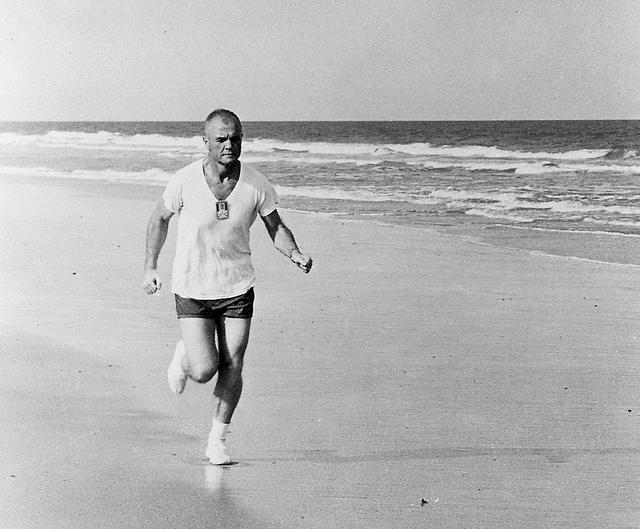
1962 -- Running along the beach at Cape Canaveral, Florida, astronaut John H. Glenn Jr., pilot of the Mercury-Atlas 6 mission, participates in a strict physical training program, as he exemplifies by frequent running.

Around a table in Bay 2 Orbiter Processing Facility at NASA's Kennedy Space Center in Florida, STS-95 crew members look over equipment during the Crew Equipment Interface Test (CEIT) for their mission. From left, they are Mission Specialist…
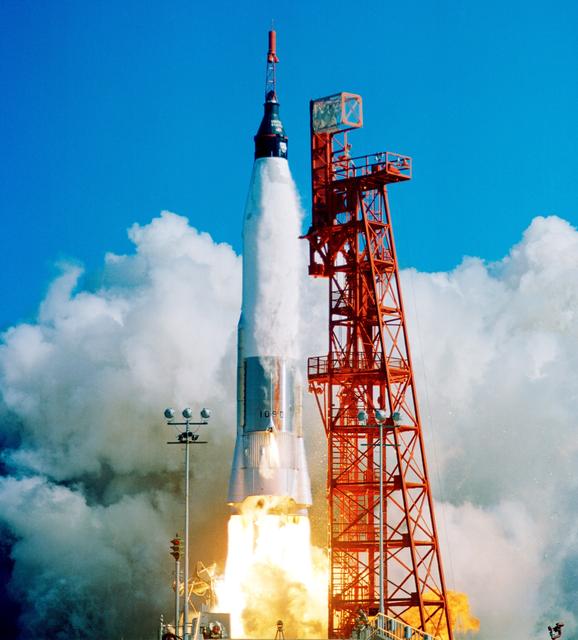
Mercury Atlas-6 lifts off on Feb. 20, 1962 carrying astronaut John Glenn on America's first orbital spaceflight.

H. Julian 'Harvey' Allen at his retirement party in the hangar
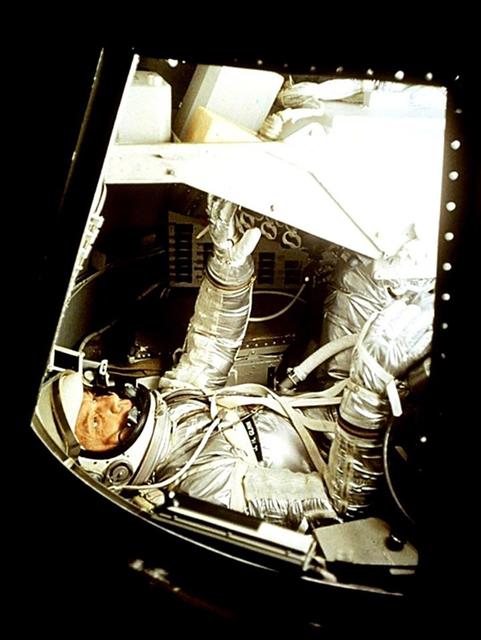
January 1962 -- Project Mercury Astronaut John H. Glenn Jr., prime pilot for the MA-6 mission, takes a work-out in the procedures trainer in preparation for the flight.

John Glenn and NASA Kennedy Space Center Director Bob Cabana sit in the flight deck of space shuttle Discovery in Bay 1 of the Orbiter Processing Facility at NASA's Kennedy Space Center in Florida. Glenn is at the space center to mark the 5…

Mercury astronauts John Glenn, left, and Scott Carpenter sit in front of the plot board from the Mercury control center on display at the Kennedy Space Center Visitor Complex. The astronauts, part of the original class of seven astronauts c…

On Oct. 27, 2020, in front of the iconic Vehicle Assembly Building at NASA’s Kennedy Space Center, the Bell Huey 2 (left) and Airbus H135 helicopters used for security operations at the Florida spaceport perform one flight together before t…

On Oct. 27, 2020, in front of the iconic Vehicle Assembly Building at NASA’s Kennedy Space Center, the Bell Huey 2 (left) and Airbus H135 helicopters used for security operations at the Florida spaceport perform one flight together before t…
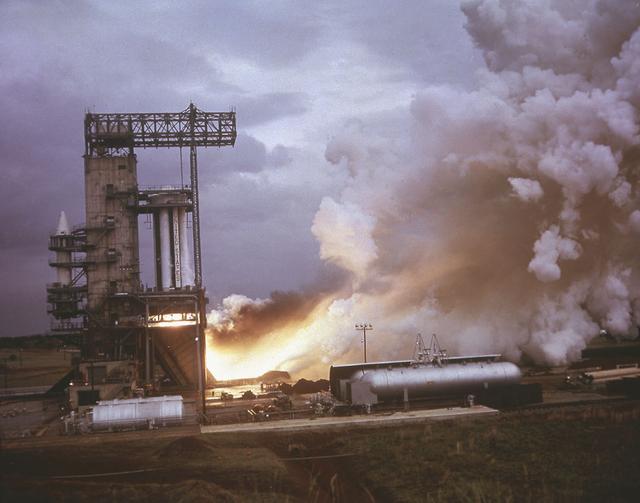
Marshall Space Flight Center (MSFC) was the birthplace of the United States' rocket program. In the early 1960s, most of the rocket development and testing were done at the MSFC. Pictured is an example of what the test engineers would have…

Dr. Robert H. Goddard and liquid oxygen-gasoline rocket in the frame from which it was fired on March 16, 1926, at Auburn, Mass. It flew for only 2.5 seconds, climbed 41 feet, and landed 184 feet away in a cabbage patch. From 1930 to 1941,…

Portrait of NASA Ames Engineer H. Julian 'Harvey' Allen explaining blunt nose principle.

Mercury astronaut John Glenn and his wife, Annie, pose during a luncheon Feb. 17, 2012, celebrating 50 years of Americans in orbit, an era which began with Glenn's Mercury mission MA-6, on Feb. 20, 1962. Glenn's launch aboard an Atlas rocke…

STS-95 Payload Specialist John H. Glenn Jr. (second from right), senator from Ohio, poses (left to right) with his son, David, daughter, Lyn, and (far right) his wife, Annie, after landing at Kennedy Space Center's Shuttle Landing Facility…

Astronaut John H. Glenn Jr. uses binoculars to view the Earth through the window of the Mercury-Atlas (MA-6) Friendship 7 capsule during the U.S.'s initial orbital flight.
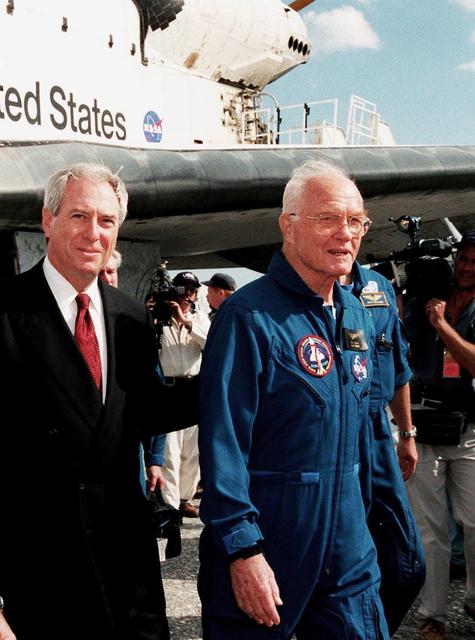
NASA Administrator Dan Goldin, left, walks with Sen. John Glenn (D-Ohio) on Nov. 7, 1998. Glenn had just returned to Earth following the STS-95 space shuttle mission. Glenn's initial trip into space on Feb. 20, 1962 aboard Mercury 6 made hi…

NASA Ames Center Director Harvey Allen (1965-1969) at the board.
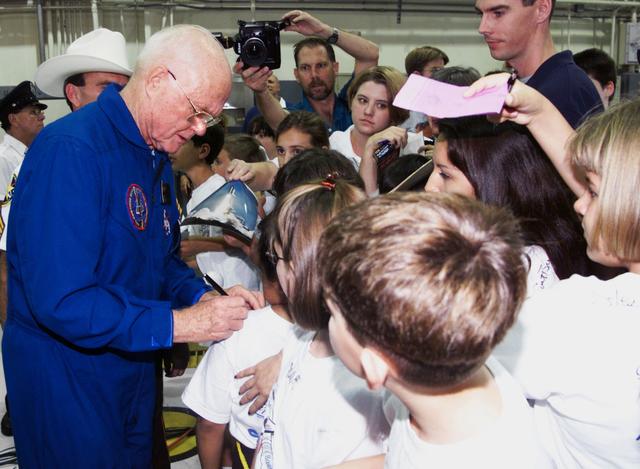
John Glenn signs autographs for school children following his STS-95 flight aboard the space shuttle Discovery.

STS-95 Payload Specialist John H. Glenn Jr., senator from Ohio, gives a thumbs up on his arrival at Kennedy Space Center's Shuttle Landing Facility aboard a T-38 jet. He and other crewmembers will be making final preparations for launch, ta…

Alignment of the H-1 engine performed in the Army Ballistic Missile Agency (ABMA ), building 4708, in February 1960. A cluster of eight H-1 engines were used to thrust the first stage of the Saturn I launch vehicle. The H-1 engine was devel…
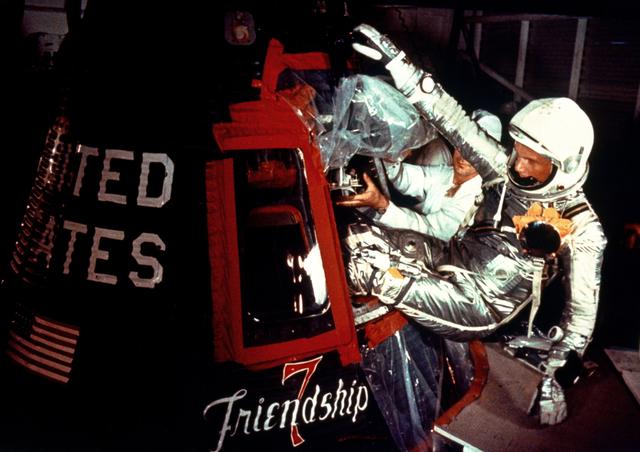
Project Mercury astronaut John H. Glenn Jr., enters the Friendship 7 spacecraft during the last part of the countdown on Feb. 20, 1962. At 9:47 a.m. EST, the Atlas launch vehicle lifted the spacecraft into orbit for a three-orbit mission la…

Astronaut John Glenn Jr. is honored by President John F. Kennedy after Glenn's historical first manned orbital flight, Mercury-Atlas 6. The ceremony was held in front of Hangar S at Cape Canaveral Air Force Station. To Glenn's left are his…

H-1 Engine major components with callouts (chart 1): The H-1 engine was used in a cluster of eight on the the first stage of Saturn I (S-I stage) and Saturn IB (S-IB stage). The engines were arranged in a double pattern: four engines, locat…

February 1962 -- Astronaut John H. Glenn Jr., Mercury-Atlas 6 pilot.

The Bell Huey 2 (left) and Airbus H135 helicopters used for security operations at NASA’s Kennedy Space Center in Florida perform one flight together on Oct. 27, 2020, before the Hueys are retired from their service. The Airbus H135s are re…

On Oct. 27, 2020, in front of the iconic Vehicle Assembly Building at NASA’s Kennedy Space Center, the Bell Huey 2 (left) and Airbus H135 helicopters used for security operations at the Florida spaceport perform one flight together before t…

A cluster of eight H-1 engines were used to thrust the first stage of Saturn I (S-I stage) and Saturn IB (S-IB stage). The engines were arranged in a double pattern. Four engines, located inboard, were fixed in a square pattern around the s…

A Cluster of eight H-1 engines were used to thrust the first stage of Saturn I (S-I stage) and Saturn IB (S-IB stage). The engines were arranged in a double pattern. Four engines, located inboard, were fixed in a square pattern around the s…

Harvey Allen at his retirement party held in the Ames Hangar N-211.

President Barack Obama presents former United States Marine Corps pilot, astronaut and United States Senator John Glenn with a Medal of Freedom, Tuesday, May 29, 2012, during a ceremony at the White House in Washington.

1998 -- John H. Glenn Jr. is a former American astronaut, Marine Corps fighter pilot, and United States Senator. He was the third American to fly in space and the first American to orbit the Earth. This photo for his second space flight on…

The space shuttle Discovery lifts off Launch Pad 39B to begin a nine-day mission in Earth-orbit. Launch was at 2:19 p.m. EST, Oct. 29, 1998. Onboard were Curtis L. Brown Jr., Steven W. Lindsey, Scott F. Parazynski, Steven K. Robinson, Pedro…

Portrait: Ames Director H Julian Allen (1965 - 1969)

Harvey Allen, Chief of the High-Speed Research Division at NASA Ames Research Center, in his home.

1961 -- The first three Americans in space, Mercury astronauts, from the left, John H. Glenn Jr., Virgil I. (Gus) Grissom and Alan B. Shepard Jr. standing by Redstone rocket in their spacesuits.

Oct. 1998 -- STS-95 payload specialist John Glenn removes the Advanced Organic Separation (ADSEP) cartridges and moves them to the Spacehab module.

Oil Portrait: H. Julian Allen, Ames Director from 1965 thru 1969

Portrait: Ames Director H Julian Allen (1965 - 1969)

In the white room at the Kenndy Space Center's Launch Pad 39B, STS-95 Payload Specialist John H. Glenn Jr., senator from Ohio, is prepared by closeout room crew members Danny Wyatt (left to right), Carlous Gillis, Jim Kelly and Travis Thomp…

On Oct. 27, 2020, in front of the iconic Vehicle Assembly Building at NASA’s Kennedy Space Center, the Bell Huey 2 (left) and Airbus H135 helicopters used for security operations at the Florida spaceport perform one flight together before t…

On Oct. 27, 2020, in front of the iconic Vehicle Assembly Building at NASA’s Kennedy Space Center, the Bell Huey 2 (left) and Airbus H135 helicopters used for security operations at the Florida spaceport perform one flight together before t…

On Oct. 27, 2020, in front of the iconic Vehicle Assembly Building at NASA’s Kennedy Space Center, the Bell Huey 2 (left) and Airbus H135 helicopters used for security operations at the Florida spaceport perform one flight together before t…

Dr. Goddard's 1926 rocket configuration. Dr. Goddard's liquid oxygen-gasoline rocket was fired on March 16, 1926, at Auburn, Massachusetts. It flew for only 2.5 seconds, climbed 41 feet, and landed 184 feet away in a cabbage patch. From 193…