S65-45683 (21-29 Aug. 1965) --- Astronaut Charles Conrad Jr. inside the Gemini-5 spacecraft as it orbited Earth. Astronaut L. Gordon Cooper Jr. took this photograph.
Astronaut Charles Conrad - Gemini-5 Spacecraft - Post-Launch
S65-45697 (21-29 Aug. 1965) --- The western coastline of Baja, California and Cedros Island is photographed from the Gemini-5 spacecraft in orbit over Earth.
GEMINI-TITAN (GT)-5 - EARTH-SKY - (70mm HASSELBLAD)
S65-45763 (21-29 Aug. 1965) --- View of the lower tip of Baja, California and Bahia de la Paz taken from the Gemini-5 spacecraft in orbit over Earth.
GEMINI-V - EARTH-SKY VIEW - BAJA, CA - OUTER SPACE
S65-45748 (21-29 Aug. 1965) --- Looking northeast, the Imperial Valley and Salton Sea in southern California is photographed from the Earth-orbiting Gemini-5 spacecraft. This picture was taken with a modified 70mm Hasselblad camera, using M…
GEMINI-TITAN (GT)-5 - EARTH-SKY - (70mm HASSELBLAD)
STS005-45-1821 (11-16 Nov. 1982) --- Astronaut William B. Lenoir, STS-5 mission specialist, takes a break to eat his meal on the space shuttle Columbia. Wet trash stowage bags float freely around him and a fire extinguisher hangs on the wal…
Mission specialist Lenoir takes break to eat his meal
S65-28710 (17 Aug. 1965) --- Astronaut L. Gordon Cooper Jr., command pilot for the Gemini-5 spaceflight, has his blood pressure checked by Dr. Charles A. Berry, chief, Center Medical Programs, Manned Spacecraft Center, during a preflight ph…
Astronaut Gordon Cooper receives preflight medical exam for Gemini 5 flight
S65-48759 (21 Aug. 1965) --- View of astronaut Charles Conrad Jr. through the window as he sits in the Gemini-5 spacecraft during preflight activities.
View of Astronaut Charles Conrad Jr. in Gemini 5 spacecraft
S65-19585 (21 May 1965) --- Astronaut James A. McDivitt, command pilot for the Gemini-Titan 4 prime crew, participates in a weight and balance test during a wet mock simulation exercise at Cape Kennedy, Florida. The two-man Gemini-4 mission…
Astronaut Edward White being weighed and balanced in spacecraft seat
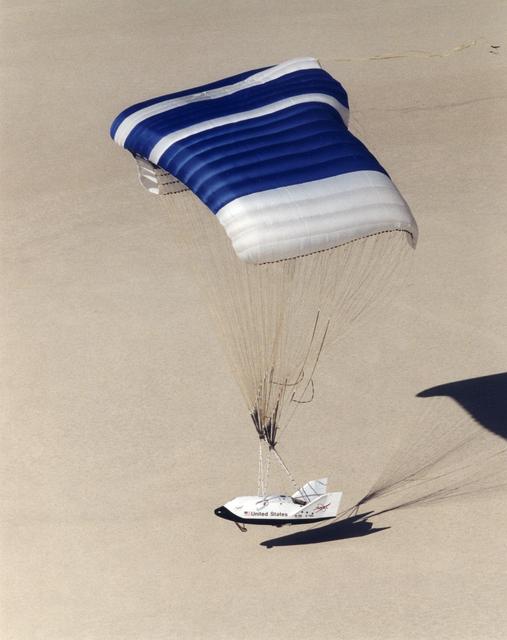
The X-38 Crew Return Vehicle descends under its steerable parafoil over the California desert in its first free flight at the Dryden Flight Research Center, Edwards, California. The flight took place March 12, 1998.
X-38 - First Free Flight, March 12, 1998
The X-38, a research vehicle built to help develop technology for an emergency Crew Return Vehicle from the International Space Station, is seen just before touchdown on a lakebed near the Dryden Flight Research Center, Edwards California,…
The X-38 Second Prototype Flares to a Landing over the Lakebed at the End of Its Fifth Flight at Edwards Air Force Base
NASA's X-38, a research vehicle developed as part of an effort to build an emergency Crew Return Vehicle (CRV) for the International Space Station, descends toward the desert floor under its steerable parafoil on its second free flight. The…
X-38 in Flight during Second Free Flight
A 1953 photo of some of the research aircraft at the NACA High-Speed Flight Research Station (now known as the the Dryden Flight Research Center). The photo shows the X-3 (center) and, clockwise from left: X-1A (Air Force serial number 48-1…
E-2889
The X-38, a research vehicle built to help develop technology for an emergency Crew Return Vehicle (CRV), descends under its steerable parafoil on a March 1999 test flight at the Dryden Flight Research Center, Edwards, California.
X-38 Vehicle #132 in Flight with Deployed Parafoil during First Free Flight
The X-38, a research vehicle built to help develop technology for an emergency Crew Return Vehicle (CRV), flares for its lakebed landing at the end of a March 1999 test flight at the Dryden Flight Research Center, Edwards, California.
X-38 Vehicle #132 Landing on First Free Flight
The X-38 technology demonstrator descends under its steerable parafoil toward a lakebed landing in a March 2000 test flight.
The X-38 Second Prototype Glides to a Landing over the Lakebed at the End of Its Fifth Flight at Edwards Air Force Base
The X-38, a research vehicle built to help develop technology for an emergency Crew Return Vehicle (CRV), maneuvers toward landing at the end of a March 1999 test flight at the Dryden Flight Research Center, Edwards, California.
X-38 Vehicle #132 in Flight Approaching Landing during First Free Flight
S65-45736 (21-29 Aug. 1965) --- Alexandria, Egypt is photographed from the Gemini-5 spacecraft in orbit over Earth.
EARTH SKY - GEMINI-TITAN (GT)-5 (70mm HASSELBLAD)
S65-45753 (21-29 Aug. 1965) --- Cape Kennedy, Florida is featured in this image photographed from the Gemini-5 spacecraft in orbit over Earth.
GEMINI-TITAN (GT)-5 - EARTH-SKY - (70mm HASSELBLAD)
S82-36286 (15 Aug. 1982) --- These four men will be aboard the space shuttle Columbia for NASA's first operational Space Transportation System (STS) mission. They are astronauts Vance D. Brand (second left), STS-5 commander; Robert F. Overm…
OFFICIAL PORTRAIT - STS-5 MISSION CREW - JSC
S65-45731 (21-29 Aug. 1965) --- View of the Gulf of Tonkin, China and the Luichow Peninsula photographed from the Gemini-5 spacecraft in orbit over Earth.
GEMINI-TITAN (GT)-5 - EARTH SKY (70MM HASSELBLAD)
S68-19459 (22 Jan. 1968) --- The Apollo 5 (LM-1/Saturn 204) unmanned space mission was launched from the Kennedy Space Center's Launch Complex 37 at 5:48:09 p.m. (EST), Jan. 22, 1968. The Lunar Module-1 payload was boosted into Earth orbit…
Apollo V - Liftoff - Cape
S65-50774 (21 Aug. 1965) --- The National Aeronautics and Space Administration launched the Gemini-5 spacecraft from Pad 19 at 9 a.m. (EST) Aug. 21, 1965, on a planned eight-day orbital mission. Astronaut L. Gordon Cooper Jr. was the comman…
Launch of the Gemini 5 spacecraft from Pad 19 at 9 a.m. Aug. 21, 1965.
STS005-38-943 (17 Nov. 1982) --- The Satellite Business Systems (SBS-3) satellte is deployed from its protective cradle in the cargo bay of the space shuttle Columbia. Part of Columbia's wings can be seen on both the port and starboard side…
Satellite deployment during STS-5
S65-42044 (28 July 1965) --- Close-up view of the Rendezvous Evaluation Pod installed in the equipment section of the Gemini-5 spacecraft at Pad 19.
Closeup view of Rendezvous Evaluation Pod
S68-18733 (22 Jan. 1968) --- Dr. Robert R. Gilruth (right), MSC Director, sits with Dr. Christopher C. Kraft Jr., MSC director of flight operations, at his flight operations director console in the Mission Control Center, Building 30, durin…
Dr. Gilruth and Dr. Kraft - Mission Control Center (MCC) - Apollo V Launch - MSC
Crew members surround the X-38 lifting body research vehicle after a successful test flight and landing in March 1998. The flight was the first free flight for the vehicle and took place at the Dryden Flight Research Center, Edwards, Califo…
X-38 - On Ground after First Free Flight, March 12, 1998
The X-38 technology demonstrator descends under its steerable parafoil toward a lakebed landing in a March 2000 test flight.
The X-38 Second Prototype Glides to a Landing over the Lakebed at the End of Its Fifth Flight at Edwards Air Force Base
The X-38 Crew Return Vehicle descends under its steerable parafoil over the California desert in its first free flight at the Dryden Flight Research Center, Edwards, California. The flight took place March 12, 1998.
X-38 - First Free Flight, March 12, 1998
The X-38, a research vehicle built to help develop technology for an emergency Crew Return Vehicle (CRV), descends under its steerable parafoil on a March 1999 test flight at the Dryden Flight Research Center, Edwards, California.
X-38 Vehicle #132 in Flight with Deployed Parafoil during First Free Flight
The X-38 Crew Return Vehicle descends under its steerable parafoil over the California desert during its first free flight in March 1998 at the Dryden Flight Research Center, Edwards, California.
X-38 - First Free Flight, March 12, 1998
The X-38, a research vehicle built to help develop technology for an emergency Crew Return Vehicle (CRV), descends under its steerable parachute during a July 1999 test flight at the Dryden Flight Research Center, Edwards, California. It wa…
X-38 Ship #2 in Free Flight
S65-45717 (21-29 Aug. 1965) --- View of the Himalayas and Northern India photographed from the Gemini-5 spacecraft in orbit over Earth.
EARTH-SKY - GEMINI-TITAN (GT)-5 (70mm Hasselblad)
S66-59530 (August 1965) --- This is the insignia of the Gemini-Titan 5 (GT-5) spaceflight. The Gemini-5 prime crew members are astronauts L. Gordon Cooper Jr., command pilot; and Charles Conrad Jr., pilot. The covered wagon symbolizes pione…
MISSION PATCH - GEMINI-5 SPACE FLIGHT - MSC
S65-46990 (16 Aug. 1965) --- Astronauts Charles Conrad Jr. (left), pilot, and L. Gordon Cooper Jr., command pilot, are the prime crew for the Gemini-Titan 5 mission.
Gemini-Titan (GT)- 5 - Prime Crew - Closeup - Cape
S65-45737 (22 Aug. 1965) --- Looking northeast, the Strait of Gibraltar, Morocco (foreground) and Spain (background) are photographed from the Gemini-5 spacecraft during its 14th revolution of Earth.
GEMINI-V - EARTH-SKY - STRAITS OF GIBRALTAR - OUTER SPACE
S65-45280 (21-29 Aug. 1965) --- Overall view of the Mission Control Center (MCC), Houston, Texas, during the Gemini-5 flight. Note the screen at the front of the MCC which is used to track the progress of the Gemini spacecraft.
Overall view of Mission Control Center, Houston, Tx during Gemini 5
S68-19460 (22 Jan. 1968) --- The Apollo 5 (LM-1/Saturn 204) unmanned space mission was launched from the Kennedy Space Center's Launch Complex 37 at 5:48:09 p.m. (EST), Jan. 22, 1968. The Lunar Module-1 payload was boosted into Earth orbit…
Apollo V - Liftoff - Cape
S68-18700 (22 Jan. 1968) --- Two prime crew members of the first manned Apollo space flight were present at Cape Kennedy for the launch of the Apollo V (LM-1/Saturn 204) unmanned space mission. On left is astronaut Walter M. Schirra Jr.; an…
Crew Members - First Manned Apollo Flight - Unmanned Mission Launch - Cape
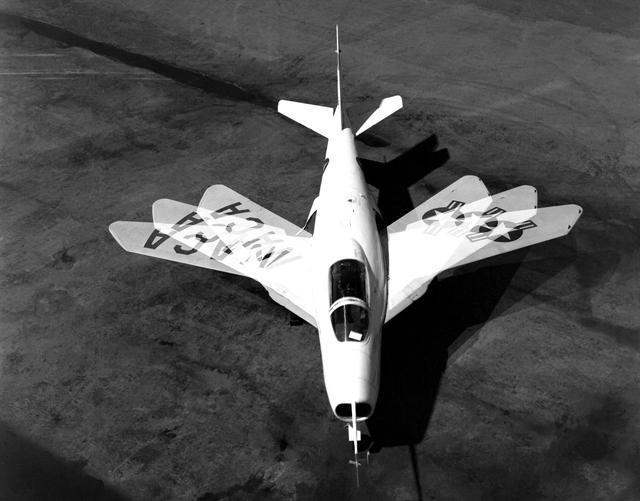
The Bell X-5 swings its wings in this multiple exposure photograph. Variable-sweep wing technology later appeared on the F-111, F-14 and B-1.
Bell X-5 Wings Sweep
S65-45610 (21 Aug. 1965) --- Astronaut Charles Conrad Jr. as seen through the Gemini-5 spacecraft window before launch.
Astronaut Charles Conrad as seen through Gemini 5 spacecraft window
The X-38 Crew Return Vehicle descends under its steerable parafoil over the California desert in its first free flight at the Dryden Flight Research Center, Edwards, California. The flight took place March 12, 1998.
X-38 - First Free Flight, March 12, 1998
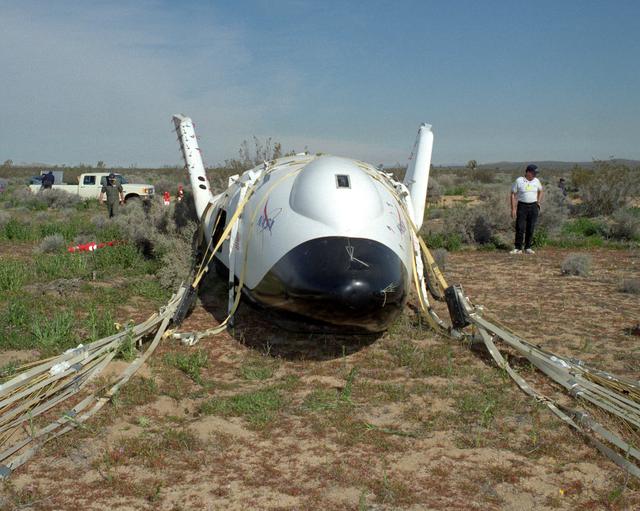
The X-38 Crew Return Vehicle touches down amidst the California desert scrubbrush at the end of its first free flight at the Dryden Flight Research Center, Edwards, California, in March 1998.
X-38 - Landing After First Free Flight, March 12, 1998
NASA's X-38, a research vehicle developed as part of an effort to build an emergency Crew Return Vehicle (CRV) for the International Space Station, descends toward the desert floor under its steerable parafoil on its second free flight. The…
X-38 in Flight during Second Free Flight
The X-38's blue and white parafoil spreads out in front of the research vehicle as it sits on a lakebed near the Dryden Flight Research Center after a March 2000 test flight.
A Ground Crewman Checks Over the X-38 Second Prototype Following the Lakebed Landing of Its Fifth Flight at Edwards Air Force Base
NASA's X-38, a research vehicle developed as part of an effort to build an emergency Crew Return Vehicle (CRV) for the International Space Station, descends toward a desert lakebed under its steerable parafoil on its second free flight. The…
X-38 in Flight during Second Free Flight
The X-38 Crew Return Vehicle descends under its steerable parafoil over the California desert in its first free flight at the Dryden Flight Research Center, Edwards, California. The flight took place March 12, 1998.
X-38 - First Free Flight, March 12, 1998
Dale Reed, a NASA engineer who worked on the original lifting-body research programs in the 1960s and 1970s, stands with a scale-model X-38 that was used in 1995 research flights, with a full-scale X-38 (80 percent of the size of a potentia…
Dale Reed with X-38 and a Subscale Model Used in Test Program