A hypothetical planet is depicted in this artist concept moving through the habitable zone and then further out into a long, cold winter.
Eccentric Habitable Zones Artist Concept
Artist's concept of a young, newly discovered planet, exposed to observation by a warped debris disk.  https://photojournal.jpl.nasa.gov/catalog/PIA26601
Young Exoplanet (Artist's Concept)
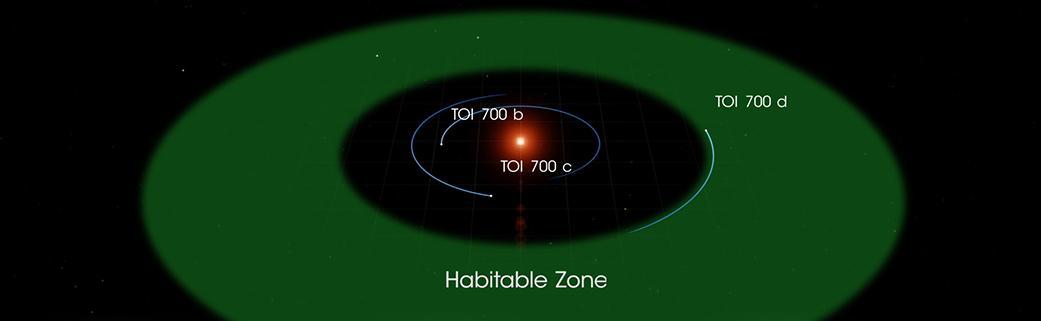
TOI 700, a planetary system 100 light-years away in the constellation Dorado, is home to TOI 700 d, the first Earth-size habitable-zone planet discovered by NASA's Transiting Exoplanet Survey Satellite.  https://photojournal.jpl.nasa.gov/ca…
TOI 700 Artists' Illustration
The super-Earth exoplanet 55 Cancri e, depicted with its star in this artist's concept, likely has an atmosphere thicker than Earth's, with ingredients that could be similar to those of Earth's atmosphere, according to a 2017 study using da…
55 Cancri e with Atmosphere (Artist's Concept)
This illustration shows the seven Earth-size planets of TRAPPIST-1, an exoplanet system about 40 light-years away, based on data current as of February 2018. The image shows the planets' relative sizes but does not represent their orbits to…
Illustration of TRAPPIST-1 Planets as of Feb. 2018
All seven planets discovered in orbit around the red dwarf star TRAPPIST-1 could easily fit inside the orbit of Mercury, the innermost planet of our solar system. In fact, they would have room to spare. TRAPPIST-1 also is only a fraction of…
TRAPPIST-1 Compared to Jovian Moons and Inner Solar System - Updated Feb. 2018
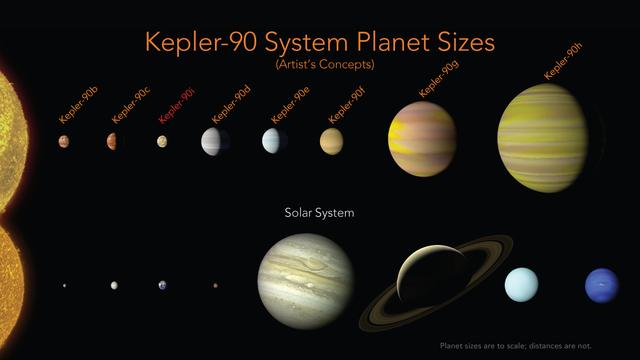
Our solar system now is tied for most number of planets around a single star, with the recent discovery of an eighth planet circling Kepler-90, a Sun-like star 2,545 light years from Earth. The planet was discovered in data from NASA's Kepl…
Kepler-90 system (Artist's Concept)
The shipping container with NASA's Transiting Exoplanet Survey Satellite (TESS) inside, is moved into the Payload Hazardous Servicing Facility (PHSF) at the agency's Kennedy Space Center in Florida. Inside the PHSF, the satellite will be pr…
TESS Spacecraft Arrival
This image shows the curvature of the Earth from 130,000 feet. It was taken remotely by a camera on EXCITE. The red blob at the top of the frame is the parachute.
GSFC2024EXCITEsViewSpace0001
The Kepler space telescope is done with its work collecting astounding science data showing there are more planets than stars in our galaxy. Here’s a round-up of what Kepler has achieved.
Kepler By the Numbers, Mission Stats
NASA social media specialist Kindra Thomas shares questions submitted from social media during a media briefing where astrophysics experts discussed the upcoming launch of NASA’s next planet hunter, the Transiting Exoplanet Survey Satellite…
Transiting Exoplanet Survey Satellite (TESS) Briefing
Sara Seager, TESS deputy director of science, MIT discusses the upcoming launch of NASA’s next planet hunter, the Transiting Exoplanet Survey Satellite (TESS), Wednesday, March 28, 2018 at NASA Headquarters in Washington. Photo Credit: (NAS…
Transiting Exoplanet Survey Satellite (TESS) Briefing
George Ricker, TESS principal investigator, MIT Kavli Institute for Astrophysics and Space Research, left, and Jeff Volosin, TESS project manager, NASA’s Goddard Space Flight Center, discuss the upcoming launch of NASA’s next planet hunter,…
Transiting Exoplanet Survey Satellite (TESS) Briefing
NASA Astrophysics Division director Paul Hertz is seen during a media briefing where he and other astrophysics experts are discussing the upcoming launch of NASA’s next planet hunter, the Transiting Exoplanet Survey Satellite (TESS), Wednes…
Transiting Exoplanet Survey Satellite (TESS) Briefing
NASA Public Affairs Officer Felicia Chou moderates a media briefing where astrophysics experts discuss the upcoming launch of NASA’s next planet hunter, the Transiting Exoplanet Survey Satellite (TESS), Wednesday, March 28, 2018 at NASA Hea…
Transiting Exoplanet Survey Satellite (TESS) Briefing
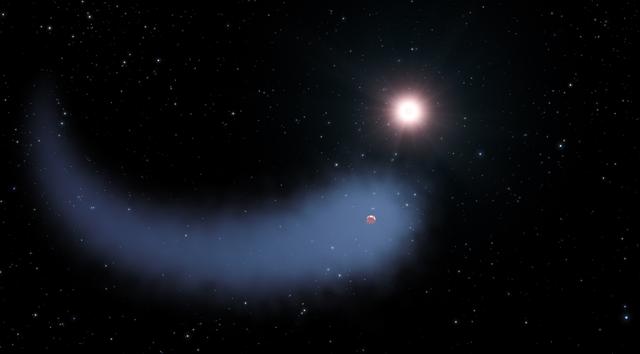
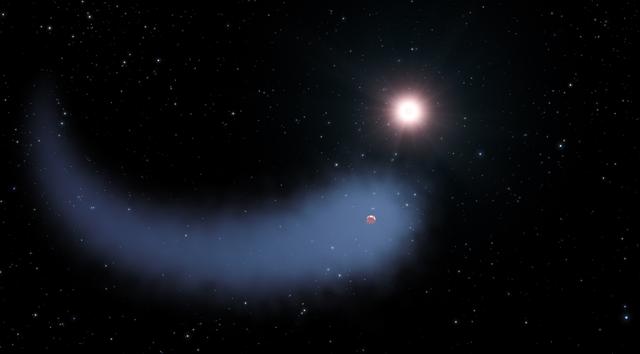
Astronomers using NASA’s Hubble Space Telescope have discovered an immense cloud of hydrogen dubbed “The Behemoth” bleeding from a planet orbiting a nearby star. The enormous, comet-like feature is about 50 times the size of the parent star…
Hubble Sees a “Behemoth” Bleeding Atmosphere Around a Warm Exoplanet
A comparison of Earth and Kepler-1649c, an exoplanet only 1.06 times Earth's radius Credit: NASA/Ames Research Center/Daniel Rutter
ACD20-0044-003
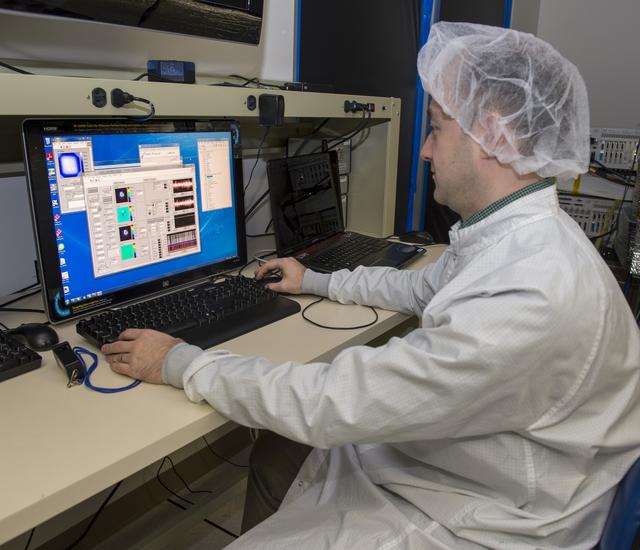
PIAA mirrors made by Tinsley and are inside the enclosure. with Ruslan Belikov
ACD13-0018-003
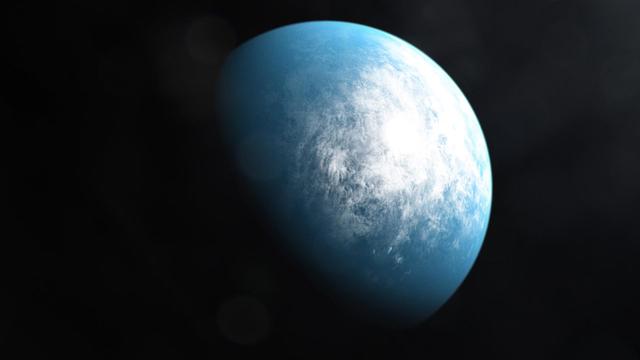
This illustration of TOI 700 d is based on several simulated environments for an ocean-covered version of the planet.  https://photojournal.jpl.nasa.gov/catalog/PIA23407
TOI 700 Habitable Zone Diagram
Caption: Glowing a dark magenta, the newly discovered exoplanet GJ 504b weighs in with about four times Jupiter's mass, making it the lowest-mass planet ever directly imaged around a star like the sun.  Credit: NASA/Goddard/S. Wiessinger  U…
Astronomers Image Lowest-mass Exoplanet Around a Sun-like Star
This graph presents known properties of the seven TRAPPIST-1 exoplanets (labeled b through h), showing how they stack up to the inner rocky worlds in our own solar system.  The horizontal axis shows the level of illumination that each plane…
Comparing TRAPPIST-1 to the Solar System
Our solar system now is tied for most number of planets around a single star, with the recent discovery of an eighth planet circling Kepler-90, a Sun-like star 2,545 light years from Earth. The planet was discovered in data from NASA's Kepl…
Kepler-90 System Compared to Our Solar System (Artist's Concept)
This artist concept shows K2-138, the first multi-planet system discovered by citizen scientists. The central star is slightly smaller and cooler than our Sun. The five known planets are all between the size of Earth and Neptune. Planet b m…
Kepler K2-138 System (Artist's Concept)
NASA's Transiting Exoplanet Survey Satellite (TESS), inside its shipping container, is moved into Payload Hazardous Servicing Facility (PHSF) at the agency's Kennedy Space Center in Florida. Inside the PHSF, the satellite will be processed…
TESS Spacecraft Arrival
NASA's Transiting Exoplanet Survey Satellite (TESS), inside its shipping container, is backed in on flatbed truck to the Payload Hazardous Servicing Facility (PHSF) at the agency's Kennedy Space Center in Florida. Inside the PHSF, the satel…
TESS Spacecraft Arrival
NASA's Transiting Exoplanet Survey Satellite (TESS) container is pressure washed at the Multi-Payload Processing Facility at the agency's Kennedy Space Center in Florida. Tess will be moved to the Payload Hazardous Servicing Facility to be…
TESS Spacecraft Arrival
The shipping container with NASA's Transiting Exoplanet Survey Satellite (TESS) inside, is moved into the Payload Hazardous Servicing Facility (PHSF) at the agency's Kennedy Space Center in Florida. Inside the PHSF, the satellite will be pr…
TESS Spacecraft Arrival
NASA Public Affairs Officer Felicia Chou moderates a media briefing where astrophysics experts discuss the upcoming launch of NASA’s next planet hunter, the Transiting Exoplanet Survey Satellite (TESS), Wednesday, March 28, 2018 at NASA Hea…
Transiting Exoplanet Survey Satellite (TESS) Briefing
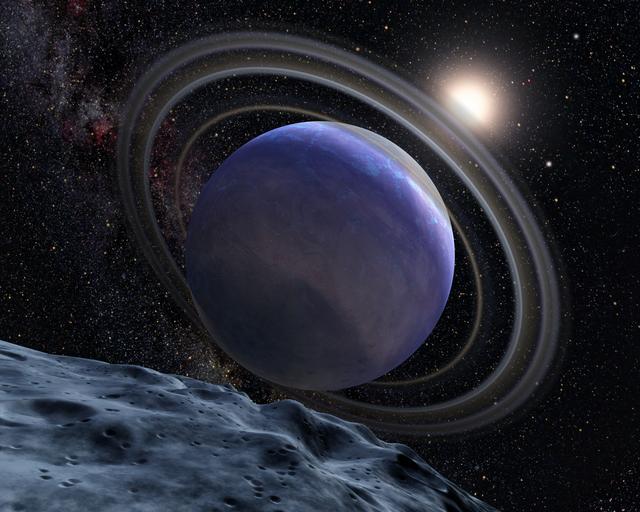
Release Date April 1, 2009  This is an artistic illustration of the giant planet HR 8799b.  The planet was first discovered in 2007 at the Gemini North observatory. It was identified in the NICMOS archival data in a follow-up search of NICM…
Artist's Concept of Exoplanet HR 8799b
After nine years in deep space collecting data that revealed our night sky to be filled with billions of hidden planets, more planets even than stars, NASA’s Kepler space telescope has run out of fuel needed for further science operations.…
A New View of Our Starry Night
NASA Goddard astrophysicist Kyle Helson looks at EXCITE (EXoplanet Climate Infrared TElescope) as it dangles from the ceiling of a hangar at NASA’s Columbia Scientific Balloon Facility in Fort Sumner, New Mexico.
GSFC2024excite01
Astronomers using NASA’s Hubble Space Telescope have discovered an immense cloud of hydrogen dubbed “The Behemoth” bleeding from a planet orbiting a nearby star. The enormous, comet-like feature is about 50 times the size of the parent star…
Hubble Sees a “Behemoth” Bleeding Atmosphere Around a Warm Exoplanet
A comparison of Earth and Kepler-1649c, an exoplanet only 1.06 times Earth's radius. Labeled Art Credit: NASA/Ames Research Center/Daniel Rutter
ACD20-0044-003_1
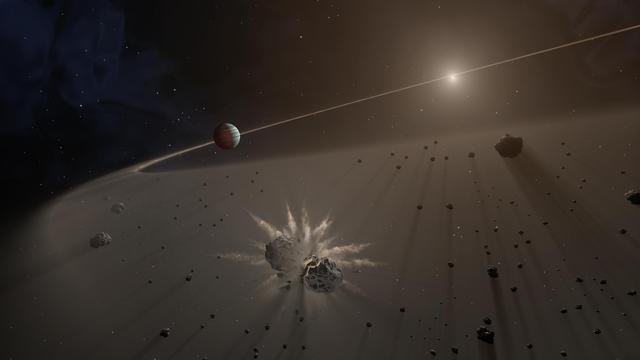
This artist's rendering shows a giant exoplanet causing small bodies to collide in a disk of dust.  A study in The Astronomical Journal finds that giant exoplanets with long-period orbits are more likely to be found around young stars that…
Giant Exoplanet and Debris Disk (Artist's Concept)
This artist's concept shows planet KELT-9b orbiting its host star, KELT-9. It is the hottest gas giant planet discovered so far.  With a dayside temperature of more than 7,800 degrees Fahrenheit (4,600 Kelvin), KELT-9b is a planet that is h…
Hottest Hot Jupiter Animation (Artist's Concept)
WASP-18b is an exoplanet located 325 light-years from Earth. The planet's mass is 10 times that of Jupiter, and it orbits its star once every 23 hours.  A 2017 study found that this planet has a stratosphere that's loaded with carbon dioxid…
WASP-18b (Artist's Concept)
This chart shows, on the top row, artist concepts of the seven planets of TRAPPIST-1 with their orbital periods, distances from their star, radii, masses, densities and surface gravity as compared to those of Earth. These numbers are curren…
TRAPPIST-1 Planet Lineup - Updated Feb. 2018
This still from a video shows illustrations of the seven Earth-size planets of TRAPPIST-1, an exoplanet system about 40 light-years away, based on data current as of February 2018. Each planet is shown in sequence, starting with the innermo…
TRAPPIST-1 Planet Animations
This illustration shows a red dwarf star orbited by a hypothetical exoplanet. Red dwarfs tend to be magnetically active, displaying gigantic arcing prominences and a wealth of dark sunspots. Red dwarfs also erupt with intense flares that co…
Flaring Red Dwarf Star (Illustration)
This artist's concept shows what the TRAPPIST-1 planetary system may look like, based on available data about the planets' diameters, masses and distances from the host star, as of February 2018.  This image represents an updated version of…
TRAPPIST-1 Planet Lineup - Updated Feb. 2018
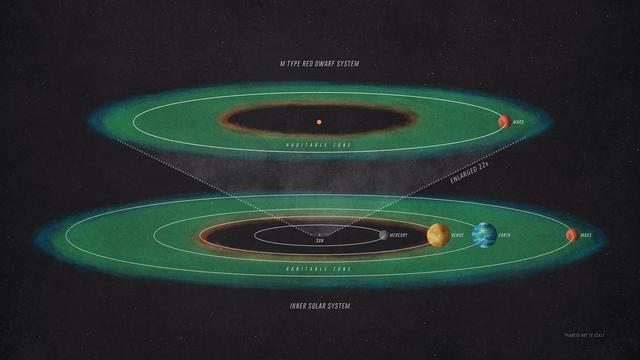
How habitable might an Exo-Mars be? It's a complex question but one that NASA's Mars Atmosphere and Volatile Evolution (MAVEN) mission can help answer.  To receive the same amount of starlight as Mars receives from our Sun, a planet orbitin…
How Habitable Might an Exo-Mars Be?
The shipping container with NASA's Transiting Exoplanet Survey Satellite (TESS) inside, is moved into the Payload Hazardous Servicing Facility (PHSF) at the agency's Kennedy Space Center in Florida. Inside the PHSF, the satellite will be pr…
TESS Spacecraft Arrival
“We like to say that Archean Earth is the most alien planet we have geochemical data for,”    For astronomers trying to understand which distant planets might have habitable conditions, the role of atmospheric haze has been hazy. To help so…
NASA Team Looks to Ancient Earth First to Study Hazy Exoplanets
George Ricker, TESS principal investigator, MIT Kavli Institute for Astrophysics and Space Research, is seen during a media briefing where he and other experts discuss the upcoming launch of NASA’s next planet hunter, the Transiting Exoplan…
Transiting Exoplanet Survey Satellite (TESS) Briefing
A model of the Transiting Exoplanet Survey Satellite (TESS) and a spare camera lens are seen during a media briefing, Wednesday, March 28, 2018 at NASA Headquarters in Washington. Photo Credit: (NASA/Bill Ingalls)
Transiting Exoplanet Survey Satellite (TESS) Briefing
Jeff Volosin, TESS project manager, NASA’s Goddard Space Flight Center, holds a spare camera lens and a model of the Transiting Exoplanet Survey Satellite (TESS) during a media briefing, Wednesday, March 28, 2018 at NASA Headquarters in Was…
Transiting Exoplanet Survey Satellite (TESS) Briefing
A model of the Transiting Exoplanet Survey Satellite (TESS) and a spare camera lens are seen during a media briefing, Wednesday, March 28, 2018 at NASA Headquarters in Washington. Photo Credit: (NASA/Bill Ingalls)
Transiting Exoplanet Survey Satellite (TESS) Briefing
It takes around an hour to fill a 39-million-cubic-foot scientific balloon with helium. The EXCITE telescope is poised for launch as the day breaks on August 31st, 2024.
GSCF2024excite03