Martha Williams, who leads the team inventing the Flexible Damage Detection System, stands in a laboratory with a prototype at NASA's Kennedy Space Center in Florida. The system uses circuits printed on thin thermal film and specialized sof…
Jamie Szafran, from left, Mark Lewis and Curtis Ihlefeld work with the prototype of the Flexible Damage Detection System in a laboratory with a prototype at NASA's Kennedy Space Center in Florida. The system uses circuits printed on thin th…
The prototype Flexible Damage Detection System stands in a laboratory at NASA's Kennedy Space Center in Florida. The system uses circuits printed on thin thermal film and specialized software. The system is designed to show where damage to…
In this photograph, the Pegasus, meteoroid detection satellite is installed in its specially modified Apollo service module atop the S-IV stage (second stage) of a Saturn I vehicle for the SA-9 mission at Cape Kennedy. Personnel in the serv…
Debbie Thomas (left) and Tukufu Zuberi of the PBS's series History Detectives during filming at a NASA Goddard Space Flight Center lab. PHOTO CREDIT: NASA/Debbie Mccallum
Debbie Thomas (right) and Tukufu Zuberi of the PBS's series History Detectives during filming at a NASA Goddard Space Flight Center lab. PHOTO CREDIT: NASA/Debbie Mccallum
Tukufu Zuberi of the History Detectives waits on the analysis of the film. Tthe History Detectives believed a piece of film was from the Echo II Project. PHOTO CREDIT: NASA/Debbie Mccallum
Marjorie Sovinski looking for the presence of chromium, which would help confirm that the exterior of the film had a chromium conversion coating. PHOTO CREDIT: NASA/Debbie Mccallum
Scaled Composites' Doug Shane examines the screen of his ground control station during tests in New Mexico. Shane used this configuration as the ground control station to remotely pilot the Proteus aircraft during a NASA sponsored series of…
Jamie Szafran, from left, Mark Lewis and Curtis Ihlefeld work with the prototype of the Flexible Damage Detection System in a laboratory with a prototype at NASA's Kennedy Space Center in Florida. The system uses circuits printed on thin th…
The complete prototype Flexible Damage Detection System stands in a laboratory at NASA's Kennedy Space Center in Florida. The system uses circuits printed on thin thermal film and specialized software. The system is designed to show where d…
The name of the instrument is X-Ray Photoelecton Spectrometer (acronymed XPS); the lab is in the Materials Engineering Branch and aptly titled the X-Ray Photoelectron Spectrometry Lab. XPS is a non-destructive surface analysis technique t…
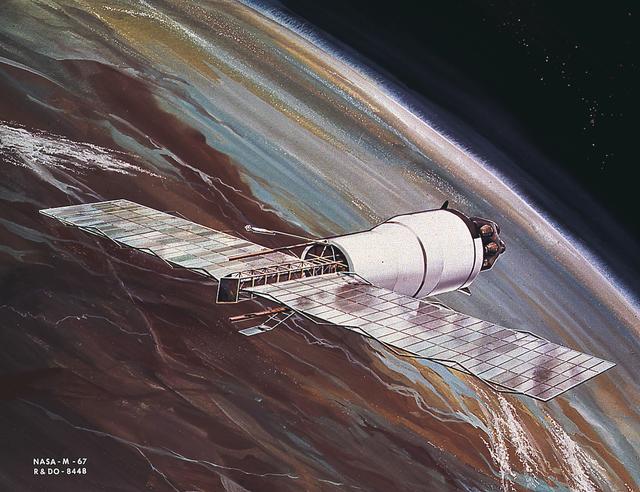
This image is an artist's conception of the Pegasus, meteoroid detection satellite, in orbit with meteoroid detector extended. The satellite, a payload for Saturn I SA-8, SA-9, and SA-10 missions, was used to obtain data on frequency and pe…
Fairchild technicians check out the extended Pegasus meteoroid detection surface. The Pegasus was developed by Fairchild Stratos Corporation, Hagerstown, Maryland, for NASA through the Marshall Space Flight Center. Three Pegasus satellites…
Debbie Thomas cutting the sample to be tested during a visit from the PBS's series History Detectives in NASA Goddard Space Flight Center lab. PHOTO CREDIT: NASA/Debbie Mccallum
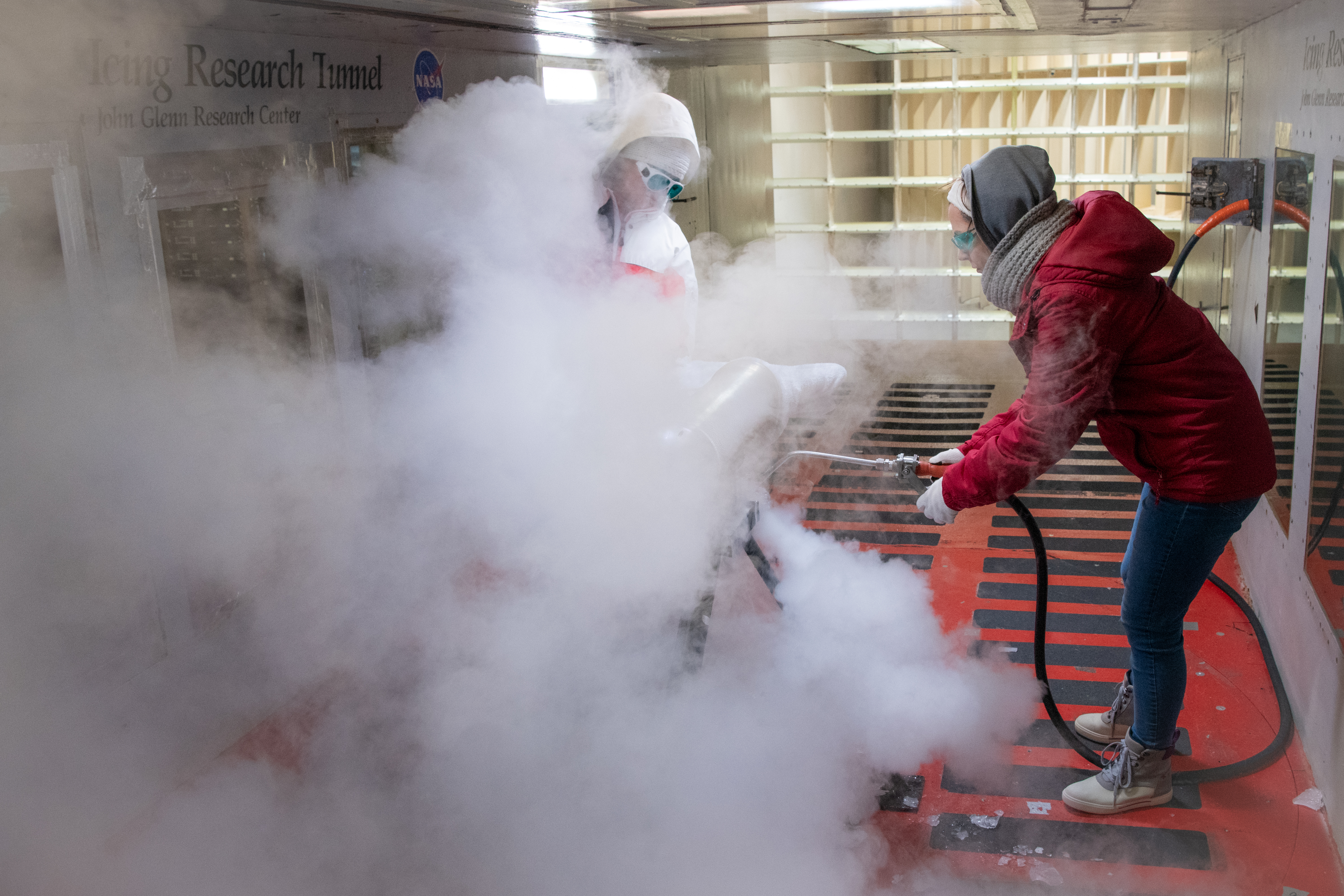
Test engineers clean the ice cloud detection probe in the Icing Research Tunnel in between test runs. Steam is used to melt the accumulated ice on the detection probe. The test engineers need to wear goggles to protect them from the laser…
Curtis Ihlefeld, left, and Mark Lewis work with the prototype of the Flexible Damage Detection System in a laboratory with a prototype at NASA's Kennedy Space Center in Florida. The system uses circuits printed on thin thermal film and spec…
Pegasus-1, meteoroid detection satellite, installed on Saturn I (SA-9 mission) S-IV stage, January 13, 1965. The satellite was used to obtain data on frequency and penetration of the potentially hazardous micrometeoroids in low Earth orbits…
The SA-9 (Saturn I Block II), the eighth Saturn I flight, lifted off on February 16, 1965. This was the first Saturn with an operational payload, the Pegasus I meteoroid detection satellite. SA-9 successfully deployed the Pegasus I, NASA's…
Marjorie Sovinski (left) and Tukufu Zuberi of the PBS's serieres History Detectives during filming at NASA Goddard Space Flight Center. PHOTO CREDIT: NASA/Debbie Mccallum
NASA software developer, Ethan Williams, left, pilot Scott Howe, and operations test consultant Jan Scofield run a flight path management software simulation at NASA’s Armstrong Flight Research Center in Edwards, California in May 2023. Thi…
Scaled Composites' Proteus aircraft and an F/A-18 Hornet from NASA's Dryden Flight Research Center during a low-level flyby at Las Cruces Airport in New Mexico.
A C-20 based at NASA’s Armstrong Flight Research Center in Edwards, California, departs to use its Uninhabited Aerial Vehicle Synthetic Aperture Radar to support the Marine Oil Spill Thickness mission. Thousands of gallons of oil seep throu…