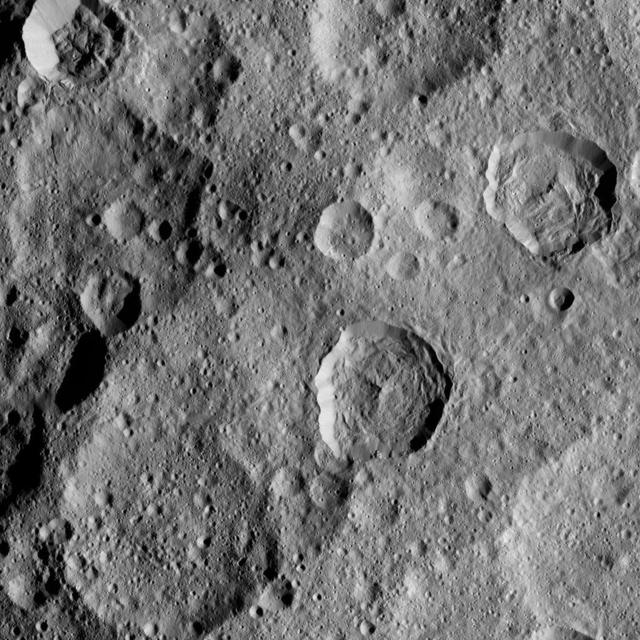
This image shows a portion of the northern hemisphere of Ceres, as seen by NASA's Dawn spacecraft. Cozobi Crater is the sharply defined impact feature at top left. At far right is Victa Crater. Abellio Crater is the sharply defined crater w…

This southern hemisphere scene from dwarf planet Ceres encompasses parts of the craters Mondamin and Darzamat. Mondamin, which is 78 miles (126 kilometers) wide, is the large crater located in the top half of the image. Darzamat, at 57 mile…
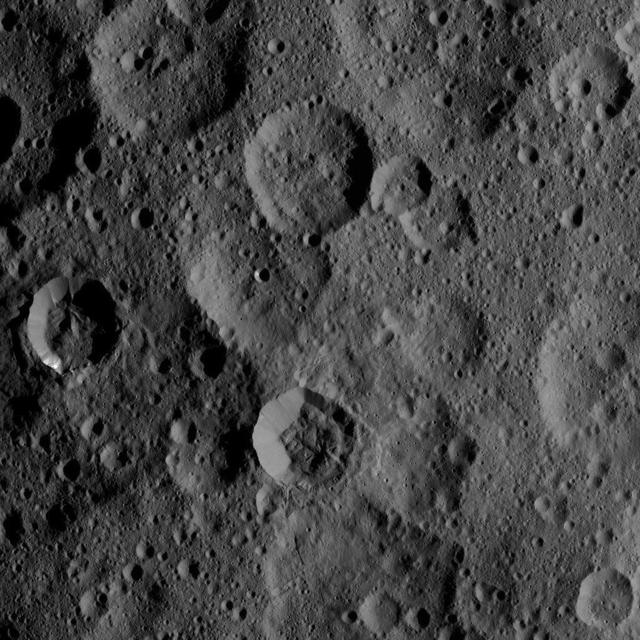
The craters Takel and Cozobi are featured in this image of Ceres from NASA's Dawn spacecraft. Takel is the young crater with bright material on the left of this image, and Cozobi is the sharply defined crater just below center. http://phot…
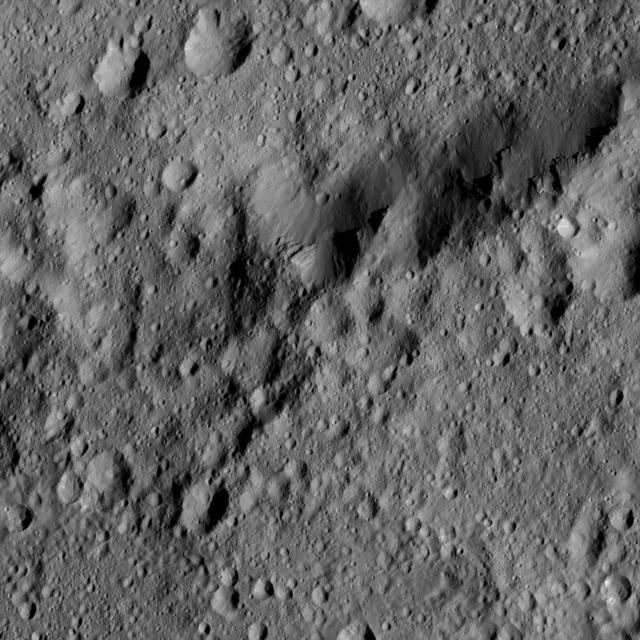
This image from NASA's Dawn spacecraft shows the edge of Ezinu Crater on Ceres. The image is centered at 36 degrees north latitude, 193 degrees east longitude. Dawn took this image on June 10, 2016, from its low-altitude mapping orbit, at…
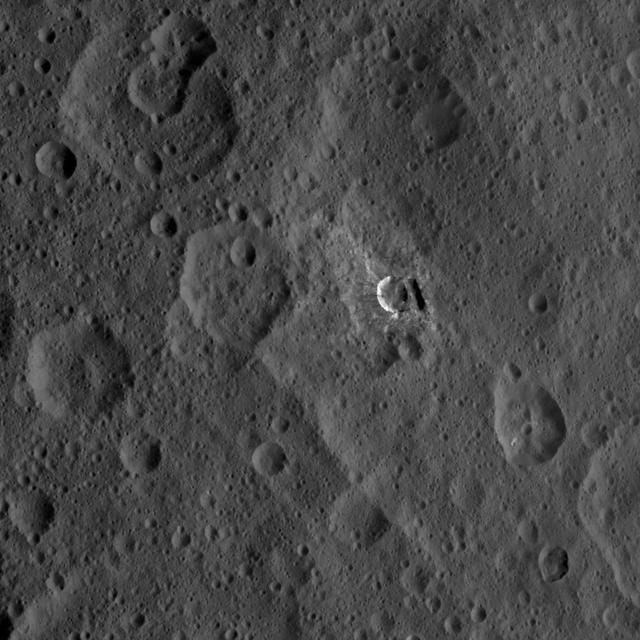
Oxo Crater and its surroundings are featured in this image of Ceres' surface from NASA's Dawn spacecraft. Dawn took this image on Oct. 18, 2016, from its second extended-mission science orbit (XMO2), at a distance of about 920 miles (1,480…
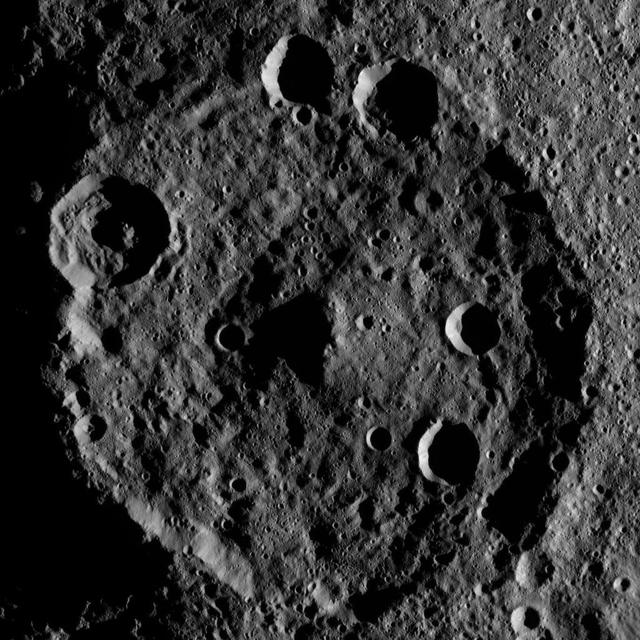
Zadeni Crater on Ceres is featured in this image from NASA's Dawn spacecraft. This large southern-hemisphere crater is 79.5 miles (128 kilometers) in diameter and is named for an ancient Georgian god of bountiful harvest. Dawn took this im…
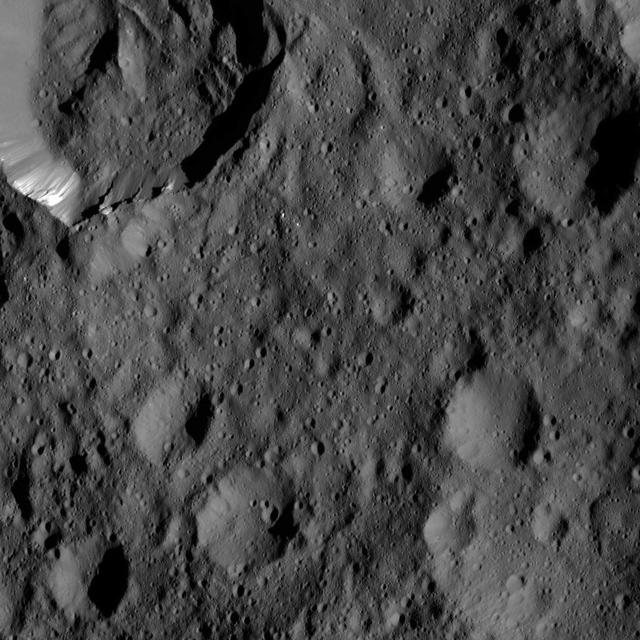
This view from NASA's Dawn spacecraft shows an older crater on Ceres that is smoothly blanketed by ejecta from the nearby, relatively young crater named Kupalo. The image is centered at 38 degrees south latitude, 178 degrees east longitude.…

This view from NASA's Dawn spacecraft shows part of the floor and eastern rim on Consus Crater (40 miles or 64 kilometers wide) on Ceres. Dawn took this image on May 29, 2016, from its low-altitude mapping orbit, at a distance of about 240…
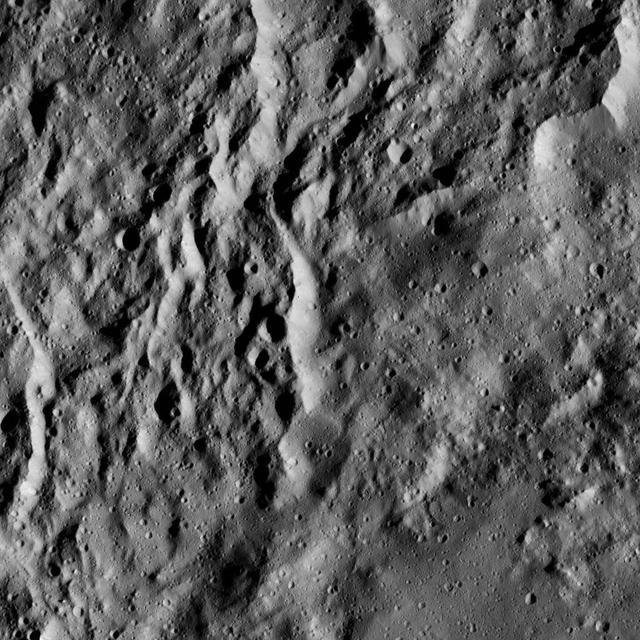
The interior of Urvara Crater (101 miles, 163 kilometers wide) is featured in this image from NASA's Dawn spacecraft. Dawn took this image on June 2, 2016, from its low-altitude mapping orbit, at a distance of about 240 miles (385 kilomete…
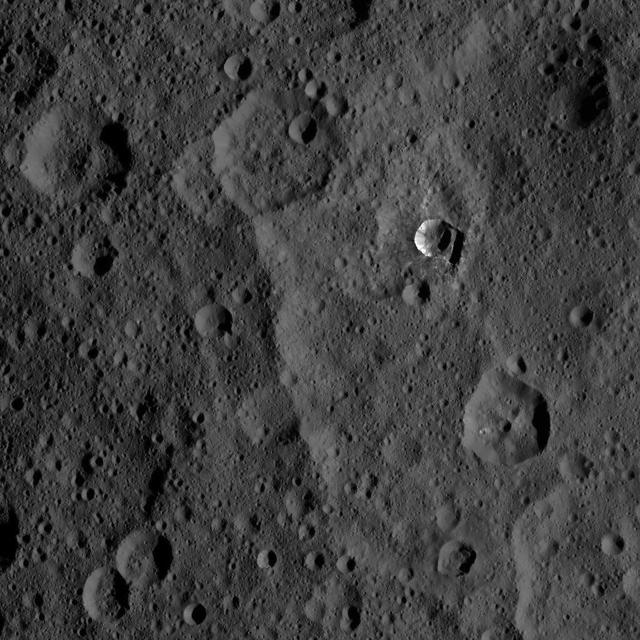
The 6-mile-wide (10-kilometer-wide) Oxo Crater stands out on the dark landscape of Ceres in this view from NASA's Dawn spacecraft. Oxo is one of several sites at which ice has been identified by Dawn's visible and infrared mapping spectrom…
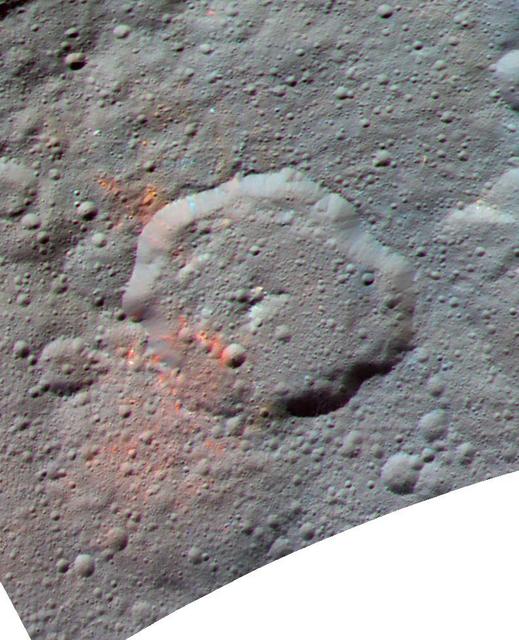
This enhanced color composite image, made with data from the framing camera aboard NASA's Dawn spacecraft, shows the area around Ernutet crater. The bright red portions appear redder with respect to the rest of Ceres. In a 2017 study in the…
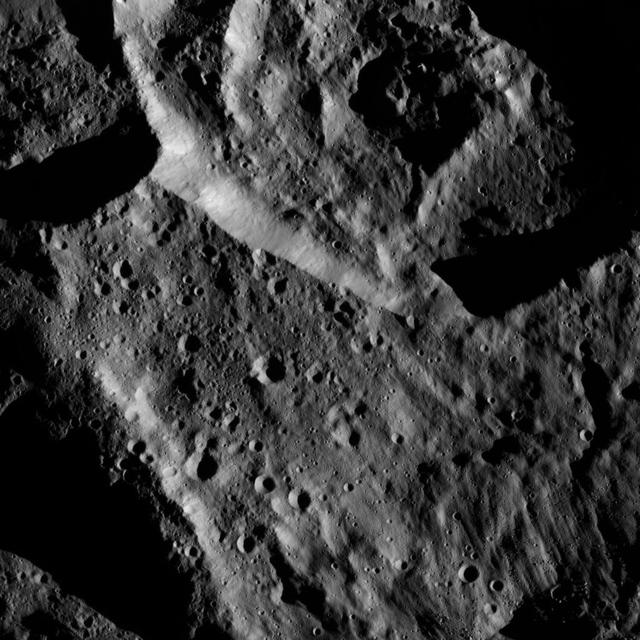
This image from NASA's Dawn spacecraft shows an area within the large crater Mondamin (78 miles, 126 kilometers wide) on Ceres. The image is centered at 67 degrees south latitude, 348 degrees east longitude. Dawn took this image on June 6,…
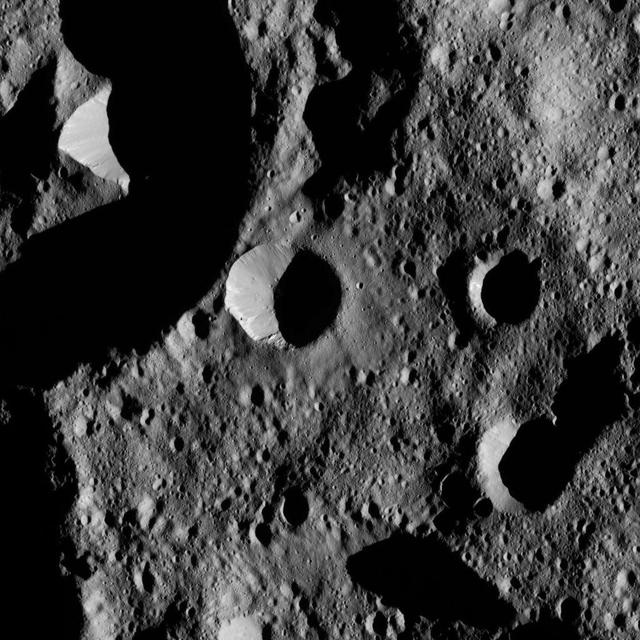
This view from NASA's Dawn spacecraft shows terrain in the northern hemisphere of Ceres, near Jarovit Crater. Dawn took this image on June 2, 2016, from its low-altitude mapping orbit, at a distance of about 240 miles (385 kilometers) abov…

Looking east to west across the rim and down into Chaplygin crater reveals this beautiful example of a fresh young crater and its perfectly preserved ejecta blanket. The delicate patterns of flow across, over, and down local topography clea…
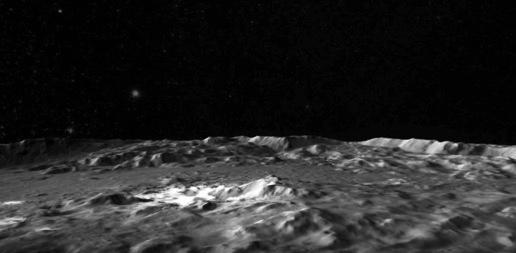
This frame from a video shows a flyover of the intriguing crater named Occator on dwarf planet Ceres. Occator is home to Ceres brightest area. Occator is home to Ceres' brightest area. It may have been produced by upwelling of salt-rich liq…
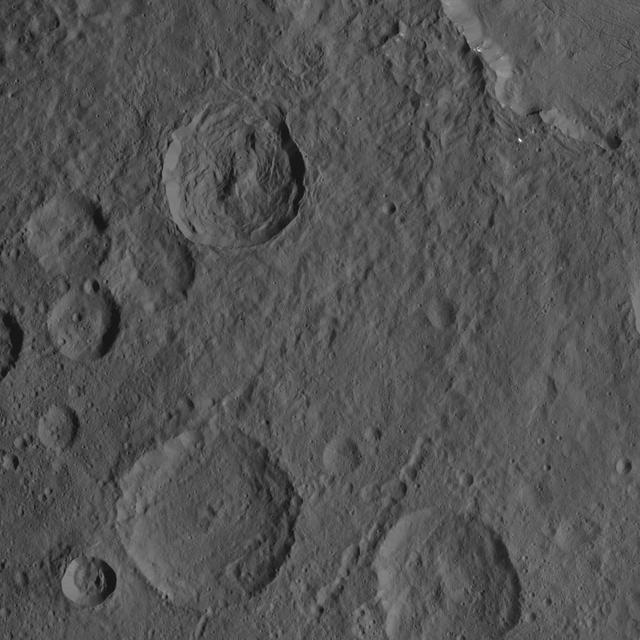
This scene captured by NASA Dawn spacecraft on Oct. 21, 2016, from Ceres northern hemisphere shows part of the rim of Dantu Crater, at top right. Rao Crater is the largest crater in the bottom left corner of the image. Dawn took this image…
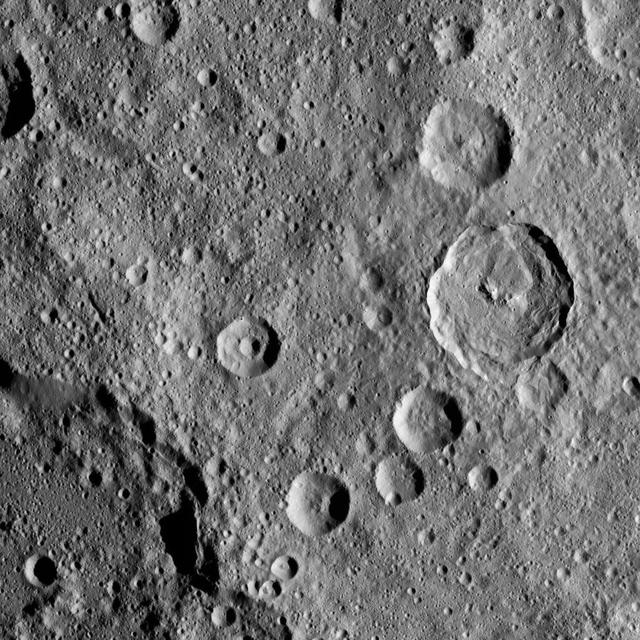
In this densely cratered area of Ceres, NASA's Dawn spacecraft spotted Tupo Crater, with its complex, hummocky interior, at center right. A portion of the rim of Darzamat Crater appears with dark shadows at lower left. Dawn took this image…
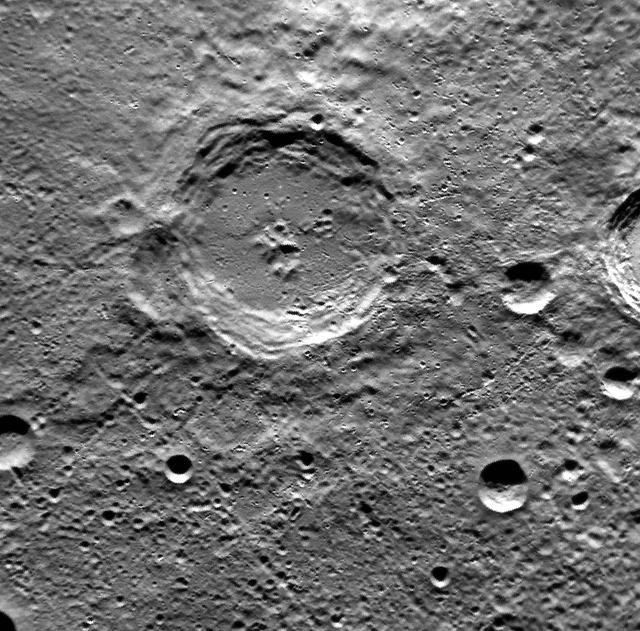
Release Date: December 21, 2011 The crater at the center of this image is named Dickens, after Charles Dickens, the English novelist who lived from 1812 to 1870. Among Dickens' famous works is A Christmas Carol, the story of Bob Cratchit,…

art002e012702 (April 6, 2026) – Poynting crater and Keeler crater are visible side by side in the lower right portion of this image of the Moon’s far side highlands. Poynting, positioned above, is a large impact crater with a well-defined r…

Ikapati Crater on Ceres is seen at top right in this image from NASA's Dawn spacecraft. Ikapati has a complex of central peaks and roughly parallel fractures on its floor. The crater, named for a Philippine goddess of cultivated lands, meas…
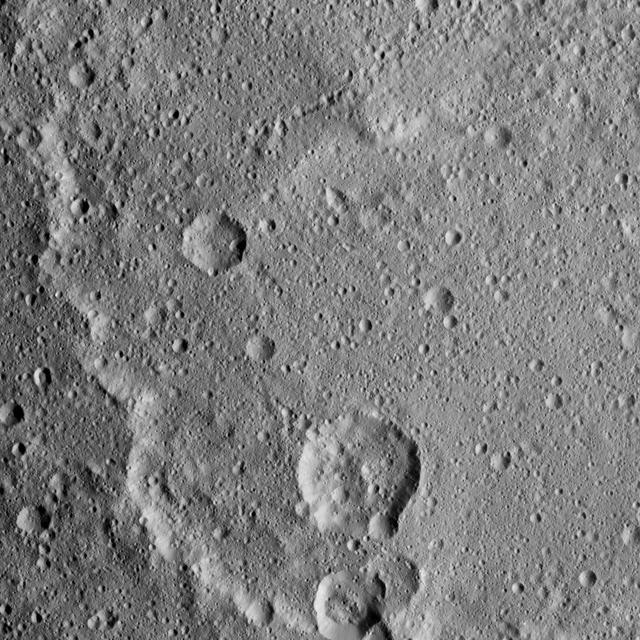
Kerwan Crater, at 174 miles (280 kilometers) in diameter is the largest crater that Dawn has discovered on Ceres. A portion of its jagged rim runs from the top left to bottom center of this image. Kerwan was named for the Hopi spirit of the…
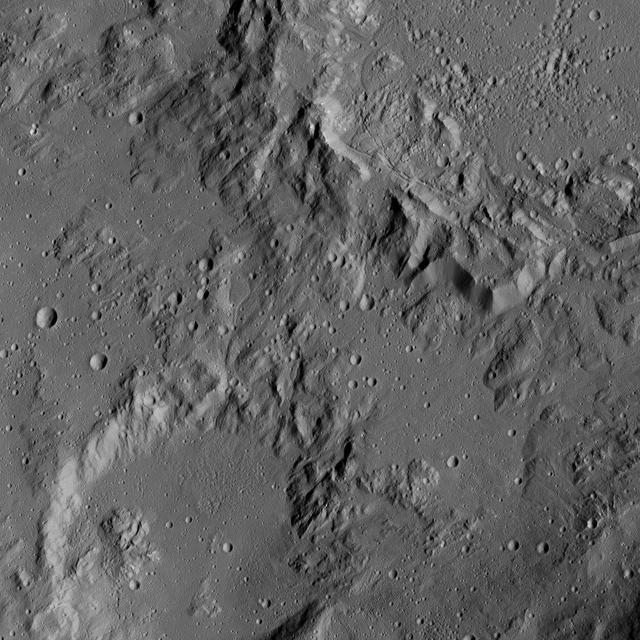
This image from NASA Dawn spacecraft shows the edge of Ikapati crater on Ceres, at upper right. Dawn took this image on June 12, 2016, from its low-altitude mapping orbit, at a distance of about 240 miles 385 kilometers above the surface.

This image from NASA's Dawn spacecraft shows Piuku Crater (19 miles, 31 kilometers wide), bottom, on Ceres. The image is centered at 14 degrees south latitude, 35 degrees east longitude. Dawn took this image on June 6, 2016, from its low-a…
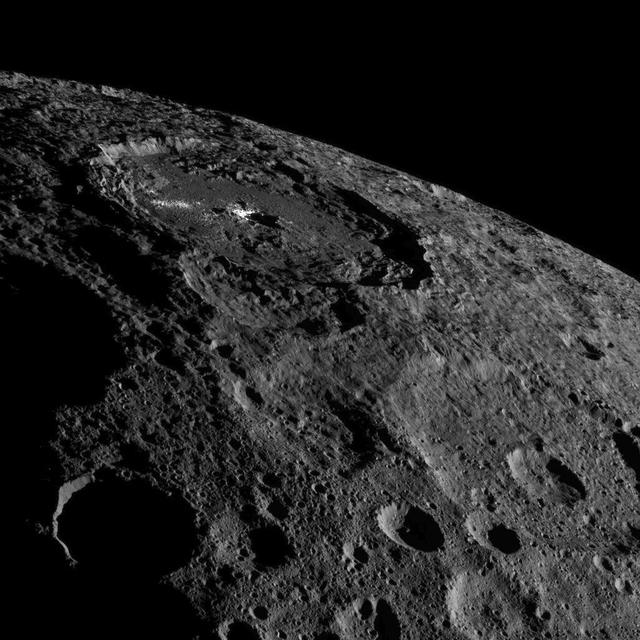
This image of the limb of dwarf planet Ceres shows a section of the northern hemisphere. Prominently featured is Occator Crater, home of Ceres' intriguing brightest areas. At 57 miles (92 kilometers) wide and 2.5 miles (4 kilometers) deep,…
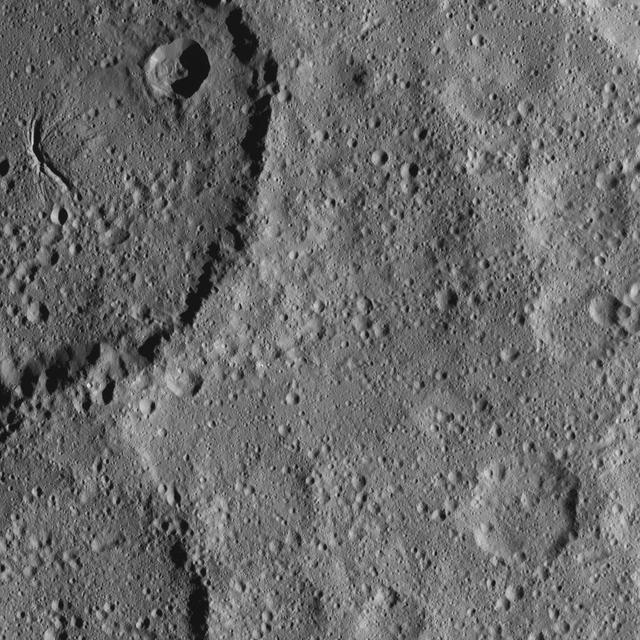
Part of Ezinu Crater on Ceres is seen at top left in this image from NASA's Dawn spacecraft. The crater features a network of canyon-like features. Ezinu measures about 72 miles (116 kilometers) in diameter and was named for the Sumerian go…

This view from NASA's Dawn spacecraft shows the center of Gaue Crater (52 miles or 84 kilometers wide) on Ceres. Dawn took this image on May 30, 2016, from its low-altitude mapping orbit, at a distance of about 240 miles (385 kilometers) a…
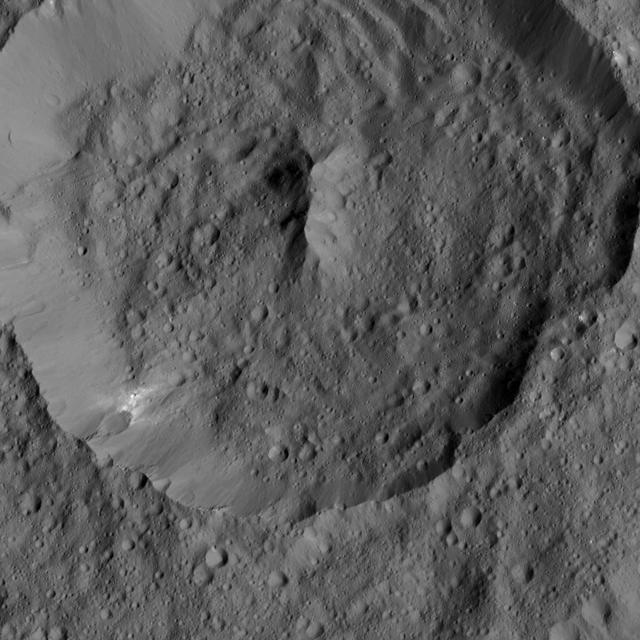
NASA's Dawn spacecraft spies Achita Crater on Ceres in this view. Achita is named for a Nigerian god of agriculture and is 25 miles (40 kilometers) wide. Dawn took this image on June 3, 2016, from its low-altitude mapping orbit, at a dista…
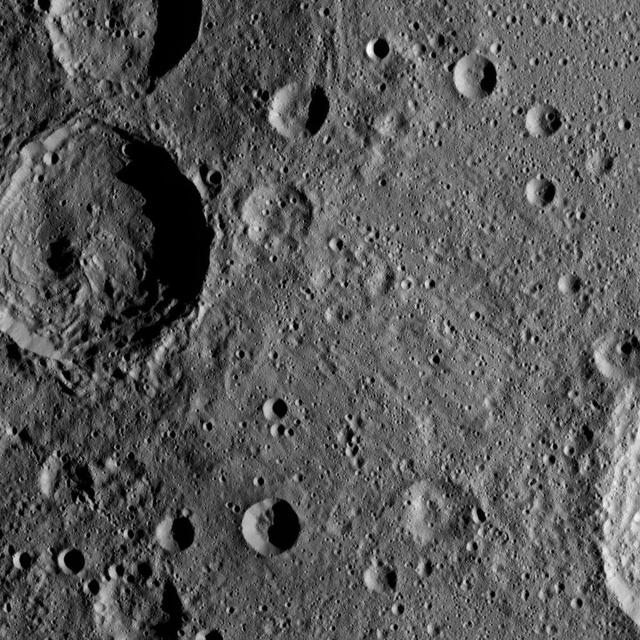
Sintana Crater is seen on the left side of this image of Ceres from NASA's Dawn spacercraft. The crater's central peak casts a shadow over its western flank. At lower right, the rim of Darzamat peeks into view. Dawn took this image on Oct…
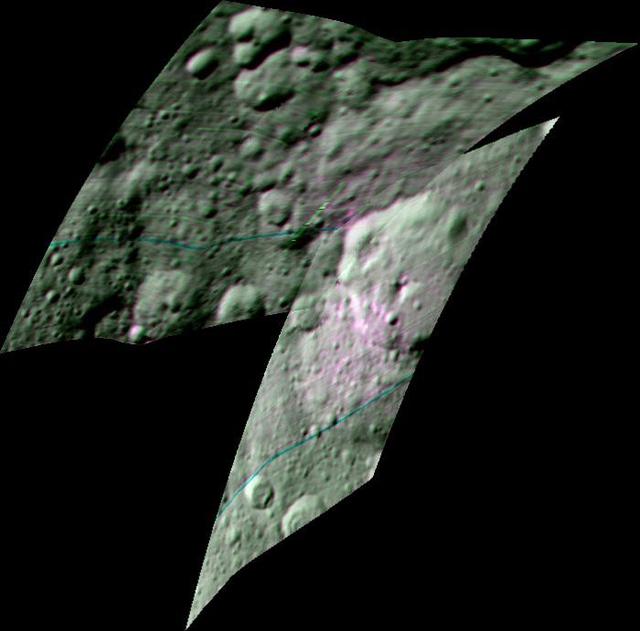
This enhanced color composite image from Dawn's visible and infrared mapping spectrometer shows the area around Ernutet Crater on Ceres. The instrument detected the evidence of organic materials in this area, as reported in a 2017 study in…

This view from NASA's Dawn spacecraft shows an area within the floor of the Mondamin impact basin, which lies in the southern hemisphere of Ceres. Mondamin Crater is about 78 miles (126 kilometers) in diameter. Dawn took this image on June…
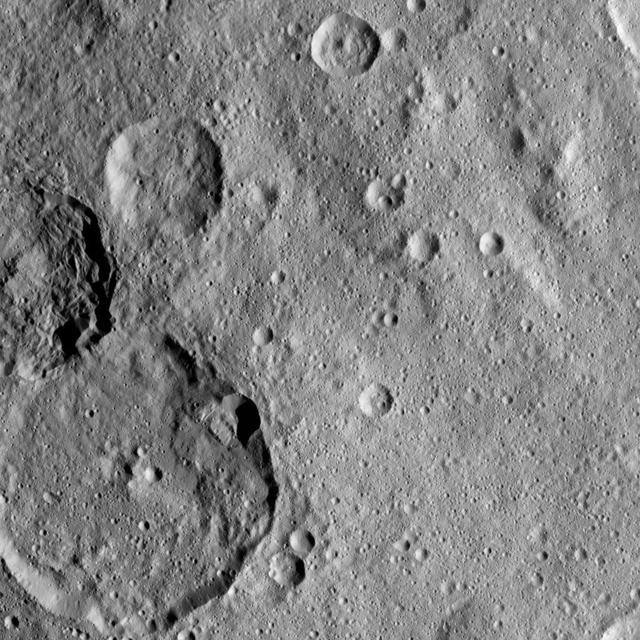
This view from NASA's Dawn spacecraft shows the craters Kondos and Jarimba on Ceres. Jarimba, at 43 miles (69 kilometers) in diameter, is the largest crater in this image, located at lower left. Above it, on the left-hand edge of the image…
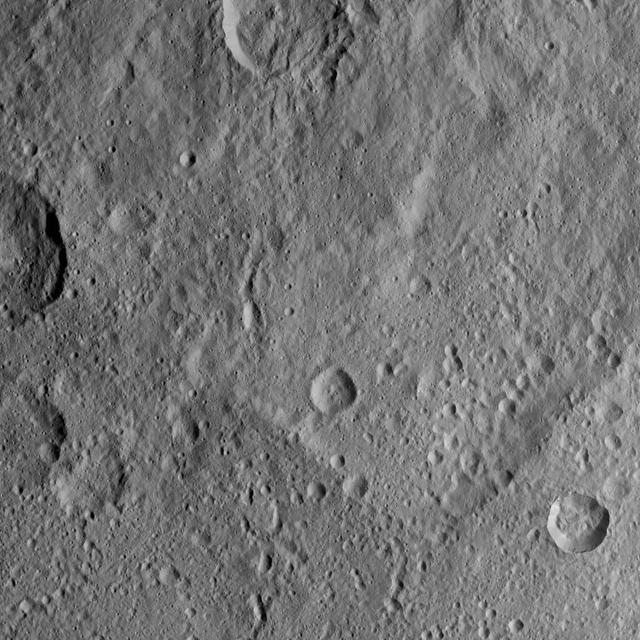
This scene from Ceres features terrain near the rim of the large crater named Kerwan, at lower left. At 174 miles (280 kilometers) in diameter, Kerwan is the largest crater that Dawn has discovered on Ceres. A much smaller, fresher crater…

art002e012028 (April 6, 2026) - The Artemis II crew captured a close-up snapshot of the near side of the Moon as NASA’s Orion spacecraft approached for the lunar flyby. The near side, characterized by the dark patches of ancient lava, is vi…
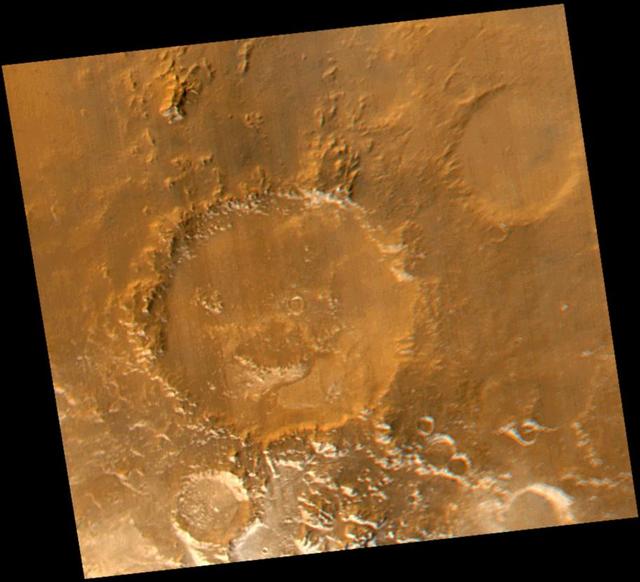
Smile! Spring has sprung in the martian southern hemisphere. With it comes the annual retreat of the winter polar frost cap. This view of "Happy Face Crater"--officially named "Galle Crater"--shows patches of white water ice frost in and ar…

Pictured are DAVINCI’s (left to right) Jim Garvin, mission principal investigator; Erika Kohler, acting deputy principal investigator; and Matthew Mullin, space laser engineer, evaluating flight data in real-time to adapt their future tests…
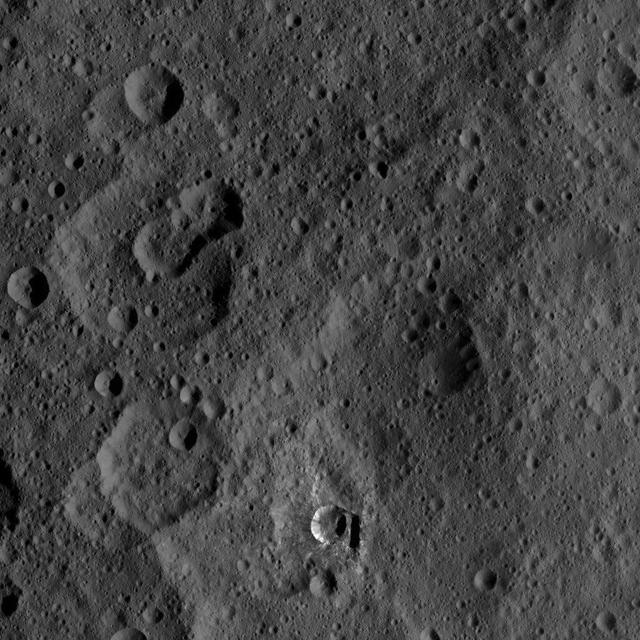
The small, bright crater Oxo on Ceres is featured in this image from NASA's Dawn spacecraft. Oxo (6 miles, 10 kilometers in diameter) is located at mid-latitudes on Ceres and likely has water ice. Dawn took this image on Oct. 17, 2016, fro…
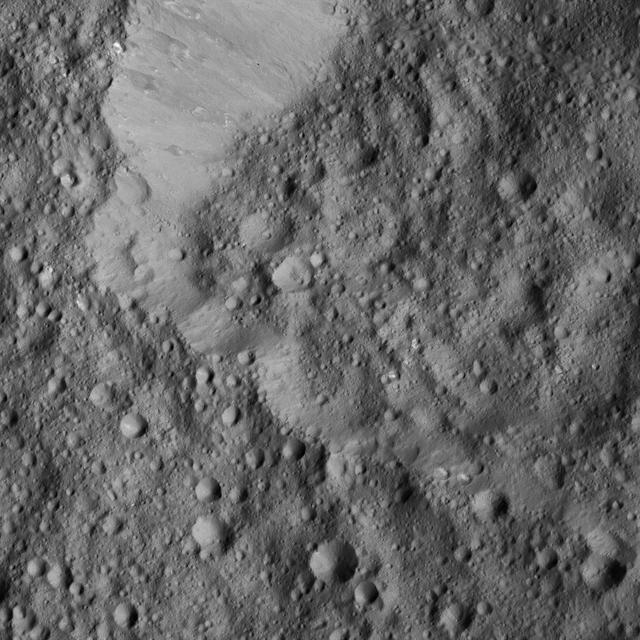
This view from NASA's Dawn spacecraft shows Rongo Crater, located near Ceres' equator. The image is centered at 0 degrees south latitude, 346 degrees east longitude. Dawn took this image on June 1, 2016, from its low-altitude mapping orbit…

Dr. Jim Garvin, mission principal investigator, left, and Dr. Erika Kohler, acting deputy principal investigator, right, take measurements of rock samples found at Crater Island, Utah on June 23, 2026. These samples become the "ground truth…
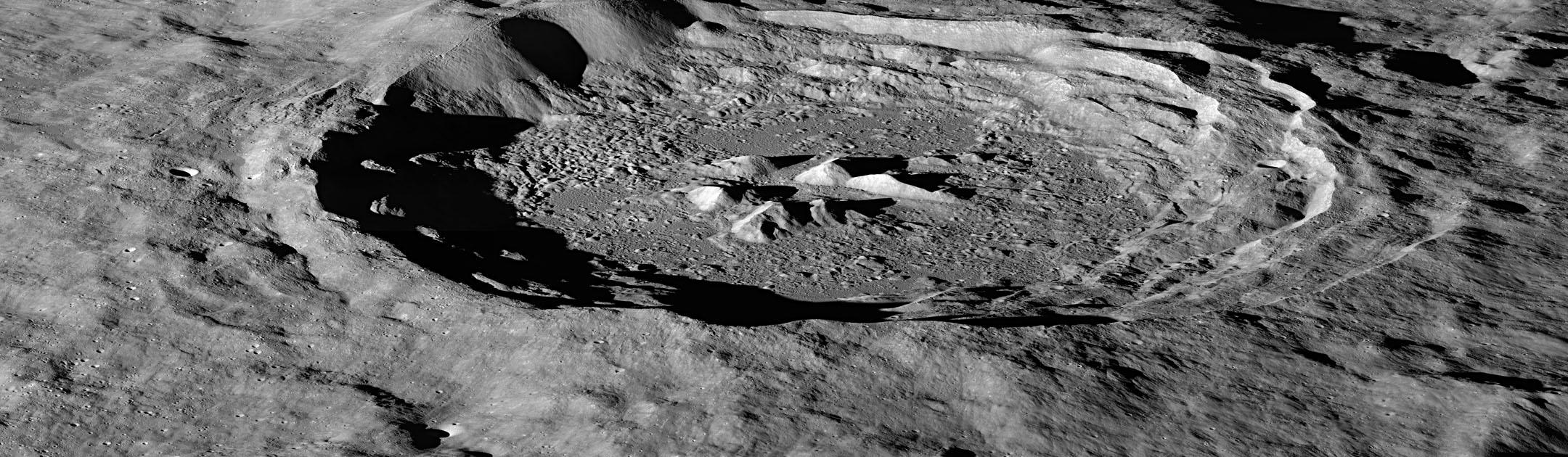
This image was captured by the Lunar Reconnaissance Orbiter Camera's (LROC) Narrow Angle Camera (NAC) aboard NASA's Lunar Reconnaissance Orbiter satellite. The moon's Hayn Crater, located just northeast of Mare Humboldtianum, is an exquisi…
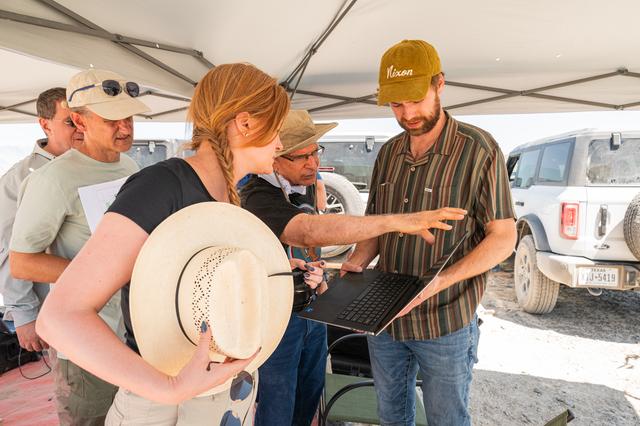
Pictured are DAVINCI’s (left to right) Mike Ravine, Brent Bos, Erika Kohler, Jim Garvin, and Christian Tate, evaluating flight data in real-time to adapt their future tests to the lessons learned from each flight. The researchers are standi…
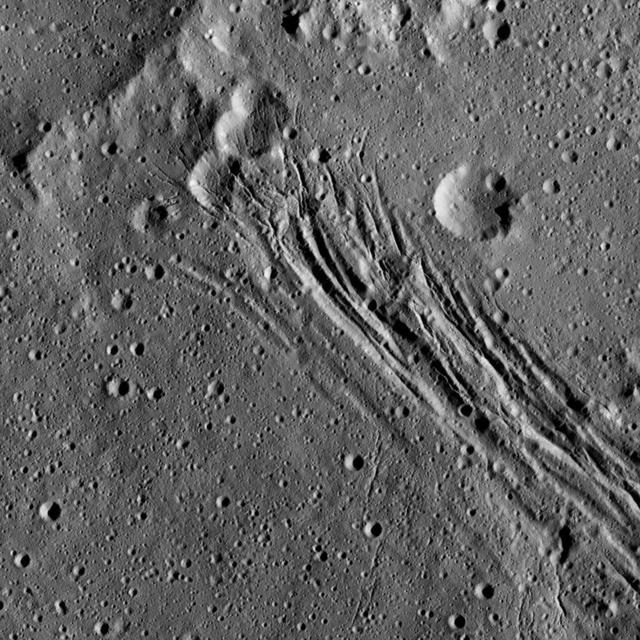
This image, taken by NASA's Dawn spacecraft, shows a series of linear features, which are depressions that located within the large Yalode Crater on Ceres. The widest of the linear features is approximately 0.9 miles (1.5 kilometers) in wid…
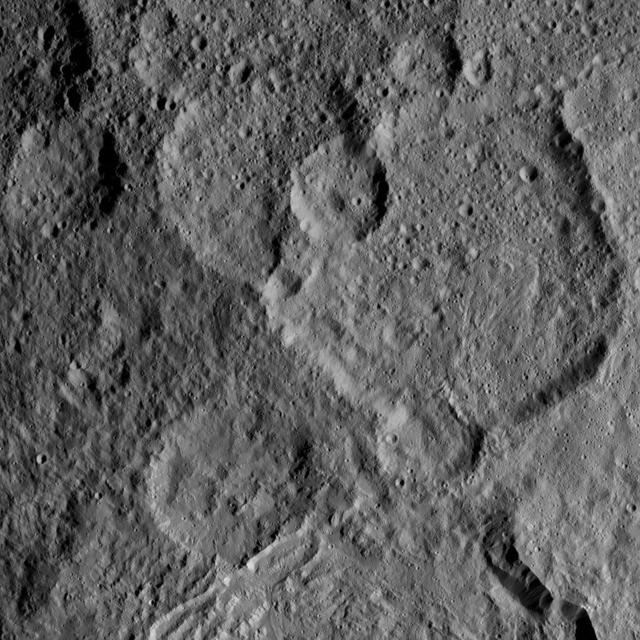
This view, taken on Oct. 21, 2016, from NASA Dawn spacecraft shows Megwomets Crater on Ceres. Megwomets is the largest crater in this image, at right of center. The crater is named for a Yurok god of acorns and distributor of vegetal abunda…

NASA's Dawn spacecraft captured this view on May 28, 2016, showing a relatively young crater with smooth walls and a sharp rim. The crater has a prominent central ridge, imprinted upon the rim of the larger Datan Crater, lying toward the lo…

Dantu Crater on Ceres, at top center, is featured in this image from NASA's Dawn spacecraft. Dantu, whose diameter is 77 miles (124 kilometers), has a central complex of mountain peaks. Small patches of bright material can be seen in some p…
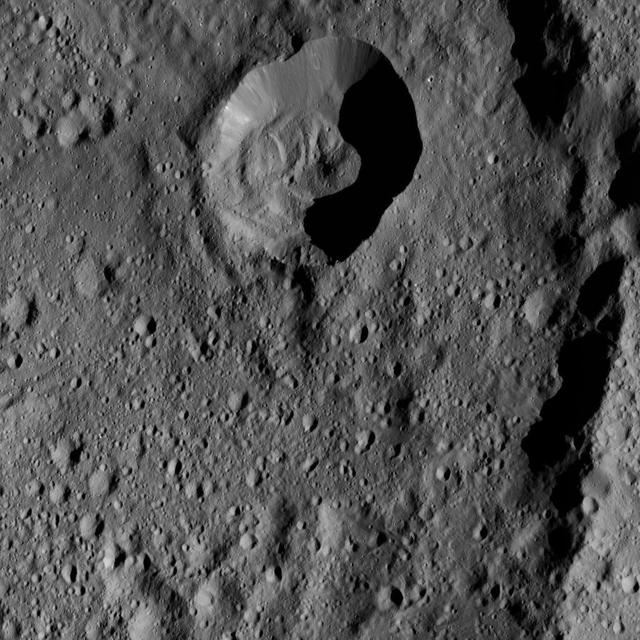
This view from NASA's Dawn spacecraft shows an area within Ezinu Crater on Ceres. Ezinu, which is 72 miles (116 kilometers) wide, was named for the Sumerian goddess of grain. Part of the crater's eastern rim is visible along the right side…
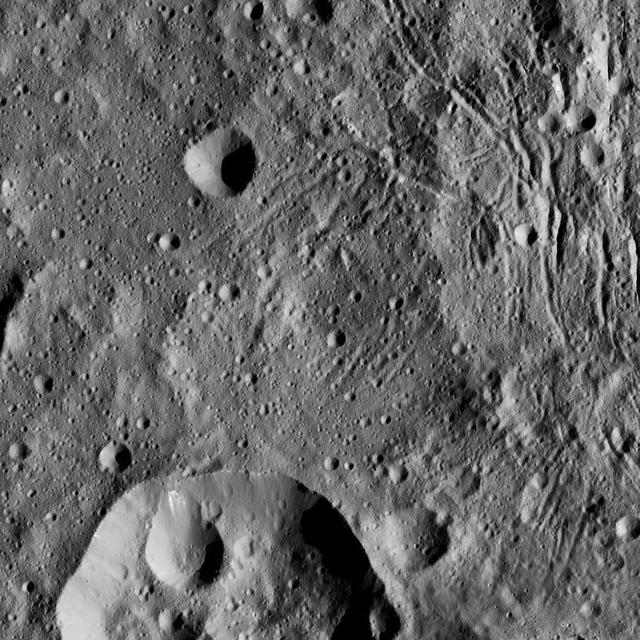
This image from NASA's Dawn spacecraft shows part of Lono Crater (at bottom) within the giant Yalode impact basin on Ceres. Lono is 12 miles (20 kilometers) wide, and Yalode is 160 miles (260 kilometers) in diameter. A video featuring Yalod…

DAVINCI VADIX team members discuss observations at Crater Island, Utah, June 23, 2026. NASA/Mike Guinto
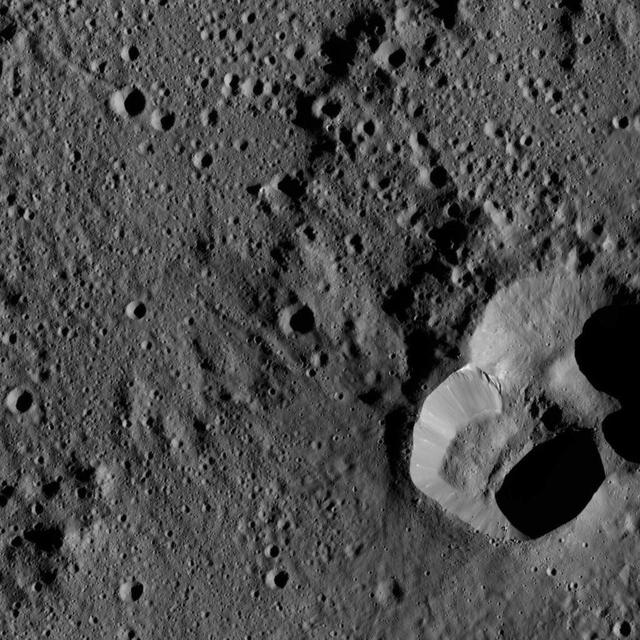
This view from NASA's Dawn spacecraft shows an area in the interior of Yalode Crater on Ceres. Yalode is one of the largest impact basins on Ceres, with a diameter of 160 miles (260 kilometers). Dawn took this image on June 3, 2016, from i…