
This graphic shows the computer simulation of a black hole from start to finish. Plasma is falling slowly toward the black hole in a (at the upper left). The plasma has a magnetic field, shown by the white lines. It picks up speed as it fal…

This artist's concept shows a black hole with an accretion disk -- a flat structure of material orbiting the black hole -- and a jet of hot gas, called plasma. Using NASA's NuSTAR space telescope and a fast camera called ULTRACAM on the Wi…

VANDENBERG AIR FORCE BASE, Calif. – In a clean room at Vandenberg Air Force Base in California, the Pegasus XL launch vehicle awaits a fillet and wing fit check. The Orbital Sciences Corp. Pegasus rocket will launch the Nuclear Spectroscopi…

SCI2017_0007: Artist illustration of the thick ring of dust that can obscure the energetic processes that occur near the supermassive black hole of an active galactic nuclei. The SOFIA studies suggest that the dust distribution is about 30…

VANDENBERG AIR FORCE BASE, Calif. – In a clean room at Vandenberg Air Force Base in California, technicians perform a fillet and wing fit check on the Pegasus XL launch vehicle. The Orbital Sciences Corp. Pegasus rocket will launch the Nucl…

The beautiful spiral galaxy visible in the center of the image is known as RX J1140.1+0307, a galaxy in the Virgo constellation imaged by the NASA/ESA Hubble Space Telescope, and it presents an interesting puzzle. At first glance, this gala…

VANDENBERG AIR FORCE BASE, Calif. – In a clean room at Vandenberg Air Force Base in California, technicians complete a second fillet and wing fit check on the Pegasus XL launch vehicle. The Orbital Sciences Corp. Pegasus rocket will launch…

The blue dots in this field of galaxies, known as the COSMOS field, show galaxies that contain supermassive black holes emitting high-energy X-rays. The black holes were detected by NASA's Nuclear Spectroscopic Array, or NuSTAR, which spott…

When two black holes collide, they release massive amounts of energy in the form of gravitational waves that last a fraction of a second and can be "heard" throughout the universe - if you have the right instruments. Today we le…

This Chandra X-Ray Observatory (CXO) image is a spectrum of a black hole, which is similar to the colorful spectrum of sunlight produced by a prism. The x-rays of interest are shown here recorded in bright stripes that run rightward and lef…

NASA image release May 20, 2011 <b>To see a really cool video related to this image go here: <a href="http://www.flickr.com/photos/gsfc/5740451675/in/photostream">www.flickr.com/photos/gsfc/5740451675/in/photostream</a></b> The giant elli…

NASA image release September 29, 2011 This image of the distant active galaxy Markarian 509 was taken in April 2007 with the Hubble Space Telescope's Wide Field Camera 2. To read more go to: <a href="http://www.nasa.gov/mission_pages/hub…

Simulation frames from this NASA Goddard neutron star merger animation: <a href="http://bit.ly/1jolBYY" rel="nofollow">bit.ly/1jolBYY</a> Credit: NASA's Goddard Space Flight Center This supercomputer simulation shows one of the most viole…

A SpaceX Falcon 9 rocket carrying NASA’s Pandora small satellite, the Star-Planet Activity Research CubeSat (SPARCS), and Black Hole Coded Aperture Telescope (BlackCAT) CubeSat lifts off from Space Launch Complex 4 East at Vandenberg Space…

This animation shows the events that serve as the basis of an astrophysics technique called "echo mapping," also known as reverberation mapping. At center is a supermassive black hole surrounded by a disk of material called an accretion dis…

Chandra X-Ray Observatory provided this composite X-ray (blue and green) and optical (red) image of the active galaxy NGC 1068 showing gas blowing away in a high-speed wind from the vicinity of a central supermassive black hole. Regions of…

VANDENBERG AIR FORCE BASE, Calif. – In a clean room at Vandenberg Air Force Base in California, technicians complete a second fillet and wing fit check on the Pegasus XL launch vehicle. The Orbital Sciences Corp. Pegasus rocket will launch…

VANDENBERG AIR FORCE BASE, Calif. – In a clean room at Vandenberg Air Force Base in California, technicians prepare to complete a second fillet and wing fit check on the Pegasus XL launch vehicle. The Orbital Sciences Corp. Pegasus rocket w…

VANDENBERG AIR FORCE BASE, Calif. – In a clean room at Vandenberg Air Force Base in California, technicians prepare to do a fillet and wing fit check on the Pegasus XL launch vehicle. The Orbital Sciences Corp. Pegasus rocket will launch th…

VANDENBERG AIR FORCE BASE, Calif. – In a clean room at Vandenberg Air Force Base in California, technicians complete a second fillet and wing fit check on the Pegasus XL launch vehicle. The Orbital Sciences Corp. Pegasus rocket will launch…

On June 15, NASA's Swift caught the onset of a rare X-ray outburst from a stellar-mass black hole in the binary system V404 Cygni. Astronomers around the world are watching the event. In this system, a stream of gas from a star much like th…

VANDENBERG AIR FORCE BASE, Calif. – In a clean room at Vandenberg Air Force Base in California, technicians prepare to do a fillet and wing fit check on the Pegasus XL launch vehicle. The Orbital Sciences Corp. Pegasus rocket will launch th…

This supercomputer simulation shows one of the most violent events in the universe: a pair of neutron stars colliding, merging and forming a black hole. A neutron star is the compressed core left behind when a star born with between eight a…

SCI2012_0003: SOFIA mid-infrared image of the planetary nebula Minkowski 2-9 (M2-9), also known as the Butterfly Nebula, compared with a visual-wavelength Hubble Space Telescope image at the same scale and orientation. The nebula is compose…

An image of the galaxy Arp299B, which is undergoing a merging process with Arp299A (the galaxy to the left), captured by NASA's Hubble space telescope. The inset features an artist's illustration of a tidal disruption event (TDE), which occ…

This computer-simulated image shows a supermassive black hole at the core of a galaxy. The black region in the center represents the black hole’s event horizon, where no light can escape the massive object’s gravitational grip. The black ho…

Simulation frames from this NASA Goddard neutron star merger animation: <a href="http://bit.ly/1jolBYY" rel="nofollow">bit.ly/1jolBYY</a> Credit: NASA's Goddard Space Flight Center This supercomputer simulation shows one of the most viole…

Simulation frames from this NASA Goddard neutron star merger animation: <a href="http://bit.ly/1jolBYY" rel="nofollow">bit.ly/1jolBYY</a> Credit: NASA's Goddard Space Flight Center This supercomputer simulation shows one of the most viole…

Simulation frames from this NASA Goddard neutron star merger animation: <a href="http://bit.ly/1jolBYY" rel="nofollow">bit.ly/1jolBYY</a> Credit: NASA's Goddard Space Flight Center This supercomputer simulation shows one of the most viole…

This image of the suspected Black Hole, Cygnus X-1, was the first object seen by the High Energy Astronomy Observatory (HEAO)-2/Einstein Observatory. According to the theories to date, one concept of a black hole is a star, perhaps 10 times…

A SpaceX booster returns for landing following the launch of NASA’s Pandora small satellite, the Star-Planet Activity Research CubeSat (SPARCS), and Black Hole Coded Aperture Telescope (BlackCAT) CubeSat from Space Launch Complex 4 East at…

This computer-simulated image shows a supermassive black hole at the core of a galaxy. The black region in the center represents the black hole’s event horizon, where no light can escape the massive object’s gravitational grip. The black ho…

A 2 week observation through the optic eye of the Chandra X-Ray Observatory revealed this sturning explosion occurring in the super massive black hole at the Milky Way's center, known as Sagittarius A or Sgr A*. Huge lobes of 20-million deg…

VANDENBERG AIR FORCE BASE, Calif. – In a clean room at Vandenberg Air Force Base in California, technicians prepare to complete a second fillet and wing fit check on the Pegasus XL launch vehicle. The Orbital Sciences Corp. Pegasus rocket w…

VANDENBERG AIR FORCE BASE, Calif. – In a clean room at Vandenberg Air Force Base in California, technicians perform a fillet and wing fit check on the Pegasus XL launch vehicle. The Orbital Sciences Corp. Pegasus rocket will launch the Nucl…

VANDENBERG AIR FORCE BASE, Calif. – In a clean room at Vandenberg Air Force Base in California, technicians prepare to do a fillet and wing fit check on the Pegasus XL launch vehicle. The Orbital Sciences Corp. Pegasus rocket will launch th…

VANDENBERG AIR FORCE BASE, Calif. – In a clean room at Vandenberg Air Force Base in California, technicians perform a fillet and wing fit check on the Pegasus XL launch vehicle. The Orbital Sciences Corp. Pegasus rocket will launch the Nucl…

VANDENBERG AIR FORCE BASE, Calif. – In a clean room at Vandenberg Air Force Base in California, technicians prepare to complete a second fillet and wing fit check on the Pegasus XL launch vehicle. The Orbital Sciences Corp. Pegasus rocket w…

VANDENBERG AIR FORCE BASE, Calif. – In a clean room at Vandenberg Air Force Base in California, technicians complete a second fillet and wing fit check on the Pegasus XL launch vehicle. The Orbital Sciences Corp. Pegasus rocket will launch…

Some 290 million years ago, a star much like the sun wandered too close to the central black hole of its galaxy. Intense tides tore the star apart, which produced an eruption of optical, ultraviolet and X-ray light that first reached Earth…

Every second a star somewhere out in the universe explodes as a supernova. But some extremely massive stars go out with a whimper instead of a bang. When they do, they can collapse under the crushing tug of gravity and vanish out of sight,…

An artist's concept of a tidal disruption event (TDE) that happens when a star passes fatally close to a supermassive black hole, which reacts by launching a relativistic jet. https://photojournal.jpl.nasa.gov/catalog/PIA22355

NASA image release May 20, 2011 <b>To see a really cool video related to this image go here: <a href="http://www.flickr.com/photos/gsfc/5740451675/in/photostream">www.flickr.com/photos/gsfc/5740451675/in/photostream</a></b> This composite…

Simulation frames from this NASA Goddard neutron star merger animation: <a href="http://bit.ly/1jolBYY" rel="nofollow">bit.ly/1jolBYY</a> Credit: NASA's Goddard Space Flight Center This supercomputer simulation shows one of the most viole…

Nearly all black holes come in one of two sizes: stellar mass black holes that weigh up to a few dozen times the mass of our sun or supermassive black holes ranging from a million to several billion times the sun’s mass. Astronomers believe…

This is an illustration of a supermassive black hole, weighing as much as 21 million suns, located in the middle of the ultradense galaxy M60-UCD1. The dwarf galaxy is so dense that millions of stars fill the sky as seen by an imaginary vis…

Tidal disruption event Every galaxy has a black hole at its center. Usually they are quiet, without gas accretions, like the one in our Milky Way. But if a star creeps too close to the black hole, the gravitational tides can rip away the st…
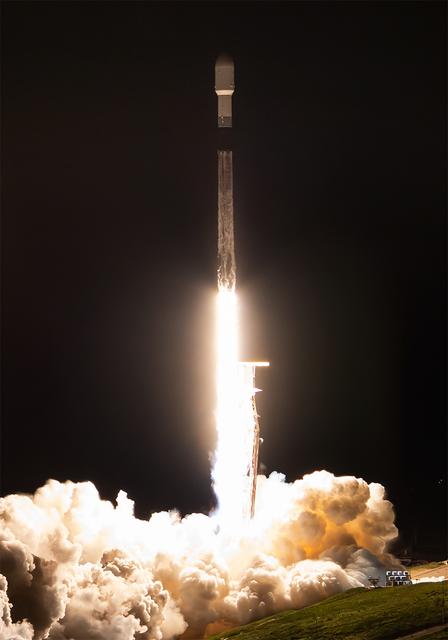
A SpaceX Falcon 9 rocket carrying NASA’s Pandora small satellite, the Star-Planet Activity Research CubeSat (SPARCS), and Black Hole Coded Aperture Telescope (BlackCAT) CubeSat lifts off from Space Launch Complex 4 East at Vandenberg Space…