This Expedition Seven image, taken while aboard the International Space Station (ISS), shows the limb of the Earth at the bottom transitioning into the orange-colored stratosphere, the lowest and most dense portion of the Earth's atmosphere…
International Space Station (ISS)
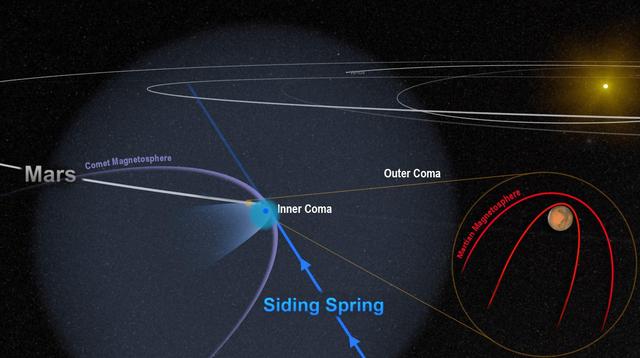
This artist depiction shows the close encounter between comet Siding Sprng and Mars in 2014. The comet powerful magnetic field temporarily merged with, and overwhelmed, the planet weak magnetic field.
Passing Comet Affects Magnetic Field at Mars
The places where the red line on this graph extends higher than the blue line show detection of metals added to the Martian atmosphere from dust particles released by a passing comet on Oct. 19, 2014. The graphed data are from NASA MAVEN sp…
Comet Meteor Shower Put Magnesium and Iron into Martian Atmosphere
The purple color in this animated GIF shows auroras across Mars' nightside as detected by the Imaging Ultraviolet Spectrograph instrument aboard NASA's MAVEN (Mars Atmosphere and Volatile EvolutioN) orbiter. The brighter the purple, the mor…
MAVEN Detects Auroras During Solar Storm in 2024
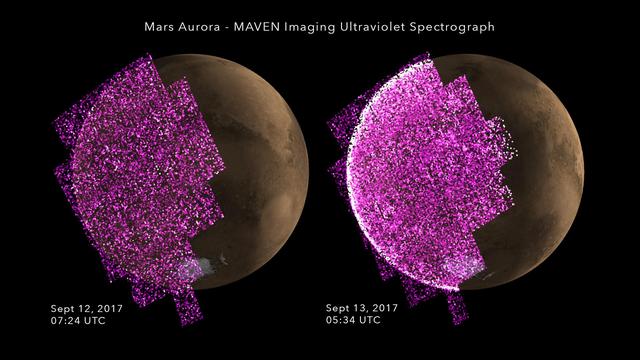
These images show the sudden appearance of a bright aurora on Mars during a solar storm in September 2017. The purple-white color scheme shows the intensity of ultraviolet light seen on Mars' night side before (left) and during (right) the…
Solar Storm Triggers Whole-Planet Aurora at Mars
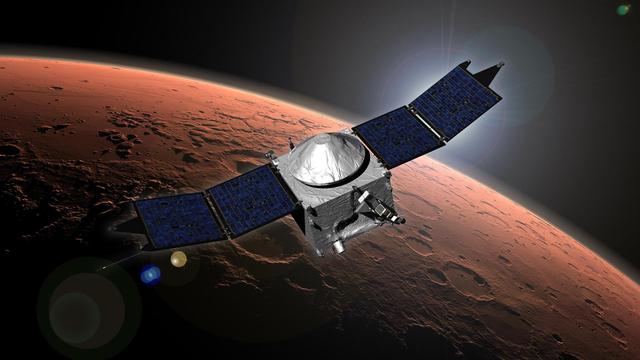
This artist concept depicts NASA Mars Atmosphere and Volatile EvolutioN MAVEN spacecraft near Mars. MAVEN is in development for launch in 2013 and will be the first mission devoted to understanding the Martian upper atmosphere.
MAVEN at Mars Artist Concept
These eight graphs present data from the Neutral Gas and Ion Mass Spectrometer on NASA MAVEN orbiter identifying ions of different metals added to the Martian atmosphere shortly after comet C/2013 A1 Siding Spring sped close to Mars.
Ions of Eight Metals from Comet Dust Detected in Mars Atmosphere
NASA MAVEN spacecraft obtained this ultraviolet image of hydrogen surrounding comet Siding Spring on Oct. 17, 2014, two days before the comet closest approach to Mars.
MAVEN Ultraviolet Image of Comet Siding Spring Hydrogen Coma
During STS-32, onboard Columbia, Orbiter Vehicle (OV) 102, a leakage problem at environmental control and life support system (ECLSS) air revitalization system (ARS) humidity separator A below the middeck is solved with a plastic bag and a…
STS-32 OV-102 air revitalization system (ARS) humidity separator problem
The first demonstration of NASA MAVEN Mars orbiter capability to relay data from a Mars surface mission, on Nov. 6, 2014, included this image, taken Oct. 23, 2014, by Curiosity Navigation Camera, showing part of Pahrump Hills outcrop.
Image Relayed by MAVEN Mars Orbiter from Curiosity Mars Rover
This chart describes the Skylab student experiment, Atmospheric Absorption of Heat, proposed by Joe B. Zmolek of Oshkosh, Wisconsin. This experiment utilized Skylab's Earth Resources Experiment spectrometers to determine the attenuation of…
Skylab
A model of the Mars Atmosphere and Volatile EvolutioN (MAVEN) spacecraft is seen on display during a media briefing where panelist outlined activities around the Sunday, Sept. 21 orbital insertion at Mars of MAVEN, Wednesday, Sept. 17, 2014…
MAVEN Briefing
For the first time, scientists using NASA’s Hubble Space Telescope have witnessed a massive object with the makeup of a comet being ripped apart and scattered in the atmosphere of a white dwarf, the burned-out remains of a compact star. The…
Hubble Witnesses Massive Comet-Like Object Pollute Atmosphere of a White Dwarf
A NASA F-18 jet is prepared for takeoff from the agency's Shuttle Landing Facility at NASA's Kennedy Space Center in Florida. Several flights a day have been taking place the week of Aug. 21, 2017 to measure the effects of sonic booms. It i…
Sonic Booms in Atmospheric Turbulence (SonicBAT) Testing
ER-2 tail number 809, is one of two Airborne Science ER-2s used as science platforms by Dryden. The aircraft are platforms for a variety of high-altitude science missions flown over various parts of the world. They are also used for earth s…
Lockheed ER-2 #809 high altitude research aircraft in flight
This cross section of the Earth's atmosphere at sunset and earth limb (24.5S, 43.5E) displays an unusual layering believed to be caused by temperature inversions which effectively concentrate smoke, dust and aerosols into narrow layers. the…
Sunset
STS066-21-029 (3-14 Nov. 1994) --- On the space shuttle Atlantis' aft flight deck, astronaut Ellen Ochoa, payload commander, supports the Atmospheric Trace Molecule Spectroscopy (ATMOS) experiment with a checkout of a pair of 8mm video tape…
Astronaut Ellen Ochoa works with ATMOS experiment checkout
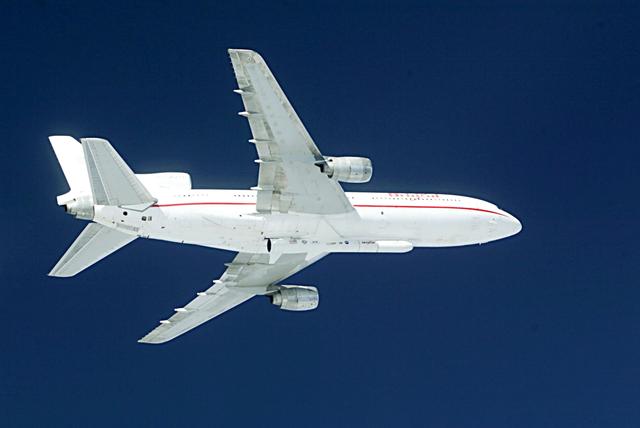
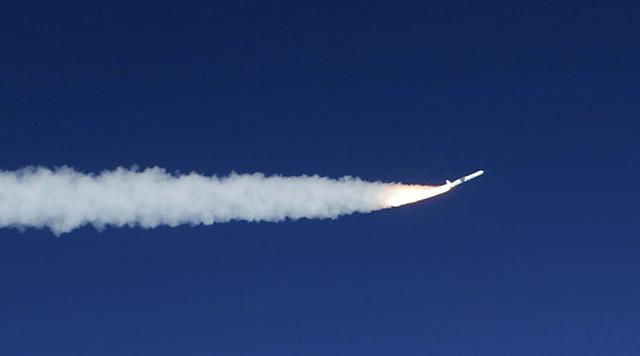
Orbital Sciences Corportation's L1011 prepares to release a Pegasus rocket, January 25, 2003, off the coast of Cape Canaveral, FL,  which will deliver the SORCE satellite, Solar Radiation and Climate Experiment, into the low-Earth orbit. Th…
SORCE
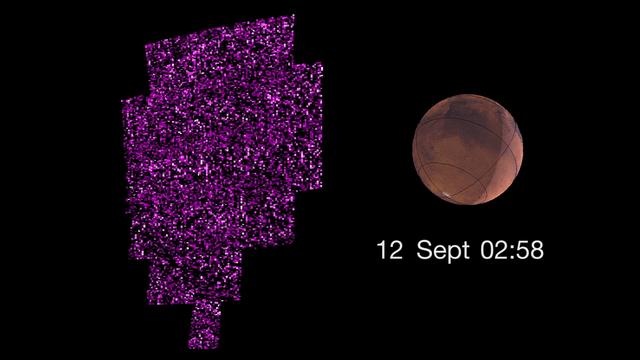
This frame from an animation shows the sudden appearance of a bright aurora on Mars during a solar storm. The purple-white color scheme shows the intensity of ultraviolet light seen on Mars' night side over the course of the event.  The dat…
Solar Storm Triggers Whole-Planet Aurora at Mars (Video)
Astronomers are using the NASA/ESA Hubble Space Telescope to study auroras — stunning light shows in a planet’s atmosphere — on the poles of the largest planet in the solar system, Jupiter. This observation program is supported by measureme…
Hubble Captures Vivid Auroras in Jupiter’s Atmosphere
These profiles show the brightness of aurora emission in Mars' atmosphere at different altitudes. The data are from observations by the Imaging Ultraviolet Spectrograph instrument (IUVS) on NASA's Mars Atmosphere and Volatile Evolution orbi…
Martian Aurora 25 Times Brighter Than Prior Brightest
This graphic depicts what Mars atmosphere would have looked like to a viewer with ultraviolet-seeing eyes after a meteor shower on Oct. 19, 2014.
Emission from Ionized Magnesium in Mars Atmosphere After Comet Flyby
This radio hardware, the Electra UHF Transceiver on NASA MAVEN mission to Mars, is designed to provide communication relay support for robots on the surface of Mars.
Electra Relay Radio on MAVEN Mission to Mars
A Pegasus rocket starts it's first stage burn to propel the SORCE Satellite payload into low-Earth orbit, January 25, 2003, off the coast of Cape Canaveral, FL, The SORCE satellite, Solar Radiation and Climate Experiment,is a joint project…
SORCE
This image shows an artist concept of NASA Mars Atmosphere and Volatile Evolution MAVEN mission.
MAVEN Artist Concept
This illustration depicts charged particles from a solar storm stripping away charged particles of Mars' atmosphere, one of the processes of Martian atmosphere loss studied by NASA's MAVEN mission, beginning in 2014. Unlike Earth, Mars lack…
Visualizing a Solar Storm's Effect on Mars Atmosphere (Illustration)
James Green , NASA PLanetary Science Division Director at the Mars Atmosphere and Volatile Evolution Mission (MAVEN) ORBIT INSERTION event
James Green , NASA PLanetary Science Division Director at the Ma
This STS-48 onboard photo is of the Upper Atmosphere Research Satellite (UARS) in the grasp of the RMS (Remote Manipulator System) during deployment, September 1991.  UARS gathers data related to the chemistry, dynamics, and energy of the o…
Space Shuttle Projects
This is an STS-66 mission onboard photo showing the Remote Manipulator System (RMS) moving toward one of the solar science instruments for the third Atmospheric Laboratory for Applications and Science (ATLAS-3) mission in the cargo bay of t…
Spacelab
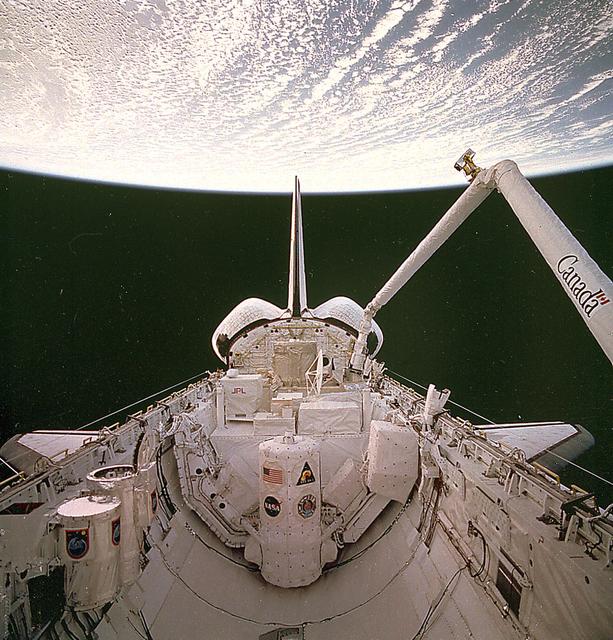
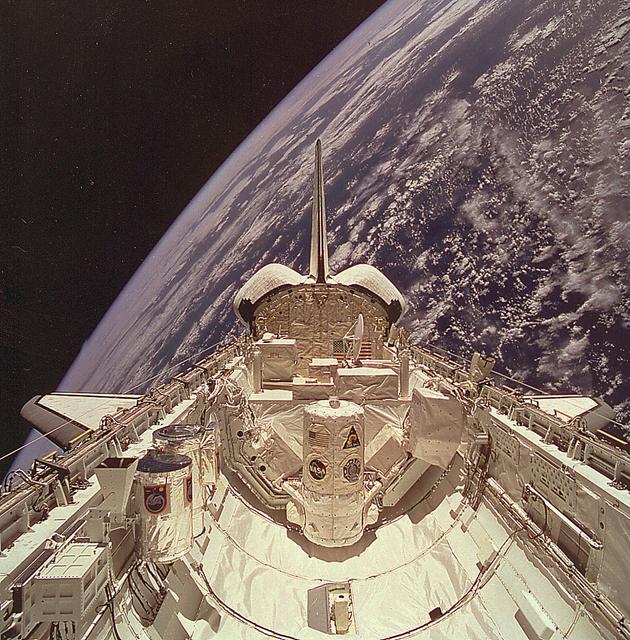
STS056-91-050 (8-17 April 1993) --- This 70mm frame shows the cargo bay of the Earth-orbiting Space Shuttle Discovery backdropped against clouds.  Most of the elements of the ATLAS-2 payload can be seen, but missing is the SPARTAN-201 satel…
STS-56 onorbit view of Discovery's, OV-103's, payload bay with ATLAS-2 pallet
NASA pilot Nils Larson, and flight test engineer and pilot Wayne Ringelberg, head for a mission debrief after flying a NASA F/A-18 at Mach 1.38 to create sonic booms as part of the SonicBAT flight series at NASA’s Armstrong Flight Research…
NASA Test Flights Examine Effect of Atmospheric Turbulence on Sonic Booms
A NASA pilot boards an F-18 jet prior to take off from the agency's Shuttle Landing Facility at NASA's Kennedy Space Center in Florida. Several flights a day have been taking place the week of Aug. 21, 2017 to measure the effects of sonic b…
Sonic Booms in Atmospheric Turbulence (SonicBAT) Testing
A NASA F-18 jet is prepared for takeoff from the agency's Shuttle Landing Facility at NASA's Kennedy Space Center in Florida. Several flights a day have been taking place the week of Aug. 21, 2017 to measure the effects of sonic booms. It i…
Sonic Booms in Atmospheric Turbulence (SonicBAT) Testing
STS066-129-005 (3-14 Nov 1994) --- Clouds over the Atlantic Ocean serve as the backdrop for this 70mm scene of the Atmospheric Laboratory for Applications and Science (ATLAS-3) payload in the cargo bay of the Earth-orbiting Space Shuttle At…
ATLAS-3 payload in the payload bay of STS-66 shuttle Atlantis in orbit
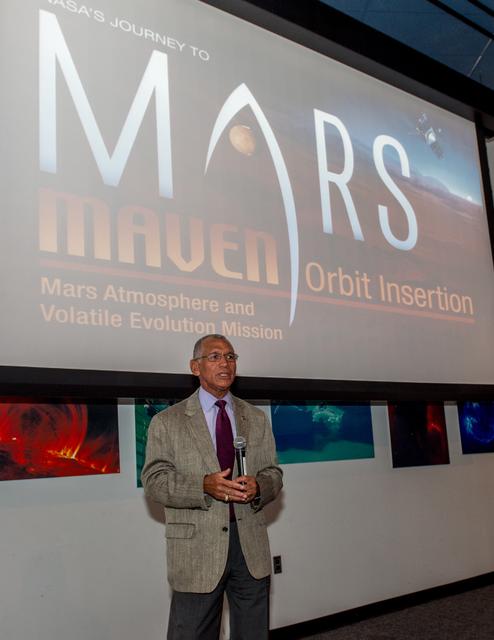
NASA Administrator Charlie Bolden at the Mars Atmosphere and Volatile Evolution Mission (MAVEN) ORBIT INSERTION event
NASA Administrator Charlie Bolden at the Mars Atmosphere and Vol
This artist concept depicts NASA Mars Atmosphere and Volatile EvolutioN MAVEN spacecraft near Mars.
MAVEN Artist Concept
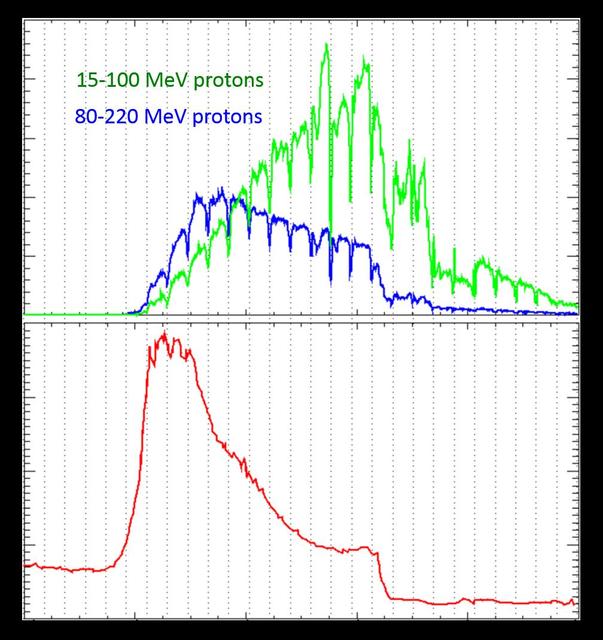
Energetic particles from a large solar storm in September 2017 were seen both in Mars orbit and on the surface of Mars by NASA missions to the Red Planet.  The horizontal axis for both parts of this graphic is the time from Sept. 10 to Sept…
Solar Storm's Radiation at Martian Orbit and Surface
NASA Mars Atmosphere and Volatile EvolutioN MAVEN spacecraft is scheduled to launch in November 2013 and will be the first mission devoted to understanding the Martian upper atmosphere.
Primary Structure for MAVEN Spacecraft
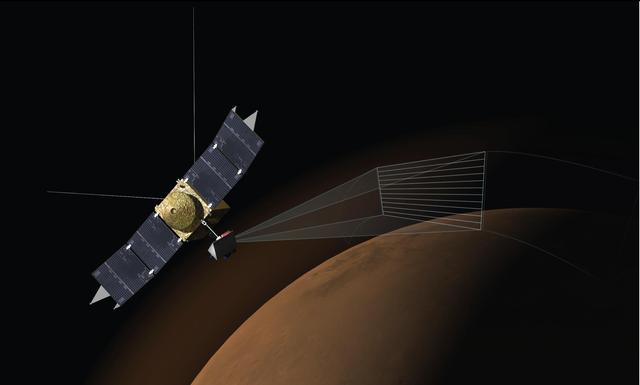
This artist concept depicts the Imaging Ultraviolet Spectrograph IUVS on NASA MAVEN spacecraft scanning the upper atmosphere of Mars. IUVS uses limb scans to map the chemical makeup and vertical structure across Mars upper atmosphere.
Artist Concept of MAVEN Imaging Ultraviolet Spectrograph at Work
iss074e0089802 (Jan. 16, 2026) --- The first rays of an orbital sunrise illuminate Earth’s atmosphere in this photograph taken from the International Space Station as it orbited 268 miles above French Polynesia in the Pacific Ocean at appro…
The first rays of an orbital sunrise illuminate Earth’s atmosphere
This STS-48 onboard photo is of the Upper Atmosphere Research Satellite (UARS) in the grasp of the RMS (Remote Manipulator System) during deployment, September 1991.  UARS gathers data related to the chemistry, dynamics, and energy of the o…
Space Shuttle Projects
This is an STS-66 mission onboard photo of the Space Shuttle Orbiter Atlantis showing the payload of the third Atmospheric Laboratory for Applications and Science (ATLAS-3) mission. During the ATLAS missions, international teams of scientis…
Spacelab
Media, including a puppeteer, participate in a press conference for the ATom airborne science mission which is studying the atmosphere.
AFRC2016-0192-08
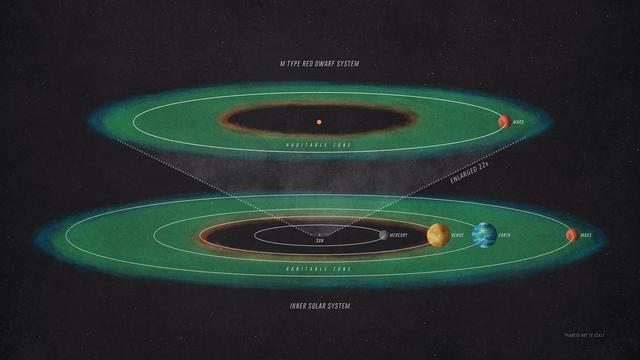
How habitable might an Exo-Mars be? It's a complex question but one that NASA's Mars Atmosphere and Volatile Evolution (MAVEN) mission can help answer.  To receive the same amount of starlight as Mars receives from our Sun, a planet orbitin…
How Habitable Might an Exo-Mars Be?
The DC-8 Airborne Laboratory in a left banking turn above the airport at Palmdale, California. The right wing is silhouetted against the blue sky, while the left wing contrasts with the desert terrain. The former airliner is a "dash-72" mod…
DC-8 Airborne Laboratory in flight over Palmdale, CA
NASA's DC-8 Airborne Science platform shown against a background of a dark blue sky on February 20, 1998. The aircraft is shown from the right rear, slightly above its plane, with the right wing in the foreground and the left wing and horiz…
DC-8 Airborne Laboratory in flight
Microphone arrays are strategically positioned along the ground at NASA's Kennedy Space Center in Florida to collect sound signatures from sonic booms created by agency F-18 jets flying faster than the speed of sound. Several flights a day…
Sonic Booms in Atmospheric Turbulence (SonicBAT) Testing
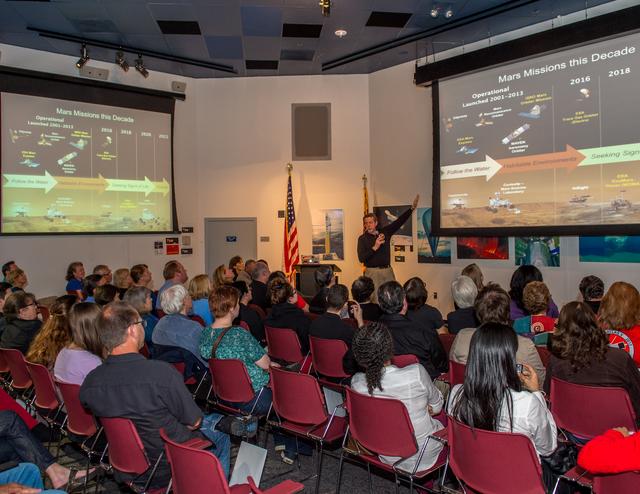
Lisa May, lead program executive, Mars Exploration Program, NASA Headquarters, and Bruce Jakosky, MAVEN principal investigator, Laboratory for Atmospheric and Space Physics, University of Colorado, Boulder, are seen during a media briefing…
MAVEN Briefing