Andromeda Galaxy (ref; P-26394C)
ARC-1983-AC83-0565-3
This image from NASA's retired Spitzer Space Telescope highlights the stars and dust clouds in the Andromeda galaxy. One of Earth's nearest galactic neighbors, Andromeda spans a swath of sky nearly 3.8 degrees across, which is close to the…
The Infrared Face of the Andromeda Galaxy
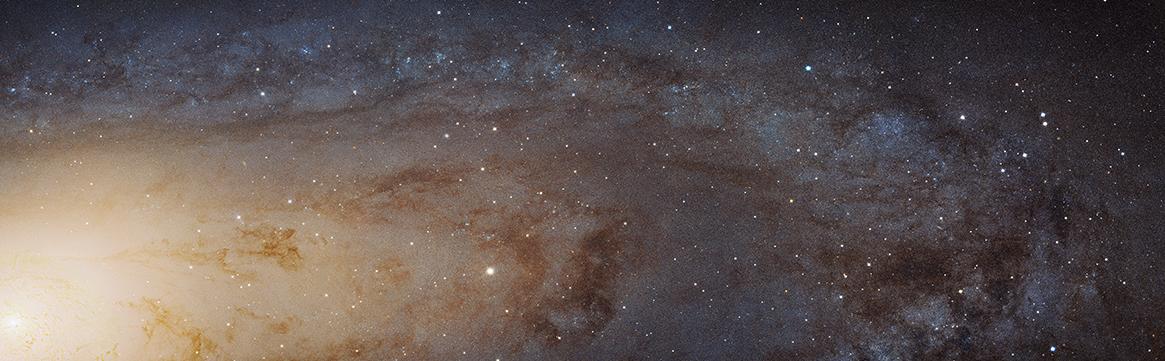
The largest NASA Hubble Space Telescope image ever assembled, this sweeping bird’s-eye view of a portion of the Andromeda galaxy (M31) is the sharpest large composite image ever taken of our galactic next-door neighbor. Though the galaxy is…
Hubble’s High-Definition Panoramic View of the Andromeda Galaxy
The Andromeda Galaxy, also known as M31 since it is the 31st object on Messier's list of diffuse sky objects, is the nearest large galaxy to our own Milky Way galaxy. Our galaxy is thought to look much like Andromeda, but it is about four t…
Space Science
Andromeda galaxy from Palomar Observatory
ARC-1983-AC83-0565-2
This image of the Andromeda galaxy, or M31, includes data from the ESA (European Space Agency) Herschel mission, supplemented with data from ESA's retired Planck observatory and two retired NASA missions: the Infrared Astronomical Satellite…
Andromeda Galaxy Imaged by Herschel, Planck, IRAS, COBE
NASA image release January 10, 2011  The Triangulum, located nearly 3 million light years from Earth, is another far galaxy where researchers have found diffuse interstellar bands (DIBs). The detailed observations needed to see DIBs along a…
The Triangulum
Both of the High Energy Astronomy Observatory (HEAO) 2/Einstein Observatory imaging devices were used to observe the Great Nebula in Andromeda, M31. This image is a wide field x-ray view of the center region of M31 by the HEAO-2's Imaging P…
High Energy Astronomy Observatory (HEAO)
Andromeda galaxy from Infrared Astronomical Satellite  (ref; 83-HC-316)
ARC-1983-AC83-0565-1
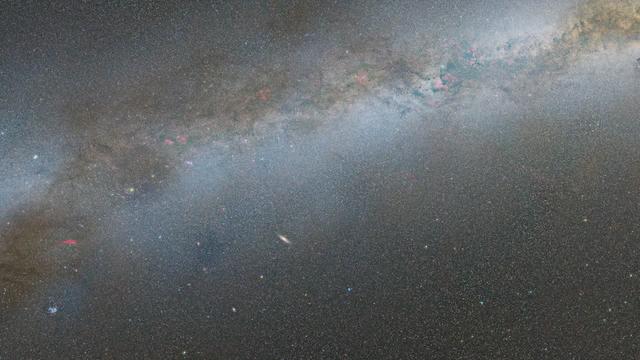
Zoom into the Andromeda galaxy.  The largest NASA Hubble Space Telescope image ever assembled, this sweeping view of a portion of the Andromeda galaxy (M31) is the sharpest large composite image ever taken of our galactic neighbor. Though t…
Hubble's High-Definition Panoramic View of the Andromeda Galaxy
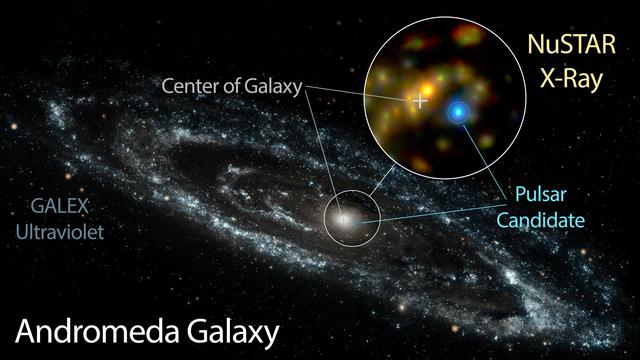
NASA's Nuclear Spectroscope Telescope Array, or NuSTAR, has identified a candidate pulsar in Andromeda -- the nearest large galaxy to the Milky Way. This likely pulsar is brighter at high energies than the Andromeda galaxy's entire black ho…
Pulsar Candidate in Andromeda
Chandra X-Ray Observatory took this first x-ray picture of the Andromeda Galaxy (M31) on October 13, 1999. The blue dot in the center of the image is a "cool" million-degree x-ray source where a supermassive black hole with the mass of 30-m…
History of Chandra X-Ray Observatory
No more images