
This graph depicts the increased signal quality possible with optical fibers made from ZBLAN, a family of heavy-metal fluoride glasses (fluorine combined zirconium, barium, lanthanum, aluminum, and sodium) as compared to silica fibers. NASA…
Marshall Space Flight Center's researchers have conducted suborbital experiments with ZBLAN, an optical material capable of transmitting 100 times more signal and information than silica fibers. The next step is to process ZBLAN in a microg…

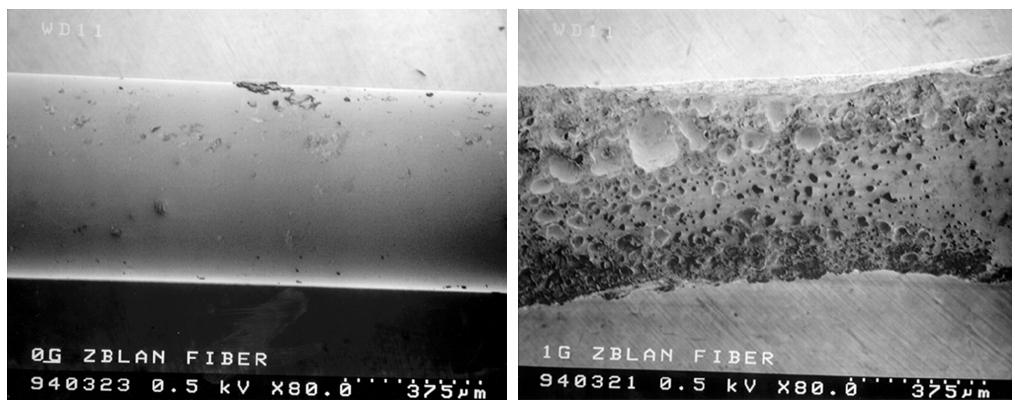
Scarning electron microscope images of the surface of ZBLAN fibers pulled in microgravity (ug) and on Earth (1g) show the crystallization that normally occurs in ground-based processing. The face of each crystal will reflect or refract a po…

Sections of ZBLAN fibers pulled in a conventional 1-g process (right) and in experiments aboard NASA's KC-135 low-gravity aircraft (left). The rough surface of the 1-g fiber indicates surface defects that would scatter an optical signal and…