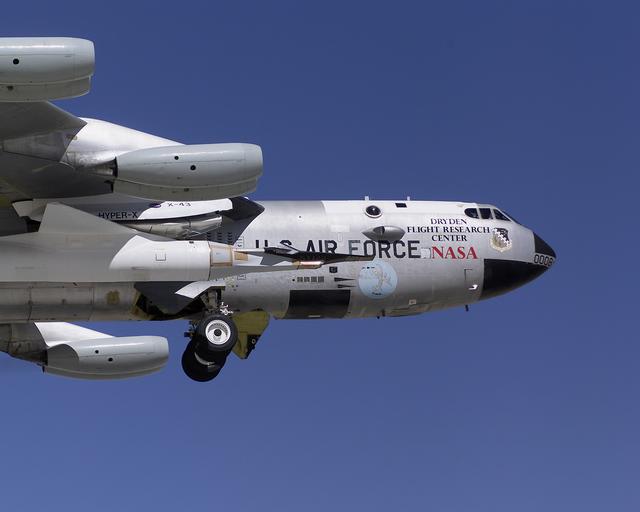
The first X-43A hypersonic research aircraft and its modified Pegasus booster rocket were carried aloft by NASA's NB-52B carrier aircraft from Dryden Flight Research Center at Edwards Air Force Base, Calif., on June 2, 2001 for the first of…
Moments after release from NASA's B-52 carrier aircraft, the X-43A/Pegasus "stack" is seen before ignition of the Pegasus rocket motor on
The first X-43A hypersonic research aircraft and its modified Pegasus booster rocket were carried aloft by NASA's NB-52B carrier aircraft from Dryden Flight Research Center at Edwards Air Force Base, Calif., on June 2, 2001 for the first of…
The X-43A/Pegasus combination dropped into the Pacific Ocean after losing control early in the first free-flight attempt
NASA's historic B-52 mothership carried the X-43A and its Pegasus booster rocket on a captive carry flight from Edwards Air Force Base.
NASA's historic B-52 mothership carried the X-43A and its Pegasus booster rocket on a captive carry flight from Edwards Air Force Base
NASA's historic B-52 mother ship carried the X-43A and its Pegasus booster rocket on a captive carry flight from Edwards Air Force Base Jan. 26, 2004. The X-43A and its booster remained mated to the B-52 throughout the two-hour flight, inte…
NASA's B-52 mother ship carries the X-43A and its booster rocket on a captive carry flight Jan. 26, 2004
Shadowed by two F/A-18s, NASA Dryden's venerable NB-52B is saluted by employees as it makes its final flyover after the last X-43A launch in November 2004.
EC04-0327-39
Attached to the same B-52B mothership that once launched X-15 research aircraft in the 1960s, NASA's third X-43A performed a captive carry evaluation flight from Edwards Air Force Base, California on September 27, 2004. The X-43 remained ma…
NASA's B-52B launch aircraft takes off carrying the third X-43A hypersonic research vehicle on a captive carry evaluation flight September 27, 2004
The X-43A hypersonic research aircraft and its modified Pegasus® booster rocket are nestled under the wing of NASA's NB-52B carrier aircraft during pre-flight systems testing at the Dryden Flight Research Center, Edwards, Calif. The combine…
The X-43A hypersonic research aircraft and its modified Pegasus® booster rocket nestled under the wing of NASA's NB-52B carrier aircraft during pre-flight systems testing
NASA Dryden Flight Research Center's workhorse B-52B launch aircraft, known as NASA 008, displays new markings.
EC04-0197-4
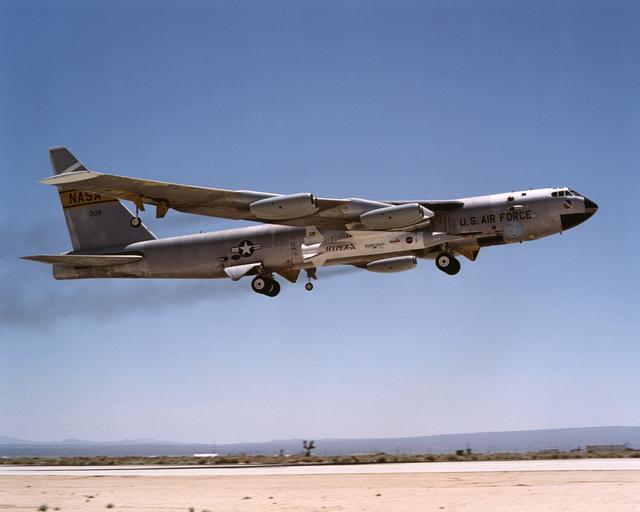
The second X-43A hypersonic research aircraft and its modified Pegasus booster rocket left the runway, carried aloft by NASA's B-52B launch aircraft from the NASA Dryden Flight Research Center at Edwards Air Force Base, Calif., on March 27,…
NASA's B-52B launch aircraft takes off carrying the second X-43A hypersonic research vehicle attached to a modified Pegasus rocket, on March 27, 2004
The small size of the X-43A scramjet is evident in this nose-on view while mounted to its modified Pegasus booster under the wing of NASA's B-52B mothership.
The small size of the X-43A scramjet is evident in this nose-on view while mounted to its modified Pegasus booster under the wing of NASA's B-52B mothership
Orbital Sciences Corp. technicians remove protective shrouds from the modified Pegasus booster before takeoff on the X-43A's Mach 9.6 record scramjet flight.
Orbital Sciences Corp. technicians remove protective shrouds from the modified Pegasus booster before takeoff on the X-43A's Mach 9.6 record scramjet flight
The second X-43A hypersonic research aircraft and its modified Pegasus booster rocket drop away from NASA's B-52B launch aircraft over the Pacific Ocean on March 27, 2004. The mission originated from the NASA Dryden Flight Research Center a…
A modified Pegasus rocket drops steadily away after release from NASA's B-52B, before accelerating the X-43A over the Pacific Ocean on March 27, 2004
The Pegasus rocket that powered NASA's X-43A scramjet to almost Mach 10 test conditions leaves a bright arc in the Pacific sky during the boost phase.
The Pegasus rocket that powered NASA's X-43A scramjet to almost Mach 10 test conditions leaves a bright arc in the Pacific sky during the boost phase
The second X-43A hypersonic research aircraft and its modified Pegasus booster rocket left the runway, carried aloft by NASA's B-52B launch aircraft from the NASA Dryden Flight Research Center at Edwards Air Force Base, Calif., on March 27,…
NASA's B-52B launch aircraft takes off carrying the second X-43A hypersonic research vehicle attached to a modified Pegasus rocket, on March 27, 2004
The third X-43A hypersonic research aircraft and its modified Pegasus booster rocket left the runway, carried aloft by NASA's B-52B launch aircraft from the NASA Dryden Flight Research Center at Edwards Air Force Base, California, on Novemb…
NASA's B-52B launch aircraft takes off carrying the third X-43A hypersonic research vehicle attached to a modified Pegasus rocket, on November 16, 2004
The first X-43A hypersonic research aircraft and its modified Pegasus booster rocket were carried aloft by NASA's NB-52B carrier aircraft from Dryden Flight Research Center at Edwards Air Force Base, Calif., on June 2, 2001 for the first of…
Ignition of the Pegasus rocket moments after release from the B-52 signaled acceleration of the X-43A/Pegasus combination over the Pacific Ocean
This image (captured from animation video) illustrates the X-43A research vehicle alone after separation from the Pegasus booster. (LaRC Photo # EL-2000-00531)
The second of three X-43A hypersonic research aircraft, shown here in its protective shipping jig, arrived at NASA's Dryden Flight Research Center, Edwards, California, on January 31, 2001. The arrival of the second X-43A from its manufactu…
The second X-43A hypersonic research aircraft, shown here in its protective shipping jig, arrives at NASA's Dryden Flight Research Center
NASA's historic B-52 mother ship carried the X-43A and its Pegasus booster rocket on a captive carry flight from Edwards Air Force Base Jan. 26, 2004. The X-43A and its booster remained mated to the B-52 throughout the two-hour flight, inte…
NASA's B-52 mother ship carries the X-43A and its booster rocket on a captive carry flight Jan. 26, 2004
The black X-43A rides on the front of a modified Pegasus booster rocket hung from the special pylon under the wing of NASA's B-52B mother ship. The photo was taken during a captive carry flight Jan. 26, 2004 to verify systems before an upco…
The black X-43A rides on the front of a modified Pegasus booster rocket hung from the special pylon under the wing of NASA's B-52B mother ship. The photo was taken during a captive carry flight Jan. 26, 2004 to verify systems before an upcoming launch
NASA's historic B-52 mother ship carried the X-43A and its Pegasus booster rocket on a captive carry flight from Edwards Air Force Base Jan. 26, 2004. The X-43A and its booster remained mated to the B-52 throughout the two-hour flight, inte…
NASA's B-52 mother ship carries the X-43A and its booster rocket on a captive carry flight Jan. 26, 2004
The first of three X-43A hypersonic research aircraft and its modified Pegasus® booster rocket recently underwent combined systems testing while mounted to NASA's NB-52B carrier aircraft at the Dryden Flight Research Center, Edwards, Calif.…
The X-43A hypersonic research aircraft and its modified Pegasus® booster rocket recently underwent combined systems testing while mounted to NASA's NB-52B carrier aircraft
The first of three X-43A hypersonic research aircraft and its modified Pegasus® booster rocket recently underwent combined systems testing while mounted to NASA's NB-52B carrier aircraft at the Dryden Flight Research Center, Edwards, Califo…
The X-43A hypersonic research aircraft and its modified Pegasus® booster rocket mounted to NASA's NB-52B carrier aircraft at the Dryden Flight Research Center, Edwards, California
Attached to the same B-52B mothership that once launched X-15 research aircraft in the 1960s, NASA's third X-43A performed a captive carry evaluation flight from Edwards Air Force Base, California on September 27, 2004. The X-43 remained ma…
NASA's B-52B launch aircraft takes off carrying the third X-43A hypersonic research vehicle on a captive carry evaluation flight September 27, 2004
The third X-43A hypersonic research aircraft and its modified Pegasus booster rocket accelerate after launch from NASA's B-52B launch aircraft over the Pacific Ocean on November 16, 2004. The mission originated from the NASA Dryden Flight R…
A modified Pegasus rocket ignites moments after release from the B-52B, beginning the acceleration of the X-43A over the Pacific Ocean on Nov. 16, 2004
The third X-43A hypersonic research aircraft and its modified Pegasus booster rocket drop away from NASA's B-52B launch aircraft over the Pacific Ocean on November 16, 2004. The mission originated from the NASA Dryden Flight Research Center…
A modified Pegasus rocket drops away after release from NASA's B-52B before accelerating the X-43A over a Pacific Ocean test range on Nov. 16, 2004
The second X-43A hypersonic research aircraft and its modified Pegasus booster rocket accelerate after launch from NASA's B-52B launch aircraft over the Pacific Ocean on March 27, 2004. The mission originated from the NASA Dryden Flight Res…
A modified Pegasus rocket ignites moments after release from the B-52B, beginning the acceleration of the X-43A over the Pacific Ocean on March 27, 2004
Employees atop NASA Dryden's main building celebrate the return flyby of the B-52B aircraft after it launched the second X-43A aircraft on its successful flight.
Employees atop DFRC's main building celebrate the return flyby of the B-52B aircraft after it launched the second X-43A aircraft on its successful flight
NASA engineers monitor mission progress from a Dryden control room prior to launch of the X-43A scramjet and its booster from NASA's B-52B mothership.
NASA engineers monitor mission progress from a Dryden control room prior to launch of the X-43A scramjet and its booster from NASA's B-52B mothership
The third X-43A hypersonic research aircraft, attached to a modified Pegasus booster rocket, was taken to launch altitude by NASA's B-52B launch aircraft from the NASA Dryden Flight Research Center at Edwards Air Force Base, California, on…
NASA's B-52B launch aircraft cruises to a test range over the Pacific Ocean carrying the third X-43A vehicle attached to a Pegasus rocket on November 16, 2004
NASA's B-52B mothership, escorted by two F-18s, makes a final flyover after its last research mission that launched the X-43A on its record Mach 9.6 flight.
NASA's B-52B mothership, escorted by two F-18s, makes a final flyover after its last research mission that launched the X-43A on its record Mach 9.6 flight
The first X-43A hypersonic research aircraft and its modified Pegasus booster rocket were carried aloft by NASA's NB-52B carrier aircraft from Dryden Flight Research Center at Edwards Air Force Base, Calif., on June 2, 2001 for the first of…
X-43A departs NASA Dryden Flight Research Center for first free-flight attempt
This image (captured from animation video) illustrates the separation of the X-43A research vehicle from the Pegasus booster. (LaRC Photo # EL-2000-00532)
The first of three X-43A hypersonic research aircraft was mated to its modified Pegasus® booster rocket in late January at NASA's Dryden Flight Research Center, Edwards, Calif.
X-43A hypersonic research aircraft mated to its modified Pegasus® booster rocket.
Hitching a ride on the same B-52 mother ship that once launched X-15 research aircraft in the 1960s, NASA's X-43A scramjet and it's Pegasus booster rocket performed a captive carry evaluation flight from Edwards Air Force Base, California,…
Hitching a ride on NASA's B-52 mother ship, the X-43A scramjet performed a captive carry evaluation flight from Edwards Air Force Base, California, January 26, 2004
NASA's Hyper-x Program Manager, Vince Rausch talks about the upcoming launch of the X43A vehicle over the Pacific Ocean later this month from his office at NASA Langley Research Center in Hampton, VA.  Hyper X is a high risk, high payoff pr…
X43 Hyper-X
NASA's NB-52B carrier aircraft rolls down a taxiway at Edwards Air Force Base with the X-43A hypersonic research aircraft and its modified Pegasus® booster rocket slung from a pylon under its right wing. Part of a combined systems test cond…
NASA's NB-52B carrier aircraft rolls down a taxiway with the X-43A hypersonic research aircraft and its modified Pegasus® booster rocket slung from a pylon under its right wing
As part of a combined systems test conducted by NASA Dryden Flight Research Center, NASA's NB-52B carrier aircraft rolls down a taxiway at Edwards Air Force Base with the X-43A hypersonic research aircraft and its modified Pegasus® booster…
NASA's NB-52B carrier aircraft rolls down a taxiway with the X-43A hypersonic research aircraft and its modified Pegasus® booster rocket attached to a pylon under its right wing.
Rep. Ken Calvert, (R-Calif.), chairman of the House Subcommittee on Space and Aeronautics, received an update on the mission of NASA's Dryden Flight Research Center during a visit on June 2, 2005. Rep. Calvert, accompanied by several staff…
Rep. Ken Calvert, R-Calif., chairman of the House Subcommittee on Space and Aeronautics, was briefed by X-43A engineer Laurie Grindle during his tour of Dryden
NASA avionics technicians Randy Wagner and Terry Bishop make final adjustments on the scramjet-powered X-43A before its record Mach 9.6 flight.
NASA avionics technicians Randy Wagner and Terry Bishop make final adjustments on the scramjet-powered X-43A before its record Mach 9.6 flight
NASA's B-52B aircraft over the Dryden Flight Research Center after the successful launch of the second X-43A hypersonic research vehicle.
NASA's B-52B aircraft over the Dryden Flight Research Center after the successful launch of the second X-43A hypersonic research vehicle
NASA's B-52B launch aircraft at sunset with the second X-43A hypersonic research vehicle attached to a modified Pegasus rocket under its right wing.
NASA's B-52B launch aircraft at sunset with the second X-43A hypersonic research vehicle attached to a modified Pegasus rocket under its right wing
The second X-43A hypersonic research aircraft, attached to a modified Pegasus booster rocket and followed by a chase F-18, was taken to launch altitude by NASA's B-52B launch aircraft from the NASA Dryden Flight Research Center at Edwards A…
NASA's B-52B launch aircraft cruises to a test range over the Pacific Ocean carrying the second X-43A vehicle attached to a Pegasus rocket on March 27, 2004
NASA X-43A Monitor Station Operator Brad Neal performs final checks and pre-flight preparations aboard the B-52 for the third X-43A research vehicle Mach 10 flight on November 16, 2004. Takeoff of the B-52B mothership carrying the X-43A too…
NASA's Brad Neal, X-43A Monitor Station Operator aboard NASA's B-52B mothership, performing pre-flight checks on November 16, 2004
The second X-43A hypersonic research vehicle, mounted under the right wing of the B-52B launch aircraft, viewed from the B-52 cockpit. The crew is working on closing out the research vehicle, preparing it for flight.
The second X-43A hypersonic research vehicle, mounted under the right wing of the B-52B launch aircraft, viewed from the B-52 cockpit
The second X-43A hypersonic research aircraft and its modified Pegasus booster rocket accelerate after launch from NASA's B-52B launch aircraft over the Pacific Ocean on March 27, 2004. The mission originated from the NASA Dryden Flight Res…
he second X-43A and its modified Pegasus booster rocket accelerate after launch from NASA's B-52B launch aircraft over the Pacific Ocean
The Hyper-X X-43A project team in front of NASA's B-52B launch aircraft with the Pegasus booster and X-43A vehicle attached.
The Hyper-X X-43A project team