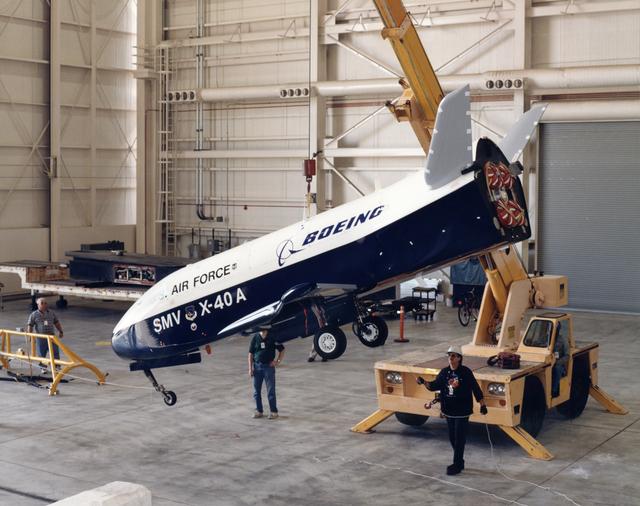
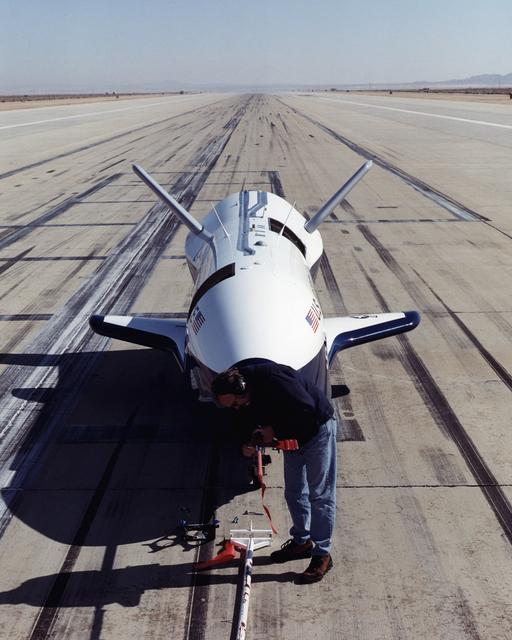
The X-40A SMV being delivered to NASA Dryden Flight Research Center at Edwards, California.
X-40A arrives at NASA Dryden - on ramp
Thermal Evaluaion of X-37 Body Flap Sea test in Panel Test Facility PTF-115
ARC-2003-ACD03-0242-071
Thermal Evaluaion of X-37 Body Flap Sea test in Panel Test Facility PTF-115 With Winnie Chen, Boeing test engineer
ARC-2003-ACD03-0242-007
Pictured is an artist's conception of the X-37 Demonstrator descending down left. As part of the Pathfinder Program, the X-37 flight experiment demonstrates advanced space transportation technologies through the use of flight experiments. T…
Pathfinder
X-40A Free Flight #5. The unpowered X-40A, an 85 percent scale risk reduction version of the proposed X-37, proved the capability of an autonomous flight control and landing system in a series of glide flights at NASA's Dryden Flight Resear…
X-40A Free Flight #5
X-40A Free Flight #5. The unpowered X-40A, an 85 percent scale risk reduction version of the proposed X-37, proved the capability of an autonomous flight control and landing system in a series of glide flights at NASA's Dryden Flight Resear…
X-40A Free Flight #5
Aerospace industry representatives view actual and mock-up versions of 'X-Planes' intended to enhance access to space during a technical exposition on June 22, 2000 at Dryden Flight Research Center, Edwards, California. From left to right:…
EC00-0198-1
The photograph depicts the X-37 neutral buoyancy simulator mockup at Dryden Flight Research Center. The X-37 experimental launch vehicle is roughly 27.5 feet (8.3 meters) long and 15 feet (4.5 meters) in wingspan. Its experiment bay is 7 fe…
Advanced Concept
NASA's X-37 Approach and Landing Test Vehicle is installed is a structural facility at Boeing's Huntington Beach, California plant. Tests, completed in July, were conducted to verify the structural integrity of the vehicle in preparation fo…
Advanced Space Transportation Program (ASTP)
Ground crewmen help guide the alignment of the X-40 technology demonstrator as the experimental craft is gently lowered to the ground by a U.S. Army CH-47 Chinook cargo helicopter following a captive-carry test flight at NASA's Dryden Fligh…
Ground crewmen help guide the alignment of the X-40A as the experimental craft is gently lowered to the ground by a U.S. Army CH-47 Chinook helicopter following a captive-carry test flight
The X-40 sub-scale technology demonstrator and its U.S. Army CH-47 Chinook helicopter mothership fly over a dry lakebed runway during a captive-carry test flight from NASA's Dryden Flight Research Center, Edwards, California. The X-40 is at…
The X-40 sub-scale technology demonstrator and its U.S. Army CH-47 Chinook helicopter mothership fly over a dry lakebed runway during a captive-carry test flight at NASA's Dryden Flight Research Center
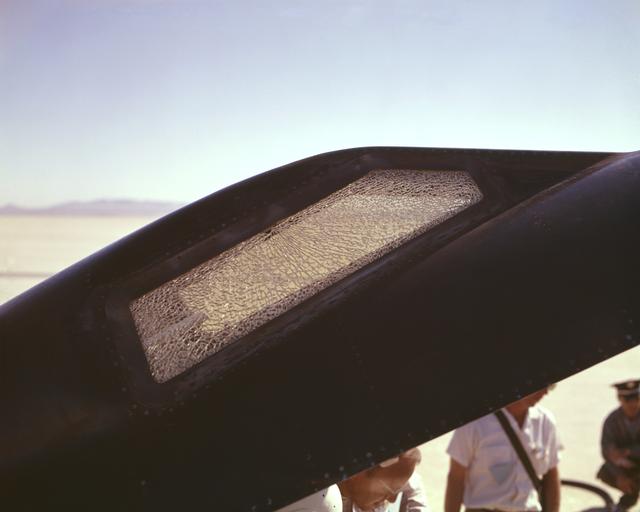
Cracked canopy glass on right side of X-15 #2 after flt. 2-21-37 on Nov. 9 1961. Robert White-pilot. First flight to mach 6.
Cracked canopy glass on right side of X-15 #2 after flt. 2-21-37 on Nov. 9 1961. Robert White-pilot. First flight to mach 6
Anthony piazza, a researcher at NASA’s Armstrong Flight Research center in Edwards, California, works with high-temperature strain sensors. This test article is a bending load bar, which enables high-temperature optical strain sensor resear…
Piazza Knows How to Manage the Heat
The X-40A SMV being delivered to NASA Dryden Flight Research Center at Edwards, California.
X-40A arrives at NASA Dryden - in hangar
Thermal Evaluaion of X-37 Body Flap Sea test in Panel Test Facility PTF-115
ARC-2003-ACD03-0242-034
Thermal Evaluaion of X-37 Body Flap Sea test in Panel Test Facility PTF-115 With Winnie Chen, and Patric Briney, Boeing test engineers
ARC-2003-ACD03-0242-006
Pictured is an artist's concept of the X-37 Demonstrator re-entry. After being launched from the cargo bay of a Shuttle as a secondary payload, the X-37 remains on-orbit up to 21 days performing a variety of experiments before re-entering t…
Pathfinder
Pictured is an artist's concept of the experimental Reusable Launch Vehicle (RLV), the X-37 located in the cargo bay of a space shuttle with Earth in the background. The X-37 was designed to launch from the space shuttle's cargo bay as a se…
Advanced Concept
X-40A departure with CH-47 - flight #7
Aerospace industry representatives view actual and mock-up versions of 'X-Planes' intended to enhance access to space during a technical exposition on June 22, 2000 at Dryden Flight Research Center, Edwards, California. From left to right:…
EC00-0198-2
A worker attaches covers for the nose pitot boom before removing the unpiloted X-40 from the runway at Edwards Air Force Base, California, following its successful free-flight on March 14, 2001. The unpiloted X-40 is a risk-reduction vehicl…
A worker attaches covers for the nose pitot boom before removing the unpiloted X-40 from the runway at Edwards Air Force Base, California, following its successful free-flight on March 14, 2001
NASA's X-37 Approach and Landing Test Vehicle is installed is a structural facility at Boeing's Huntington Beach, California plant, where technicians make adjustments to composite panels. Tests, completed in July, were conducted to verify t…
Advanced Space Transportation Program (ASTP)
Wranglers steadied the X-40A at NASA's Dryden Flight Research Center, Edwards, California, March 14, 2001, as the experimental craft was carried to 15,000 feet for an unpiloted glide flight. The unpiloted X-40 is a risk-reduction vehicle fo…
Wranglers steadied the X-40A at NASA's Dryden Flight Research Center, Edwards, California, March 14, 2001, as the experimental craft was carried to 15,000 feet for an unpiloted glide flight
A U.S. Army CH-47 Chinook helicopter slowly lowers the X-40 sub-scale technology demonstrator to the ground under the watchful eyes of ground crew at the conclusion of a captive-carry test flight at NASA's Dryden Flight Research Center, Edw…
A U.S. Army CH-47 Chinook helicopter slowly lowers the X-40 sub-scale technology demonstrator to the ground under the watchful eyes of ground crew at the conclusion of a captive-carry test flight
NASA's X-38 glided high over California desert test ranges as it descended from 37,500 feet to land on Rogers Dry Lake for the seventh free flight of the program July 10, 2001.
X-38 over the Mojave Desert, July 10, 2001
Anthony piazza, a researcher at NASA’s Armstrong Flight Research center in Edwards, California, works with high-temperature strain sensors. This test article is a bending load bar, which enables high-temperature optical strain sensor resear…
Piazza Knows How to Manage the Heat
Thermal Evaluaion of X-37 Body Flap Sea test in Panel Test Facility PTF-115
ARC-2003-ACD03-0242-072
Thermal Evaluaion of X-37 Body flap Seal testing in the Panel Test Facility PFT-115
ARC-2003-ACD03-0242-100
Thermal Evaluaion of X-37 Body Flap Sea test in Panel Test Facility PTF-115 with (l) Duoc Tran, Boeing Test engineer and (r) Vincent Meglio, NASA lead Engineering Technician / Operator
ARC-2003-ACD03-0242-037
Pictured is an artist's conception of the X-37 Demonstrator ascending left upright. As part of the Pathfinder Program, the X-37 flight experiment demonstrates advanced space transportation technologies through the use of flight experiments.…
Pathfinder
Pictured is an artist's concept of the experimental X-37 Reusable Launch Vehicle re-entering Earth‘s atmosphere. NASA and the Boeing Company entered a cooperative agreement to develop and fly a new experimental space plane called the X-37 t…
Advanced Concept
X-40A Free Flight #5. The unpowered X-40A, an 85 percent scale risk reduction version of the proposed X-37, proved the capability of an autonomous flight control and landing system in a series of glide flights at NASA's Dryden Flight Resear…
X-40A Free Flight #5
Aerospace industry representatives view actual and mock-up versions of 'X-Planes' intended to enhance access to space during a technical exposition on June 22, 2000 at Dryden Flight Research Center, Edwards, California. From left to right:…
EC00-0198-85
Aerospace industry representatives view actual and mock-up versions of 'X-Planes' intended to enhance access to space during a technical exposition on June 22, 2000 at Dryden Flight Research Center, Edwards, California. From left to right:…
EC00-0198-102
A newly constructed pylon (green) for carrying aerospace vehicles aloft flies attached to the wing of NASA Dryden Flight Research Center's B-52H aircraft.
EC04-0194-19
This photograph is an artist's cutaway view of the X-37 flight demonstrator showing its components. The X-37 experimental launch vehicle is roughly 27.5 feet (8.3 meters) long and 15 feet (4.5 meters) in wingspan. Its experiment bay is 7 fe…
Advanced Concept
First flight at NASA's Dryden Flight Research Center for the X-40A was a 74 second glide from 15,000 feet on March 14, 2001. The unpiloted X-40 is a risk-reduction vehicle for the X-37, which is intended to be a reusable space vehicle.  NAS…
First flight at NASA's Dryden Flight Research Center for the X-40A was a 74 second glide from 15,000 feet on March 14, 2001
With a small stabilization parachute trailing behind, the X-40 sub-scale technology demonstrator is suspended under a U.S. Army CH-47 Chinook cargo helicopter during a captive-carry test flight at NASA's Dryden Flight Research Center, Edwar…
With a small stabilization parachute trailing behind, the X-40 sub-scale technology demonstrator is suspended under a U.S. Army CH-47 Chinook cargo helicopter during a captive-carry test flight
The X-40 sub-scale technology demonstrator is suspended under a U.S. Army CH-47 Chinook cargo helicopter during a captive-carry test flight at NASA's Dryden Flight Research Center, Edwards, California. The captive carry flights are designed…
The X-40 sub-scale technology demonstrator is suspended under a U.S. Army CH-47 Chinook cargo helicopter during a captive-carry test flight at NASA's Dryden Flight Research Center, Edwards, California.
The X-37 advanced technology demonstrator flaperon unit was one of the first ever thermal and mechanical qualification tests of a carbon-carbon control surface designed for space flight. The test also featured extensive use of high-temperat…
Piazza Knows How to Manage the Heat
No more images