The second of three X-43A hypersonic research aircraft, shown here in its protective shipping jig, arrived at NASA's Dryden Flight Research Center, Edwards, California, on January 31, 2001. The arrival of the second X-43A from its manufactu…
The second X-45A Unmanned Combat Air Vehicle (UCAV) technology demonstrator completed its first flight on November 21, 2002, after taking off from a dry lakebed at NASA's Dryden Flight Research Center, Edwards Air Force Base, California. X…
Hitching a ride on the same B-52 mother ship that once launched X-15 research aircraft in the 1960s, NASA's X-43A scramjet and it's Pegasus booster rocket performed a captive carry evaluation flight from Edwards Air Force Base, California,…
The black X-43A rides on the front of a modified Pegasus booster rocket hung from the special pylon under the wing of NASA's B-52B mother ship. The photo was taken during a captive carry flight Jan. 26, 2004 to verify systems before an upco…
NASA's historic B-52 mother ship carried the X-43A and its Pegasus booster rocket on a captive carry flight from Edwards Air Force Base Jan. 26, 2004. The X-43A and its booster remained mated to the B-52 throughout the two-hour flight, inte…
This image of the suspected Black Hole, Cygnus X-1, was the first object seen by the High Energy Astronomy Observatory (HEAO)-2/Einstein Observatory. According to the theories to date, one concept of a black hole is a star, perhaps 10 times…
The second X-43A hypersonic research aircraft and its modified Pegasus booster rocket left the runway, carried aloft by NASA's B-52B launch aircraft from the NASA Dryden Flight Research Center at Edwards Air Force Base, Calif., on March 27,…
The second X-43A hypersonic research aircraft and its modified Pegasus booster rocket accelerate after launch from NASA's B-52B launch aircraft over the Pacific Ocean on March 27, 2004. The mission originated from the NASA Dryden Flight Res…
In this 1950 view of the left side of the NACA High-Speed Flight Research Station's X-4 research aircraft, the low swept wing and horizontal taillest design are seen. The X-4 Bantam, a single-place, low swept-wing, semi-tailless aircraft, w…
The second X-43A hypersonic research aircraft and its modified Pegasus booster rocket left the runway, carried aloft by NASA's B-52B launch aircraft from the NASA Dryden Flight Research Center at Edwards Air Force Base, Calif., on March 27,…
The second X-43A hypersonic research aircraft and its modified Pegasus booster rocket left the runway, carried aloft by NASA's B-52B launch aircraft from the NASA Dryden Flight Research Center at Edwards Air Force Base, Calif., on March 27,…
NASA personnel in a control room during the successful second flight of the X-43A aircraft. front row, left to right: Randy Voland, LaRC Propulsion; Craig Christy, Boeing Systems; Dave Reubush, NASA Hyper-X Deputy Program Manager; and Vince…
Engineers and technicians in the control room at the Dryden Flight Research Center must constantly monitor critical operations and checks during research projects like NASA's hypersonic X-43A. Visible in the photo, taken two days before the…
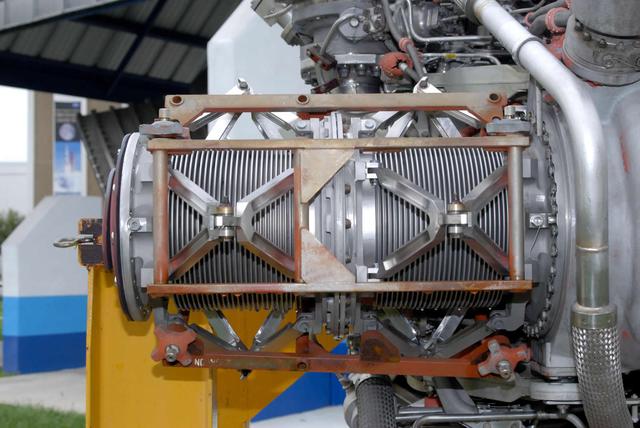
Stennis Space Center engineers are preparing to conduct water tests on an updated version of the scissors duct component of the J-2X engine. Measuring about 2 feet long and about 8 inches in diameter, the duct on the J-2X predecessor, the J…
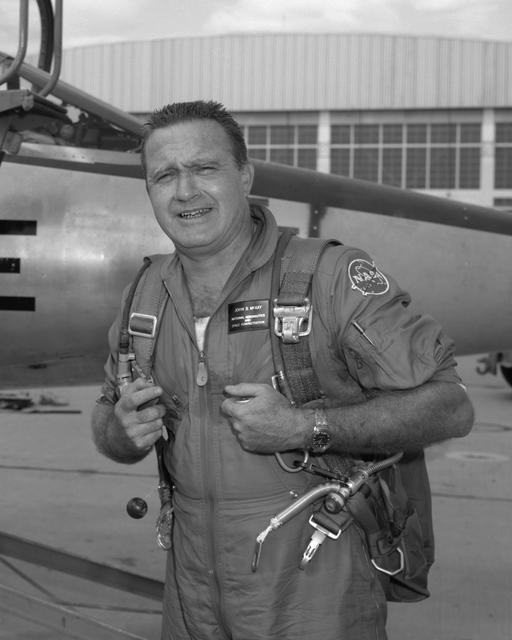
Joseph A. Walker was a Chief Research Pilot at the NASA Dryden Flight Research Center during the mid-1960s. He joined the NACA in March 1945, and served as project pilot at the Edwards flight research facility on such pioneering research pr…
The second X-45A Unmanned Combat Air Vehicle (UCAV) technology demonstrator completed its first flight on November 21, 2002, after taking off from a dry lakebed at NASA's Dryden Flight Research Center, Edwards Air Force Base, California. X…
This photograph is of the High Energy Astronomy Observatory (HEAO)-2 telescope being checked by engineers in the X-Ray Calibration Facility at the Marshall Space Flight Center (MSFC). The MSFC was heavily engaged in the technical and scient…
A 1953 photo of some of the research aircraft at the NACA High-Speed Flight Research Station (now known as the the Dryden Flight Research Center). The photo shows the X-3 (center) and, clockwise from left: X-1A (Air Force serial number 48-1…
The second X-43A hypersonic research aircraft and its modified Pegasus booster rocket drop away from NASA's B-52B launch aircraft over the Pacific Ocean on March 27, 2004. The mission originated from the NASA Dryden Flight Research Center a…
The second X-43A hypersonic research aircraft and its modified Pegasus booster rocket accelerate after launch from NASA's B-52B launch aircraft over the Pacific Ocean on March 27, 2004. The mission originated from the NASA Dryden Flight Res…
The second X-43A hypersonic research aircraft and its modified Pegasus booster rocket left the runway, carried aloft by NASA's B-52B launch aircraft from the NASA Dryden Flight Research Center at Edwards Air Force Base, Calif., on March 27,…
NASA’s X-59 undergoes a structural stress test at a Lockheed Martin facility in Fort Worth, Texas. The X-59’s nose makes up one third of the aircraft, at 38-feet in length. The X-59 is a one-of-a-kind airplane designed to fly at supersonic…
In the center foreground of this 1953 hangar photo is the YF-84A (NACA 134/Air Force 45-59490) used for vortex generator research. It arrived on November 28, 1949, and departed on April 21, 1954. Beside it is the third D-558-1 aircraft (NAC…
This STS-51F mission onboard Photograph shows some of the Spacelab-2 instruments in the cargo bay of the Orbiter Challenger. The Plasma Diagnostics Package (PDP). shown at the end of the Remote Manipulator System (RMS), used instruments on…
The second X-45A Unmanned Combat Air Vehicle (UCAV) technology demonstrator completed its first flight on November 21, 2002, after taking off from a dry lakebed at NASA's Dryden Flight Research Center, Edwards Air Force Base, California. X…
The second X-45A Unmanned Combat Air Vehicle (UCAV) technology demonstrator completed its first flight on November 21, 2002, after taking off from a dry lakebed at NASA's Dryden Flight Research Center, Edwards Air Force Base, California. X…
NASA's historic B-52 mother ship carried the X-43A and its Pegasus booster rocket on a captive carry flight from Edwards Air Force Base Jan. 26, 2004. The X-43A and its booster remained mated to the B-52 throughout the two-hour flight, inte…
NASA's historic B-52 mother ship carried the X-43A and its Pegasus booster rocket on a captive carry flight from Edwards Air Force Base Jan. 26, 2004. The X-43A and its booster remained mated to the B-52 throughout the two-hour flight, inte…
Hitching a ride on the same B-52 mother ship that once launched X-15 research aircraft in the 1960s, NASA's X-43A scramjet and it's Pegasus booster rocket performed a captive carry evaluation flight from Edwards Air Force Base, California,…
This photograph is of the High Energy Astronomy Observatory (HEAO)-2 telescope being evaluated by engineers in the clean room of the X-Ray Calibration Facility at the Marshall Space Flight Center (MSFC). The MSFC was heavily engaged in the…
The second X-43A hypersonic research aircraft, attached to a modified Pegasus booster rocket and followed by a chase F-18, was taken to launch altitude by NASA's B-52B launch aircraft from the NASA Dryden Flight Research Center at Edwards A…
Employees atop NASA Dryden's main building celebrate the return flyby of the B-52B aircraft after it launched the second X-43A aircraft on its successful flight.
The second X-43A hypersonic research vehicle, mounted under the right wing of the B-52B launch aircraft, viewed from the B-52 cockpit. The crew is working on closing out the research vehicle, preparing it for flight.
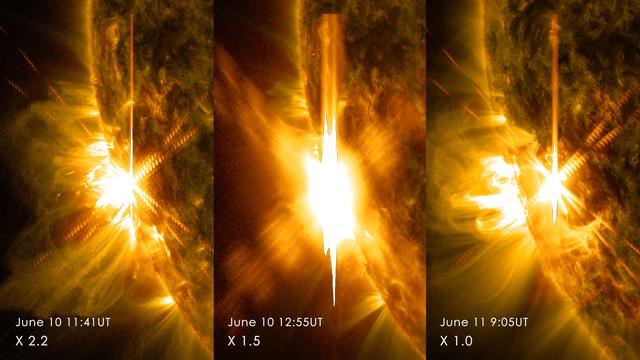
Three X-class flares erupted from the left side of the sun June 10-11, 2014. These images are from NASA's Solar Dynamics Observatory and show light in a blend of two ultraviolet wavelengths: 171 and 131 angstroms. The former is colorized in…
A vintage 1960 J-2 thrust chamber is fitted with brackets and pumps recently at the Pratt & Whitney Rocketdyne assembly facility in Stennis Space Center's Building 9101. Together, the parts comprise the J-2X Powerpack 1A test article. Missi…
The X-2, initially an Air Force program, was scheduled to be transferred to the civilian National Advisory Committee for Aeronautics (NACA) for scientific research. The Air Force delayed turning the aircraft over to the NACA in the hope of…
The Bell Aircraft Corporation X-1-2 aircraft on the ramp at NACA High Speed Flight Research Station located on the South Base of Muroc Army Air Field in 1947. The X-1-2 flew until October 23, 1951, completing 74 glide and powered flights wi…