The Wake Shield Facility (WSF) is a free-flying research and development facility that is designed to use the pure vacuum of space to conduct scientific research in the development of new materials. The thin film materials technology develo…
Microgravity
On June 15, NASA's Swift caught the onset of a rare X-ray outburst from a stellar-mass black hole in the binary system V404 Cygni. Astronomers around the world are watching the event. In this system, a stream of gas from a star much like th…
NASA Missions Monitor a Waking Black Hole
The Wake Shield Facility is displayed on a test stand at JSC. Astronaut Ronald M. Sega, mission specialist for STS-60, is seen with the facility during a break in testing in the acoustic and vibration facility at JSC.
Astronaut Ronald Sega with Wake Shield Facility on test stand at JSC
Space Vacuum Epitaxy Center works with industry and government laboratories to develop advanced thin film materials and devices by utilizing the most abundant free resource in orbit: the vacuum of space. SVEC, along with its affiliates, is…
Microgravity
Pictured on a test stand at JSC is the Wake Shield Facility scheduled to fly on STS-60.
Wake Shield Facility on test stand at JSC
Dryden Flight Research Center's Piper PA-30 Twin Commanche, which helped validate the RPRV concept, descends to a remotely controlled landing on Rogers Dry Lake, unassisted by the onboard pilot. A Piper PA-30 Twin Commanche, known as NASA 8…
PA-30 Twin Comanche - NASA 808 in flight
STS060-15-003 (3-11 Feb 1994) --- This 35mm frame shows the major payloads of the Space Shuttle Discovery's STS-60 mission, backdropped against clouds over the Atlantic Ocean.  In the foreground is the SPACEHAB module, with the Wake Shield…
View of payloads in the STS-60 Discovery's payload bay while in orbit
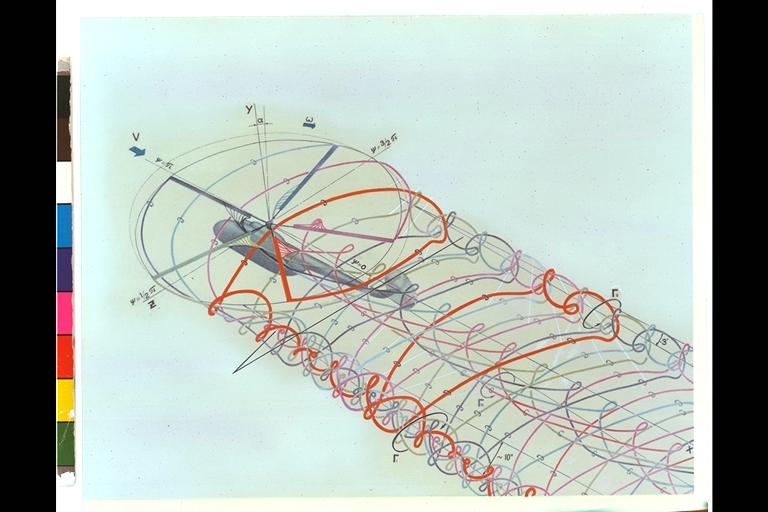
Wake Vortex behind a helicopter describing Longitudinal Cores (Secondary Vortes Generation) from Aviatsiya / Kosmonautika, 1973 (Illustration)
ARC-1976-AC76-1585
The Wake Shield Facility is a free-flying research and development facility that is designed to use the pure vacuum of space to conduct scientific research in the development of new materials. The thin film materials technology developed by…
Microgravity
Space Vacuum Epitaxy Center works with industry and government laboratories to develop advanced thin film materials and devices by utilizing the most abundant free resource in orbit: the vacuum of space. SVEC, along with its affiliates, is…
Microgravity
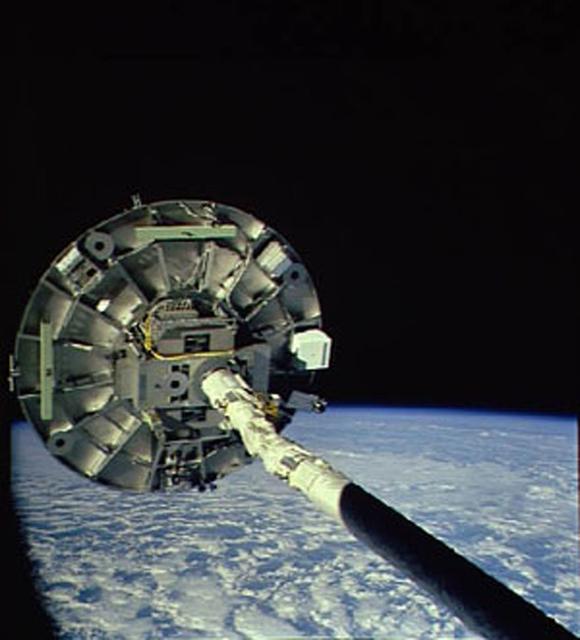
STS060-76-095 (3-11 Feb 1994) --- The ram side of the Wake Shield Facility (WSF) in the grasp of the Space Shuttle Discovery's Remote Manipulator System (RMS) arm is featured in this 70mm frame.  Clouds over the Atlantic Ocean and the black…
Ram side of Wake Shield Facility
STS060-09-024 (3-11 Feb 1994) --- As the Space Shuttle Discovery flew over a point between New Zealand and Australia, one of the STS-60 crew members used a 35mm camera to capture this image featuring three-fourths of the disc of the Wake Sh…
View of the Wake Shield Facility back dropped against the Southern Lights
STS060-57-033 (3-11 Feb 1994) --- Astronaut Ronald M. Sega suspends himself in the weightlessness aboard the Space Shuttle Discovery's crew cabin, as the Remote Manipulator System (RMS) arm holds the Wake Shield Facility (WSF) aloft.  The m…
Astronaut Ronald Sega in crew cabin
STS060-74-054 (3-11 Feb 1994) --- The Wake Shield Facility (WSF) is held in the grasp of Discovery's Remote Manipulator System (RMS).  The 70mm image, backdropped against the blackness of space, also shows the SPACEHAB module in the forward…
Wake Shield Facility in grasp of the Remote Manipulator System
Wake Vortex behind a helicopter (Illustration)
ARC-1976-AC76-0585
CAPE CANAVERAL, Fla. -- Employees at NASA's Kennedy Space Center in Florida gathered in the Press Site parking lot, with the towering Vehicle Assembly Building in the background on June 27, 2011, to record a wake-up call to Atlantis' STS-13…
KSC-2011-4892
STS026-43-082 (29 Sept. - 3 Oct. 1988) --- This 70mm northerly oriented frame over the Pacific Ocean features the Hawaiian Islands chain. The islands perturb the prevailing northeasterly winds producing extensive cloud wakes in the lee of t…
Hawaiian Island Archipelago
These open ocean Internal Waves were seen off the Namibia Coast, Africa (23.0S, 14.0E). The periodic and regularly spaced sets of internal waves most likely coincide with tidal periods about 12 hours apart. The wave length (distance from cr…
Open ocean Internal Waves, Namibia Coast, Africa.
These open ocean Internal Waves were seen off the Namibia Coast, Africa (19.5S, 11.5E). The periodic and regularly spaced sets of incoming internal appear to be diffracting against the coastline and recombining to form a network of interfer…
Open ocean Internal Waves, Namibia Coast, Africa.
Technicians check instrumentation and systems on NASA 808, a PA-30 aircraft, prior to a research flight. The aircraft was used as the testbed in development of control systems for remotely piloted vehicles that were "flown" from the ground.…
PA-30 Twin Comanche - NASA 808 in hangar
STS054-72-056 (13-19 Jan 1993) --- A ship wake in the Bay of Bengal is noticeable in this 70mm frame.  The sun glint pattern on the ocean reveals many patterns of sea surface roughness related to currents, waves, wind roughening, and biolog…
STS-54 Earth observation of a ship wake in the Bay of Bengal
No more images