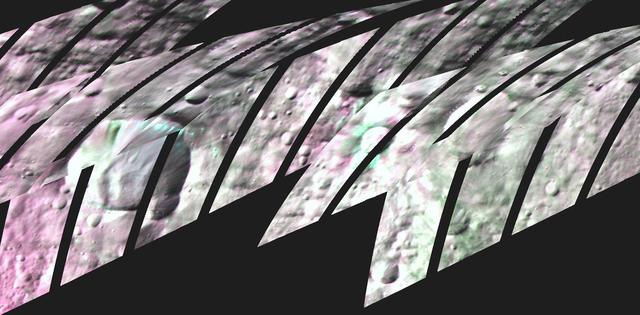
Dawn mission Vesta Logo, part of NASA Dawn Mission Art series.  http://photojournal.jpl.nasa.gov/catalog/PIA19372
Dawn Mission Vesta Logo
This image shows infrared views of two craters,Bellicia left and Arruntia right, at the giant asteroid Vesta that NASA Dawn mission has found to sport the mineral olivine.
Two Craters with Olivine
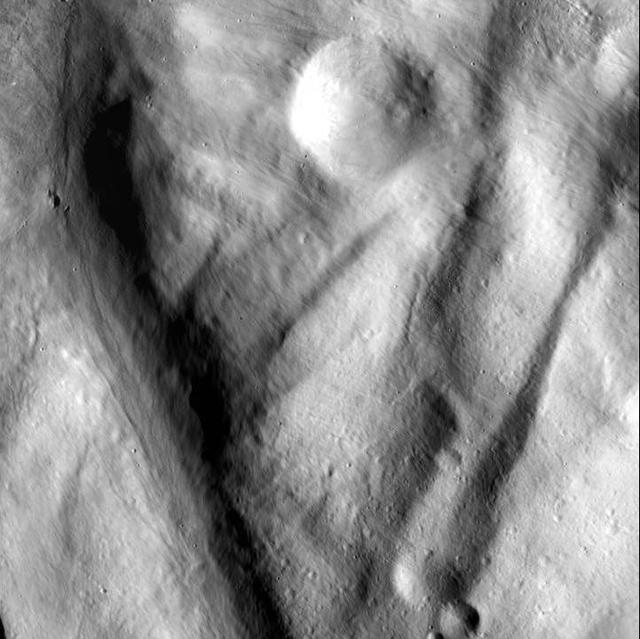
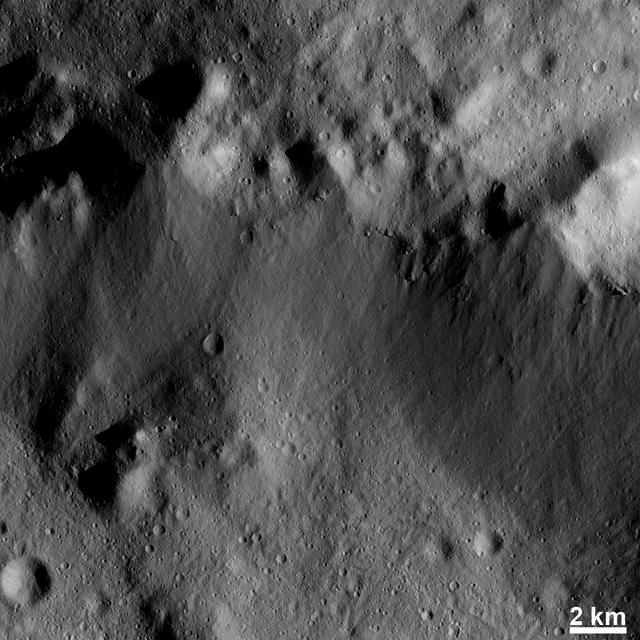
These images from NASA Dawn spacecraft show part of asteroid Vesta equatorial region, which contains impact craters and troughs linear depressions.
Topography of Vesta Equatorial Region III
This image from NASA Dawn spacecraft of asteroid Vesta shows Laelia crater and Sextilia crater, located in Vesta Sextilia quadrangle, in Vesta southern hemisphere.
Laelia and Sextilia Craters
This image obtained by the framing camera on NASA Dawn spacecraft shows the south pole of the giant asteroid Vesta. Scientists are discussing whether the circular structure that covers most of this image originated by a collision with anoth…
Viewing the South Pole of Vesta
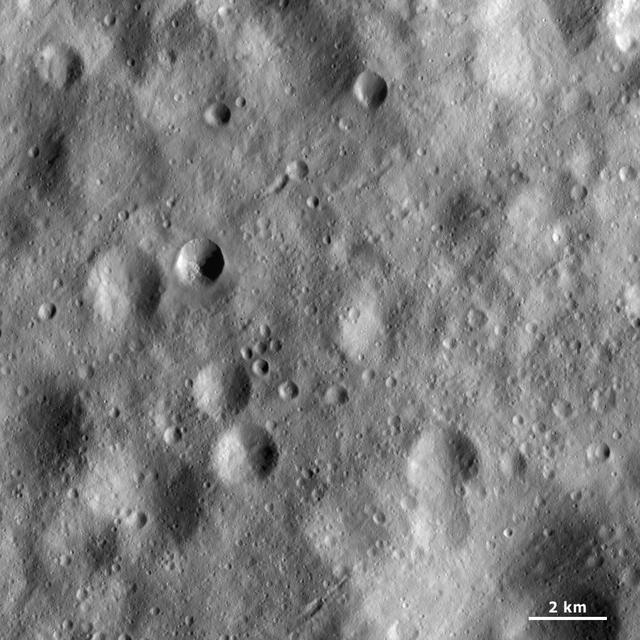
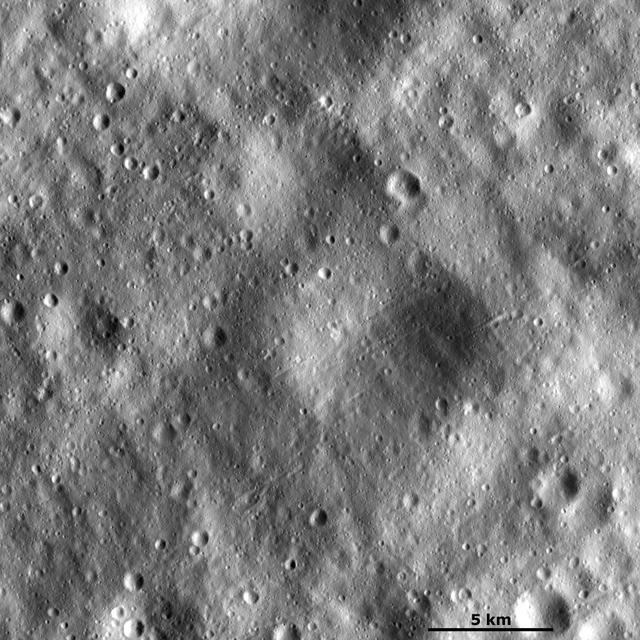
This image from NASA Dawn spacecraft shows a part of asteroid Vesta surface that is covered by heavily cratered regolith. Regolith is the fine-grained material that covers most of Vesta surface.
Surface Covered with Regolith and Craters
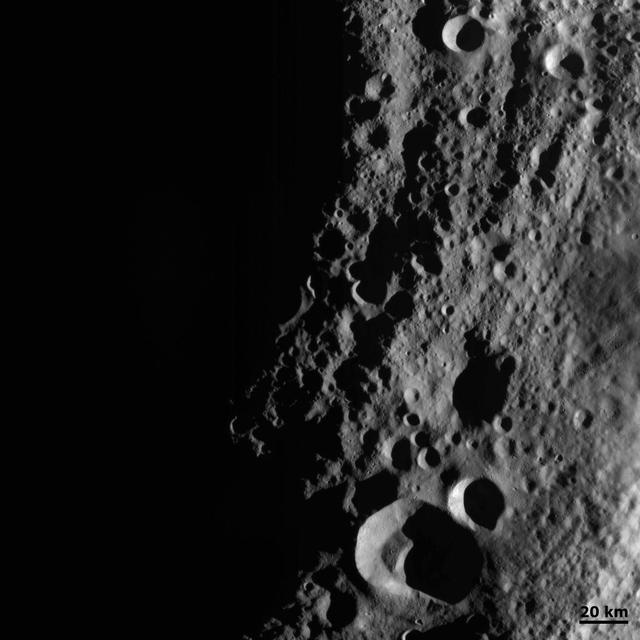
This detail of NASA Dawn spacecraft framing camera image shows low sun angles and large shadows on asteroid Vesta.
Night and Day Boundary on Vesta
These images from NASA Dawn spacecraft are located in asteroid Vesta Gegania quadrangle, just south of Vesta equator. Rubria, with dark and bright material is above Divalia Fossa, and Occia, with bright and dark material is below.
Divalia Fossa and Rubria and Occia Craters, Apparent Brightness and Topography Images
This image from NASA Dawn mission shows a crater in the northern hemisphere of the giant asteroid Vesta called Bellicia.
Bellicia Crater, in Visible Light
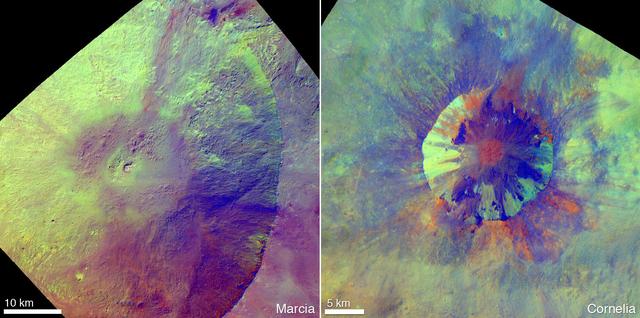
These enhanced-color views from NASA Dawn mission show an unusual pitted terrain on the floors of the craters named Marcia left and Cornelia right on the giant asteroid Vesta.
Pitted Terrain in Color
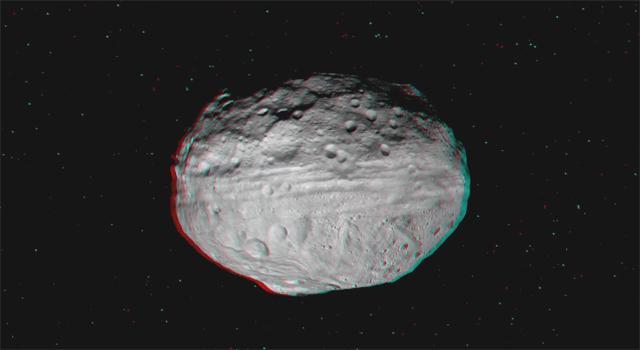
This 3D image was obtained as Dawn approached Vesta and circled the giant asteroid during the mission survey orbit phase. You need 3D glasses to view this image.
Dawn Soars Over Asteroid Vesta in 3-D
This image of Oppia AV-L-22, from the atlas of the giant asteroid Vesta, was created from images taken as NASA Dawn mission flew around the object, also known as a protoplanet. The set of maps was created from mosaics of10,000 images from D…
Oppia AV-L-22
This image from NASA Dawn spacecraft is dominated by bright rayed craters of different sizes. The most prominent bright rayed crater is named Tuccia.
Bright Rayed Craters in Tuccia Quadrangle
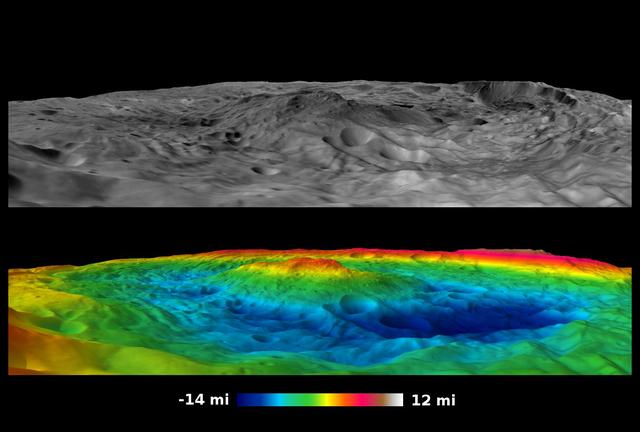
Scientists with NASA Dawn mission have created perspective views of the Rheasilvia impact basin on the giant asteroid Vesta. Rheasilvia is located in Vesta southern hemisphere.
South Pole Vistas
These images from NASA Dawn spacecraft are located in asteroid Vesta Urbinia quadrangle, in Vesta southern hemisphere.
Apparent Brightness and Topography Images of Canuleia and Sossia Craters
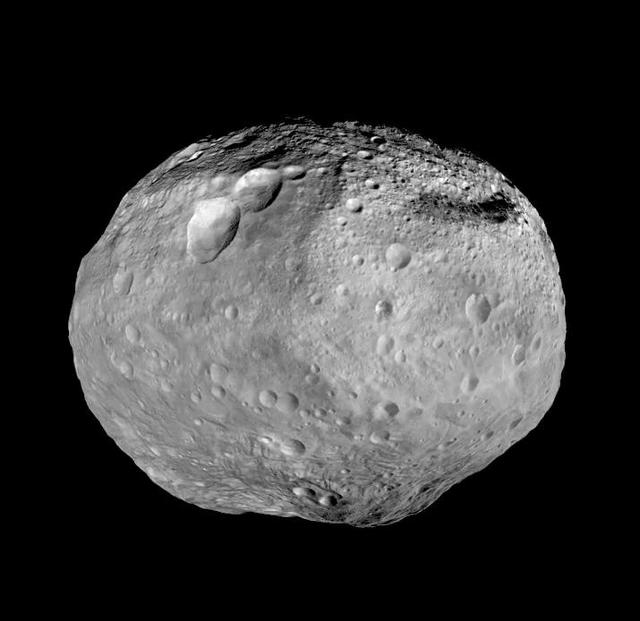
As NASA Dawn spacecraft takes off for its next destination, this mosaic synthesizes some of the best views the spacecraft had of the giant asteroid Vesta. The set of three craters known as the nowman can be seen at the top left.
Full View of Vesta
Numerous small, bright spots appear on asteroid Vesta, as seen in this image from NASA Dawn spacecraft. This region is just north of the equator, to the west of Marcia crater.
Bright Spots Near Marcia
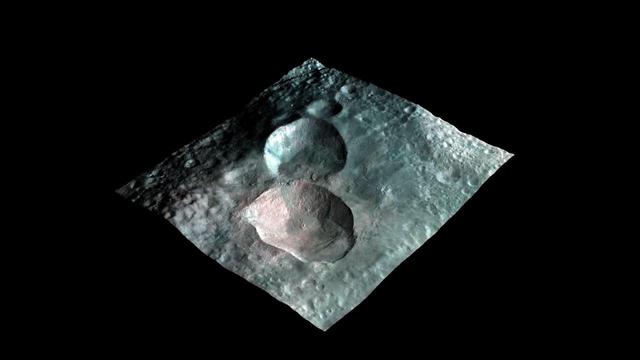
This image from NASA Dawn mission shows a 3-D rendering of the craters that make up the nowman feature on the giant asteroid Vesta. From left to right, the craters are named Marcia, Calpurnia, and Minucia.
Views of the Snowman
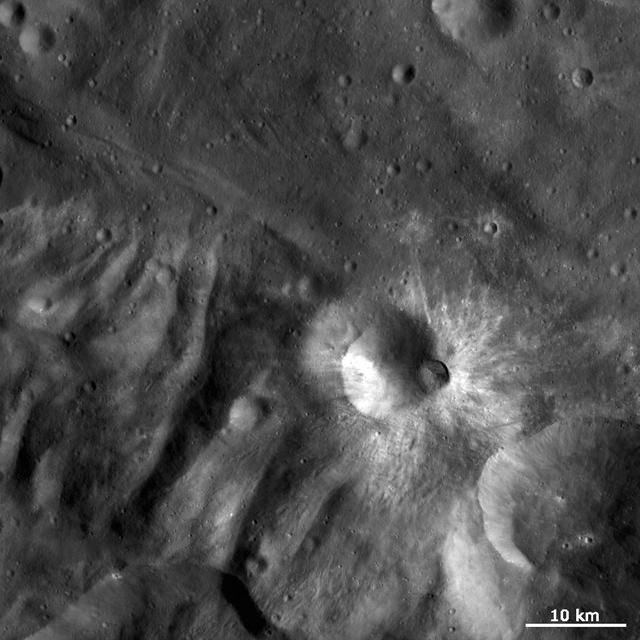
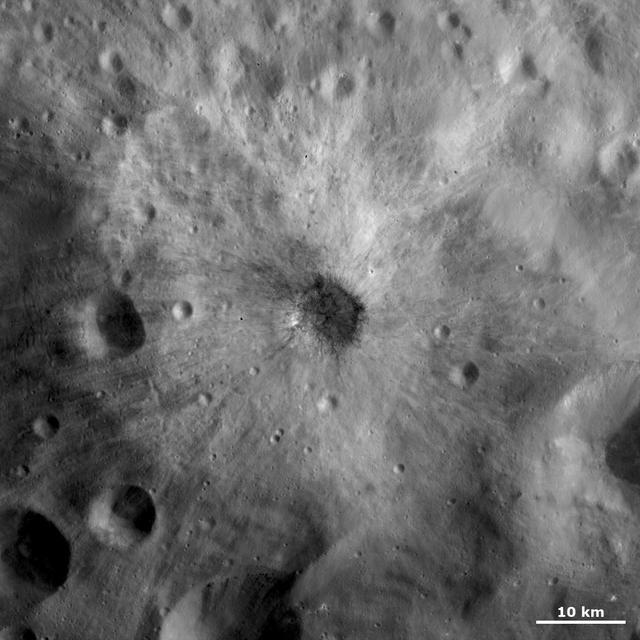
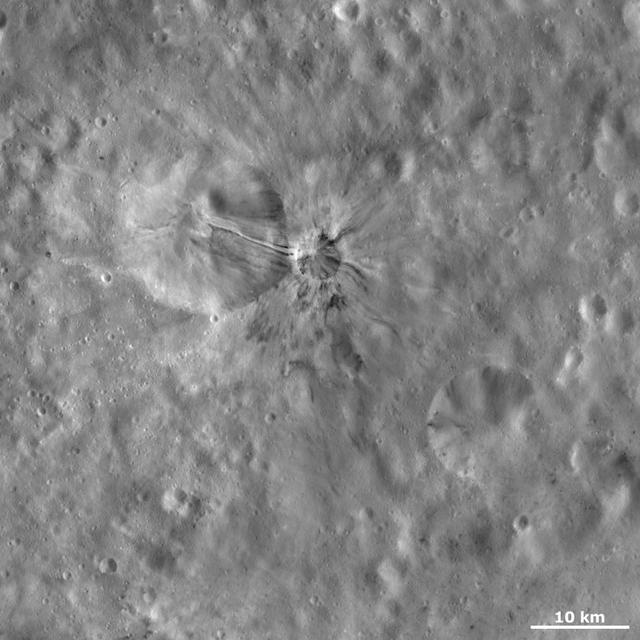
This image from NASA Dawn spacecraft is centered on a small, young, fresh crater with bright and dark ejecta rays extending from it. The crater is located in Vesta Tuccia quadrangle on asteroid Vesta.
Crater with Dark and Bright Ejecta
These images from NASA Dawn spacecraft show part of asteroid Vesta equatorial region, which contains many different sizes of impact craters.
Topography of Vesta Equatorial Region II
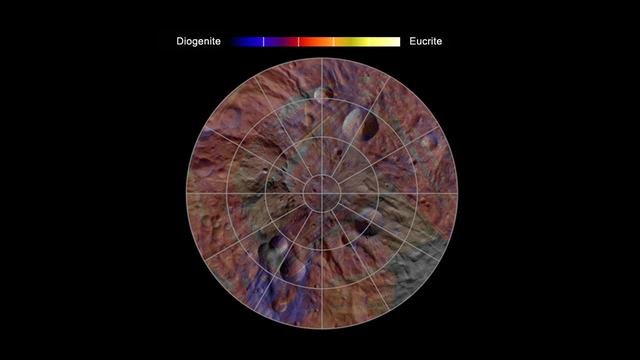
This image, made from data obtained by NASA Dawn spacecraft, shows the mineral distribution in the southern hemisphere of the giant asteroid Vesta.
Mineral Diversity at Vesta South Pole
These composite images from NASA Dawn spacecraft images show the spectacular spectral diversity of asteroid Vesta surface.
Color Composite Images of Vesta
This image from NASA Dawn spacecraft of asteroid Vesta shows a long chain of craters in the right part of the image, located in Vesta Caparronia quadrangle, in Vesta northern hemisphere.
Chain of Craters
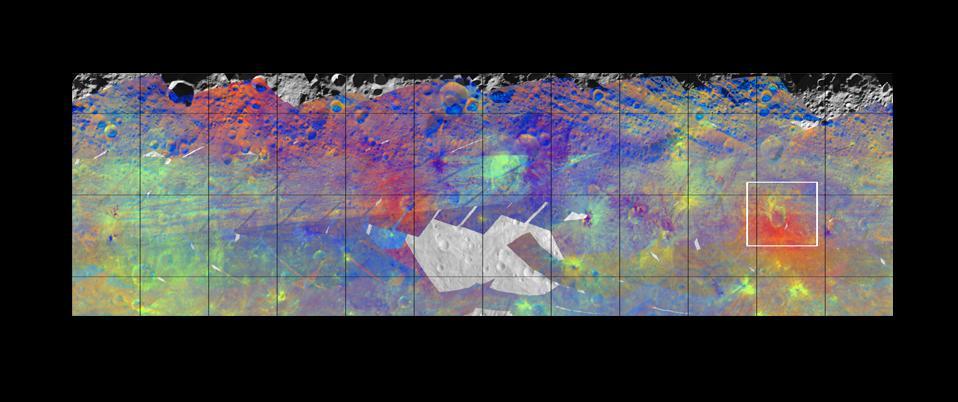
This image from NASA Dawn mission shows the varied minerals on the surface of the giant asteroid Vesta in false color.
Colorized Infrared View of Vesta
This image, from NASA Dawn spacecraft, shows rock material that has moved across the surface and flowed into a low area in the ridged floor of the Rheasilvia basin on asteroid Vesta.
Flowing Material
This image from NASA Dawn spacecraft is located in Lucaria Tholus quadrangle, in Vesta northern hemisphere. Around Publicia rim are many alternating streaks of bright and dark material tumbling down towards its center.
Publicia Crater
This image from NASA Dawn spacecraft of asteroid Vesta shows Antonia crater. Antonia rim has two different states of freshness: the bottom left one-third of the rim is very degraded but the other two-thirds of the rim is reasonably fresh.
Antonia Crater
These images from NASA Dawn spacecraft are located in asteroid Vesta Pinaria quadrangle, in Vesta southern hemisphere.
HAMO and LAMO Images of Aquilia Crater
This image from NASA Dawn spacecraft shows many highly degraded craters in the top part of the image. These craters are so degraded that their rims are only partially visible.
Mass Wasting on Steep Slopes
These images from NASA Dawn spacecraft are located in Vesta Numisia quadrangle, in Vesta northern hemisphere.
Fabia Crater, Apparent Brightness and Topography Images
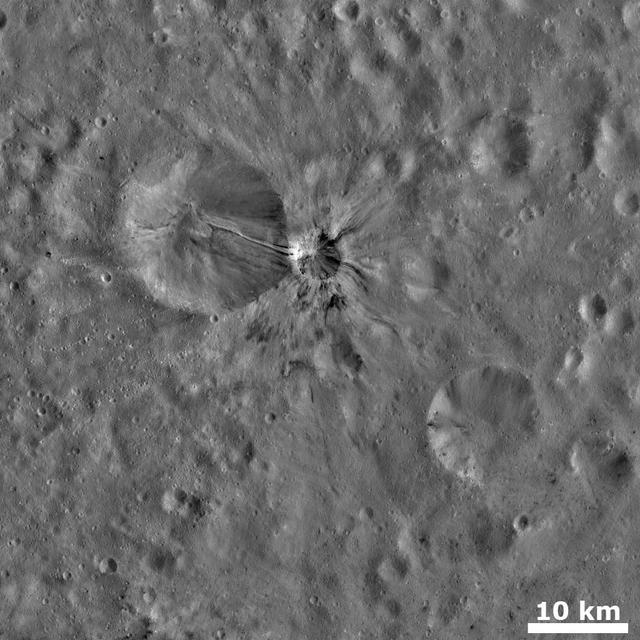
This image from NASA Dawn spacecraft shows a small, young, fresh crater on asteroid Vesta with bright and dark rays extending from it.
Fresh Crater with Bright and Dark Rays
This image from NASA Dawn spacecraft of asteroid Vesta shows Eusebia crater on the right. The smaller crater, offset from the center of the image, with a smaller crater on its rim is Tuccia crater.
Tuccia and Eusebia Craters
These composite images from NASA Dawn spacecraft show three views of a terrain with ridges and grooves near Aquilia crater in the southern hemisphere of the giant asteroid Vesta.
Aquilia Area in Color
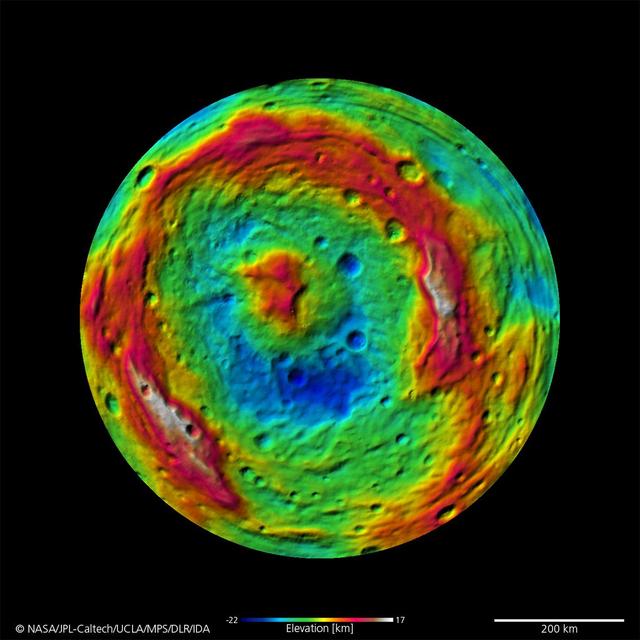
The terrain model of Vesta southern hemisphere shows a big circular structure, its rim rising above the interior of the structure. This false-color map of the giant asteroid Vesta is from the framing camera aboard NASA Dawn spacecraft.
A False-Color Topography of Vesta South Pole
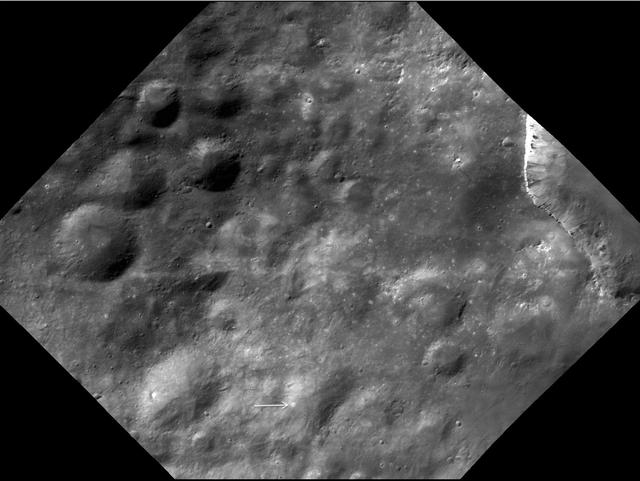
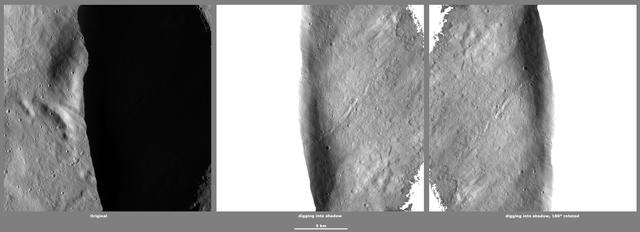
These images from NASA Dawn spacecraft, located in asteroid Vesta Oppia quadrangle, in Vesta northern hemisphere, demonstrate a special analytical technique, which results in shadowed areas of Vesta surface becoming illuminated.
Revealing Shadows 2
This image from NASA Dawn spacecraft of asteroid Vesta shows Rubria crater, with dark and bright material, offset from the center of the image. Rubria crater is located in Vesta Gegania quadrangle, just south of Vesta equator.
Rubria Crater
This still from an animation made from data obtained by NASA Dawn spacecraft shows the topography of a portion of the wall and interior of the Rheasilvia impact basin in asteroid Vesta south-polar region.
Wall of Rheasilvia
This image from NASA Dawn spacecraft shows many large subdued craters that have smaller, younger craters on top of them on asteroid Vesta. There are two large subdued craters in the center of the image, which have very degraded and rounded…
Large Subdued and Small Fresh Craters
These images from NASA Dawn spacecraft are located in asteroid Vesta Tuccia quadrangle, in Vesta southern hemisphere.
Apparent Brightness and Topography Images of Antonia Crater
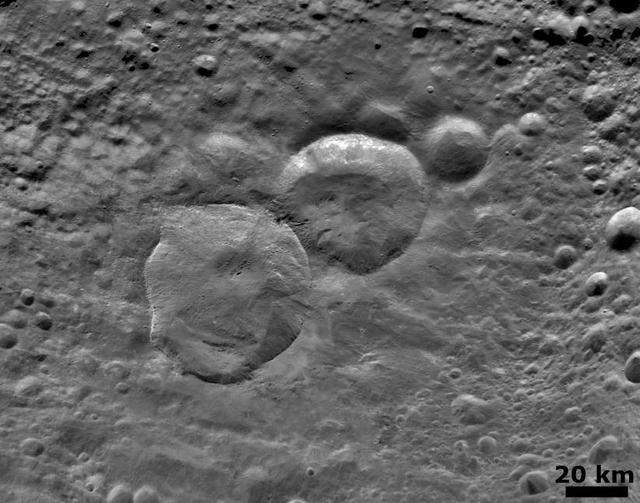
This image from NASA Dawn spacecraft shows a detailed view of three craters, informally nicknamed Snowman by the camera team members.
Detailed Snowman Crater
This image of Eutropia AV-L-10, from the atlas of the giant asteroid Vesta, was created from images taken as NASA Dawn mission flew around the object, also known as a protoplanet. The set of maps was created from mosaics of10,000 images fro…
Eutropia AV-L-10
This image from NASA Dawn spacecraft shows is located in asteroid Vesta Rheasilvia quadrangle, near Vesta south pole. Severina crater has a fresh, sharp rim and a smaller, presumably younger, crater on its rim.
Lines of Craters
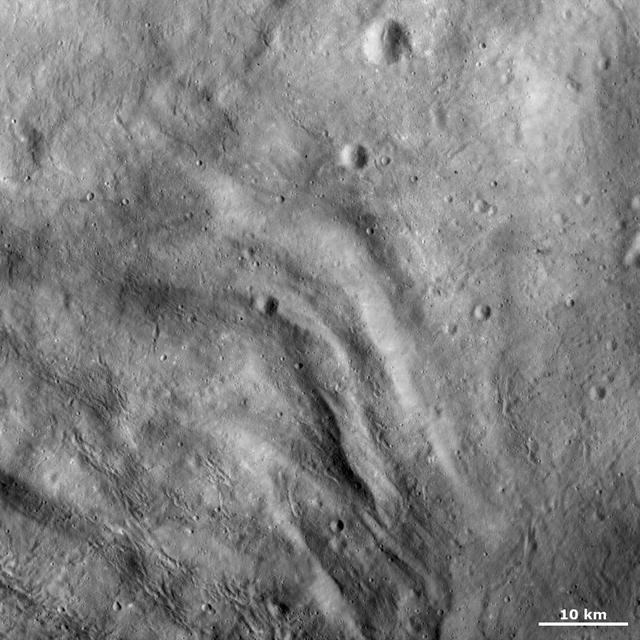
This image from NASA Dawn spacecraft shows undulating terrain, located only in asteroid Vesta southern hemisphere, in and around the Rheasilvia impact basin.
Undulating Terrain in Vesta Southern Hemisphere
These images from NASA Dawn spacecraft are located in Urbinia quadrangle, in Vesta southern hemisphere.
HAMO and LAMO Images of Canuleia Crater
This image from NASA Dawn spacecraft is centered on the Sextilia crater in asteroid Vesta southern hemisphere. Craters on Vesta are named after Vestal virgins, priestesses of the Roman goddess Vesta.
Sextilia Crater and Surroundings
This image from NASA Dawn spacecraft of asteroid Vesta shows Aelia crater with a larger, more degraded crater to the left. Dark and bright material crops out from Aelia rim and slumps towards its center extending in rays outside the crater…
Aelia Crater
This image from NASA Dawn spacecraft of asteroid Vesta shows Lepida crater, located in Vesta Floronia quadrangle, in Vesta northern hemisphere.
Lepida Crater
This 3D image shows the topography of craters and grooves of asteroid Vesta south polar region obtained by the framing camera instrument aboard NASA Dawn spacecraft on Aug. 23 and 28, 2011. You need 3D glasses to view this image.
Anaglyph of Craters in the South Polar Region