
This photograph shows a solar prominence in action, one of Skylab's many splendorous views. It was taken on August 21, 1973. Interpretation of the rich store of Skylab ultraviolet solar data was facilitated by computerized color enhancement…

In 1986, NASA introduced a Shuttle-borne ultraviolet observatory called Astro. The Astro Observatory was designed to explore the universe by observing and measuring the ultraviolet radiation from celestial objects. Astronomical targets of o…

Hinode (Sunrise), formerly known as Solar-B before reaching orbit, was launched from the Uchinoura Space Center in Japan on September 23, 2006. Hinode was designed to probe into the Sun’s magnetic field to better understand the origin of so…

Hinode (Sunrise), formerly known as Solar-B before reaching orbit, was launched from the Uchinoura Space Center in Japan on September 23, 2006. Hinode was designed to probe into the Sun’s magnetic field to better understand the origin of so…

This 1973 chart details Skylab's Ultraviolet (UV) Spectrograph, an Apollo Telescope Mount instrument. Its telescope, with camera and TV capability, photographed the Sun in selected ultraviolet wavelengths. The spectrograph was used to recor…

This is a presentation of two comparison images of the Spiral Galaxy M81 in the constellation URA Major. The galaxy is about 12-million light years from Earth. The left image is the Spiral Galaxy M81 as photographed by the Ultraviolet Imagi…

This chart details Skylab's Ultraviolet (UV) X-Ray Solar Photography experiment (S020) in an Apollo Telescope Mount facility. It was designed to photograph normal and explosive areas within the solar atmosphere in the UV and x-ray spectra.…

This 1970 photograph shows Skylab's Ultraviolet (UV)/X-Ray Solar Photography instrument, an Apollo Telescope Mount (ATM) facility designed to photograph normal and explosive areas in the solar atmosphere in the x-ray and UV spectra. The Mar…

STS035-28-006 (2-10 Dec 1990) --- STS-35 Astronomy Laboratory 1 (ASTRO-1) telescopes, in on-orbit operating position in the payload bay (PLB), are silhouetted against an reaction control system (RCS) right thruster firing. Three ultraviolet…
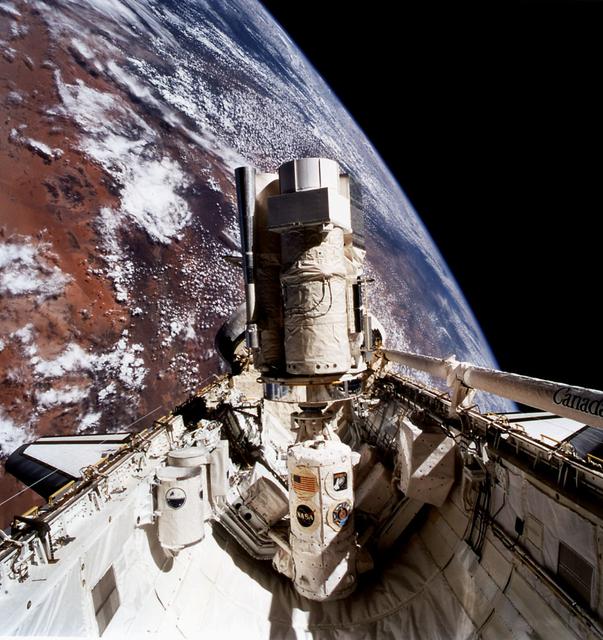
ASTRO-2 was the second dedicated Spacelab mission to conduct astronomical observations in the ultraviolet spectral regions. It consisted of three unique instruments: the Hopkins Ultraviolet Telescope (HUT), the Ultraviolet Imaging Telescope…

This photograph was taken during the integration of the Astro-1 mission payloads at the Kennedy Space Center on March 20, 1990, showing the Broad Band X-Ray Telescope (BBXRT) at the left, as three telescopes for the Astro-1 Observatory are…
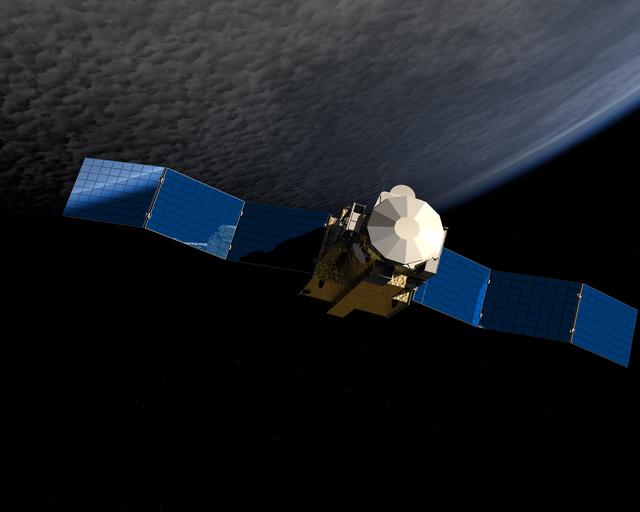
Hinode (Sunrise), formerly known as Solar-B before reaching orbit, was launched from the Uchinoura Space Center in Japan on September 23, 2006. Hinode was designed to probe into the Sun’s magnetic field to better understand the origin of so…
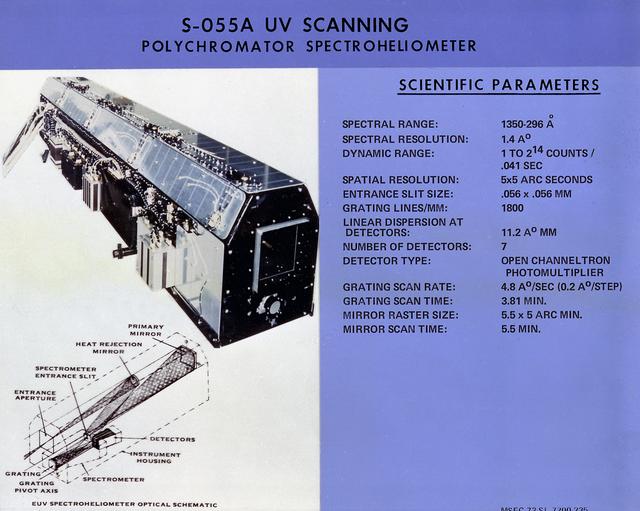
This chart describes scientific parameters of the Skylab Ultraviolet (UV) Scanning Polychromator Spectroheliometer, one the eight Apollo Telescope Mount facilities. It was designed to observe and provide temporal changes in UV radiation emi…

This chart describes Skylab's Extreme Ultraviolet (XUV) Coronal Spectroheliograph, one of the eight Apollo Telescope Mount facilities. It was designed to sequentially photograph the solar chromosphere and corona in selected ultraviolet wave…

STS-35 Astronomy Laboratory 1 (ASTRO-1) is installed in Columbia's, Orbiter Vehicle (OV) 102's, payload bay (PLB) at the Kennedy Space Center (KSC) Orbiter Processing Facility (OPF). On the left, in the aft PLB is the Broad Band X Ray Teles…

Roman Space Telescope team members inspect the primary mirror in the dark using flashlights and UV lights to help them see any contamination, inside the cleanroom at Goddard Space Flight Center, Greenbelt Md., July 2, 2025. The green glow o…

STS035-13-008 (2-10 Dec. 1990) --- The various components of the Astro-1 payload are seen backdropped against the blue and white Earth in this 35mm scene photographed through Columbia's aft flight deck windows. Parts of the Hopkins Ultravio…

MARSHALL SCIENTIST ED WEST ASSEMBLES THE OPTICAL SYSTEM OF THE SOLAR ULTRAVIOLET MAGNETOGRAPH INVESTIGATION TELESCOPE

In this photograph, the instruments of the Astro-1 Observatory are erected in the cargo bay of the Columbia orbiter. Astro-1 was launched aboard the the Space Shuttle Orbiter Columbia (STS-35) mission on December 2, 1990. The Astro Observat…

This image shows a part of the Cygnus loop supernova remnant, taken by the Ultraviolet Imaging Telescope (UIT) on the Astro Observatory during the Astro-1 mission (STS-35) on December 5, 1990. Pictured is a portion of the huge Cygnus loop,…

This photograph shows Skylab's Extreme Ultraviolet (XUV) Spectroheliograph during an acceptance test and checkout procedures in April 1971. The unit was an Apollo Telescope Mount (ATM) instrument designed to sequentially photograph the sola…

This 1970 photograph shows the Skylab's Ultraviolet (UV) Spectrograph, an Apollo Telescope Mount instrument. Its telescope, with camera and TV capability, photographed the Sun in selected ultraviolet wavelengths. The spectrograph was used t…
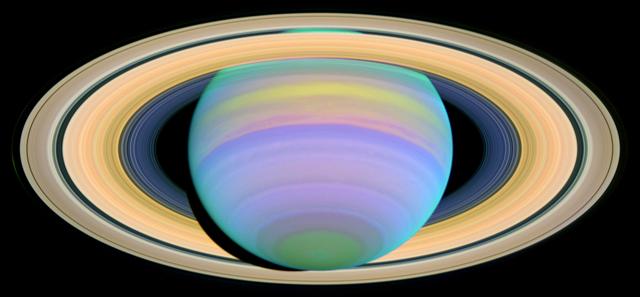
Saturn's Rings in Ultraviolet Light Credit: NASA and E. Karkoschka (University of Arizona) The Hubble Space Telescope is a project of international cooperation between NASA and the European Space Agency. NASA's Goddard Space Flight Center…

STS035-35-007 (2-10 Dec 1990) --- During the STS-35 mission, the Astronomy Laboratory 1 (ASTRO-1) payload, in its on-orbit operating configuration in the payload bay (PLB), is silhouetted against the firing of a reaction control system (RCS…