Detailed measurements of the physical properties of the seven rocky TRAPPIST-1 planets and the four terrestrial planets in our solar system help scientists find similarities and differences between the two planet families.  https://photojou…
TRAPPIST-1 and Solar System Planet Stats
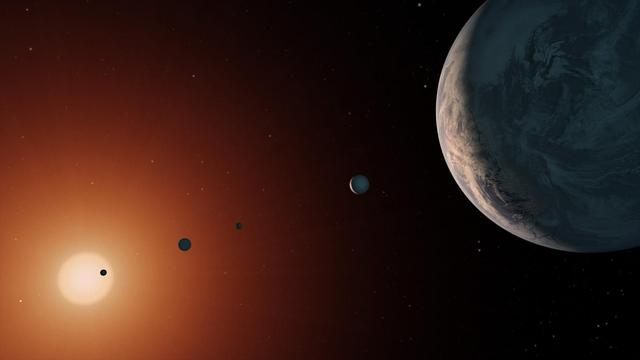
This illustration shows the seven TRAPPIST-1 planets as they might look as viewed from Earth using a fictional, incredibly powerful telescope. The sizes and relative positions are correctly to scale: This is such a tiny planetary system tha…
Transit Illustration of TRAPPIST-1
This artist's concept shows what the TRAPPIST-1 planetary system may look like, based on available data about the planets' diameters, masses and distances from the host star. The system has been revealed through observations from NASA's Spi…
TRAPPIST-1 Planet Lineup
This chart shows, on the top row, artist concepts of the seven planets of TRAPPIST-1 with their orbital periods, distances from their star, radii, masses, densities and surface gravity as compared to those of Earth. These numbers are curren…
TRAPPIST-1 Planet Lineup - Updated Feb. 2018
This graph presents known properties of the seven TRAPPIST-1 exoplanets (labeled b through h), showing how they stack up to the inner rocky worlds in our own solar system.  The horizontal axis shows the level of illumination that each plane…
Comparing TRAPPIST-1 to the Solar System
This still from a video shows illustrations of the seven Earth-size planets of TRAPPIST-1, an exoplanet system about 40 light-years away, based on data current as of February 2018. Each planet is shown in sequence, starting with the innermo…
TRAPPIST-1 Planet Animations
This illustration shows what the TRAPPIST-1 system might look like from a vantage point near planet TRAPPIST-1f (at right).  The system has been revealed through observations from NASA's Spitzer Space Telescope and the ground-based TRAPPIST…
TRAPPIST-1 System - Artist Concept
This graph presents measured properties of the seven TRAPPIST-1 exoplanets (labeled b through h), showing how they stack up with one another as well as with Earth and the other inner rocky worlds in our own solar system. The relative sizes…
Comparison of TRAPPIST-1 to the Solar System
This illustration shows three possible interiors of the seven rocky exoplanets in the TRAPPIST-1 system, based on precision measurements of the planet densities. Overall the TRAPPIST-1 worlds have remarkably similar densities, which suggest…
Possible Interiors of the TRAPPIST-1 Exoplanets
This frame from a video depicts artist concepts of each of the seven planets orbiting TRAPPIST-1, an ultra-cool dwarf stars.  Over 21 days, NASA's Spitzer Space Telescope measured the drop in light as each planet passed in front of the star…
TRAPPIST-1 Planets - Flyaround Animation
The TRAPPIST-1 system contains a total of seven planets, all around the size of Earth. Three of them -- TRAPPIST-1e, f and g -- dwell in their star's so-called "habitable zone." The habitable zone, or Goldilocks zone, is a band around ever…
The TRAPPIST-1 Habitable Zone
This artist's concept appeared on the Feb. 23, 2017 cover of the journal Nature announcing that the TRAPPIST-1 star, an ultra-cool dwarf, has seven Earth-size planets orbiting it. Any of these planets could have liquid water on them. Planet…
Abstract Concept of TRAPPIST-1 System
All seven planets discovered in orbit around the red dwarf star TRAPPIST-1 could easily fit inside the orbit of Mercury, the innermost planet of our solar system. In fact, they would have room to spare. TRAPPIST-1 also is only a fraction of…
TRAPPIST-1 Compared to Jovian Moons and Inner Solar System - Updated Feb. 2018
Measuring the mass and diameter of a planet reveals its density, which can give scientists clues about its composition. Scientists now know the density of the seven TRAPPIST-1 planets with a higher precision than any other planets in the un…
Measuring the Masses and Diameters of the TRAPPIST-1 Planets
This artist's concept allows us to imagine what it would be like to stand on the surface of the exoplanet TRAPPIST-1f, located in the TRAPPIST-1 system in the constellation Aquarius.  Because this planet is thought to be tidally locked to i…
Surface of TRAPPIST-1f
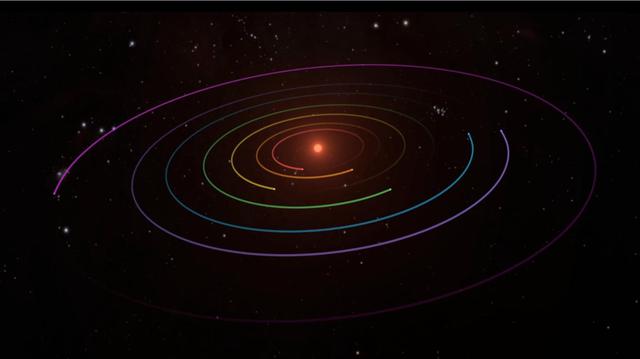
This frame from a video details a system of seven planets orbiting TRAPPIST-1, an ultra-cool dwarf star. Spitzer was able to identify a total of seven rocky worlds, including three in the habitable zone where liquid water might be found.  A…
TRAPPIST-1 Planetary Orbits and Transits
This chart shows, on the top row, artist concepts of the seven planets of TRAPPIST-1 with their orbital periods, distances from their star, radii and masses as compared to those of Earth. On the bottom row, the same numbers are displayed fo…
TRAPPIST-1 Statistics Table
All seven planets discovered in orbit around the red dwarf star TRAPPIST-1 could easily fit inside the orbit of Mercury, the innermost planet of our solar system. In fact, they would have room to spare. TRAPPIST-1 also is only a fraction of…
TRAPPIST-1 Comparison to Solar System and Jovian Moons
This illustration shows the seven Earth-size planets of TRAPPIST-1, an exoplanet system about 40 light-years away, based on data current as of February 2018. The image shows the planets' relative sizes but does not represent their orbits to…
Illustration of TRAPPIST-1 Planets as of Feb. 2018
This artist's concept shows what the TRAPPIST-1 planetary system may look like, based on available data about the planets' diameters, masses and distances from the host star, as of February 2018.  This image represents an updated version of…
TRAPPIST-1 Planet Lineup - Updated Feb. 2018
No more images