
Test firing of a Redstone Missile at Redstone Test Stand in the early 1950's. The Redstone was a high-accuracy, liquid-propelled, surface-to-surface missile developed by the von Braun Team under the management of the U.S. Army. The Redstone…
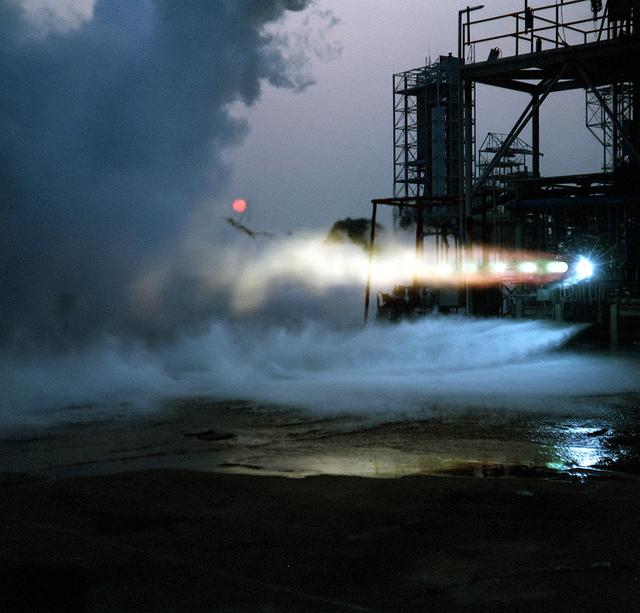
A 40K Pratt Whitney engine for the National Launch System is test fired at Marshall's Test Stand 116.

This photograph depicts the F-1 engine firing in the Marshall Space Flight Center’s F-1 Engine Static Test Stand. Construction of the S-IC Static test stand complex began in 1961 in the west test area of MSFC, and was completed in 1964. It…

What better way to mark 50 years of rocket engine testing than with a rocket engine test? Stennis Space Center employees enjoyed a chance to view an RS-68 engine test at the B-1 Test Stand on April 19, almost 50 years to the day that the fi…

In this photograph, the single H-1 engine was test-fired at Canoga Park, California. Initial development of testing for the H-1 engine took place in the engineering facilities at Rocketdyne's main plant in Canoga Park, California.
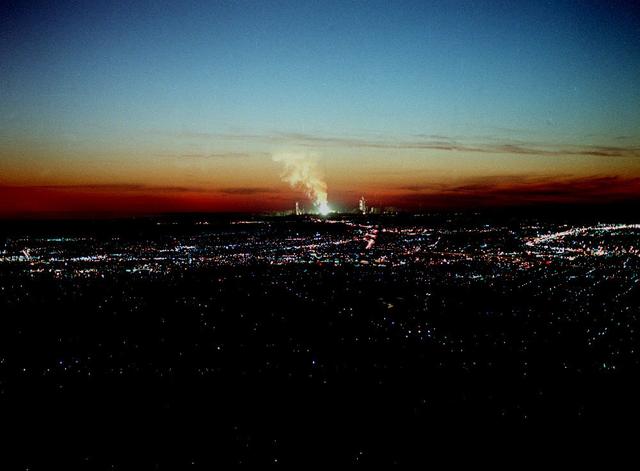
A 48 inch Advanced Solid Rocket Motor is test fired at Marshall's Solid Propulsion Research Test Article facility for M-NASA Project.

Test firing of the Saturn I S-I Stage (S-1-10) at the Marshall Space Flight Center. This test stand was originally constructed in 1951 and sometimes called the Redstone or T tower. In l961, the test stand was modified to permit static firin…

This photograph depicts a view of the test firing of all five F-1 engines for the Saturn V S-IC test stage at the Marshall Space Flight Center. The S-IC stage is the first stage, or booster, of a 364-foot long rocket that ultimately took as…

This photograph shows a test firing of the the Saturn V S-II (second) stage at the Mississippi Test Facility's (MTF) S-II test stand. When the Saturn V booster stage (S-IC) burns out and drops away, power for the Saturn will be provided by…

Lee B. James (left), manager of the Saturn Program at the Marshall Space flight Center (MSFC), talks with Isom Pigell in the firing room 1 of the Kennedy Space Center (KSC) control center during the countdown demonstration test for the Apol…

NASA astronaut Victor Glover, left, and a SpaceX employee, seated at consoles inside SpaceX Mission Control in Hawthorne, California, monitor the Crew Dragon spacecraft static fire engine tests taking place at Cape Canaveral Air Force Stati…

NASA astronaut Bob Behnken, seated at a console inside SpaceX Mission Control in Hawthorne, California, monitors the Crew Dragon spacecraft static fire engine tests taking place at Cape Canaveral Air Force Station in Florida on Nov. 13, 201…

NASA astronauts Doug Hurley, left, and Bob Behnken, seated at consoles inside SpaceX Mission Control in Hawthorne, California, monitor the Crew Dragon spacecraft static fire engine tests taking place at Cape Canaveral Air Force Station in F…

The Saturn V first stages were test fired at the Mississippi Test Facility and at the Marshall Space Flight Center (MSFC). Five F-1 engines powered the first stage, each developing 1.5 million pounds of thrust. The first stage, known as the…

The core stage for the first flight of NASA’s Space Launch System rocket is seen in the B-2 Test Stand during a second hot fire test, Thursday, March 18, 2021, at NASA’s Stennis Space Center near Bay St. Louis, Mississippi. The four RS-25 e…

Solid Rocket Qualification Motor Firing at the Morton Thiokol facility at Brigham City, Utah on 20 April 1988.

This photograph depicts the Rocketdyne static firing of the F-1 engine at the towering 76-meter Test Stand 1-C in Area 1-125 of the Edwards Air Force Base in California. The Saturn V S-IC (first) stage utilized five F-1 engines for its thru…

Pictured is an early testing of the Solid Rocket Motor (SRM) at the Thiokol facility in Utah. The SRMs later became known as Solid Rocket Boosters (SRBs) as they were more frequently used on the Space Shuttles.

NASA engineers successfully complete the first series of tests in the early development of the J-2X engine that will power the Ares I and Ares V rockets, key components of NASA's Constellation Program.

Year 2015 got off to a blazing start as NASA conducted its first test of an RS-25 rocket engine on the A-1 Test Stand at Stennis Space Center on Jan. 9, 2015. The 500-second test provided critical data on engine performance. RS-25 engines w…

A close-up image of the single H-1 engine was test-fired at Canoga Park, California. Initial development of testing for the H-1 engine took place in the engineering facilities at Rocketdyne's main plant in Canoga Park, California.

Two large-engine tests were conducted simultaneously for the first time at Stennis Space Center on Aug. 16. A plume on the left indicates a test on the facility's E-1 Test Stand. On the right, a finger of fire indicates a test under way on…

This image depicts a firing of a single H-1 engine at the Marshall Space Flight Center’s (MSFC’s) Power Plant test stand. This 1950s test stand, inherited from the Army, was used to test fire engines until the Test Area was completed in the…

This photograph shows a test firing of the the Saturn V S-II (second) stage at the Mississippi Test Facility's (MTF) S-II test stand. When the Saturn V booster stage (S-IC) burns out and drops away, power for the Saturn will be provided by…

This photograph depicts a view of the test firing of all five F-1 engines for the Saturn V S-IC test stage at the Marshall Space Flight Center. The S-IC stage is the first stage, or booster, of a 364-foot long rocket that ultimately took as…
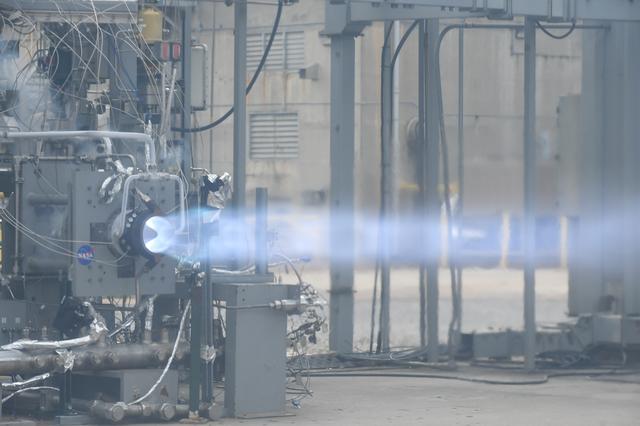
Engineers at NASA’s Marshall Space Flight Center in Huntsville, Alabama, conduct a successful, 251-second hot fire test of a full-scale Rotating Detonation Rocket Engine combustor in fall 2023, achieving more than 5,800 pounds of thrust.

Dr. Kurt Debus, director of the Kennedy Space Flight Center (KSC), participated in the countdown demonstration test for the Apollo 11 mission in firing room 1 of the KSC control center. The Apollo 11 mission, the first lunar landing mission…

NASA astronauts Doug Hurley, left, and Bob Behnken watch the liftoff of a SpaceX Falcon 9 rocket and Crew Dragon spacecraft on the uncrewed In-Flight Abort Test, Jan. 19, 2020, inside Firing Room 4 in Kennedy Space Center’s Launch Control C…

Lee B. James (left), manager of the Saturn Program at the Marshall Space flight Center (MSFC), talks with Isom Pigell in the firing room 1 of the Kennedy Space Center (KSC) control center during the countdown demonstration test for the Apol…

NASA astronauts Doug Hurley, left, and Bob Behnken, seated at consoles inside SpaceX Mission Control in Hawthorne, California, monitor the Crew Dragon spacecraft static fire engine tests taking place at Cape Canaveral Air Force Station in F…

View of a single engine orbital maneuvering system (OMS) firing on the Discovery. The payload bay is open and the protective canisters for the AUSSAT communications satellite (open) and the ASC-1 are visible. A cloudy Earth's horizon can be…

NASA guests gather to watch as the core stage for the first flight of NASA's Space Launch System rocket undergoes a scheduled eight minute duration hot fire test in the B-2 Test Stand, January 16, 2021, at NASA's Stennis Space Center near B…

In honor of the Centernial of Flight Celebration and commissioned by the American Institute of Aeronautics and Astronautics (AIAA), a team of engineers from Marshall Space Flight Center (MSFC) built a replica of the first liquid-fueled rock…
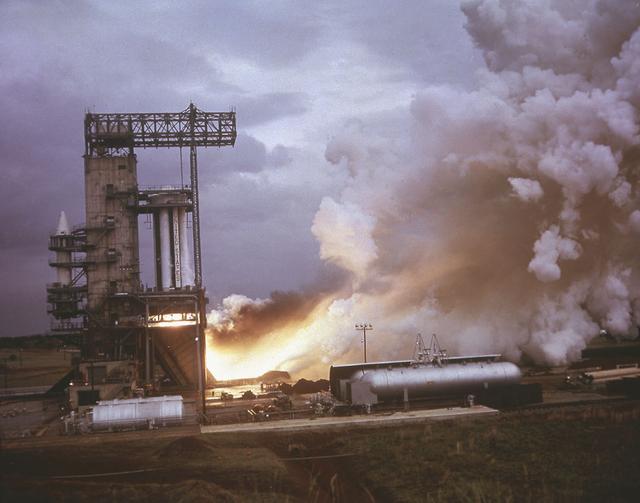
Marshall Space Flight Center (MSFC) was the birthplace of the United States' rocket program. In the early 1960s, most of the rocket development and testing were done at the MSFC. Pictured is an example of what the test engineers would have…

NASA engineers successfully complete the first series of tests in the early development of the J-2X engine that will power the Ares I and Ares V rockets, key components of NASA's Constellation Program.

The F-1 engine was developed and built by Rocketdyne under the direction of the Marshall Space Flight Center. It measured 19 feet tall by 12.5 feet at the nozzle exit, and produced a 1,500,000-pound thrust using liquid oxygen and kerosene a…

Two large-engine tests were conducted simultaneously for the first time at Stennis Space Center on Aug. 16. A plume on the left indicates a test on the facility's E-1 Test Stand. On the right, a finger of fire indicates a test under way on…

A new NASA Space Shuttle Main Engine (SSME) roars to the approval of more than 2,000 people who came to John C. Stennis Space Center in Hancock County, Miss., on July 25 for a flight-certification test of the SSME Block II configuration. Th…

Shuttle crew escape systems (CES) tractor rocket tests conducted at Hurricane Mesa, Utah. This preliminary ground test of the tractor rocket will lead up to in-air evaluations. View shows tractor rocket as it is fired from side hatch mockup…

The first hot-fire test of the J-2X power pack 1A gas generator was performed Jan. 31 on the A-1 Test Stand at Stennis Space Center. Initial indications are that all test objectives were met. The test was designed as a 3.42-second helium sp…

The Marshall Space Flight Center (MSFC) engineers test fired a 26-foot long, 100,000-pound-thrust solid rocket motor for 30 seconds at the MSFC east test area, the first test firing of the Modified NASA Motor (M-NASA Motor). The M-NASA Moto…

NASA Administrator Jim Bridenstine, left, and SpaceX Chief Engineer Elon Musk converse inside Firing Room 4 in Kennedy Space Center’s Launch Control Center while awaiting the liftoff of a SpaceX Falcon 9 rocket and Crew Dragon spacecraft on…

NASA astronauts Doug Hurley, left, and Bob Behnken, seated at consoles inside SpaceX Mission Control in Hawthorne, California, monitor the Crew Dragon spacecraft static fire engine tests taking place at Cape Canaveral Air Force Station in F…

NASA astronaut Victor Glover, right, and a SpaceX employee, seated at consoles inside SpaceX Mission Control in Hawthorne, California, monitor the Crew Dragon spacecraft static fire engine tests taking place at Cape Canaveral Air Force Stat…

This photograph is a view of the Saturn V S-IC-5 (first) flight stage static test firing at the S-IC-B1 test stand at the Mississippi Test Facility (MTF), Bay St. Louis, Mississippi. Begirning operations in 1966, the MTF has two test stands…
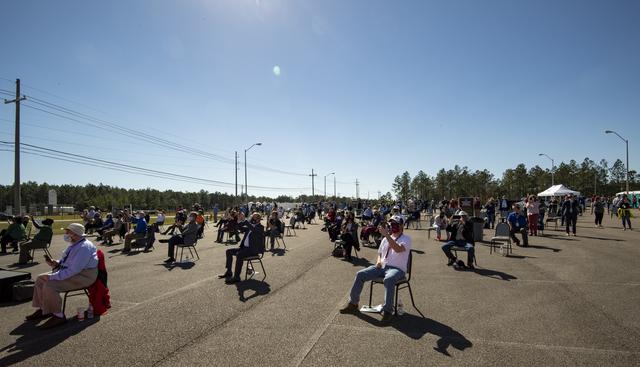
Invited guests watch as the core stage for the first flight of NASA’s Space Launch System rocket undergoes a second hot fire test in the B-2 Test Stand, Thursday, March 18, 2021, at NASA’s Stennis Space Center near Bay St. Louis, Mississipp…
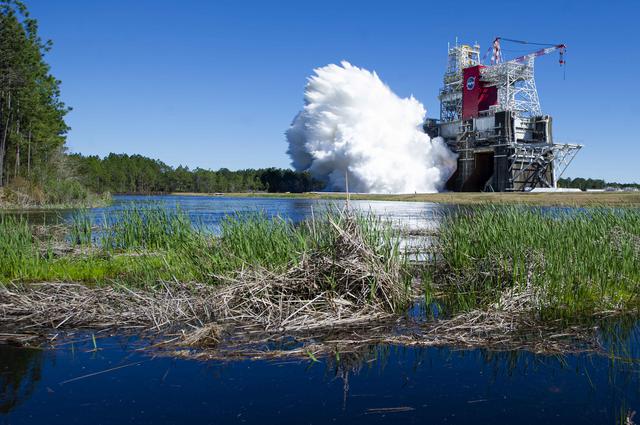
NASA conducts a hot fire test March 18, 2021, of the core stage for the agency’s Space Launch System rocket on the B-2 Test Stand at Stennis Space Center near Bay St. Louis, Mississippi. The hot fire test of the stage’s four RS-25 engines g…

Acting NASA Administrator Steve Jurczyk, left, and Rick Gilbrech, director of NASA's Stennis Space Center, right, high five following a second hot fire test of the core stage for the first flight of NASA’s Space Launch System rocket in the…