
SSC's rocket engine test complex and its four unique test stands provide test operations for the development and certification of propulsion systems, subsystems and components.

Work continues on the A-3 Test Stand at Stennis Space Center. The new stand will allow operators to test next-generation rocket engines at simulated altitudes up to 100,000 feet. The test stand is scheduled for completion and activation in…

Rocket engine propellant tanks and cell dome top the A-3 Test Stand under construction at Stennis Space Center. The stand will test next-generation rocket engines that could carry humans beyond low-Earth orbit into deep space once more.

A tethered Stennis Space Center employee climbs an A-3 Test Stand ladder June 8, 2012, against the backdrop of the A-2 and B-1/B-2 stands. The new A-3 Test Stand will enable simulated high-altitude testing of next-generation rocket engines.

A Stennis Space Center employee works March 2, 2012, to further construction of the A-3 Test Stand, which will enable simulated high-altitude testing of next-generation rocket engines.

Construction of the A-3 Test Stand at Stennis Space Center continued throughout 2011. The stand is the first large test structure built at Stennis since the 1960s.

The A-3 Test Stand under construction at Stennis Space Center is set for completion and activation in 2013. It will allow operators to conduct simulated high-altitude testing on the next-generation J-2X rocket engine.

Test firing of a Redstone Missile at Redstone Test Stand in the early 1950's. The Redstone was a high-accuracy, liquid-propelled, surface-to-surface missile developed by the von Braun Team under the management of the U.S. Army. The Redstone…

Stennis Space Center employees marked another construction milestone July 25 with installation of the 85,000-gallon liquid hydrogen tank atop the A-3 Test Stand. The 300-foot-tall stand is being built to test next-generation rocket engines…

Work on the A-3 Test Stand at Stennis Space Center took a step forward in July with delivery of the first-stage steam ejector July 13. Stennis employees are shown preparing the ejector to be lifted into place on the test stand. When activat…

This is a ground level view of Test Stand 500 at the east test area of the Marshall Space Flight Center. Originally constructed in 1966, Test Stand 500 is a multipurpose, dual-position test facility. The stand was utilized to test liquid hy…

SLS ENGINE SECTION TEST STAND WITH CONSTRUCTION CREW

The Redstone Test Stand was used during the 1950s in early development of the Redstone missile propulsion system. This was the test stand where the modified Redstone missile that launched into space the first American, Alan Shepard, was sta…

This is a ground level view of Test Stand 300 at the east test area of the Marshall Space Flight Center. Test Stand 300 was constructed in 1964 as a gas generator and heat exchanger test facility to support the Saturn/Apollo Program. Deep-s…

Two large-engine tests were conducted simultaneously for the first time at Stennis Space Center on Aug. 16. A plume on the left indicates a test on the facility's E-1 Test Stand. On the right, a finger of fire indicates a test under way on…

Team members check the progress of a liquid nitrogen cold shock test on the A-1 Test Stand at Stennis Space Center on Sept. 15. The cold shock test is used to confirm the test stand's support system can withstand test conditions, when super…

Two large-engine tests were conducted simultaneously for the first time at Stennis Space Center on Aug. 16. A plume on the left indicates a test on the facility's E-1 Test Stand. On the right, a finger of fire indicates a test under way on…

Stennis Space Center employees have installed liquid oxygen and liquid hydrogen tanks atop the A-3 Test Stand, raising the structure to its full 300-foot height. The stand is being built to test next-generation rocket engines that could car…

Construction on the new A-3 Test Stand continues at NASA's Stennis Space Center. The stand is the first large test structure built at the NASA facility since the 1960s.

Construction continues on NASA's A-3 Test Stand at Stennis Space Center. The stand is the first large test structure built at the south Mississippi facility since the 1960s.

Work continues on the A-3 Test Stand at Stennis Space Center. The new stand will allow operators to test next-generation rocket engines at simulated altitudes up to 100,000 feet. The test stand is scheduled for completion and activation in…

Stennis Space Center Director Patrick Scheuermann presents center director coins to employees following the 'topping out' of the A-3 Test Stand with placement of test cell dome on April 13. The stand is the first large test structure built…

Construction on the new A-3 Test Stand continues at NASA's Stennis Space Center. The stand is the first large test structure built at the NASA facility since the 1960s.

A tethered Stennis Space Center employee climbs an A-3 Test Stand ladded June 8, 2012, against the backdrop of the A-2 and B-1/B-2 stands. The new A-3 Test Stand will enable simulated high-altitude testing of next-generation rocket engines.

Employees at Stennis Space Center continue work on the A-3 Test Stand. As shown, a section of the test cell is lifted for installation on the stand's structural steel frame. Work on the A-3 Test Stand began in 2007. It is scheduled for acti…

The A-3 Test Stand under construction at Stennis Space Center is set for completion and activation in 2013. It will allow operators to conduct simulated high-altitude testing on the next-generation J-2X rocket engine.

Space shuttle main engine No. 0525 is lifted from the A-2 Test Stand at Stennis Space Center against the backdrop of the new A-3 Test Stand under construction, offering a glimpse of the past and future in the nation's space exploration prog…
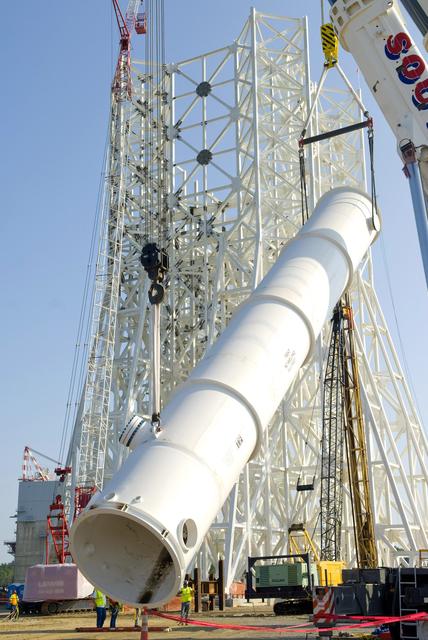
A water tank is lifted into place at the A-3 Test Stand being built at NASA's John C. Stennis Space Center. Fourteen water, liquid oxygen (LOX) and isopropyl alcohol (IPA) tanks are being installed to support the chemical steam generators t…

SLS ENGINE SECTION TEST STAND WITH CONSTRUCTION CREW

In this aerial view, a barge can be seen towing a container away from a test stand at the John C. Stennis Space Center.

This photograph shows the installation of a Mercury capsule and escape system on top of a booster prior to test firing of the Mercury-Redstone at Marshall Space Flight Center's (MSFC's) Redstone Test Stand. Assembled by MSFC, the Mercury-Re…
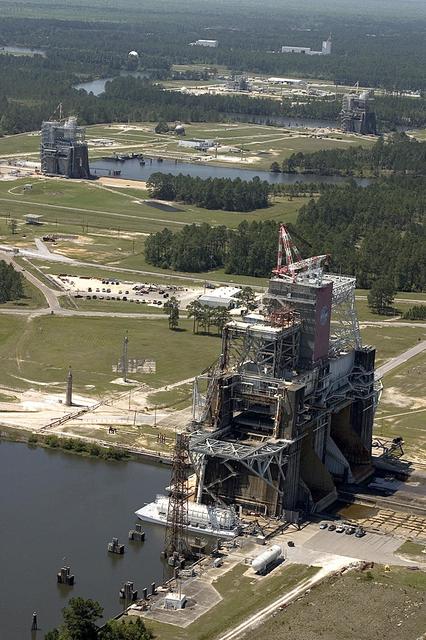
An aerial photo shows the B-1/B-2 Test Stand (foreground), A-2 Test Stand (middle) and A-1 Test Stand (back). The historic stands have been used to test engines used on every manned Apollo and space shuttle mission.

John C. Stennis Space Center employees remove one-half of the A-2 Test Stand clamshell used for testing space shuttle main engines. Space shuttle main engine testing concluded July 2009; the A-2 stand now is being prepared for testing the n…

NASA conducted a successful seven-second test of the next-generation J-2X rocket engine on the A-2 Test Stand at Stennis Space Center on May 16, 2012. The J-2X is being developed for NASA by Pratt & Whitney Rocketdyne.

In addition to the historic A-2 Test Stand (foreground) and A-1 Test Stand (back right), construction of a new A-3 Test Stand (back left) is under way at Stennis Space Center. The new stand will allow operators to test next-generation rocke…

A Stennis Space Center employee works March 2, 2012, to further construction of the A-3 Test Stand, which will enable simulated high-altitude testing of next-generation rocket engines.

Rocket engine propellant tanks and cell dome top the A-3 Test Stand under construction at Stennis Space Center. The stand will test next-generation rocket engines that could carry humans beyond low-Earth orbit into deep space once more.

Stennis Space Center employees continue work on the A-3 Test Stand test cell. The stand is being built to test next-generation rocket engines that could carry humans beyond low-Earth orbit into deep space.

A construction 'topping out' milestone was reached April 13 with placement of the test cell dome atop NASA's new A-3 Test Stand at Stennis Space Center. NASA broke ground in 2007 for the new stand, which is being built to provide simulated…

Construction of the A-3 Test Stand at Stennis Space Center continued throughout 2011. The stand is the first large test structure built at Stennis since the 1960s.

Construction of the A-3 Test Stand at Stennis Space Center continued June 8 with installation of a 35,000-gallon liquid oxygen tank atop the steel structure. The stand is being built to test next-generation rocket engines that will carry hu…

A water tank is lifted into place at the A-3 Test Stand being built at NASA's John C. Stennis Space Center. Fourteen water, liquid oxygen (LOX) and isopropyl alcohol (IPA) tanks are being installed to support the chemical steam generators t…

On October 27, 1961, the Marshall Space Flight Center (MSFC) and the Nation marked a high point in the 3-year-old Saturn development program when the first Saturn vehicle flew a flawless 215-mile ballistic trajectory from Cape Canaveral, Fl…

SLS ENGINE SECTION TEST STAND READY FOR STRUCTURAL TEST ARTICLE
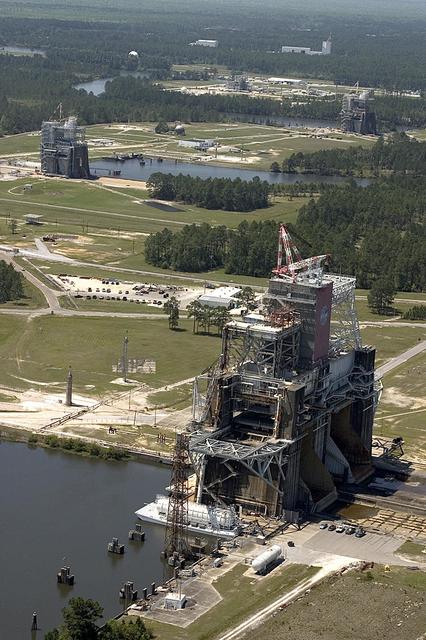
An aerial photo shows the B-1/B-2 Test Stand (foreground), A-2 Test Stand (middle) and A-1 Test Stand (back). The historic stands have been used to test engines used on every manned Apollo and space shuttle mission.

John C. Stennis Space Center employees remove space shuttle main engine run ducts from the A-2 Test Stand engine deck Oct. 25, 2010. Testing of space shuttle main engines concluded in July 2009. Stennis is preparing the A-2 Test Stand for t…

John C. Stennis Space Center employees install a new master interface tool on the A-2 Test Stand on Oct. 27, 2010. Until July 2009, the stand had been used for testing space shuttle main engines. With that test series complete, employees ar…

A photo taken from the top of the new A-3 Test Stand at Stennis Space Center offers a panoramic view of the A, B and E test complexes at the south Mississippi facility.