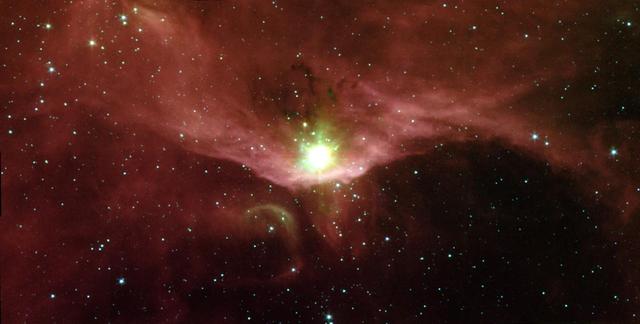
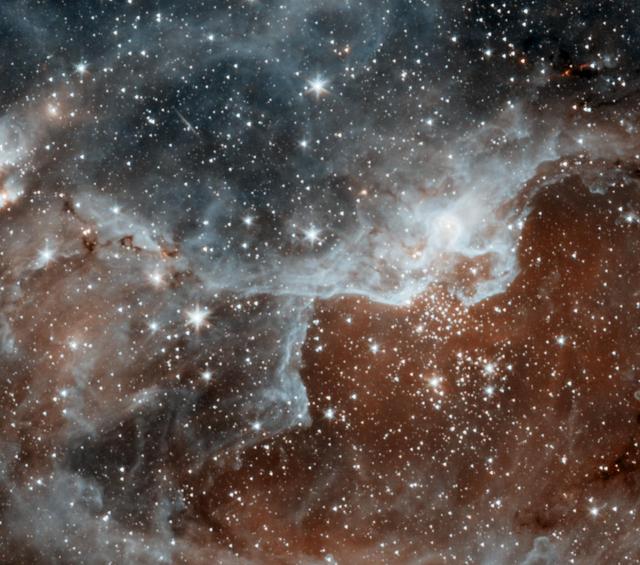
This image from NASA Spitzer Space Telescope shows young stars plus diffuse emission from dust. The Corona Australis region containing, at its heart, the Coronet cluster is one of the nearest and most active regions of ongoing star formatio…
Infrared Coronet Cluster
This spectrum shows the light from a dusty, distant galaxy located 11 billion light-years away. The galaxy is invisible to optical telescopes, but NASA Spitzer Space Telescope captured the light from it and dozens of other similar galaxies.
Fingerprints in the Light
This image layout shows two views of the same baby star from NASA Spitzer Space Telescope. Spitzer view shows that this star has a second, identical jet shooting off in the opposite direction of the first.
Undercover Jet Exposed
In the quest to better understand the birth of stars and the formation of new worlds, astronomers have used NASA's Spitzer Space Telescope to examine the massive stars contained in a cloudy region called Sharpless 140. This cloud is a fasci…
A Natal Microcosm
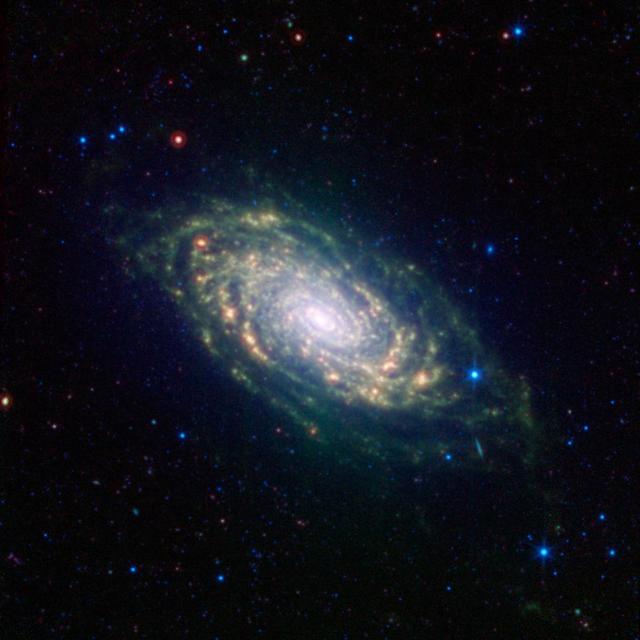
This image from NASA Spitzer Space Telescope shows infrared light from the Sunflower galaxy, otherwise known as Messier 63. Spitzer view highlights the galaxy dusty spiral arms.
Sunflower Galaxy Glows with Infrared Light
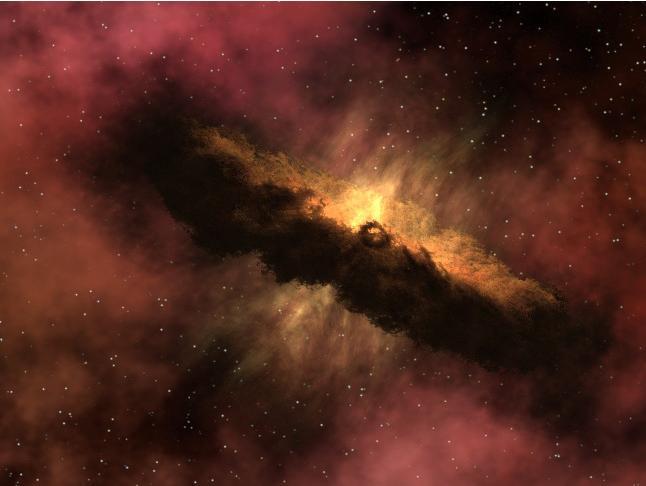
This artist animation depicts one of the most widely accepted theories pertaining to the origin of comets. This image is courtesy of NASA Spitzer Science Center at the California Institute of Technology, Pasadena, Calif.
Genesis of a Comet Artist Concept
This is a composite image of N49, the brightest supernova remnant in optical light in the Large Magellanic Cloud; the image combines data from the Chandra X-ray Telescope blue and NASA Spitzer Space Telescope red.
Stellar Debris in the Large Magellanic Cloud
The giant star Zeta Ophiuchi, a young, large and hot star located around 370 light-years away, is having a hocking effect on the surrounding dust clouds in this infrared image from NASA Spitzer Space Telescope.
Massive Star Makes Waves
This animation shows two massive black holes in the OJ 287 galaxy. The smaller black hole orbits the larger one, which remains stationary in the animation and is surrounded by a disk of gas. When the smaller black hole crashes through the d…
Animation of Black Hole Disk Flare in OJ 287
This view of the North America nebula combines both visible and infrared light observations, taken by the Digitized Sky Survey and NASA Spitzer Space Telescope. Clusters of young stars about one million years old can be found throughout the…
North America Nebula in Different Lights
This illustration shows one possible scenario for the hot, rocky exoplanet called 55 Cancri e, which is nearly two times as wide as Earth. New data from NASA Spitzer Space Telescope show that the planet has extreme temperature swings.
Hot-Lava World Illustration
This artist concept shows the immediate aftermath of a large asteroid impact around NGC 2547-ID8, a 35-million-year-old sun-like star thought to be forming rocky planets.
Building Planets Through Collisions Artist Concept
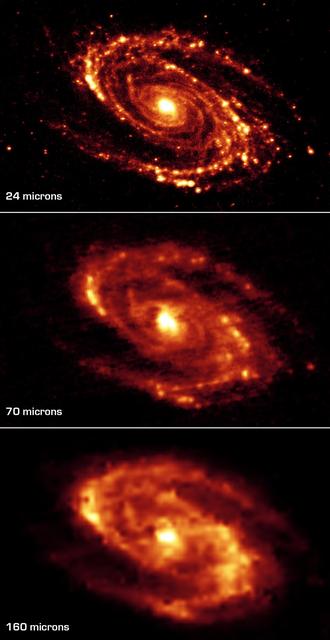
The magnificent and dusty spiral arms of the nearby galaxy Messier 81 are highlighted in these NASA Spitzer Space Telescope images.
Long-Wavelength Infrared Views of Messier 81
This artist concept shows NASA Spitzer Space Telescope surrounded by examples of exoplanets the telescope has examined in over its ten years in space.
Spitzer Trains Its Eyes on Exoplanets Artist Concept
This infrared image from NASA Spitzer Space Telescope shows a swirling landscape of stars known as the North America nebula. Clusters of young stars about one million years old can be found throughout the image.
The Case of the Disappearing Continent
These images from NASA Spitzer Space Telescope, taken one year apart, show the supernova remnant Cassiopeia A yellow ball and surrounding clouds of dust reddish orange.
A Year in the Life of an Infrared Echo
This artist concept portrays a free-floating brown dwarf, or failed star. A new study using data from NASA Spitzer Space Telescope shows that several of these objects are warmer than previously thought.
Free-floating Failed Star Artist Concept
A growing black hole, called a quasar, is seen at the center of a faraway galaxy in this artist concept. Astronomers using NASA Spitzer and Chandra space telescopes discovered swarms of similar quasars hiding in dusty galaxies in the distan…
Bursting with Stars and Black Holes Artist Concept
This plot of data from NASA Spitzer Space Telescope reveals the light from a uper Earth called 55 Cancri e. The planet is the smallest yet, beyond our solar system, to reveal its direct light.
Magician of a Planet Disappears to Reveal Itself
This artist conception shows a nearly invisible ring around Saturn -- the largest of the giant planet many rings. It was discovered by NASA Spitzer Space Telescope.
Saturn Infrared Ring Artist Concept
This artist concept depicts the pulsar planet system discovered by Aleksander Wolszczan in 1992. Wolszczan used the Arecibo radio telescope in Puerto Rico to find three planets circling a pulsar called PSR B1257+12.
Extreme Planets Artist Concept
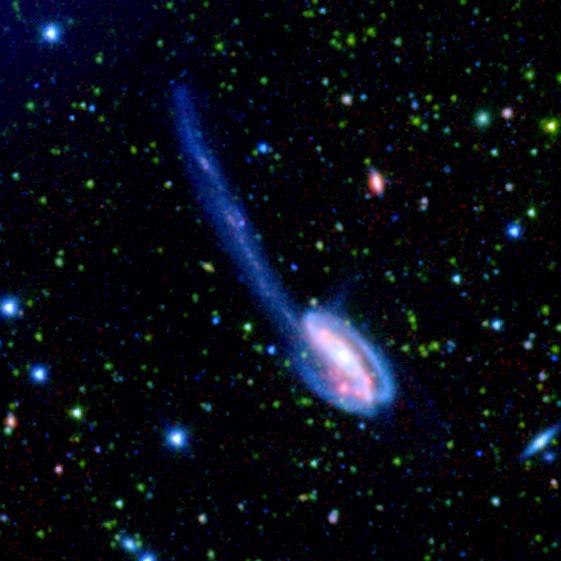
The Tadpole galaxy is the result of a recent galactic interaction in the local universe. These spectacular images were taken by NASA Spitzer Wide-area Infrared Extragalactic SWIRE Legacy project.
A SWIRE Picture is Worth Billions of Years
This image shows an outflow of gas from a new star as it jets from a space object dubbed IRAS 21078+5211. The reddish blob in its center, as picked up by NASA Spitzer Space Telescope contrasts nicely with the clouds, colored green, that sur…
A Shocking Outflow
Using the unique orbit of NASA Spitzer Space Telescope and a depth-perceiving trick called parallax, astronomers have determined the distance to an invisible Milky Way object called OGLE-2005-SMC-001.
Distance to Dark Bodies
This diagram shows findings of results of observations made primarily by NASA Spitzer Telescopes and the Very Large Array radio telescope and illuminates new details about a celestial andbar connecting two massive islands of galaxies.
Bent Galactic Jets
NASA Spitzer Space Telescope has captured a new, infrared view of the choppy star-making cloud called M17, also known as Omega Nebula or the Swan nebula.
Celestial Sea of Stars
Astronomers using NASA Spitzer Space Telescope have detected what they believe is an alien world just two-thirds the size of Earth -- one of the smallest on record.
Exoplanet is Extremely Hot and Incredibly Close Artist Concept
This image from NASA Spitzer Space Telescope shows what lies near the sword of the constellation Orion -- an active stellar nursery containing thousands of young stars and developing protostars. Many will turn out like our sun.
Stars Adorn Orion Sword
This image is one of the first to be taken during Spitzer warm mission -- a new phase that began after the telescope, which operated for more than five-and-a-half years, ran out of liquid coolant.
Spitzer First Warm Images
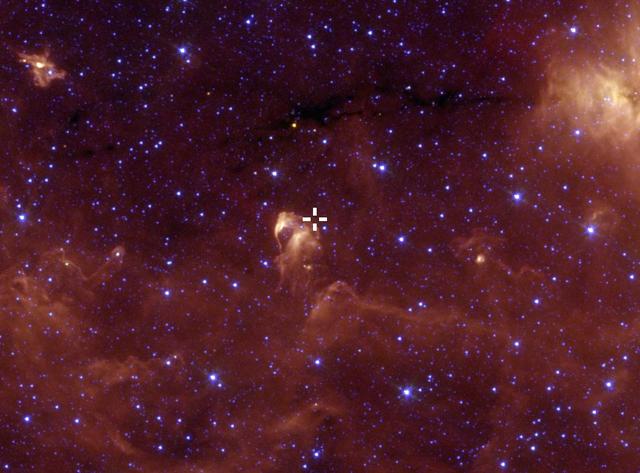
The location of Gaia 17bpi, which lies in the Sagitta constellation, is indicated in this image taken by NASA's Spitzer Space Telescope.  https://photojournal.jpl.nasa.gov/catalog/PIA22918
Star Gaia 17pbi Seen by Spitzer
This is an image from NASA Spitzer Space Telescope of stars and galaxies in the Ursa Major constellation. This infrared image covers a region of space so large that light would take up to 100 million years to travel across it.
The Universe First Fireworks
The image on the left shows a portion of our sky, called the Boötes field, in infrared light, while the image on the right shows a mysterious, background infrared glow captured by NASA Spitzer Space Telescope in the same region of sky.
Unmasking a Hidden Glow
The famous Horsehead nebula takes on a ghostly appearance in this image from NASA Spitzer Space Telescope, released on December 18, 2014.
Horsehead of a Different Color
This artist concept based on data found by NASA Spitzer Space Telescope shows upsilon Andromedae b, a hot gas giant that whips around its star every 4.6 days. Because it is so close to its star, it is tidally locked.
Planetary Hot Spot Not Under the Glare of Star Artist Concept
NASA Spitzer Space Telescope has, for the first time, detected tiny quartz-like crystals sprinkled in young planetary systems. The crystals, which are types of silica minerals called cristobalite and tridymite.
Quartz-like Crystals Found in Planetary Disks
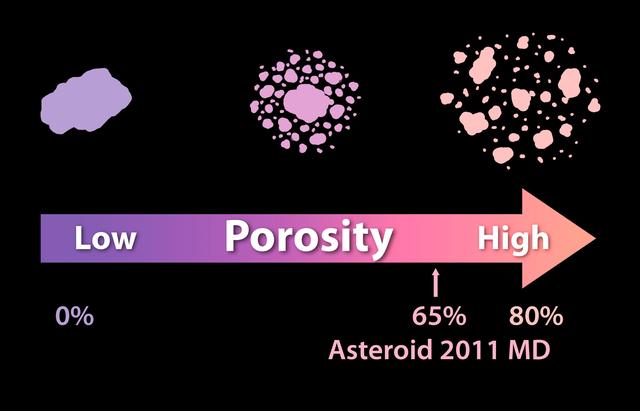
Observations from NASA Spitzer Space Telescope, taken in infrared light, have helped to reveal that a small asteroid called 2011 MD is made-up of two-thirds empty space.
Solid as a Rock? Porosity of Asteroids
One of our closest galactic neighbors shows its awesome beauty in this new image from NASA Spitzer Space Telescope. M33, also known as the Triangulum Galaxy, is a member of what known as our Local Group of galaxies.
M33: A Close Neighbor Reveals its True Size and Splendor 3-color composite
This frame from an animation based on NASA Spitzer Space Telescope data illustrates an unexpected warm spot on the surface of a gaseous exoplanet.The bright orange patches are the hottest part of the planet.
Weird Warm Spot on Exoplanet
The star-forming nebula W51 is one of the largest "star factories" in the Milky Way galaxy. Interstellar dust blocks the visible light emitted by the region, but it is revealed by NASA's Spitzer Space Telescope, which captures infrared ligh…
Spitzer Image of Star Factory W51
This illustration shows a cool star, called W1906+40, marked by a raging storm near one of its poles. The storm is thought to be similar to the Great Red Spot on Jupiter. Scientists discovered it using NASA's Kepler and Spitzer space telesc…
Cool Star Marked by Long-Lived Storm Artist Concept
The Cat's Paw Nebula, imaged here by NASA's Spitzer Space Telescope, lies inside the Milky Way Galaxy and is located in the constellation Scorpius. Its distance from Earth is estimated to be between 1.3 kiloparsecs (about 4,200 light years)…
Cat's Paw Image 1
This artist image depicts a faraway solar system like our own except for one big difference. Planets and asteroids circle around not one, but two suns. NASA Spitzer Space Telescope found evidence that such solar systems may be common in the…
Two Suns Raise Family of Planetary Bodies Artist Animation
NASA Spitzer Space Telescope and the National Optical Astronomy Observatory compare infrared and visible views of the famous Orion nebula and its surrounding cloud, an industrious star-making region located near the hunter constellation swo…
The Infrared Hunter
This infrared vision of NASA Spitzer Space Telescope has revealed that the Sombrero galaxy, named after its appearance in visible light to a wide-brimmed hat, is in fact two galaxies in one.
The Sombrero Galaxy Split Personality
New observations from NASA Spitzer Space Telescope reveal the Sombrero galaxy is not simply a regular flat disk galaxy of stars as previously believed, but a more round elliptical galaxy with a flat disk tucked inside.
Sombrero Galaxy Not So Flat After All
How many rings do you see in this new image of galaxy Messier 94, also known as NGC 4736? At first glance one might see a number of them, astronomers believe there is just one. This image was captured in infrared light by NASA Spitzer Space…
Galactic Wheels within Wheels
Generations of stars can be seen in this new infrared portrait from NASA Spitzer Space Telescope. In this wispy star-forming region, called W5, the oldest stars can be seen as blue dots in the centers of the two hollow cavities.
Spitzer Reveals Stellar Family Tree
This graphic illustrates a stellar fountain of crystal rain, beginning with a NASA Spitzer picture of the star in question, and ending with an artist concept of what the crystal rain might look like.
Finding Forsterite Around a Developing Star Artist Concept