
Advance Concept Office Space Transportation Team Assess the Latest Vehicle Studies

This is an artist's concept of the X-34 reusable technology testbed vehicle that was designed to demonstrate technologies that were essential to lowering the cost of access to space. Powered by a LOX and RP-1 liquid Fastrac engine that was…
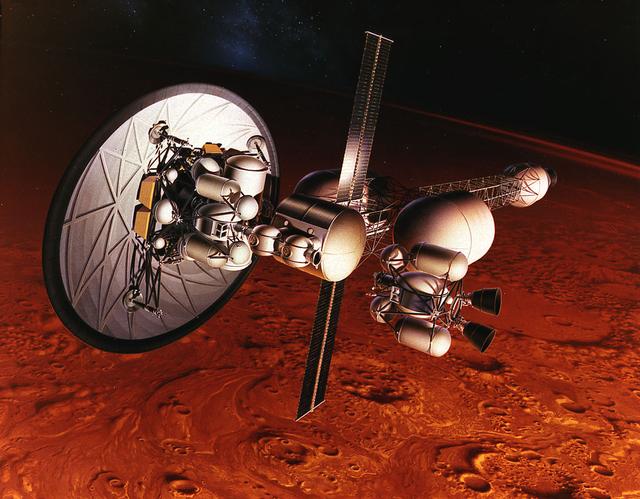
Originally investigated in the 1960's by Marshall Space Flight Center plarners as part of the Nuclear Energy for Rocket Vehicle Applications (NERVA) program, nuclear-thermal rocket propulsion has been more recently considered in spacecraft…

This artist's concept depicts the X-34 Demonstrator in flight. Part of the Pathfinder Program, the X-34 was a reusable technology testbed vehicle that was designed and built by the Marshall Space Flight Center to demonstrate technologies th…

This is an artist's concept of the X-34 Demonstrator, a reusable technology testbed vehicle that was designed to demonstrate technologies that were essential to lowering the cost of access to space. Powered by a LOX and RP-1 liquid Fastrac…

Pictured is an artist's concept of the experimental X-37 Reusable Launch Vehicle re-entering Earth‘s atmosphere. NASA and the Boeing Company entered a cooperative agreement to develop and fly a new experimental space plane called the X-37 t…

Pictured is the X-34 Demonstrator parked on the runway. Part of the Pathfinder Program, the X-34 was a reusable technology testbed vehicle that was designed and built by the Marshall Space Flight Center to demonstrate technologies that are…

Artist John J. Olson's conception for the future of space exploration: A base on Mars.

Advance Concept Office Space Transportation Team Assess the Latest Vehicle Studies

It is predicted that by the year 2040, there will be no distinction between a commercial airliner and a commercial launch vehicle. Fourth Generation Reusable Launch Vehicles (RLVs) will be so safe and reliable that no crew escape system wil…

Looking like an alien space ship or a flying saucer the Microwave Lightcraft is an unconventional launch vehicle approach for delivering payload to orbit using power transmitted via microwaves. Microwaves re beamed from either a ground stat…

This artist’s concept is of the X-33 Advanced Technology Demonstrator, a subscale prototype Reusable Launch Vehicle (RLV), in its 1997 configuration. Named the Venture Star, this vehicle manufactured by Lockheed Martin Skunk Works, is shown…

S82-25504 (20 Jan. 1982) --- These two veteran astronauts were named as prime crew members for STS-3 in the space shuttle Columbia. Wearing modified USAF-type altitude pressure garments in their Earth-bound shuttle trainer are astronauts Ja…

This is an artist's concept of an orbiting space vehicle in the Jovian system using an electrodynamic tether propellantless propulsion system. Electrodynamic tethers offer the potential to greatly extend and enhance future scientific missio…

Harnessing the Sun's energy through Solar Thermal Propulsion will propel vehicles through space by significantly reducing weight, complexity, and cost while boosting performance over current conventional upper stages. Another solar powered…

Photography from Shuttle ALT FF-5. S77-30393: ALT Fr. 3258, a higher-up shot of the Enterprise approaching runway for landing. EAFB, CA

Secretary Elaine L. Chao, of the U.S. Department of Transportation (DOT), visits NASA’s Kennedy Space Center in Florida on April 24, 2019. She spoke to Kennedy’s leadership in the Operations and Support Building II and discussed the DOT’s r…

The Advanced Space Transportation Group takes the future of space travel far into the 21st Century. Pictured is an artist's concept of a third generation Reusable Launch Vehicle (RLV). Projected for the year 2025, this third generation RLV…

Pictured is NASA's poster art for the X-34 technology Demonstrator. The X-34 was part of NASA's Pathfinder Program which demonstrated advanced space transportation technologies through the use of flight experiments and experimental vehicles…

Pictured is an artist's concept of the Rocket Based Combined Cycle (RBCC) launch. The RBCC's overall objective is to provide a technology test bed to investigate critical technologies associated with opperational usage of these engines. The…

Pictured is a component of the Rocket Based Combined Cycle (RBCC) engine. This engine was designed to ultimately serve as the near term basis for Two Stage to Orbit (TSTO) air breathing propulsion systems and ultimately a Single Stage to Or…

Pictured is an artist's conception of the X-37 Demonstrator descending down left. As part of the Pathfinder Program, the X-37 flight experiment demonstrates advanced space transportation technologies through the use of flight experiments. T…

Pictured in the high bay, is the X-34 Technology Demonstrator in the process of completion. The X-34 wass part of NASA's Pathfinder Program which demonstrated advanced space transportation technologies through the use of flight experiments…

Pictured is an artist's conception of the X-37 Demonstrator ascending left upright. As part of the Pathfinder Program, the X-37 flight experiment demonstrates advanced space transportation technologies through the use of flight experiments.…

This is an artist's rendition of an antimatter propulsion system. Matter - antimatter arnihilation offers the highest possible physical energy density of any known reaction substance. It is about 10 billion times more powerful than that of…
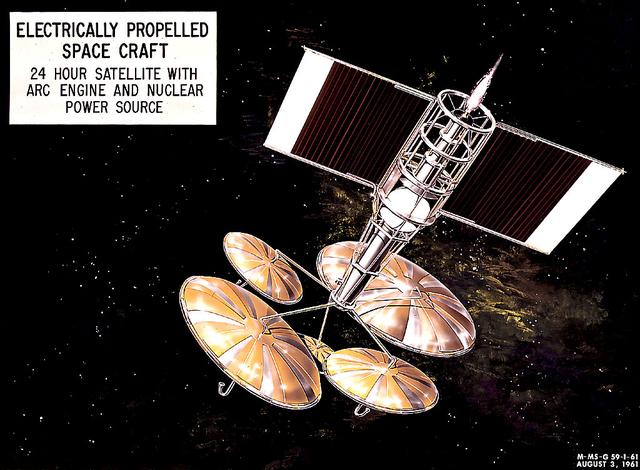
This 1960 artist's concept shows a 24-hour communication satellite design incorporating an arc engine with a nuclear power source. The concept was one of many missions proposed by the Marshall Space Flight Center for electrically-propelled…
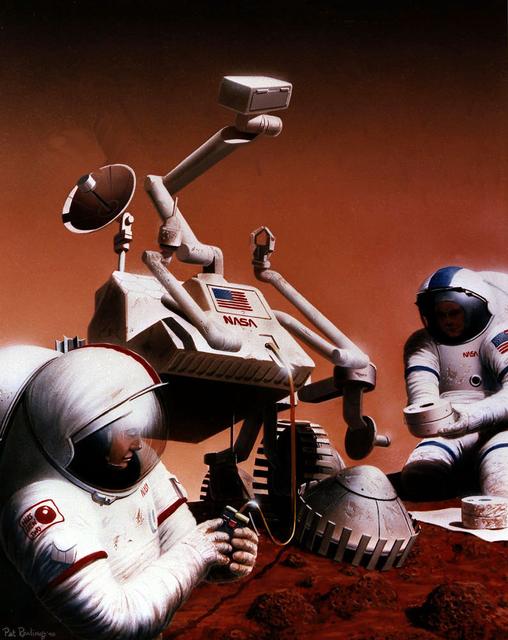
Artist Pat Rawlings' concept of the type of work and hazards future astronauts will encounter on outer worlds: Mars Rover Repair
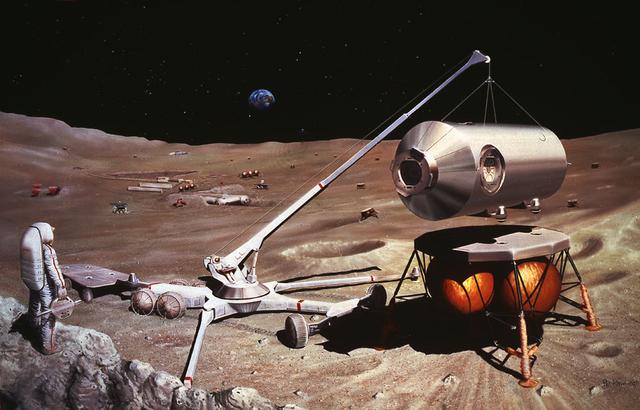
Artist Pat Rawlings' conception of the different types of machinery that will likely be needed in the future: Lunar Crane

S82-36286 (15 Aug. 1982) --- These four men will be aboard the space shuttle Columbia for NASA's first operational Space Transportation System (STS) mission. They are astronauts Vance D. Brand (second left), STS-5 commander; Robert F. Overm…

Pictured is an artist's concept of an advanced chemical propulsion system called Pulse Detonation. Long term technology research in this advanced propulsion system has the potential to dramatically change the way we think about space propul…

S83-30190 (8 April 1983) --- Vice President George Bush talks to the Earth-orbiting STS-6 astronauts from the spacecraft communicators; (CAPCOM) console in the mission operations control room (MOCR) of the Johnson Space Center?s mission co…

S71-33781 (11 May 1971) --- High angle view showing the Apollo 15 (Spacecraft 112/Lunar Module 10/Saturn 510) space vehicle on the way from the Vehicle Assembly Building (VAB) to Pad A, Launch Complex 39, Kennedy Space Center (KSC). The Sat…

Pictured is an artist's concept of the Rocket Based Combined Cycle (RBCC) launch. The RBCC's overall objective is to provide a technology test bed to investigate critical technologies associated with opperational usage of these engines. The…

This artist's concept depicts the X-34 Demonstrator in flight. Part of the Pathfinder Program, the X-34 was a reusable technology testbed vehicle that was designed and built by the Marshall Space Flight Center to demonstrate technologies th…

Pictured is an artist's concept of the X-37 Demonstrator re-entry. After being launched from the cargo bay of a Shuttle as a secondary payload, the X-37 remains on-orbit up to 21 days performing a variety of experiments before re-entering t…

This artist's concept depicts the X-34 Demonstrator landing in a dessert. Part of the Pathfinder Program, the X-34 was a reusable technology testbed vehicle that was designed and built by the Marshall Space Flight Center to demonstrate tech…

The X-34 demonstrator is shown being taken out of its hangar and placed on the tarmac. The X-34 was classified as part of the Pathfinder class demonstrators which include small experimental vehicles or less expensive flight experiments. The…

This artist's concept depicts the X-34 Demonstrator sitting on a runway. Part of the Pathfinder Program, the X-34 was a reusable technology testbed vehicle that was designed and built by the Marshall Space Flight Center to demonstrate techn…

Pictured is an artist's concept of the experimental Reusable Launch Vehicle (RLV), the X-37 located in the cargo bay of a space shuttle with Earth in the background. The X-37 was designed to launch from the space shuttle's cargo bay as a se…

S82-31207 (1 May 1982) --- These two astronauts will man the space shuttle Columbia for NASA's fourth and final (STS-4) orbital flight test. Thomas K. (Ken) Mattingly II, right, is crew commander. Henry W. Hartsfield Jr., is pilot. Their fl…

The Boussard Interstellar Ramjet engine concept uses interstellar hydrogen scooped up from its environment as the spacecraft passes by to provide propellant mass. The hydrogen is then ionized and then collected by an electromagentic field.…

S83-35017 (June 1983) --- These six men represent the first crewmembers to man the Columbia when it gets reactivated later this year. The four NASA astronauts are joined by a European and MIT scientist payload specialist and the Spacelab m…

S83-29016 (4 March 1983) --- These five astronauts represent the Space Transportation System's (STS) first five-member crew. They will be aboard the Space Shuttle Challenger for the mission, scheduled for June of this year. Astronaut Rober…

S79-31777 (7 May 1979) --- Astronaut Robert L. Crippen.

Travel to distant stars is a long-range goal of Marshall Space Flight Center's Advanced Concept Group. One of the many propulsion systems currently being studied is fusion power. The objective of this and many other alternative propulsion s…

S79-31775 (29 April 1979) --- These two astronauts are the prime crewmen for the first flight in the Space Transportation System (STS-1) program. Astronauts John W. Young, left, commander, and Robert L. Crippen, pilot, will man the space sh…

Various views of STS-6 MOCR activities during Day-5 with Vice-Pres. George Bush, Cap Communicator Bridges, JSC Director Gerald Griffin, Eugene F. Kranz, NASA Admin. James M. Beggs, Cap Com Astronaut O'Connor, Flight Directors Jay H. Greene,…

S71-33786 (11 May 1971) --- The 363-feet tall Apollo (Spacecraft 112/Lunar Module 10/Saturn 510) space vehicle which leaves the Vehicle Assembly Building (VAB) to Pad A, Launch Complex 39, Kennedy Space Center (KSC). The Saturn V stack and…