
This is an artist's rendition of an antimatter propulsion system. Matter - antimatter arnihilation offers the highest possible physical energy density of any known reaction substance. It is about 10 billion times more powerful than that of…

Pictured is an artist's concept of the Rocket Based Combined Cycle (RBCC) launch. The RBCC's overall objective is to provide a technology test bed to investigate critical technologies associated with opperational usage of these engines. The…

Dr. Luz M. Calle, a principal investigator for corrosion research at NASA’s Kennedy Space Center, shows a dish of crystals left over from an experiment to separate salt from water Dec. 12, 2018. Astronauts traveling on long-duration mission…

NASA Glenn's new LED solar simulator was developed by Angstrom Designs and UC Santa Barbara under a Small Business Innovative Research program to test the next generation of high-efficiency space solar cells for future missions. The new sim…

NASA Glenn engineer Dr. Peter Peterson prepares a high-power Hall thruster for ground testing in a vacuum chamber that simulates the environment in space. This high-powered solar electric propulsion thruster has been identified as a critica…

The Glenn Extreme Environment Chamber (GEER) simulates the extreme conditions found in space and tests many devices that will explore Venus to see if they can withstand the punishing environment and temperatures over 800 degrees F.

Travel to distant stars is a long-range goal of Marshall Space Flight Center's Advanced Concept Group. One of the many propulsion systems currently being studied is fusion power. The objective of this and many other alternative propulsion s…

Pictured is an artist's concept of an advanced chemical propulsion system called Pulse Detonation. Long term technology research in this advanced propulsion system has the potential to dramatically change the way we think about space propul…

Carla Rosenberg of the National Center for Microgravity Research explains the operation of the Middeck Glovebox to a middle school student. The activity was part of the Space Research and You education event held by NASA's Office of Biologi…

The 2017 class of astronaut candidates are inside the Space Station Processing Facility high bay during a familiarization tour of facilities at NASA's Kennedy Space Center in Florida. They are viewing the Interim Cryogenic Propulsion System…

A new, world-class laboratory for research into future space transportation technologies is under construction at the Marshall Space Flight Center (MSFC) in Huntsville, AL. The state-of-the-art Propulsion Research Laboratory will serve as a…

Patrick Chan, electronics engineer, and NASA Armstrong Flight Research Center’s FOSS portfolio project manager, shows a fiber used in a temperature sensing system. Armstrong’s Fiber Optic Sensing System was used to measure temperatures duri…

NASA SPACE TECHNOLOGY RESEARCH FELLOWSHIP (NSTRF) STUDENT BRIANA TOMBOULIAN AT THE 2013 MSFC RADIATOR FACILITY SHOWING A TEST ARTICLE

iss071e439784 (Aug. 5, 2024) --- NASA astronaut and Expedition 71 Flight Engineer Mike Barratt replaces fuel bottles and other components inside the Combustion Integrated Rack located inside the Intenational Space Station's Destiny laborato…

The Materials International Space Station Experiment-Flight Facility, or MISSE-FF, hardware arrived at the Space Station Processing Facility low bay at NASA's Kennedy Space Center in Florida. Technicians assist as a crane is used to lift MI…

Pictured is an artist's concept of the Rocket Based Combined Cycle (RBCC) launch. The RBCC's overall objective is to provide a technology test bed to investigate critical technologies associated with opperational usage of these engines. The…

Hall Effect Rocket with Magnetic Shielding Technology Development Unit 1 with Large Radiator working in conjunction with High Power 300 volt Silicon Carbide Power Processing Unit

Pictured is a component of the Rocket Based Combined Cycle (RBCC) engine. This engine was designed to ultimately serve as the near term basis for Two Stage to Orbit (TSTO) air breathing propulsion systems and ultimately a Single Stage to Or…

Diane Linne in the Simulated Lunar Operations, SLOPE Lab - Percussive Excavation Bucket reduces reaction forces for extraterrestrial digging of loose and compacted or icy soils.

Portrait of Orion Service Module Spacecraft Adapter Jettisonable (SAJ) Hardware Lead Engineer Lizalyn Smith. Ms. Smith participated in various 'Hidden Figures to Modern Figures' events sponsored by NASA Glenn Research Center to encourage s…
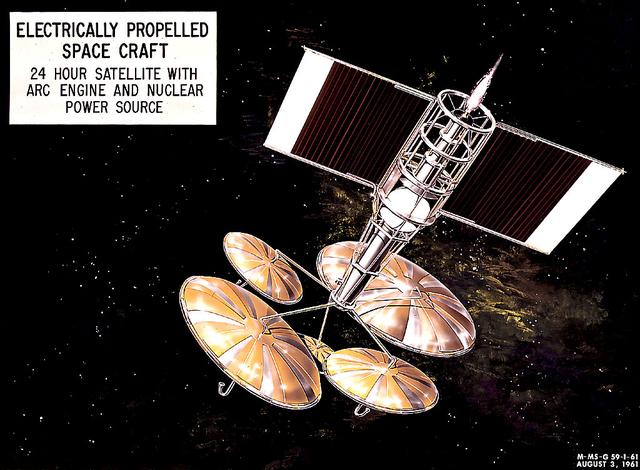
This 1960 artist's concept shows a 24-hour communication satellite design incorporating an arc engine with a nuclear power source. The concept was one of many missions proposed by the Marshall Space Flight Center for electrically-propelled…

Environmental Portrait of Research Engineer Wensheng Huang working on a Hall thruster in the Electric Propulsion Laboratory at NASA Glenn Research Center.

This is a close-up of an exact replica of the Apollo-era Lunar Roving Vehicle Wheel, of which twelve originals still rest on the surface of the Moon. The tire was designed to flex under load, without air, and was formed from a mesh of plate…

Line drawing depicts the location of one of three racks that will make up the Materials Science Research Facility in the U.S. Destiny laboratory module to be attached to the International Space Station (ISS). Other positions will be occupie…

NASA Administrator Jim Bridenstine, at left, speaks to Matt Romeyn, a project scientist, during a tour of a plant research laboratory inside the Space Station Processing Facility (SSPF) at NASA's Kennedy Space Center in Florida, on Aug. 7,…

The 2017 class of astronaut candidates are inside the Space Station Processing Facility high bay during a familiarization tour of facilities at NASA's Kennedy Space Center in Florida. The candidates toured center facilities, including the N…

The 2017 class of astronaut candidates are inside the Space Station Processing Facility high bay during a familiarization tour of facilities at NASA's Kennedy Space Center in Florida. Behind them is the Interim Cryogenic Propulsion System f…

Harnessing the Sun's energy through Solar Thermal Propulsion will propel vehicles through space by significantly reducing weight, complexity, and cost while boosting performance over current conventional upper stages. Another solar powered…

Brad McLain for the Space Biology Museum Network spins a volunteer in a rotating chair to illustrate how dependent the human vestibular system is on visual cues. The volunteer's thumbs indicate which way she thinks she is turning. Similar t…

The grand opening of NASA’s new, world-class laboratory for research into future space transportation technologies located at the Marshall Space Flight Center (MSFC) in Huntsville, Alabama, took place in July 2004. The state-of-the-art Prop…

Fluids and Combustion Facility (FCF), Combustion Integration Rack (CIR) during testing in the Structural Dynamics Laboratory (SDL). The Fluids and Combustion Facility (FCF) is a set of two International Space Station (ISS) research faciliti…

Deena Dombrosky (Zin Technologies Engineer) is shown here filling a Procter & Gamble (P & G) sample that will be used in ground-testing as NASA prepares for their experiment on the International Space Station (ISS). The sample particles ar…

NASA Glenn engineer Monica Guzik in the Small Multi-Purpose Research Facility (SMiRF). The facility provides the ability to simulate the environmental conditions encountered in space for a variety of cryogenic applications such as thermal p…
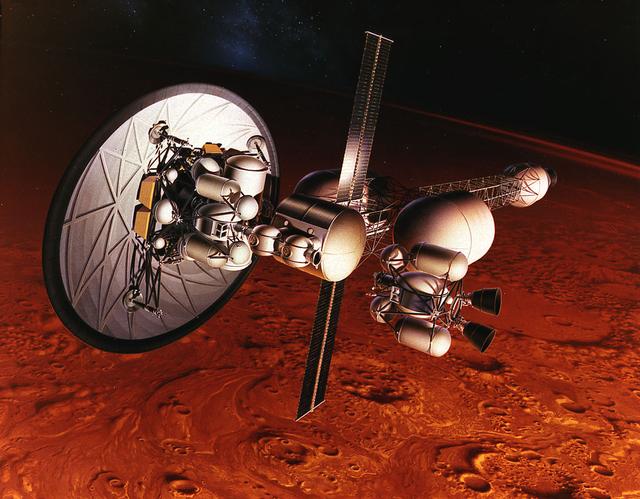
Originally investigated in the 1960's by Marshall Space Flight Center plarners as part of the Nuclear Energy for Rocket Vehicle Applications (NERVA) program, nuclear-thermal rocket propulsion has been more recently considered in spacecraft…

Indian Space Research Organization ISRO visited Goddard March 13, 2019 pictured here with Mark Clampin and Center Director Chris Scolese

Dr. Luz M. Calle, a principal investigator for corrosion research at NASA’s Kennedy Space Center, examines microcapsules under a microscope Dec. 12, 2018. Microencapsulation is a way to create smart coatings or paint capable of indicating,…

The Boussard Interstellar Ramjet engine concept uses interstellar hydrogen scooped up from its environment as the spacecraft passes by to provide propellant mass. The hydrogen is then ionized and then collected by an electromagentic field.…

ZEISS COMPOUND MICROSCOPE WITH MONITOR & MELISSA KIRVEN-BROOKS. Space Station Biological Research Project. (SSBRP)

Looking like an alien space ship or a flying saucer the Microwave Lightcraft is an unconventional launch vehicle approach for delivering payload to orbit using power transmitted via microwaves. Microwaves re beamed from either a ground stat…

A Virginia student works with a bottle and its cap in a mockup of the Middeck Glovebox used by astronauts on a number of space shuttle research missions. The activity was part of the Space Research and You education event held by NASA's Off…

This is an artist's concept of an orbiting space vehicle in the Jovian system using an electrodynamic tether propellantless propulsion system. Electrodynamic tethers offer the potential to greatly extend and enhance future scientific missio…
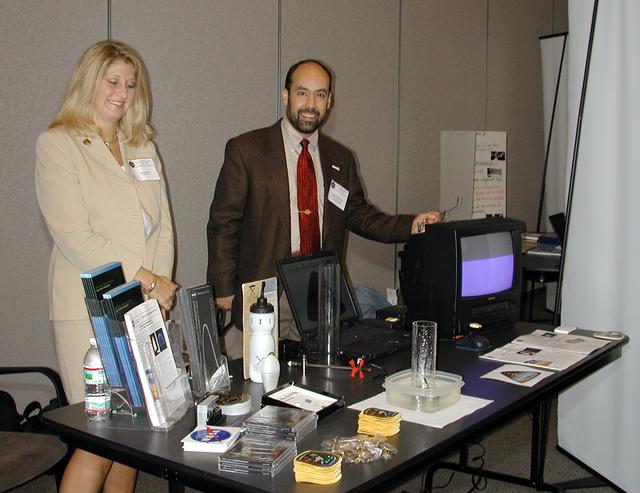
Christi Parker of CST Inc. of Huntsville, AL, and Angel Abbud-Madrid, of the Center for Commercial Applications of Combustion in Space (CCACS) at the Colorado school of Mines, prepare a demonstration of the CCACS Water Mist experiment sched…

iss064e025418 (Jan. 21, 2021) --- NASA astronaut and Expedition 64 Flight Engineer Kate Rubins sequences DNA aboard the International Space Station for an experiment that seeks to diagnose medical conditions and identify microbes. Learn mor…

The 2017 class of astronaut candidates are inside the Space Station Processing Facility high bay during a familiarization tour of facilities at NASA's Kennedy Space Center in Florida. They are viewing the Interim Cryogenic Propulsion System…

In the Space Life Sciences Laboratory at NASA's Kennedy Space Center in Florida, student interns are joining agency scientists, contributing in the area of plant growth research for food production in space. The agency attracts its future w…

Advanced Plant Experiment, APEX-4, support in the Telescience Support Center at NASA Glenn. APEX-4 continues a highly successful investigation into the effects of microgravity on the development of roots and cells on plant seedlings. After…

In the Space Life Sciences Laboratory at NASA's Kennedy Space Center in Florida, student interns such as Payton Barnwell are joining agency scientists, contributing in the area of plant growth research for food production in space. Barnwell…

Patrick Chan, electronics engineer, and NASA Armstrong’s FOSS portfolio project manager, closely examines an optic fiber inside of a protective sleeve. Armstrong’s Fiber Optic Sensing System recently supported tests in which oxygen was turn…