
CAPE CANAVERAL, Fla. – In the Space Station Processing Facility at NASA's Kennedy Space Center, workers prepare to install the final solar array wing for the International Space Station onto the S6 truss element. Scheduled to launch on the…

The Electrical Maintenance Facility (EMF) at NASA's Kennedy Space Center in Florida has solar panels capable of producing 125 kilowatts. Installation of the panels began in August 2019 and by February 2020, the panels were up and running, g…

The Electrical Maintenance Facility (EMF) at NASA's Kennedy Space Center in Florida has solar panels capable of producing 125 kilowatts. Installation of the panels began in August 2019 and by February 2020, the panels were up and running, g…

The Electrical Maintenance Facility (EMF) at NASA's Kennedy Space Center in Florida has solar panels capable of producing 125 kilowatts. Installation of the panels began in August 2019 and by February 2020, the panels were up and running, g…

The Electrical Maintenance Facility (EMF) at NASA's Kennedy Space Center in Florida has solar panels capable of producing 125 kilowatts. Installation of the panels began in August 2019 and by February 2020, the panels were up and running, g…

The Electrical Maintenance Facility (EMF) at NASA's Kennedy Space Center in Florida has solar panels capable of producing 125 kilowatts. Installation of the panels began in August 2019 and by February 2020, the panels were up and running, g…

Using the Solar Vector Magnetograph, a solar observation facility at NASA's Marshall Space Flight Center (MSFC), scientists from the National Space Science and Technology Center (NSSTC) in Huntsville, Alabama, are monitoring the explosive p…

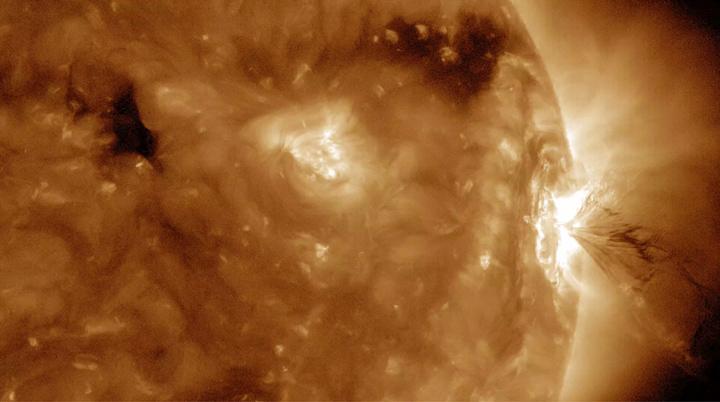
The sun's only visible active region sputtered and spurted and eventually unleashed a small (C-class) flare (Feb. 7, 2018). The flare appears as a brief, bright flash about mid-way through the half-day clip. Normally, we do not pay much att…

A pair of relatively small (but frenetic) active regions rotated into view, spouting off numerous small flares and sweeping loops of plasma (May 31-June 2, 2017). At first, only the one active region was observed, but mid-way though the vid…
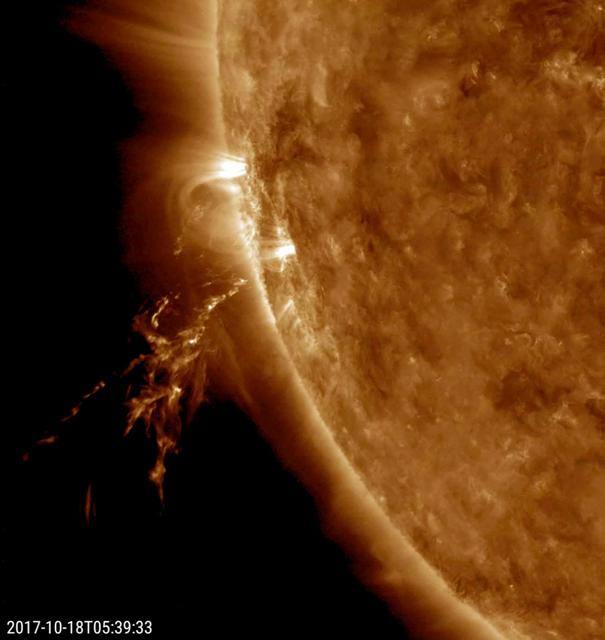
A small eruption blew a bright, disjointed stream of plasma into space (Oct. 18, 2017). The source of the blast was just out of sight beyond the edge of the sun. Images from SOHO's coronagraph instruments show a bright loop of material head…
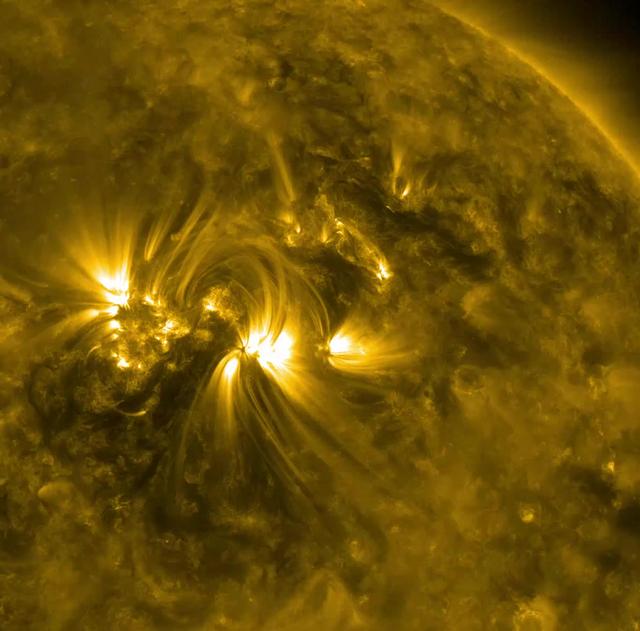
The magnetic field lines between a pair of active regions formed a beautiful set of swaying arches, seen in this footage captured by NASA’s Solar Dynamics Observatory on April 24-26, 2017. The arches are traced out by charged particles spin…

NASA Kennedy Space Center employees attend the Energy Action Day event held in the center's Space Station Processing Facility. Part of Energy Awareness Month, the event featured subject matter experts in the area of solar energy, its connec…

Anuj Chokshi of FPL, center, speaks during the Energy Action Day employee event held in NASA Kennedy Space Center's Space Station Processing Facility. Part of Energy Awareness Month, the event featured subject matter experts in the area of…

This composite image of nine pictures shows the progression of a partial solar eclipse near Banner, Wyoming on Monday, Aug. 21, 2017. A total solar eclipse swept across a narrow portion of the contiguous United States from Lincoln Beach, Or…

Chuck Tatro of NASA's Launch Services Program discusses the use of solar arrays on space science missions during the Energy Action Day employee event held in Kennedy Space Center's Space Station Processing Facility. Part of Energy Awareness…

An active region rotated into view and sputtered with numerous small flares and towering magnetic field lines that stretched out many times the diameter of Earth (May 23-25, 2018). Active regions are areas of intense magnetic energy. The fi…

CAPE CANAVERAL, Fla. – In the Space Station Processing Facility at NASA's Kennedy Space Center, workers prepare to move the final solar array wing for the International Space Station for installation on the S6 truss element. Scheduled to l…

The Electrical Maintenance Facility (EMF) at NASA's Kennedy Space Center in Florida has solar panels capable of producing 125 kilowatts. Installation of the panels began in August 2019 and by February 2020, the panels were up and running, g…

The Electrical Maintenance Facility (EMF) at NASA's Kennedy Space Center in Florida has solar panels capable of producing 125 kilowatts. Installation of the panels began in August 2019 and by February 2020, the panels were up and running, g…

The Electrical Maintenance Facility (EMF) at NASA's Kennedy Space Center in Florida has solar panels capable of producing 125 kilowatts. Installation of the panels began in August 2019 and by February 2020, the panels were up and running, g…

Robert Youngquist, Ph.D., tests a sample disk with a "Solar White" cryogenic selective surface coating with a flash light, demonstrating the coating’s reflective properties. The innovative coating is predicted to reflect more than 99.9 perc…
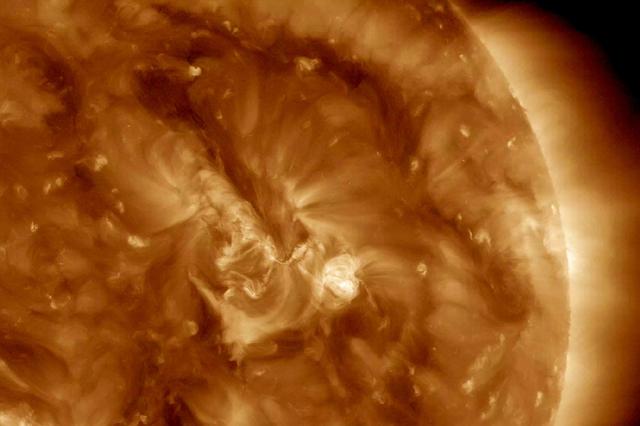
A minor solar eruption triggered a crackling, white flash that sent an expanding wave of plasma below it over about six hours (Nov. 4, 2016). Some of the plasma also appeared to surge along a narrow path above the active region as well. Suc…

A solar prominence gathered itself into a twisting cone, then rose up and broke apart in a delicate dance of plasma above the sun (Feb. 20, 2017). The event, observed in a wavelength of extreme ultraviolet light, lasted just about four hour…

A prominence at the edge of the sun provided us with a splendid view of solar plasma as it churned and streamed over less than one day (June 25-26, 2017). The charged particles of plasma were being manipulated by strong magnetic forces. Whe…

On Jan. 23-24, 2017, NASA Solar Dynamics Observatory watched as a solar prominence rose up along the edge of the sun and twisted and churned for about two days before falling apart. The dynamic action was generated by competing magnetic for…
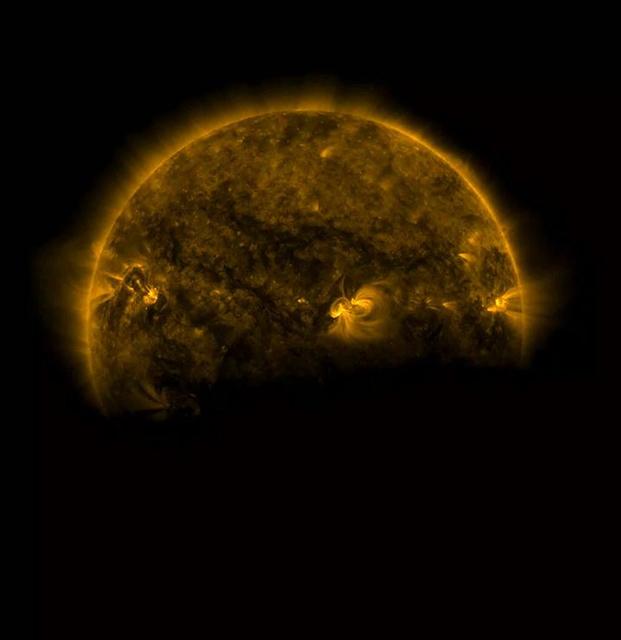
Several times a day for a few days this week the Earth completely blocked the Sun for about an hour due to SDO's orbital path (Aug. 25, 2016). The edge of the Earth is not crisp, but rather kind of fuzzy due to Earth's atmosphere. The entir…

A solar prominence at the sun's edge put on quite a display of plasma being pushed and pulled by unstable magnetic fields (May 22-24, 2017). We call them hedgerow prominences because they look somewhat like a hedge of bushes. This is one of…

NASA Kennedy Space Center's Sam Ball, third from left, speaks during the Energy Action Day employee event held in NASA Kennedy Space Center's Space Station Processing Facility. Part of Energy Awareness Month, the event featured subject matt…

People are seen as they watch a total solar eclipse through protective glasses in Madras, Oregon on Monday, Aug. 21, 2017. A total solar eclipse swept across a narrow portion of the contiguous United States from Lincoln Beach, Oregon to Cha…

Bill McCullen of Southern Power speaks to NASA Kennedy Space Center employees during the Energy Action Day event held in Kennedy's Space Station Processing Facility. Part of Energy Awareness Month, the event featured subject matter experts…

Florida Power and Light’s (FPL) new Discovery Solar Energy Center is a 74.5 megawatt solar site, spanning 491 acres at NASA’s Kennedy Space Center in Florida. The site contains about 250,000 solar panels, and once it’s operational, will pro…

The Moon is seen passing in front of the Sun at the point of the maximum of the partial solar eclipse near Banner, Wyoming on Monday, Aug. 21, 2017. A total solar eclipse swept across a narrow portion of the contiguous United States from Li…

The Electrical Maintenance Facility (EMF) at NASA's Kennedy Space Center in Florida has solar panels capable of producing 125 kilowatts. Installation of the panels began in August 2019 and by February 2020, the panels were up and running, g…

The Electrical Maintenance Facility (EMF) at NASA's Kennedy Space Center in Florida has solar panels capable of producing 125 kilowatts. Installation of the panels began in August 2019 and by February 2020, the panels were up and running, g…

The Electrical Maintenance Facility (EMF) at NASA's Kennedy Space Center in Florida has solar panels capable of producing 125 kilowatts. Installation of the panels began in August 2019 and by February 2020, the panels were up and running, g…

The Electrical Maintenance Facility (EMF) at NASA's Kennedy Space Center in Florida has solar panels capable of producing 125 kilowatts. Installation of the panels began in August 2019 and by February 2020, the panels were up and running, g…

The Electrical Maintenance Facility (EMF) at NASA's Kennedy Space Center in Florida has solar panels capable of producing 125 kilowatts. Installation of the panels began in August 2019 and by February 2020, the panels were up and running, g…

The Electrical Maintenance Facility (EMF) at NASA's Kennedy Space Center in Florida has solar panels capable of producing 125 kilowatts. Installation of the panels began in August 2019 and by February 2020, the panels were up and running, g…

The 5 KW, state-of-the-art solar demonstration site at NASA Dryden is validating earthly use of solar cells developed for NASA's Helios solar-electric aircraft.
The Sun produced three M-class (medium-sized) flares in less than 13 hours and the third one had an interesting flourish at the end (July 22-23, 2016). These were the largest flares the Sun had produced this year. The first two flares occur…

NASA Glenn's new LED solar simulator was developed by Angstrom Designs and UC Santa Barbara under a Small Business Innovative Research program to test the next generation of high-efficiency space solar cells for future missions. The new sim…

Using the Solar Vector Magnetograph, a solar observation facility at NASA's Marshall Space Flight Center (MSFC), scientists from the National Space Science and Technology Center (NSSTC) in Huntsville, Alabama, are monitoring the explosive p…

The Sun erupted with an X8 solar flare, one of the largest of the current solar cycle (Sept. 10, 2017). Its source was the same sunspot region that produced an X9 flare last week. This is shown in two wavelengths of extreme ultraviolet ligh…

THE SOLAR PROBE PLUS CUP INSTRUMENT WILL BE PART OF THE SOLAR PROBE PLUS MISSION TO STUDY THE SUN. THE CUP WILL FLY ON THE SPACECRAFT ON THE OUTSIDE OF THE SHIELD AND WILL "CATCH" CHARGED PARTICLES FROM THE SUN AND ANALYZE THEM. A TEAM FROM…

People are seen as they watch a total solar eclipse through protective glasses in Madras, Oregon on Monday, Aug. 21, 2017. A total solar eclipse swept across a narrow portion of the contiguous United States from Lincoln Beach, Oregon to Cha…

Chuck Tatro of NASA's Launch Services Program discusses the use of solar arrays on space science missions during the Energy Action Day employee event held in Kennedy Space Center's Space Station Processing Facility. Part of Energy Awareness…

People are seen as they watch a total solar eclipse through protective glasses in Madras, Oregon on Monday, Aug. 21, 2017. A total solar eclipse swept across a narrow portion of the contiguous United States from Lincoln Beach, Oregon to Cha…

NASA's Marshall Space Flight Center (MSFC) and university scientists from the National Space Science and Technology Center (NSSTC) in Huntsville, Alabama, are watching the Sun in an effort to better predict space weather - blasts of particl…