
This illustration depicts the Skylab-1 and Skylab-2 mission sequence. The goals of the Skylab were to enrich our scientific knowledge of the Earth, the Sun, the stars, and cosmic space; to study the effects of weightlessness on living organ…

S72-53094 (For release February 1973) --- This is the emblem for the third manned Skylab mission. It will be a mission of up to 56 days. Skylab is an experimental space station consisting of a 100-ton laboratory complex in which medical, sc…

S74-19677 (April 1974) --- This crystal of Germanium Selenide (GeSe) was grown under weightless conditions in an electric furnace aboard the Skylab space station. Experiment M556, Vapor Growth of IV-VI Compounds, was conducted as a comparat…

This chart lists the various experiments that flew on Skylab, along with their assigned numerical designations. The Marshall Space Flight Center had program management responsibility for the development of Skylab hardware and experiments.

S73-27081 (30 May 1973) --- Two of the three Skylab 2 astronauts are seen in the wardroom of the crew quarters of the Orbital Workshop of the Skylab 1 space station cluster in Earth orbit in this reproduction taken from a television transm…

S73-35080 (July-September 1973) --- A vertical view of northeast Oklahoma and the metropolitan Tulsa area is seen in this Skylab 3 Earth Resources Experiments Package S190-B (five-inch Earth terrain camera) photograph taken from the Skylab…

S73-35079 (July-September 1973) --- A near vertical view of the Caribbean coast of Venezuela is seen in this Skylab 3 Earth Resources Experiment Package S190-B (five-inch Earth terrain camera) photograph taken from the Skylab space station…

S73-35078 (July-Sept. 1973) --- A nearly vertical view of the Phoenix, Arizona metropolitan area is seen in this Skylab 3 (second manning) Earth Resources Experiments Package S190-B (five-inch Earth terrain camera) photograph taken from the…

S73-28818 (24 June 1973) --- Scientist-astronaut Joseph P. Kerwin, science pilot for the Skylab 2 mission, speaks to a crowd at Ellington Air Force Base during welcome home ceremonies for the crew. Astronaut Paul J. Weitz, pilot, is at cent…

S73-30110 (30 June 1973) --- The three members of the prime crew of the second manned Skylab mission (Skylab 3) discuss their scheduled 56-day flight before a gathering of news media representatives in the large auditorium of Building 1 at…

This spectacular view is a color-enhanced ultraviolet exposure of a colossal eruption, photographed during the Skylab-4 mission by the Apollo Telescope Mount facility on December 19, 1973. This giant prominence, one of the mightiest in 25 y…

S72-46699 (19 Jan. 1972) --- Prime crew members of the scheduled second Skylab mission are introduced to the media during a press conference in January 1972 at the Manned Spacecraft Center (MSC). From left to right are astronauts Jack R. Lo…

This photograph shows the launch of the SA-513, a modified unmarned two-stage Saturn V vehicle for the Skylab-1 mission, which placed the Skylab cluster into the Earth orbit on May 14, 1973. The initial step in the Skylab mission was the la…

The Saturn V vehicle, carrying the unmarned orbital workshop for the Skylab-1 mission, lifted off successfully and all systems performed normally. Sixty-three seconds into flight, engineers in the operation support and control center saw an…

This cutaway illustration shows the characteristics and basic elements of the Skylab Orbiter Workshop (OWS). The OWS was divided into two major compartments. The lower level provided crew accommodations for sleeping, food preparation and co…

This photograph is an interior view of the Orbital Workshop (OWS) upper level looking from the airlock hatch, showing the octagonal opening that separated the workshop's two levels. The trash airlock can be seen at center. The lower level o…

The Orbital Workshop internal arrangement shown here is the medical experimental equipment. In this view, looking from the wardroom area, are the lower-body Negative Pressure (Experiment M092) unit, left, and the ergometer for the vectorcar…

S73-27403 (June 1973) --- Engineers at the NASA Marshall Space Flight Center examine tools that are being considered for use in freeing the solar array wing of Skylab. The device at center is a cable cutter which is operated by cable. Enhan…

S73-33208 (August 1973) --- These three men are the prime crewmen for the Skylab 4 mission. Pictured in their flight suits with a globe and a model of the Skylab space station are, left to right, astronaut Gerald P. Carr, commander; scienti…

S73-24303 (May 1973) --- These three astronauts have been named by the National Aeronautics and Space Administration as the prime crew of the first manned Skylab mission. They are, left to right, Joseph P. Kerwin, science pilot; Charles Con…

In 1973, Skylab, America's first space station, was launched aboard a two-stage Saturn V vehicle. Saturn IB rockets were used to launch three different three-man crews to the Skylab space station.

S73-25654 (7 May 1973) --- A deliberate double exposure to help illustrate the comparative sizes and configurations of the Skylab 1 and Skylab 2 space vehicles at Launch Complex 39, Kennedy Space Center, Florida. The double exposure creates…

S73-36435 (25 Sept. 1973) --- Astronaut Jack R. Lousma, Skylab 3 pilot, egresses the Skylab 3 Command Module aboard the prime recovery ship, USS New Orleans, during recovery operations in the Pacific Ocean. Astronauts Lousma; Alan L. Bean,…

SL4-149-5036 (February 1974) --- View of triangle-shaped cleat taped on the bottom of a shoe of a Skylab 4 crew member. Photo credit: NASA

S73-35081 (July-September 1973) --- A view of approximately 3,600 square miles of north central Wyoming and southern Montana is seen in this Skylab 3 Earth Resources Experiments Package S190-B (five-inch Earth terrain camera) photograph tak…

Close-up view of partially deployed, damaged solar array before astronauts performed extravehicular activity (EVA) to completey deploy it.

S73-28419 (16 June 1973) --- The three prime crewmen of the Skylab 3 mission check over flight data during a training session in the crew quarters of the Orbital Workshop (OWS) trainer in the Mission Simulation and Training Facility at the…
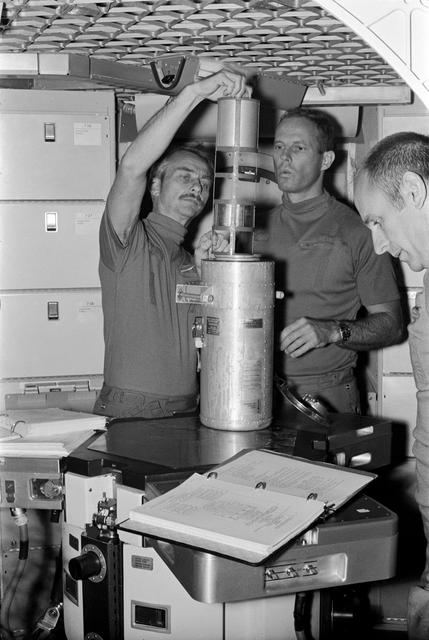
S73-28420 (16 June 1973) --- The three prime crewmen of the Skylab 3 mission check over flight data during a training session in the crew quarters of the Orbital Workshop (OWS) trainer in the Mission Simulation and Training Facility at the…

This photograph is a montage of astronaut crews for the three Skylab missions with simple biographical data of each astronaut. The 1st mission was designated as Skylab-2, 2nd mission as Skylab-3, and 3rd mission as Skylab-4. The Skylab-1 mi…

SL3-114-1683 (28 July 1973) --- A close-up view of the Skylab space station photographed against an Earth background from the Skylab 3 Command and Service Modules (CSM) during station-keeping maneuvers prior to docking. Aboard the Command…
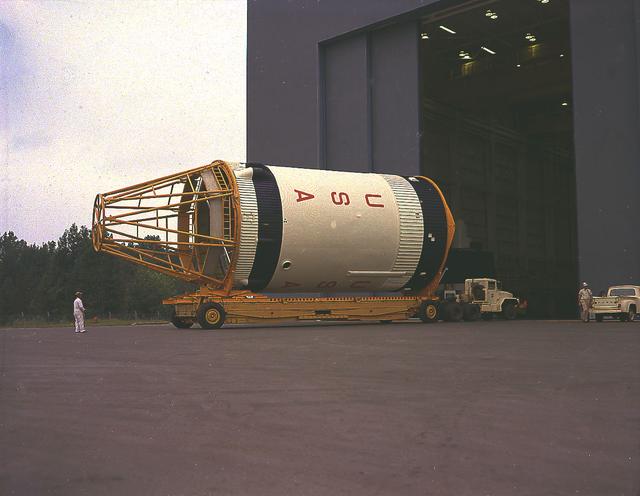
This September 1967 photograph shows workmen removing a mockup of the Saturn V S-IVB stage that housed the Skylab Orbital Workshop (OWS) from the Marshall Space Flight Center (MSFC), building 4755. The mockup was shipped to McDornell Dougla…

This photograph was taken during installation of floor grids on the upper and lower floors inside the Skylab Orbital Workshop at the McDornell Douglas plant at Huntington Beach, California. The OWS was divided into two major compartments. T…

This montage is an artist's conception of progressive views of the Comet Kohoutek based on sketches and a description by Skylab-4 astronaut Edward Gibson. An early discovery of a large comet in an orbit that would reach close to the Sun at…

The Saturn V vehicle, carrying the unmarned orbital workshop for the Skylab-1 mission, lifted off successfully and all systems performed normally. Sixty-three seconds into flight, engineers in the operation support and control center saw an…

S73-36451 (25 Sept. 1973) --- The three crewmen of the Skylab 3 mission are seen aboard the prime recovery ship, USS New Orleans, following their successful 59-day visit to the Skylab space station in Earth orbit. They are, left to right, a…
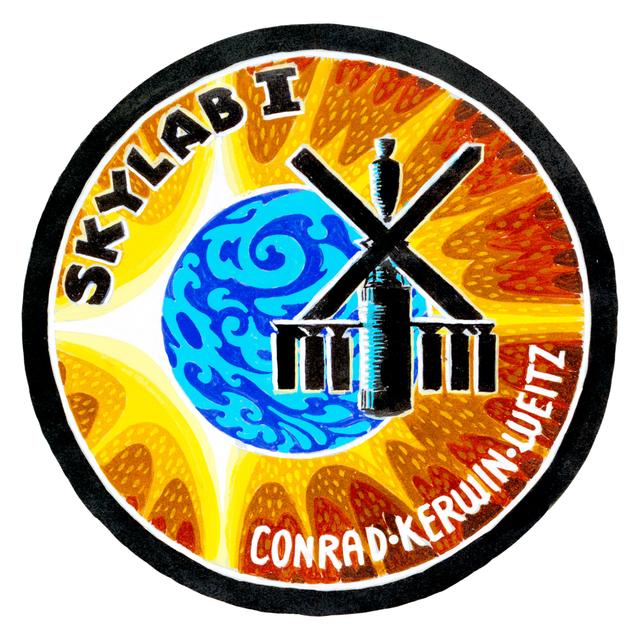
S72-52630 (February 1972) --- This is the emblem for the first manned Skylab mission. It will be a mission of up to 28 days. Skylab is an experimental space station consisting of a 100-ton laboratory complex in which medical, scientific an…

In 1973, Skylab, America's first space station, was launched aboard a two-stage Saturn V vehicle. Saturn IB rockets were used to launch three different three-man crews to the Skylab space station.

SL3-113-1586 (July-September 1973) --- This photograph is an illustration of the humorous side of the Skylab 3 crew. This dummy was left behind in the Skylab space station by the Skylab 3 crew to be found by the Skylab 4 crew. The dummy is…

S73-32568 (20 July 1973) --- Floodlights illuminate this nighttime view of the Skylab 3/Saturn 1B space vehicle at Pad B, Launch Complex 39, Kennedy Space Center, Florida, during prelaunch preparations. The reflection is the water adds to t…

S73-35082 (July-Sept. 1973) --- A near vertical view of a portion of west Africa ravaged by drought for the past five years is seen in this Skylab 3 Earth Resources Experiments Package S190-B (five-inch Earth terrain camera) photograph take…

S73-28423 (16 June 1973) --- Astronaut Jack R. Lousma, Skylab 3 pilot, reaches into a medical kit, part of the Inflight Medical Support System (IMSS), during training for the second manned Skylab Earth-orbital mission. This activity took pl…

This photograph shows Skylab's Particle Collection device, a scientific experiment designed to study micro-meteoroid particles in near-Earth space and determine their abundance, mass distribution, composition, and erosive effects. The Marsh…

This image illustrates the deployment of the Skylab parasol thermal shield. Skylab lost its thermal protection shield during its launch on May 14, 1973. The Skylab-2 crew deployed a parasol thermal shield to protect the workshop from overhe…

Shortly after liftoff on May 14, 1973, atmospheric drag tore off the thin metallic shield of Skylab that was designed to protect her from micro-meteorites and the Sun's intense heat. The Skylab-2 crew deployed a parasol sunshield to protect…

This artist's concept depicts the separation of the Skylab payload shroud. The payload shroud was both an environmental shield and an aerodynamic fairing. Attached to the forward end of the fixed airlock shroud, it protected the airlock, th…

This image of Skylab in orbit was taken as the third crew (Skylab-4) departed the space station after 84 days in the orbiting laboratory. A smiling Skylab seemed to wink good-bye for the job well done.

This photographs shows technicians positioning the Skylab Orbital Workshop (OWS) on a rotating work dolly during the assembly phase of the OWS at the McDornell Douglas facility in California. The OWS was the living and working quarters for…

Shown here is the Skylab food heating and serving tray in its stowed position. The Marshall Space Flight Center had program management responsibility for the development of Skylab hardware and experiments.