Scaled Composites' unique tandem-wing Proteus was the testbed for a series of UAV collision-avoidance flight demonstrations. An Amphitech 35GHz radar unit installed below Proteus' nose was the primary sensor for the Detect, See and Avoid te…
Proteus in flight over Rosamond Dry lakebed
An Amphitech OASys Ka-band radar was the primary sensor installed on Scaled Composites' Proteus for the second phase of NASA-sponsored unmanned aerial vehicle Detect, See and Avoid flight tests.
Amphitech Radar on Proteus
The Proteus high-altitude aircraft on the ramp at the Mojave Airport in Mojave, California.
ERAST Program Proteus Aircraft on Runway at Mojave Airport in Mojave, California
The uniquely-shaped Proteus high-altitude research aircraft lifts off from the runway at the Mojave Airport in Mojave, California.
ERAST Program Proteus Aircraft Taking Off from Mojave Airport in Mojave, California
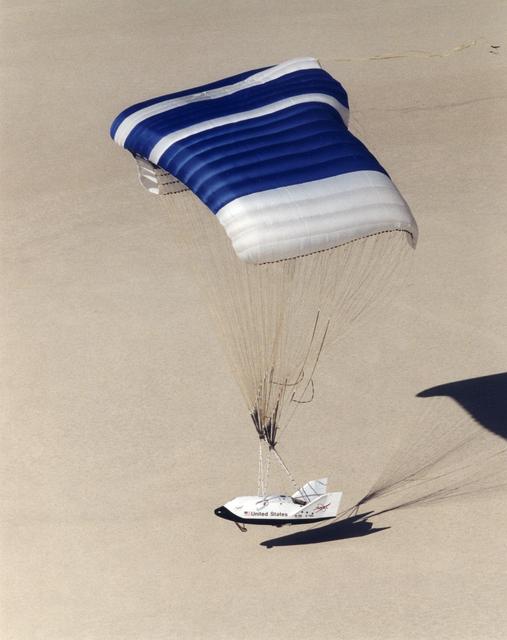
The X-38 Crew Return Vehicle descends under its steerable parafoil over the California desert in its first free flight at the Dryden Flight Research Center, Edwards, California. The flight took place March 12, 1998.
X-38 - First Free Flight, March 12, 1998
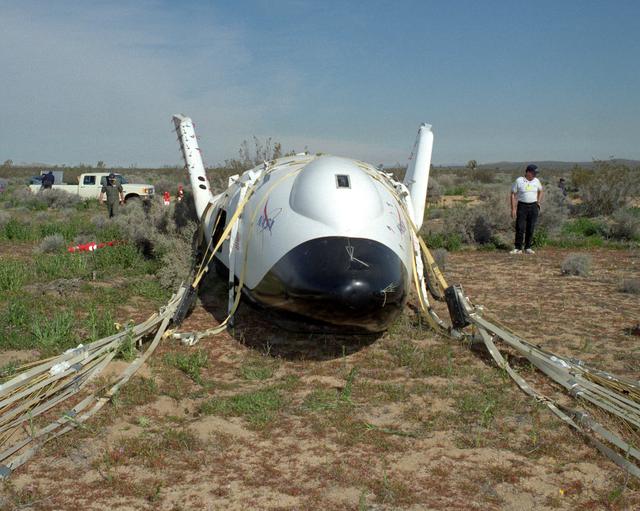
The X-38 Crew Return Vehicle touches down amidst the California desert scrubbrush at the end of its first free flight at the Dryden Flight Research Center, Edwards, California, in March 1998.
X-38 - Landing After First Free Flight, March 12, 1998
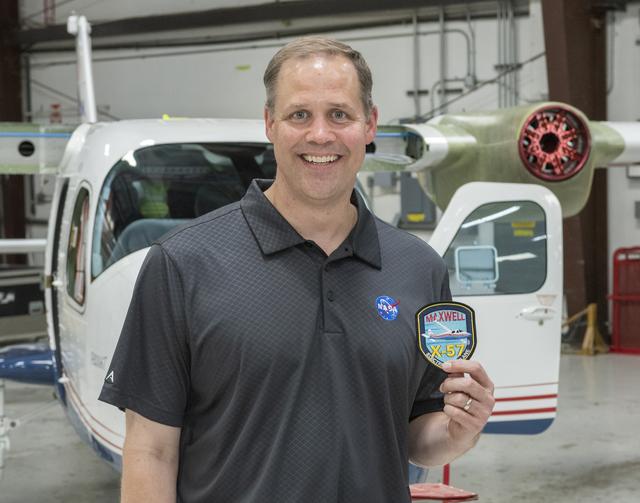
Administrator Bridenstine receives X-57 program patch standing in front of the X-57 being modified from combustion Tecnam P2006T aircraft into all-electric aircraft in Scaled Composites hangar at Mojave Air & Space Port in California.
NASA Administrator Bridenstine receives X-57 all-electric aircraft program patch standing in front of the X-57 being modified at Scaled Composites at Mojave Air and Space Port in California.
NASA's X-38, a research vehicle developed as part of an effort to build an emergency Crew Return Vehicle (CRV) for the International Space Station, descends toward the desert floor under its steerable parafoil on its second free flight. The…
X-38 in Flight during Second Free Flight
The third iteration of the X-38, V-131R, glides down under a giant parafoil towards a landing on Rogers Dry Lake near NASAÕs Dryden Flight Research Center during its first free flight Nov. 2, 2000. The X-38 prototypes are intended to perfec…
X-38 vehicle #131R in first free flight
NASA's X-38, a research vehicle developed as part of an effort to build an emergency Crew Return Vehicle (CRV) for the International Space Station, descends toward a desert lakebed under its steerable parafoil on its second free flight. The…
X-38 in Flight during Second Free Flight
The latest version of the X-38, V-131R, touches down on Rogers Dry Lake adjacent to NASAÕs Dryden Flight Research Center at Edwards, California, at the end of its first free flight under a giant parafoil on Nov. 2, 2000. The X-38 prototypes…
X-38 vehicle #131R during landing on first free flight
The X-38, a research vehicle built to help develop technology for an emergency Crew Return Vehicle (CRV), descends under its steerable parachute during a July 1999 test flight at the Dryden Flight Research Center, Edwards, California. It wa…
X-38 Ship #2 in Free Flight
The X-38, a research vehicle built to help develop technology for an emergency Crew Return Vehicle (CRV), maneuvers toward landing at the end of a March 1999 test flight at the Dryden Flight Research Center, Edwards, California.
X-38 Vehicle #132 in Flight Approaching Landing during First Free Flight
The X-38 Vehicle 131R, intended to prove the utility of a "lifeboat" crew return vehicle to bring crews home from the International Space Station in the event of an emergency, was unloaded from NASA's Super Guppy transport aircraft on July…
The X-38 vehicle #131R arrives at NASA Dryden Flight Research Center
The Proteus high-altitude aircraft at Sunset
Proteus at Sunset
Scaled Composites' unique tandem-wing Proteus was the testbed for a series of UAV collision-avoidance flight demonstrations. An Amphitech 35GHz radar unit installed below Proteus' nose was the primary sensor for the Detect, See and Avoid te…
Proteus in flight over Southern California
The unusual design of the Proteus high-altitude aircraft, incorporating a gull-wing shape for its main wing and a long, slender forward canard, is clearly visible in this view of the aircraft in flight over the Mojave Desert in California.
ERAST Program Proteus Aircraft in Flight over the Mojave Desert in California
The uniquely shaped Proteus high-altitude aircraft soars over California’s Mojave Desert during a July 1999 flight.
Proteus at Sunset
A frontal view of the Proteus high-altitude aircraft on the ramp at the Mojave Airport in Mojave, California in July 1999.
ERAST Program Proteus Aircraft Taxiing on Runway at Mojave Airport in Mojave, California
The X-38 Crew Return Vehicle descends under its steerable parafoil over the California desert in its first free flight at the Dryden Flight Research Center, Edwards, California. The flight took place March 12, 1998.
X-38 - First Free Flight, March 12, 1998
The X-38, a research vehicle built to help develop technology for an emergency Crew Return Vehicle from the International Space Station, is seen just before touchdown on a lakebed near the Dryden Flight Research Center, Edwards California,…
The X-38 Second Prototype Flares to a Landing over the Lakebed at the End of Its Fifth Flight at Edwards Air Force Base
The X-38 Crew Return Vehicle descends under its steerable parafoil over the California desert in its first free flight at the Dryden Flight Research Center, Edwards, California. The flight took place March 12, 1998.
X-38 - First Free Flight, March 12, 1998
The X-38, a research vehicle built to help develop technology for an emergency Crew Return Vehicle (CRV), descends under its steerable parafoil on a March 1999 test flight at the Dryden Flight Research Center, Edwards, California.
X-38 Vehicle #132 in Flight with Deployed Parafoil during First Free Flight
The X-38's blue and white parafoil spreads out in front of the research vehicle as it sits on a lakebed near the Dryden Flight Research Center after a March 2000 test flight.
A Ground Crewman Checks Over the X-38 Second Prototype Following the Lakebed Landing of Its Fifth Flight at Edwards Air Force Base
The X-38, a research vehicle built to help develop technology for an emergency Crew Return Vehicle (CRV), descends under its steerable parafoil on a March 1999 test flight at the Dryden Flight Research Center, Edwards, California.
X-38 Vehicle #132 in Flight with Deployed Parafoil during First Free Flight
The X-38 Crew Return Vehicle descends under its steerable parafoil over the California desert during its first free flight in March 1998 at the Dryden Flight Research Center, Edwards, California.
X-38 - First Free Flight, March 12, 1998
The X-38 technology demonstrator descends under its steerable parafoil toward a lakebed landing in a March 2000 test flight.
The X-38 Second Prototype Glides to a Landing over the Lakebed at the End of Its Fifth Flight at Edwards Air Force Base
Dale Reed, a NASA engineer who worked on the original lifting-body research programs in the 1960s and 1970s, stands with a scale-model X-38 that was used in 1995 research flights, with a full-scale X-38 (80 percent of the size of a potentia…
Dale Reed with X-38 and a Subscale Model Used in Test Program
Scaled Composites' Doug Shane examines the screen of his ground control station during tests in New Mexico. Shane used this configuration as the ground control station to remotely pilot the Proteus aircraft during a NASA sponsored series of…
Scaled Composites' Doug Shane examines the screen of his ground control station during tests in New Mexico. Shane used this configuration as the ground control station to remotely pilot the Proteus aircraft during a NASA sponsored series of tests.
Proteus and an F/A-18 Hornet from NASA's Dryden Flight Research Center are seen here in flight over Las Cruces, New Mexico.
Scaled Composites' Proteus and an F/A-18 Hornet from NASA's Dryden Flight Research Center are seen here in flight over Las Cruces, New Mexico.
Proteus aircraft low-level flyby at Las Cruces Airport.
Scaled Composites' unique tandem-wing Proteus was the testbed for a series of UAV collision-avoidance flight demonstrations. An Amphitech 35GHz radar unit installed below Proteus' nose was the primary sensor for the Detect, See and Avoid te…
Proteus front view in flight
The unusual design of the Proteus high-altitude aircraft, incorporating a gull-wing shape for its main wing and a long, slender forward canard, is clearly visible in this view of the aircraft in flight over the Mojave Desert in California.
ERAST Program Proteus Aircraft in Flight
Scaled Composites' Proteus aircraft with an F/A-18 Hornet and a Beechcraft KingAir from NASA's Dryden Flight Research Center during a low-level flyby at Mojave Airport in Southern California.  The unique tandem-wing Proteus was the testbed…
Scaled Composites' Proteus aircraft with an F/A-18 Hornet and a Beechcraft KingAir from NASA's Dryden Flight Research Center during a low-level flyby at Mojave Airport in Southern California.
Scaled Composites' Proteus aircraft and an F/A-18 Hornet from NASA's Dryden Flight Research Center at Mojave Airport in Southern California.  The unique tandem-wing Proteus was the testbed for a series of UAV collision-avoidance flight demo…
Scaled Composites' Proteus aircraft and an F/A-18 Hornet from NASA's Dryden Flight Research Center at Mojave Airport in Southern California.
Crew members surround the X-38 lifting body research vehicle after a successful test flight and landing in March 1998. The flight was the first free flight for the vehicle and took place at the Dryden Flight Research Center, Edwards, Califo…
X-38 - On Ground after First Free Flight, March 12, 1998
The X-38 technology demonstrator descends under its steerable parafoil toward a lakebed landing in a March 2000 test flight.
The X-38 Second Prototype Glides to a Landing over the Lakebed at the End of Its Fifth Flight at Edwards Air Force Base
The X-38 prototypes are intended to perfect a "crew lifeboat" for the International Space Station. The X-38 vehicle 131R demonstrates a huge 7,500 square-foot parafoil that will that will enable the Crew Return Vehicle (CRV) to land on the…
X-38 vehicle #131R during pre-launch with B-52 008 mothership and F-18 chase aircraft
NASA Administrator Bridenstine talks to press at Scaled Composites hangar at Mojave Air & Space Port in California. He talks about X-planes and their future and the Flight Opportunities program as well as commercial space partnerships with…
NASA Administrator Bridenstine speaks to press in front of X-57 all electric aircraft that is being modified at Scaled Composites at Mojave Air & Space Port in California
NASA's X-38, a research vehicle developed as part of an effort to build an emergency Crew Return Vehicle (CRV) for the International Space Station, descends toward the desert floor under its steerable parafoil on its second free flight. The…
X-38 in Flight during Second Free Flight
NASA Administrator Bridenstine talks to press at Scaled Composites hangar at Mojave Air & Space Port in California. He talks about X-planes and their future and the Flight Opportunities program as well as commercial space partnerships with…
NASA Administrator Bridenstine speaks to press in front of X-57 all electric aircraft that is being modified at Scaled Composites at Mojave Air & Space Port in California
The X-38, a research vehicle built to help develop technology for an emergency Crew Return Vehicle (CRV), descends under its steerable parafoil on a March 1999 test flight at the Dryden Flight Research Center, Edwards, California.
X-38 Vehicle #132 in Flight with Deployed Parafoil during First Free Flight
The X-38, a research vehicle built to help develop technology for an emergency Crew Return Vehicle (CRV), flares for its lakebed landing at the end of a March 1999 test flight at the Dryden Flight Research Center, Edwards, California.
X-38 Vehicle #132 Landing on First Free Flight
The X-38 Crew Return Vehicle descends under its steerable parafoil over the California desert in its first free flight at the Dryden Flight Research Center, Edwards, California. The flight took place March 12, 1998.
X-38 - First Free Flight, March 12, 1998
NASA's X-38, a prototype of a Crew Return Vehicle (CRV) resting on the lakebed near the Dryden Flight Research Center after the completion of its second free flight. The X-38 was launched from NASA Dryden's B-52 Mothership on Saturday, Febr…
X-38 on Lakebed after Landing on Second Free Flight
Administrator Bridenstine hears about the progress to modify the Tecnam P2006T from a combustion aircraft to an all-electric aircraft. Armstrong's X-57 team and ESAero, the prime contractor for the plane, are doing the briefing. The final c…
Armstrong X-57 team brief NASA Administrator Bridenstine about the progress of making a combustion aircraft into an all-electric airplane. X-57 is in Scaled Composites hangar at Mojave Air & Space Port in California. Model of the final aircraft design sta
Scaled Composites' Proteus aircraft and an F/A-18 Hornet from NASA's Dryden Flight Research Center during a low-level flyby at Las Cruces Airport in New Mexico.
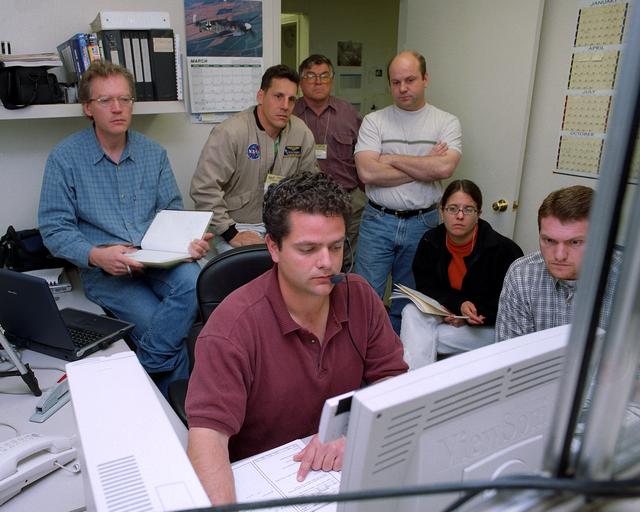
Proteus DSA control room in Mojave, CA (L to R) Jean-Pierre Soucy; Amphitech International Software engineer Craig Bomben; NASA Dryden Test Pilot Pete Siebold; (with headset, at computer controls) Scaled Composites pilot Bob Roehm; New Mexi…
Proteus DSA control room in Mojave, CA