
Saturn 1 Launch summary of research and development flights and operational flights. NASA's initial development plan for the Saturn program had called for the Saturn I to serve as a stepping stone to the development of larger Saturn vehicle…

A cutaway illustration of Saturn 1 launch vehicle mission. The Saturn I, first of the Saturn launch vehicles' family, is a two-stage vehicle with a low-earth-orbit payload capability of approximately 25,000 pounds. The research and developm…
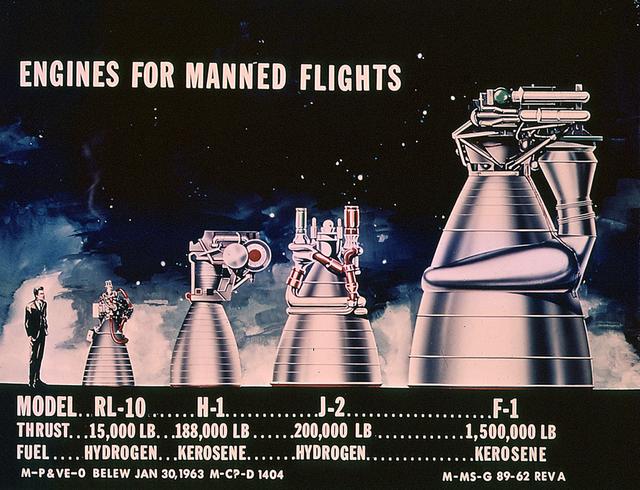
This drawing clearly shows the comparative sizes of the rocket engines used to launch the Saturn vehicles. The RL-10 and the H-1 engines were used to launch the Saturn I rockets. The J-2 engine was used on the second stage of Saturn IB and…

The new tribute to the crew of Apollo 1 who perished in a fire at the launch pad on Jan. 27, 1967, during training for the mission is shown looking down the length of the area. The tribute highlights the lives and careers of astronauts Gus…

A gateway featuring the Apollo 1 mission logo over the moon is shown inside the new tribute to the crew of Apollo 1 who perished in a fire at the launch pad on Jan. 27, 1967, during training for the mission. Astronauts Gus Grissom, Ed White…

A cluster of eight H-1 engines were used to thrust the first stage of Saturn I (S-I stage) and Saturn IB (S-IB stage). The engines were arranged in a double pattern. Four engines, located inboard, were fixed in a square pattern around the s…

A complete F-1 engine assembly is shown in this photograph. Designed and developed by Rocketdye under the direction of the Marshall Space Flight Center, the engine measured 19-feet tall by 12.5 feet at the nozzle exit, and each engine produ…

An Apollo spacecraft mockup marks the capstone of the new tribute to the crew of Apollo 1 who perished in a fire at the launch pad on Jan. 27, 1967, during training for the mission. The tribute highlights the lives and careers of astronauts…

A display case dedicated to astronaut Gus Grissom is shown inside the new tribute to the crew of Apollo 1 who perished in a fire at the launch pad on Jan. 27, 1967, during training for the mission. Grissom, Ed White II and Roger Chaffee wer…

Workmen at the Kennedy Space Center position the nose cone for the 204LM-1, an unmanned Apollo mission that tested the Apollo Lunar Module (LM) in Earth orbit. Also known as Apollo 5, the spacecraft was launched on the fourth Saturn IBC lau…

This photograph shows the Saturn-I first stage (S-1 stage) being transported to the test stand for a static test firing at the Marshall Space Flight Center. Soon after NASA began operations in October 1958, it was evident that sending peopl…

The new tribute to the crew of Apollo 1 who perished in a fire at the launch pad on Jan. 27, 1967, during training for the mission is shown looking down the length of the area. The tribute highlights the lives and careers of astronauts Gus…

Progress in the Saturn program, depicted below, was described by Dr. Wernher von Braun, Marshall Space Flight Center (MSFC) Director, in an appearance before the Senate Committee of Aeronautical and Space Sciences. "The flight configuration…

At its founding, the Marshall Space Flight Center (MSFC) inherited the Army’s Jupiter and Redstone test stands, but much larger facilities were needed for the giant stages of the Saturn V. From 1960 to 1964, the existing stands were remodel…

This photograph shows F-1 engines being stored in the F-1 Engine Preparation Shop, building 4666, at the Marshall Space Flight Center. Each F-1 engine produced a thrust of 1,500,000 pounds. A cluster of five engines was mounted on the thrus…

Workers at the Marshall Space Flight Center (MSFC) hoist S-IB-1, the first flight version of the Saturn IB launch vehicle's first stage (S-IB stage), into the Saturn IB static test stand on March 15, 1965. Developed by the MSFC and built by…

A close-up view of the F-1 Engine for the Saturn V S-IC (first) stage depicts the complexity of the engine. Developed by Rocketdyne under the direction of the Marshall Space Flight Center, the F-1 engine was utilized in a cluster of five en…

Photographed are models of early rocketry: The Atlas Mercury, Redstone Mercury; and Saturn C-1.

A Cluster of eight H-1 engines were used to thrust the first stage of Saturn I (S-I stage) and Saturn IB (S-IB stage). The engines were arranged in a double pattern. Four engines, located inboard, were fixed in a square pattern around the s…

On October 27, 1961, the Marshall Space Flight Center and the Nation marked a high point in the 3-year-old Saturn development program when the first Saturn vehicle flew a flawless 215-mile ballistic trajectory from Cape Canaveral, Florida.…

This photograph depicts a test firing of an F-1 engine at the F-1 engine test stand in the west test area of the Marshall Space Flight Center. This engine produced 1,500,000 pounds of thrust using liquid oxygen and RP-1, which is a derivati…
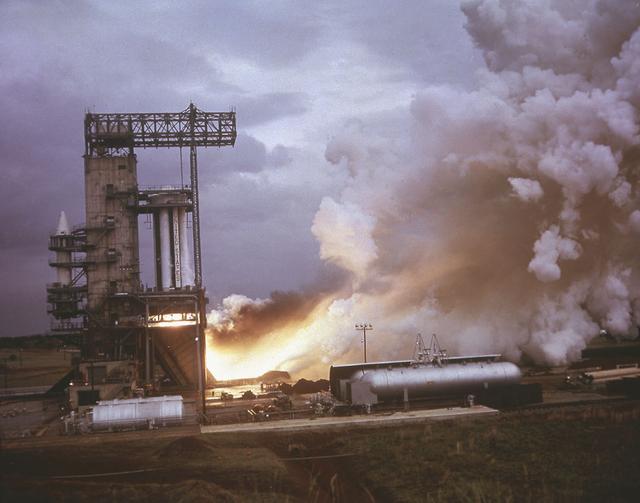
Marshall Space Flight Center (MSFC) was the birthplace of the United States' rocket program. In the early 1960s, most of the rocket development and testing were done at the MSFC. Pictured is an example of what the test engineers would have…

A spider beam for cornecting the Saturn I fuel tanks is being positioned in the fabrication and engineering laboratory of the Marshall Space Flight Center (MSFC).

The crew access arm that astronauts walked across to reach the Apollo spacecraft for missions to the moon serves as the exit for the new tribute to the crew of Apollo 1 who perished in a fire at the launch pad on Jan. 27, 1967, during train…

The three-part hatch that was in place on the Apollo 1 spacecraft is shown in a tribute to the crew of Apollo 1 who perished in a fire at the launch pad on Jan. 27, 1967, during training for the mission. This is the first time any part of t…

A display case dedicated to astronaut Ed White II is shown inside the new tribute to the crew of Apollo 1 who perished in a fire at the launch pad on Jan. 27, 1967, during training for the mission. Gus Grissom, White and Roger Chaffee were…

A display case dedicated to astronaut Roger Chaffee is shown inside the new tribute to the crew of Apollo 1 who perished in a fire at the launch pad on Jan. 27, 1967, during training for the mission. Gus Grissom, Ed White II and Chaffee wer…

A display screen showing the memorial plaque that is in place at Launch Complex 34 is shown inside the new tribute to the crew of Apollo 1 who perished in a fire at the launch pad on Jan. 27, 1967, during training for the mission. Astronaut…

Engineers at the Marshall Space Flight Center install the F-1 engines on the S-IC stage thrust structure at the S-IC static test stand. Engines are installed on the stage after it has been placed in the test stand. This image shows a close-…

Pictured in front of the Saturn 1 launch vehicle are (L to R): Dr. Rocco Petrone, Director of Launch Operations at Kennedy Space Center; Dr. Werher von Braun, Director of Marshall Space Flight Center; Dr. Oswald Lange, Director of the Satur…
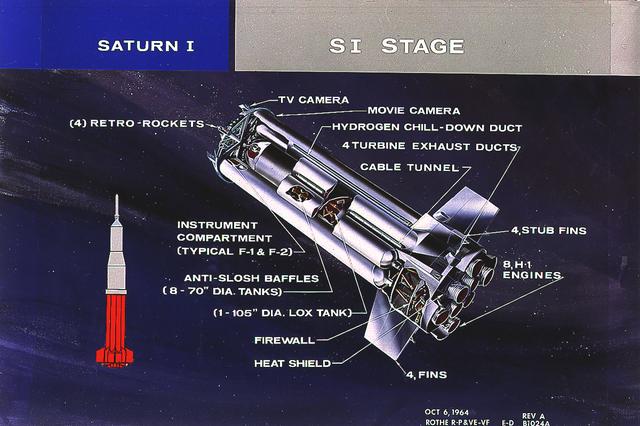
This cutaway illustrates the S-I stage, the first stage of the Saturn I vehicle developed by the Marshall Space Flight Center (MSFC). The stage was propelled by a cluster of eight H-1 engines, capable of producing 1,500,000 pounds of thrust…

S-IB-1, the first flight version of the Saturn IB launch vehicle's first stage (S-IB stage), undergoes a full-duration static firing in Saturn IB static test stand at the Marshall Space Flight Center (MSFC) on April 13, 1965. Developed by t…

S-IB-1, the first flight version of the Saturn IB launch vehicle's first stage (S-IB stage), sat in the Marshall Space Flight Center (MSFC) Saturn IB static test stand on March 15, 1965. Developed by the MSFC and built by the Chrysler Corpo…

H-1 engine major components with callouts (chart 1). The H-1 engine was used in a cluster of eight on the the first stage of Saturn I (S-I stage) and Saturn IB (S-IB stage). The engines were arranged in a double pattern: four engines, locat…
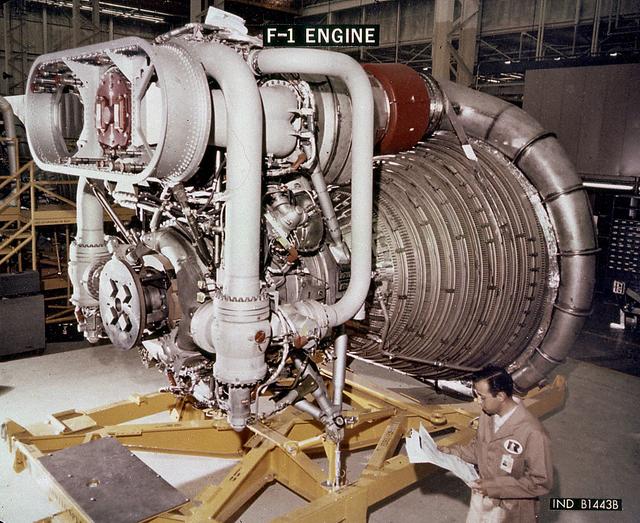
This close-up view of the F-1 engine for the Saturn V S-IC (first) stage shows the engine's complexity, and also its large size as it dwarfs the technician. Developed by Rocketdyne, under the direction of the Marshall Space Flight Center, t…

A display case dedicated to astronaut Ed White II is shown inside the new tribute to the crew of Apollo 1 who perished in a fire at the launch pad on Jan. 27, 1967, during training for the mission. Gus Grissom, White and Roger Chaffee were…

A redesigned hatch for an Apollo spacecraft is shown inside the new tribute to the crew of Apollo 1 who perished in a fire at the launch pad on Jan. 27, 1967, during training for the mission. Astronauts Gus Grissom, Ed White II and Roger Ch…

A display case dedicated to astronaut Gus Grissom is shown inside the new tribute to the crew of Apollo 1 who perished in a fire at the launch pad on Jan. 27, 1967, during training for the mission. Grissom, Ed White II and Roger Chaffee wer…

A display case dedicated to astronaut Roger Chaffee is shown inside the new tribute to the crew of Apollo 1 who perished in a fire at the launch pad on Jan. 27, 1967, during training for the mission. Gus Grissom, Ed White II and Chaffee wer…

The F-1 engine was developed and built by Rocketdyne under the direction of the Marshall Space Flight Center. It measured 19 feet tall by 12.5 feet at the nozzle exit, and produced a 1,500,000-pound thrust using liquid oxygen and kerosene a…
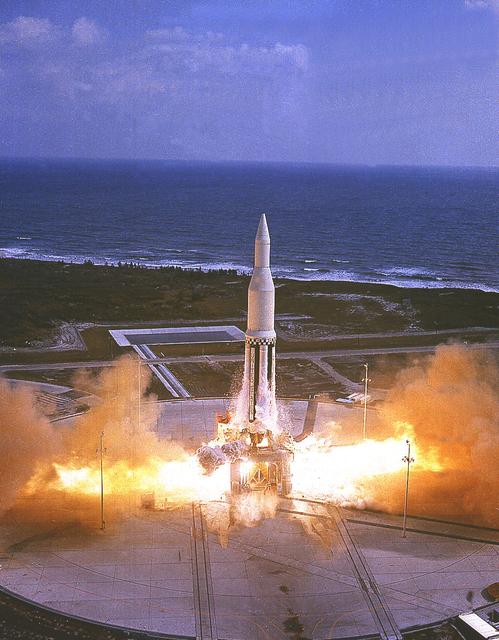
The Marshall Space Flight Center's first Saturn I vehicle, SA-1, lifts off from Cape Canaveral, Florida, on October 27, 1961. This early configuration, Saturn I Block I, 162 feet tall and weighing 460 tons, consisted of the eight H-1 engine…
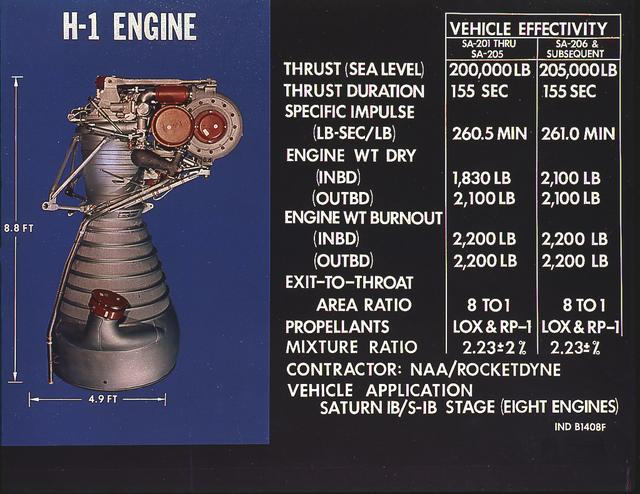
H-1 engine characteristics: The H-1 engine was developed under the management of the Marshall Space Flight Center (MSFC). The cluster of eight H-1 engines was used to power the first stage of the Saturn I (S-I stage) and Saturn IB (S-IVB st…

The Saturn Project was approved on January 18, 1960, as a program of the highest national priority. The formal test program to prove out the clustered-booster concept was well underway at Redstone Arsenal. This photograph depicts a mockup o…

The Saturn I S-I stage with eight H-1 engines, located in Marshall Space Flight Center building 4705, showing the positioning of eight H-1 engines. The Saturn I S-I stage had eight H-1 engines clustered, using liquid oxygen/kerosene-1 (LOX/…

A pioneer of America's space program, Dr. von Braun stands by the five F-1 engines of the Saturn V launch vehicle. This Saturn V vehicle is an actual test vehicle which has been displayed at the U.S. Space Rocket Center in Huntsville, Alaba…
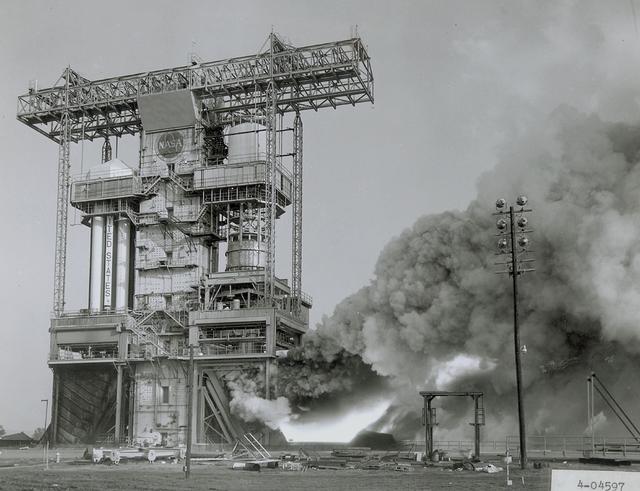
The flame and exhaust from the test firing of an F-1 engine blast out from the Saturn S-IB Static Test Stand in the east test area of the Marshall Space Flight Center. A Cluster of five F-1 engines, located in the S-IC (first) stage of the…
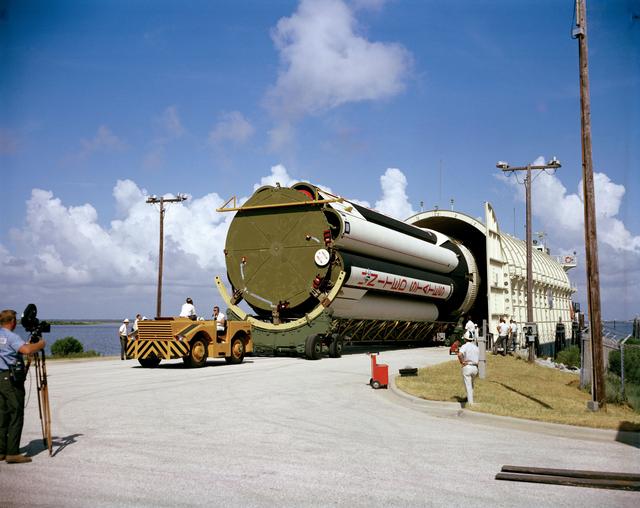
S66-50152 (1966) --- A stage of the uprated Saturn 1 launch vehicle unloaded from NASA barge Promise after arrival at Cape Kennedy. Launch vehicle for Apollo/Saturn 204 mission.

At its founding, the Marshall Space Flight Center (MSFC) inherited the Army’s Jupiter and Redstone test stands, but much larger facilities were needed for the giant stages of the Saturn V. From 1960 to 1964, the existing stands were remodel…