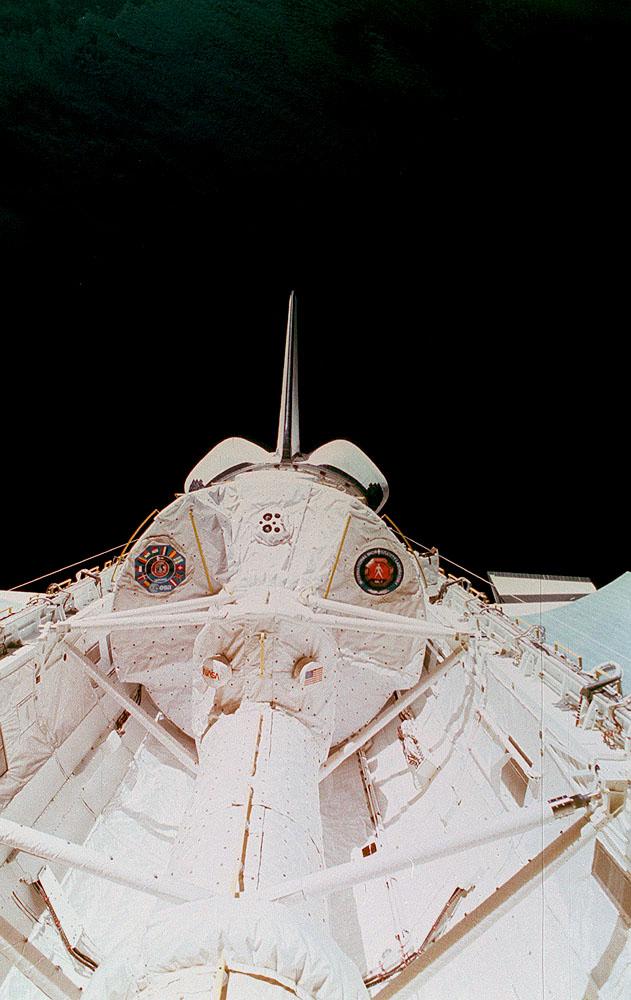
This is the Space Shuttle Orbiter Discovery, STS-42 mission, with the First International Microgravity Laboratory (IML-1) module shown in the cargo bay. IML-1, the first in a series of Shuttle flights, was dedicated to study the fundamental…
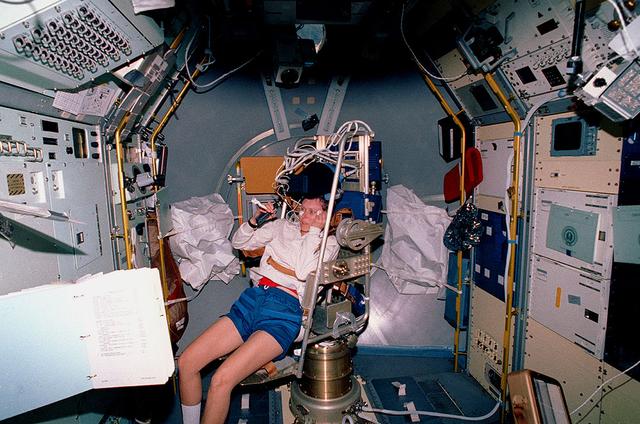
This Space Shuttle Orbiter Discovery (STS-42) onboard photo shows Canadian Payload Specialist Roberta Bondar getting into the Microgravity Vestibular Investigation (MVI) chair to begin an experiment in the International Microgravity Lab-1 (…
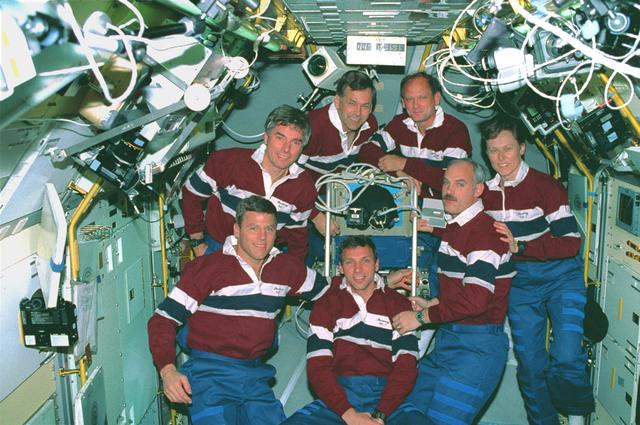
STS042-78-061 (22-30 Jan. 1992) --- The seven STS-42 crewmembers pose for a traditional in-space portrait in the shirt-sleeve environment of the International Microgravity Laboratory (IML-1) science module in the shuttle's cargo bay. (Hold…
STS-42 closeup view shows Student Experiment 81-09 (SE 81-09), Convection in Zero Gravity experiment, with radial pattern caused by convection induced by heating an oil and aluminum powder mixture in the weightlessness of space. While the S…
Air-to-air view, taken from the weather-monitoring Shuttle Training Aircraft (STA), shows STS-42 Discovery, Orbiter Vehicle (OV) 103, as it soars above the Atlantic Ocean after liftoff from a Kennedy Space Center (KSC) Launch Complex (LC) P…
The primary payload for Space Shuttle Mission STS-42, launched January 22, 1992, was the International Microgravity Laboratory-1 (IML-1), a pressurized manned Spacelab module. The goal of IML-1 was to explore in depth the complex effects of…
The primary payload for Space Shuttle Mission STS-42, launched January 22, 1992, was the International Microgravity Laboratory-1 (IML-1), a pressurized manned Spacelab module. The goal of IML-1 was to explore in depth the complex effects of…
The primary payload for Space Shuttle Mission STS-42, launched January 22, 1992, was the International Microgravity Laboratory-1 (IML-1), a pressurized manned Spacelab module. The goal of IML-1 was to explore in depth the complex effects of…
The primary payload for Space Shuttle Mission STS-42, launched January 22, 1992, was the International Microgravity Laboratory-1 (IML-1), a pressurized manned Spacelab module. The goal of IML-1 was to explore in depth the complex effects of…
The primary payload for Space Shuttle Mission STS-42, launched January 22, 1992, was the International Microgravity Laboratory-1 (IML-1), a pressurized manned Spacelab module. The goal of IML-1 was to explore in depth the complex effects of…
CAPE CANAVERAL, Fla. – The orbiter Discovery heads for the VAB atop the specially designed orbiter transporter. Once inside the VAB, Discovery will be mated with the external tank/solid rocket booster assembly. The fully assembled shuttle w…
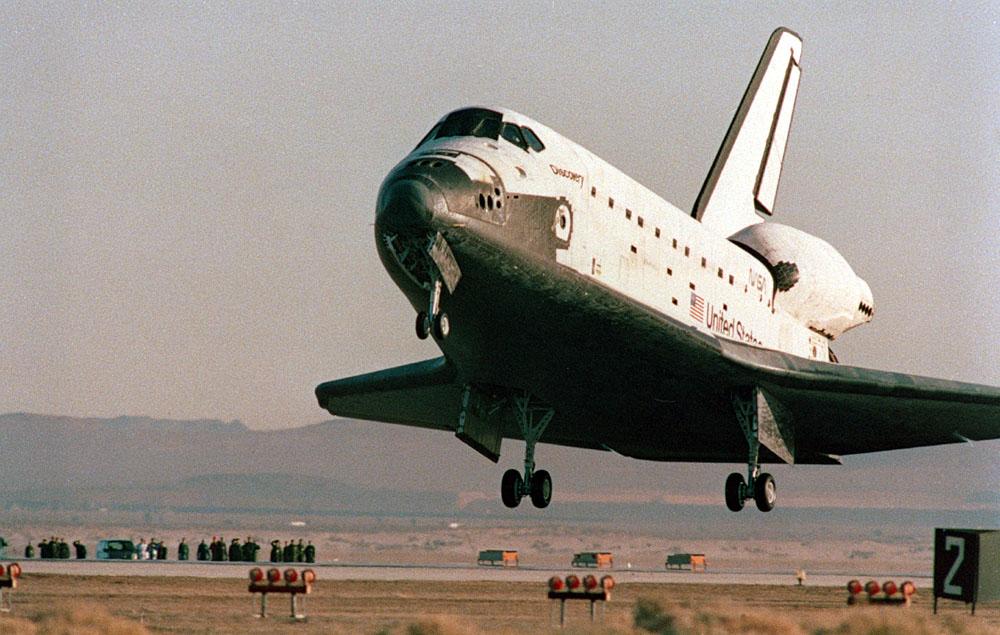
Space Shuttle Discovery STS-42) is just about to ease down its main gear on Runway 22 at Edwards Air Force Base in southern California. The successful landing completed an eight-day mission for five NASA astronauts and two payload specialis…
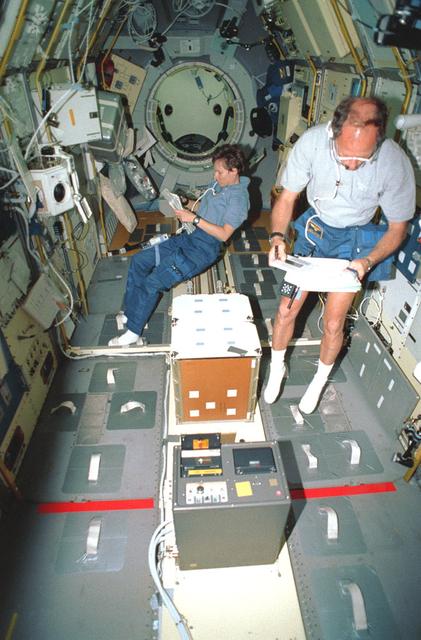
Onboard Space Shuttle Discovery (STS-42) Astronaut Norman E. Thagard, payload commander, and Canadian payload specialist Roberta L. Bondar are busily engaged with experiments in the International Microgravity Laboratory (IML-1) science modu…
International Microgravity Laboratory-1 (IML-1) was the first in a series of Shuttle flights dedicated to fundamental materials and life sciences research with the international partners. The participating space agencies included: NASA, the…
STS042-80-000AV (22-30 Jan. 1992) --- Moscow is arranged as a series of concentric transportation routes crossed by straight spokes which lead away from the Kremlin at the city center. One of the inner rings, the Garden Ring, follows the li…
S91-52649 (Nov 1991) ---- Astronaut Ulf Merbold, PhD, European Space Agency (ESA) Payload Specialist for STS-42, International Microgravity Laboratory (IML-1).
STS-42 Earth observation taken aboard Discovery, Orbiter Vehicle (OV) 103, is of New York City (NYC), New York (41.0N, 74.0W). Snow cover highlights the large areas of development and the many reservoirs in this wintertime scene of the metr…
The primary payload for Space Shuttle Mission STS-42, launched January 22, 1992, was the International Microgravity Laboratory-1 (IML-1), a pressurized manned Spacelab module. The goal of IML-1 was to explore in depth the complex effects of…
STS042-27-037 (22-30 Jan. 1992) --- Astronaut David C. Hilmers, STS-42 mission specialist, wearing a helmet assembly, sits in the Microgravity Vestibular Investigation (MVI) rotating chair. The scene is in the International Microgravity La…
The primary payload for Space Shuttle Mission STS-42, launched January 22, 1992, was the International Microgravity Laboratory-1 (IML-1), a pressurized manned Spacelab module. The goal of IML-1 was to explore in depth the complex effects of…
NASA's 747 Shuttle Carrier Aircraft No. 911, with the space shuttle orbiter Endeavour securely mounted atop its fuselage, taxies to the runway to begin the ferry flight from Rockwell's Plant 42 at Palmdale, California, where the orbiter was…
STS042-S-002 (November 1991) --- Payload specialists representing Canada and the European Space Agency (CSA - ESA) join five NASA astronauts for the January 1992 scheduled STS-42 mission. Left to right are astronauts Stephen S. Oswald, pil…
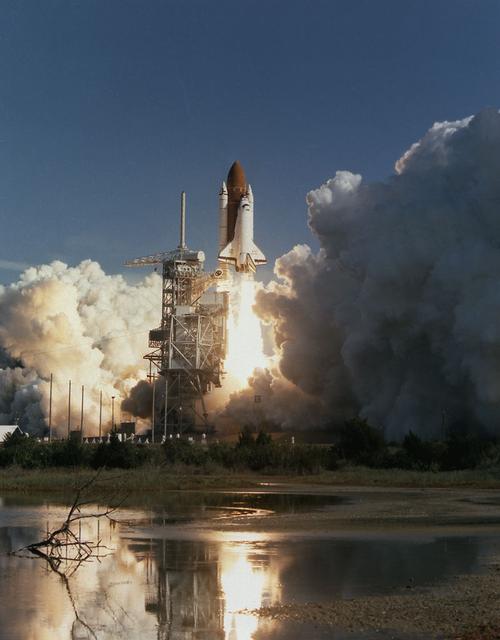
Space Shuttle Discovery (STS-42) lifted off from Kennedy Space Center (KSC) with International Microgravity Laboratory (IML-1) aboard the orbiter's cargo bay. IML missions were devoted to material and life sciences studies using the Spacela…
Onboard Space Shuttle Discovery (STS-42) the seven crewmembers pose for a traditional in-space portrait in the shirt-sleeve environment of the International Microgravity Laboratory (IML-1) science module in the Shuttle's cargo bay. Pictured…
In this photograph, astronaut Roberta Bondar conducts a life science experiment by using the Biorack Glovebox (GBX) during the International Microgravity Laboratory-1 (IML-1) mission. The Biorack was a large multipurpose facility designed f…
The STS-42 crew portrait includes from left to right: Stephen S. Oswald, pilot; Roberta L. Bondar, payload specialist 1; Norman E. Thagard, mission specialist 1; Ronald J. Grabe, commander; David C. Hilmers, mission specialist 2; Ulf D. Mer…
Astronaut Ulf Merbold on the stationary seat of the mini-sled, stares into an umbrella-shaped rotating dome with colored dots. Astronaut Merbold, assisted by astronaut David Hilmer, are conducting the Visual Simulator Experiment, a space ph…
Astronaut David C. Hilmers conducts the Microgravity Vestibular Investigations (MVI) sitting in its rotator chair inside the IML-1 science module. When environmental conditions change so that the body receives new stimuli, the nervous syste…
STS-42 Payload Specialist Roberta L. Bondar (light shirt) smiles as she looks out overhead window W7 while Mission Specialist (MS) and Payload Commander (PLC) Norman E. Thagard peers out aft viewing window W9. The two crewmembers are on the…
The primary payload for Space Shuttle Mission STS-42, launched January 22, 1992, was the International Microgravity Laboratory-1 (IML-1), a pressurized manned Spacelab module. The goal of IML-1 was to explore in depth the complex effects of…
STS042-45-033 (30 Jan. 1992) --- Astronauts Ronald J. Grabe (left) and Stephen S. Oswald man the commander and pilot stations, respectively, during the entry phase of the STS-42 mission. The pink glow through the front windows telltale of f…
STS042-203-024 (22-30 Jan. 1992) --- Astronaut David C. Hilmers (right), STS-42 mission specialist, assists European Space Agency (ESA) payload specialist Ulf Merbold with the visual stimulator experiment on the Space Shuttle Discovery's mi…
The Space Shuttle Endeavour, atop NASA's 747 Shuttle Carrier Aircraft (SCA), taking off for the Kennedy Space Center shortly after its landing on 11 October 1994, at Edwards, California, to complete mission STS-68. Endeavour was being ferri…
The primary payload for Space Shuttle Mission STS-42, launched January 22, 1992, was the International Microgravity Laboratory-1 (IML-1), a pressurized manned Spacelab module. The goal of IML-1 was to explore in depth the complex effects of…