STS-35 lifted off December 2, 1990, at 1:19 am EST, aboard the Space Shuttle Orbiter Columbia. Her crew of eight included: Vance D. Brand, commander; Colonel Guy S. Gardner, pilot; mission specialists Dr. Robert A. R. Parker, John M. (Mike)…
Space Science
The primary objective of the STS-35 mission was round the clock observation of the celestial sphere in ultraviolet and X-Ray astronomy with the Astro-1 observatory which consisted of four telescopes: the Hopkins Ultraviolet Telescope (HUT);…
Spacelab
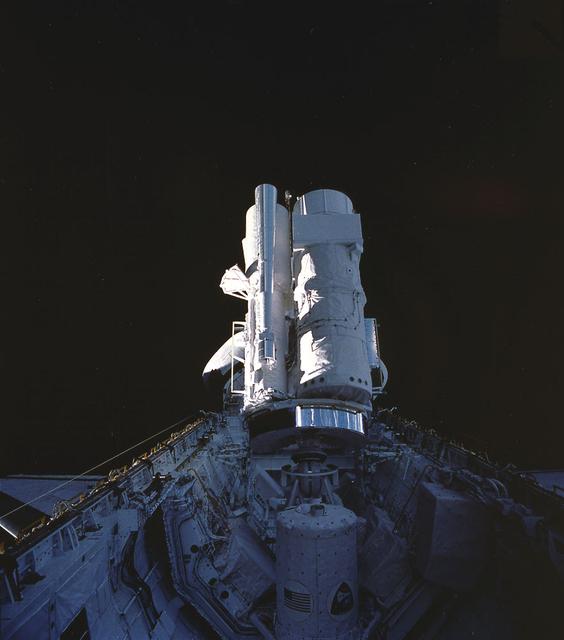
Onboard the Space Shuttle Orbiter Columbia (STS-35), the various components of the Astro-1 payload are seen backdropped against dark space. Parts of the Hopkins Ultraviolet Telescope (HUT), Ultraviolet Imaging Telescope (UIT), and the Wisco…
Spacelab
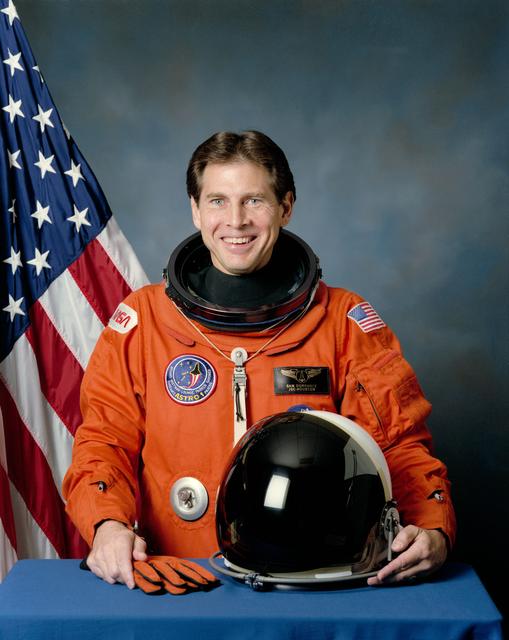
Official portrait of Samuel T. Durrance, Ph.D. and STS-35 Columbia, Orbiter Vehicle (OV) 102, Astronomy Laboratory 1 (ASTRO-1) payload specialist. Durrance wears launch and entry suit (LES) with helmet displayed on table at his left.
Official portrait of Samuel T. Durrance
STS035-501-007 (2-10 Dec. 1990) --- The STS-35 crewmembers aboard the Earth-orbiting Space Shuttle Columbia photographed this view of the Arid Simpson Desert of Australia with a handheld Rolleiflex camera. Lake Eyre is normally dry; however…
Lake Eyre, Simpson Desert, South Australia, Australia
STS035-10-005 (2-10 Dec 1990) --- STS-35 Mission Specialist (MS) Jeffrey A. Hoffman (front) and Pilot Guy S. Gardner, holding Development Test Objective (DTO) 634 trash compactor handles to the ceiling, "commute" to work on the middeck of C…
STS-35 MS Hoffman & Pilot Gardner "commute" to work on the middeck of OV-102
The primary objective of the STS-35 mission was round the clock observation of the celestial sphere in ultraviolet and X-Ray astronomy with the Astro-1 observatory which consisted of four telescopes: the Hopkins Ultraviolet Telescope (HUT);…
Around Marshall
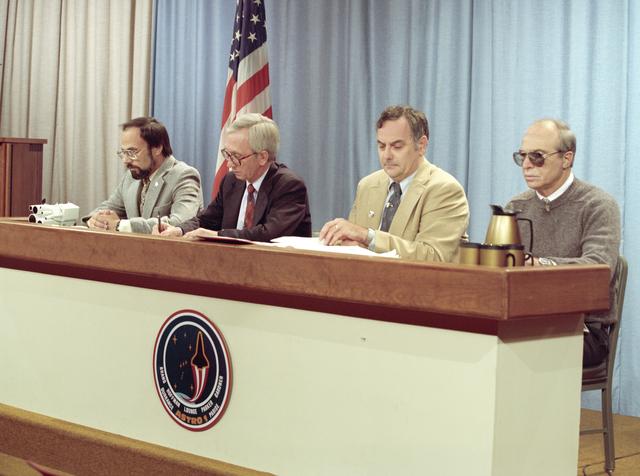
STS035-607-024 (2-10 Dec. 1990) --- This is one of 25 visuals used by the STS-35 crew at its Dec. 20, 1990 post-flight press conference. Space Shuttle Columbia's flight of almost nine days duration (launched December 2 from Kennedy Space Ce…
Thunderstorms, Indian Ocean
STS035-15-035 (2-10 Dec 1990) --- STS-35 crewmembers perform a microgravity experiment using their drinking water while on the middeck of Columbia, Orbiter Vehicle (OV) 102. Mission Specialist (MS) Jeffrey A. Hoffman (left) has released som…
STS-35 crewmembers watch a sphere of water float on OV-102's middeck
The primary objective of the STS-35 mission was round the clock observation of the celestial sphere in ultraviolet and X-Ray astronomy with the Astro-1 observatory which consisted of four telescopes: the Hopkins Ultraviolet Telescope (HUT);…
Around Marshall
STS035-10-015 (2-10 Dec 1990) --- This busy scene shows cameras and supportive photographic gear temporarily stowed on Space Shuttle Columbia's aft flight deck. It was photographed with a 35mm camera by astronaut Jeffrey A. Hoffman, mission…
STS-35 aft flight deck of Columbia, OV-102, with an array of camera equipment
STS-35 Mission Specialist (MS) Robert A.R. Parker (left) and Payload Specialist Samuel T. Durrance practice Astronomy Laboratory 1 (ASTRO-1) experiment procedures in a space shuttle aft flight deck mockup in the Payload Crew Training Comple…
STS-35 ASTRO-1 MS Parker and Payload Specialist Durrance train at MSFC
The primary objective of the STS-35 mission was round the clock observation of the celestial sphere in ultraviolet and X-Ray astronomy with the Astro-1 observatory which consisted of four telescopes: the Hopkins Ultraviolet Telescope (HUT);…
Around Marshall
In this photograph, the instruments of the Astro-1 Observatory are erected in the cargo bay of the Columbia orbiter. Astro-1 was launched aboard the the Space Shuttle Orbiter Columbia (STS-35) mission on December 2, 1990. The Astro Observat…
Spacelab
The primary objective of the STS-35 mission was round the clock observation of the celestial sphere in ultraviolet and X-Ray astronomy with the Astro-1 observatory which consisted of four telescopes: the Hopkins Ultraviolet Telescope (HUT);…
Around Marshall
CAPE CANAVERAL, Fla. – The orbiter Columbia heads for the Vehicle Assembly Building following its arrival at the Shuttle Landing Facility.  OV-102's return brings full circle mission STS-35, a nine-day flight to study astrophysics.    Photo…
KSC-90PC-1977
Designed by the crewmembers assigned to the mission, the STS-35 crew patch symbolizes the Space Shuttle flying above Earth's atmosphere to better study the many celestial objects of the universe, represented by the constellation Orion.
Space Shuttle Projects
Onboard the Space Shuttle Orbiter Columbia (STS-35), the various components of the Astro-1 payload are seen backdropped against a blue and white Earth. Parts of the Hopkins Ultraviolet Telescope (HUT), the Ultraviolet Imaging Telescope (UIT…
Spacelab
STS-35 Astronomy Laboratory 1 (ASTRO-1) is installed in Columbia's, Orbiter Vehicle (OV) 102's, payload bay (PLB) at the Kennedy Space Center (KSC) Orbiter Processing Facility (OPF). On the left, in the aft PLB is the Broad Band X Ray Teles…
STS-35 Astronomy Laboratory 1 (ASTRO-1) in OV-102's payload bay at KSC
STS035-13-008 (2-10 Dec. 1990) --- The various components of the Astro-1 payload are seen backdropped against the blue and white Earth in this 35mm scene photographed through Columbia's aft flight deck windows. Parts of the Hopkins Ultravio…
STS-35 ASTRO-1 telescopes documented in OV-102's payload bay (PLB)
STS035-12-005 (2-10 Dec 1990) --- During STS-35, middeck stowage volume G and a contingency water container (CWC) were utilized to remedy a problem onboard Columbia, Orbiter Vehicle (OV) 102. A hose connecting OV-102's waste water system to…
STS-35 stowage volume G with contingency water container (CWC) onboard OV-102
STS035-49-028 (2-10 Dec. 1990) --- This is one of 25 visuals used by the STS-35 crew at its Dec. 20, 1990 post-flight press conference. Columbia's flight of almost nine days duration (launched Dec. 2 from Kennedy Space Center and landed Dec…
STS-35 payload specialists perform balancing act on OV-102's middeck
These open ocean Internal Waves were seen off the Namibia Coast, Africa (23.0S, 14.0E). The periodic and regularly spaced sets of internal waves most likely coincide with tidal periods about 12 hours apart. The wave length (distance from cr…
Open ocean Internal Waves, Namibia Coast, Africa.
Though they are not actually asleep, three STS-35 crewmembers demonstrate the bunk-style sleep compartments onboard Columbia's, Orbiter Vehicle (OV) 102's, middeck. From top to bottom are Payload Specialist Samuel T. Durrance, Mission Speci…
STS-35 crewmembers in sleep station compartments on OV-102's middeck
STS035-05-036 (2-10 Dec 1990) --- STS-35 Commander Vance D. Brand, wearing headset, communicates with family members using Shuttle Amateur Radio Experiment (SAREX) on Columbia's, Orbiter Vehicle (OV) 102's, middeck. SAREX and its portable l…
STS-35 Commander Brand talks to family using SAREX on OV-102's middeck
STS035-15-010 (2-11 Dec 1990) --- Astronaut John M. (Mike) Lounge, STS-35 mission specialist, communicates with family members from the middeck of Space Shuttle Columbia in Earth orbit.  The STS-35 Shuttle amateur radio experiment (SAREX),…
STS-35 Mission Specialist (MS) Lounge uses SAREX on OV-102's middeck
STS035-515-003 (2-10 Dec 1990) --- STS-35 Pilot Guy S. Gardner, wearing his launch and entry suit (LES), reviews descent checklist while at the pilots station on the forward flight deck of Columbia, Orbiter Vehicle (OV) 102. Crewmembers are…
STS-35 Pilot Gardner with descent checklist on OV-102's forward flight deck
STS-31 Discovery, Orbiter Vehicle (OV) 103, lifts off from Kennedy Space Center (KSC) Launch Complex (LC) 39 Pad B. In the foreground STS-35 Columbia, OV-102, is visible on launch pad 39A. This event marked the first time since January 1986…
STS-31 Discovery, OV-103, liftoff from KSC
The primary objective of the STS-35 mission was round the clock observation of the celestial sphere in ultraviolet and X-Ray astronomy with the Astro-1 observatory which consisted of four telescopes: the Hopkins Ultraviolet Telescope (HUT);…
Around Marshall
The primary objective of the STS-35 mission was round the clock observation of the celestial sphere in ultraviolet and X-Ray astronomy with the Astro-1 observatory which consisted of four telescopes: the Hopkins Ultraviolet Telescope (HUT);…
Around Marshall
The primary objective of the STS-35 mission was round the clock observation of the celestial sphere in ultraviolet and X-Ray astronomy with the Astro-1 observatory which consisted of four telescopes: the Hopkins Ultraviolet Telescope (HUT);…
Around Marshall
The primary objective of the STS-35 mission was round the clock observation of the celestial sphere in ultraviolet and X-Ray astronomy with the Astro-1 observatory which consisted of four telescopes: the Hopkins Ultraviolet Telescope (HUT);…
Around Marshall
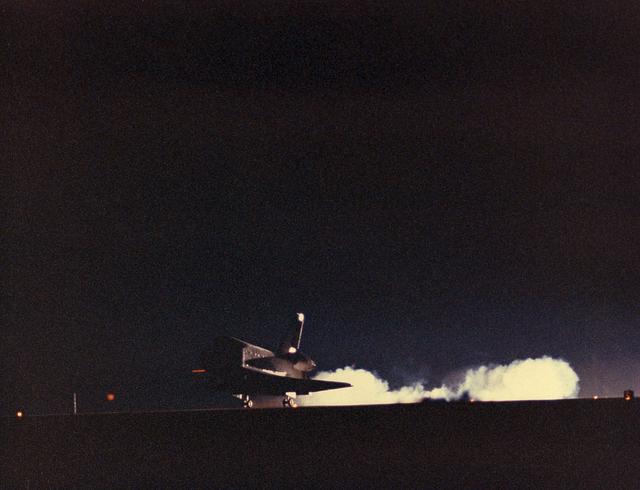
Picture perfect night landing of the Space Shuttle Columbia (STS-35).
Space Shuttle Project
STS035-49-029 (2-10 Dec 1990) --- Posing on the middeck of Columbia, Orbiter Vehicle (OV) 102, are Mission Specialist (MS) Jeffrey A. Hoffman (mustache) and MS Robert A. R. Parker. Determining who is right side up is complicated by the micr…
STS-35 MS Hoffman and MS Parker on the middeck of Columbia, OV-102
S90-48650 (5 Sept 1990) --- This rare view shows two space shuttles on adjacent pads at Launch Complex 39 with the Rotating Service Structures (RSR) retracted. Space Shuttle Columbia (foreground) is on Pad A where it awaits further processi…
Rare view of two space shuttles on adjacent KSC Launch Complex (LC) 39 pads
Columbia, Orbiter Vehicle (OV) 102, slated for mission STS-35, left, rolls past Atlantis, OV-104, on its way to Kennedy Space Center (KSC) launch pad 39A. OV-104, being readied for STS-38, is parked in front of the Vehicle Assembly Building…
STS-35 Columbia, OV-102, passes STS-38 Atlantis, OV-104, heading to Pad 39A
STS035-35-007 (2-10 Dec 1990) --- During the STS-35 mission, the Astronomy Laboratory 1 (ASTRO-1) payload, in its on-orbit operating configuration in the payload bay (PLB), is silhouetted against the firing of a reaction control system (RCS…
STS-35 ASTRO-1 telescopes documented in OV-102's PLB with RCS firing
STS035-19-021 (December 1990) ---  STS-35 Mission Specialist  Jeffrey A. Hoffman stretches out on the middeck floor while MS John M. (Mike) Lounge records his height. The two crew members are in front of the forward lockers aboard Columbia,…
STS-35 MS Hoffman's height is recorded by MS Lounge on OV-102's middeck
STS035-73-082 (2-10 Dec 1990) --- This agricultural and ranching area, Rio Sao Francisco, Brazil (13.0S, 43.5W) has been under study for several years. See scene STS-31-92-045 for comparison. This area has many small single family subsisten…
Agricultural and Ranching area, Rio Sao Francisco, Brazil
STS035-81-040 (2-10 Dec 1990) --- Numerous algae reefs are seen in Shark Bay, Western Australia, Australia (26.0S, 113.5E) especially in the southern portions of the bay. The south end is more saline because tidal flow in and out of the bay…
Algae Reefs in Shark Bay, Western Australia, Australia
S90-55294 (19 Dec. 1990) --- Johnson Space Center employees and neighbors on the ground didn't get quite this closeup of a view of the Dec. 19 1990 flyover of the Space Shuttle Columbia mounted piggyback atop NASA's Shuttle Carrier Aircraft…
Air-to-air view of Columbia, OV-102, atop SCA NASA 905 flying over JSC site
STS035-10-011 (2-10 Dec 1990) --- STS-35 Mission Specialist (MS) Robert A.R. Parker operates Astronomy Laboratory 1 (ASTRO-1) manual pointing controller (MPC) on the aft flight deck of Columbia, Orbiter Vehicle (OV) 102. Parker monitors a c…
STS-35 Mission Specialist Parker operates ASTRO-1 MPC on OV-102's flight deck
The primary objective of the STS-35 mission was round the clock observation of the celestial sphere in ultraviolet and X-Ray astronomy with the Astro-1 observatory which consisted of four telescopes: the Hopkins Ultraviolet Telescope (HUT);…
Around Marshall
STS035-28-006 (2-10 Dec 1990) --- STS-35 Astronomy Laboratory 1 (ASTRO-1) telescopes, in on-orbit operating position in the payload bay (PLB), are silhouetted against an reaction control system (RCS) right thruster firing. Three ultraviolet…
STS-35 ASTRO-1 in OV-102's payload bay silhouetted against RCS firing
In 1986, NASA introduced a Shuttle-borne ultraviolet observatory called Astro. The Astro Observatory was designed to explore the universe by observing and measuring the ultraviolet radiation from celestial objects. Astronomical targets of o…
Spacelab
The primary objective of the STS-35 mission was round the clock observation of the celestial sphere in ultraviolet and X-Ray astronomy with the Astro-1 observatory which consisted of four telescopes: the Hopkins Ultraviolet Telescope (HUT);…
Around Marshall
STS035-12-015 (2-11 Dec 1990) --- Astronaut Jeffrey A. Hoffman, STS 35 mission specialist, uses a manual pointing controller (MPC) for the Astro-1 mission's Instrument Pointing System (IPS).   By using the MPC,  Hoffman and other crewmember…
STS-35 MS Hoffman operates ASTRO-1 MPC on OV-102's aft flight deck
STS-35 Earth observation taken aboard Columbia, Orbiter Vehicle (OV) 102, is of the Persian Gulf area. Major cities and oilfields of the countries of Saudi Arabia (foreground), Iraq (top left), Iran (top center and top right), Kuwait, Bahra…
STS-35 Earth observation of the Persian Gulf area