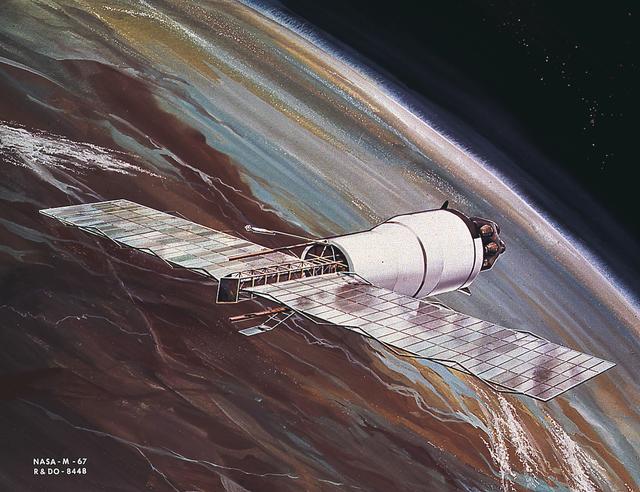
This image is an artist's conception of the Pegasus, meteoroid detection satellite, in orbit with meteoroid detector extended. The satellite, a payload for Saturn I SA-8, SA-9, and SA-10 missions, was used to obtain data on frequency and pe…

Marshall Space Flight Center (MSFC) Director, Dr. Wernher von Braun (left) confers with the Director of the MSFC Launch Operation Directorate, Dr. Debus, during the countdown for the Saturn/Pegasus (Saturn I, SA-9) launch. The successful la…

The SA-9 (Saturn I Block II), the eighth Saturn I flight, lifted off on February 16, 1965. This was the first Saturn with an operational payload, the Pegasus I meteoroid detection satellite. SA-9 successfully deployed the Pegasus I, NASA's…

Fairchild technicians check out the extended Pegasus meteoroid detection surface. The Pegasus was developed by Fairchild Stratos Corporation, Hagerstown, Maryland, for NASA through the Marshall Space Flight Center. Three Pegasus satellites…

Activities at Green Mountain Tracking Station, Alabama, during lift-off of the Saturn I, SA-9 mission, showing the overall view of instrument panels used in tracking the Pegasus, meteoroid-detection satellite. The satellite was used to obta…

The Saturn I S-IV stage (second stage) assembly for the SA-9 mission underwent the weight and balance test in the hangar building at Cape Canaveral. The S-IV stage had six RL-10 engines which used liquid hydrogen and liquid oxygen as its pr…

Pegasus-1, meteoroid detection satellite, installed on Saturn I (SA-9 mission) S-IV stage, January 13, 1965. The satellite was used to obtain data on frequency and penetration of the potentially hazardous micrometeoroids in low Earth orbits…

In this photograph, the Pegasus, meteoroid detection satellite is installed in its specially modified Apollo service module atop the S-IV stage (second stage) of a Saturn I vehicle for the SA-9 mission at Cape Kennedy. Personnel in the serv…