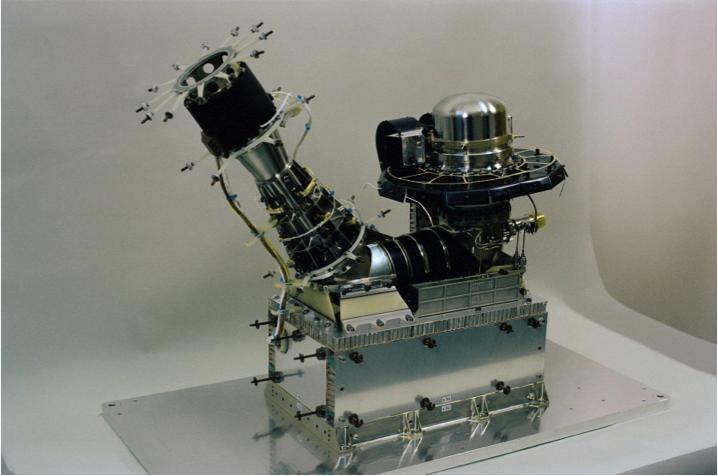
NASA has provided part of the electronics package for an instrument called the Double Focusing Mass Spectrometer, which is part of the Swiss-built Rosetta Orbiter Spectrometer for Ion and Neutral Analysis ROSINA instrument.
Electronics for a Spectrometer
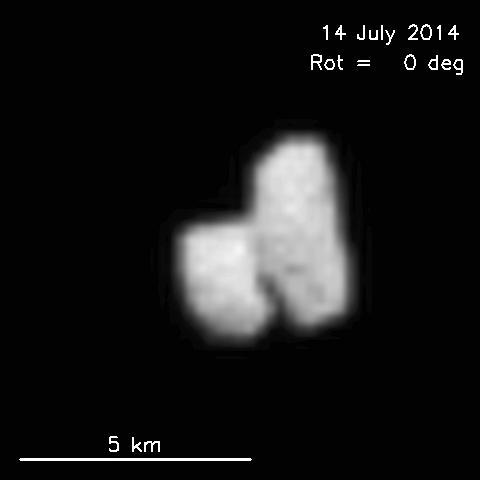
This frame from an animated sequence combined 36 interpolated images of comet 67P/Churyumov-Gerasimenko, each separated by 20 minutes. This comet is the destination for the European Space Agency Rosetta mission in 2014.
Rotation and Shape of Rosetta Mission Target Comet
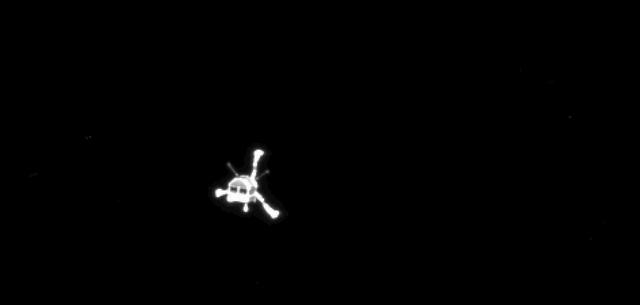
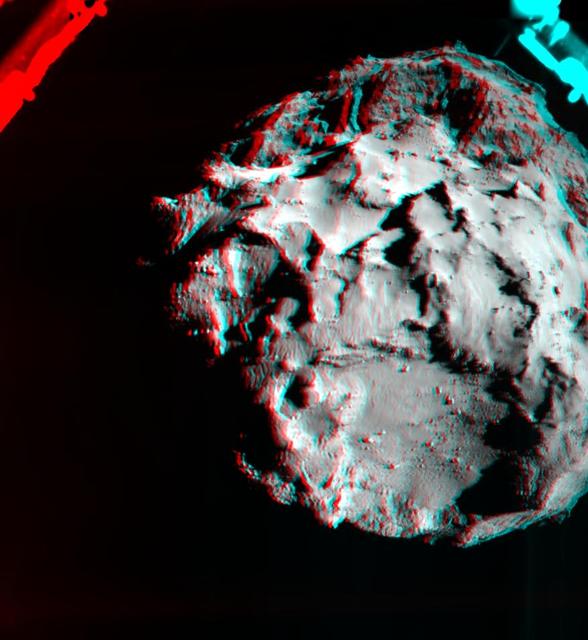
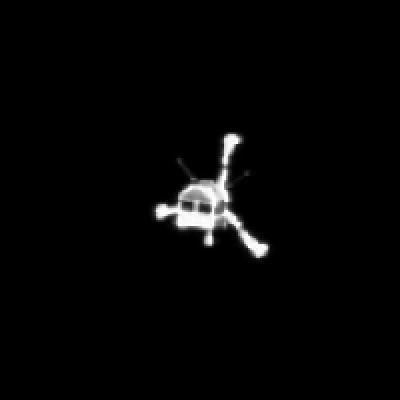
The Onboard Scientific Imaging System OSIRIS on the European Space Agency Rosetta spacecraft captured this parting shot of the mission Philae lander after its separation from the mother ship on Nov. 12, 2014.
Farewell, Philae
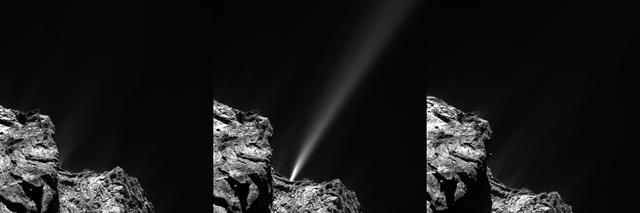
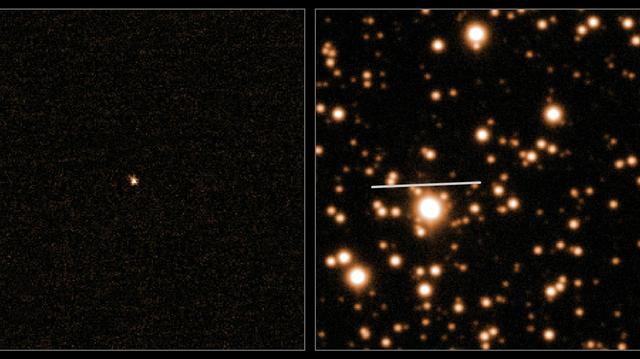
A short-lived outburst from comet 67P/Churyumov-Gerasimenko was captured by Rosetta's OSIRIS narrow-angle camera on July 29, 2015. The image at left was taken at 13:06 Greenwich Mean Time (GMT) (6:06 a.m. PDT), and does not show any visible…
Rosetta Comet In Action Animation
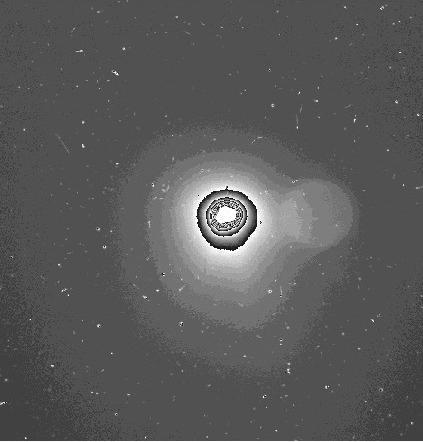
This image of the coma of comet 67P/Churyumov-Gerasimenko, seen with ESAS OSIRIS onboard the Rosetta spacecraft, shows the hazy circular structure to the right and center of the coma is an artifact due to overexposure of the nucleus.
Rosetta Comet: Imaging the Coma
This is a rare glance at the dark side of comet 67P/Churyumov-Gerasimenko. Light backscattered from dust particles in the comet coma reveals a hint of surface structures. This image was taken by OSIRIS, Rosetta scientific imaging system.
Rare Glance at Dark Side of Comet 67P/Churyumov-Gerasimenko
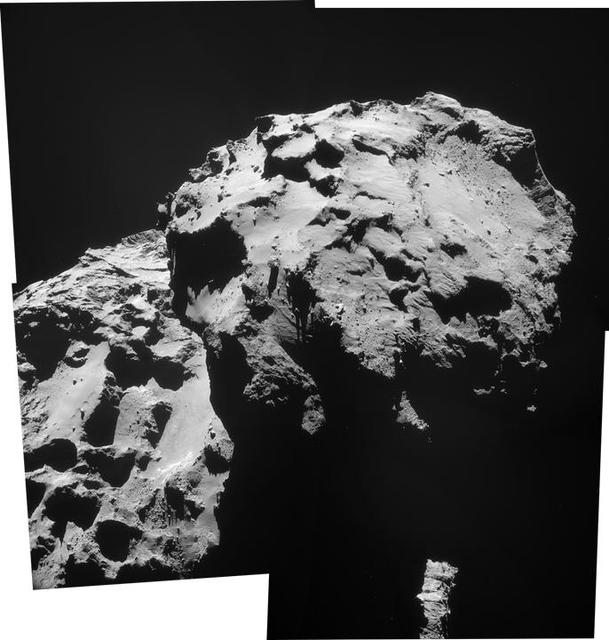
This mosaic of images from the navigation camera on the European Space Agency Rosetta spacecraft shows the nucleus of comet 67P/Churyumov-Gerasimenko as it appeared at 5 a.m. UTC on Dec. 17, 2014 9 p.m. PST on Dec. 16.
December 2014 View of Rosetta Destination Comet
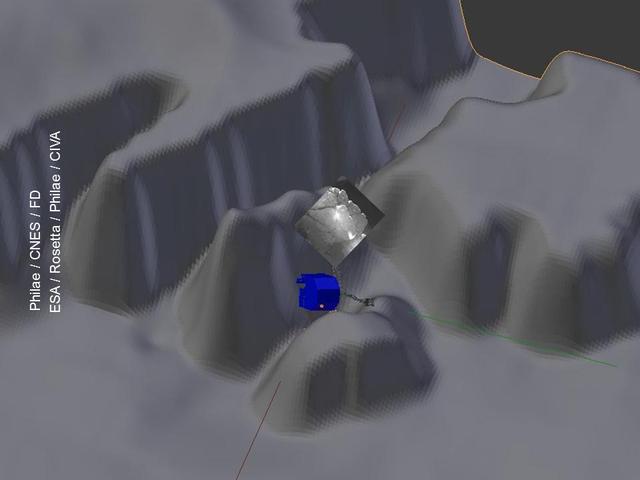
This graphic depicts the position of the Philae lander of the European Space Agency Rosetta mission in the context of topographic modeling of the surface of comet 67P/Churyumov-Gerasimenko nucleus.
Philae Lander Setting on Comet Surface
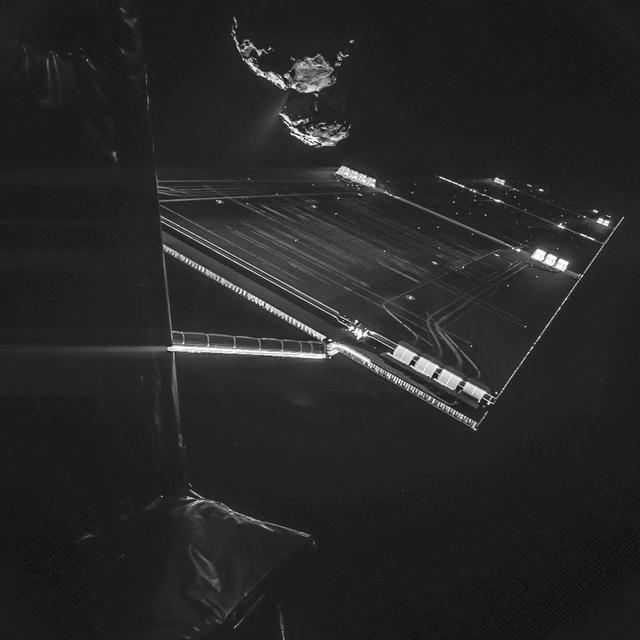
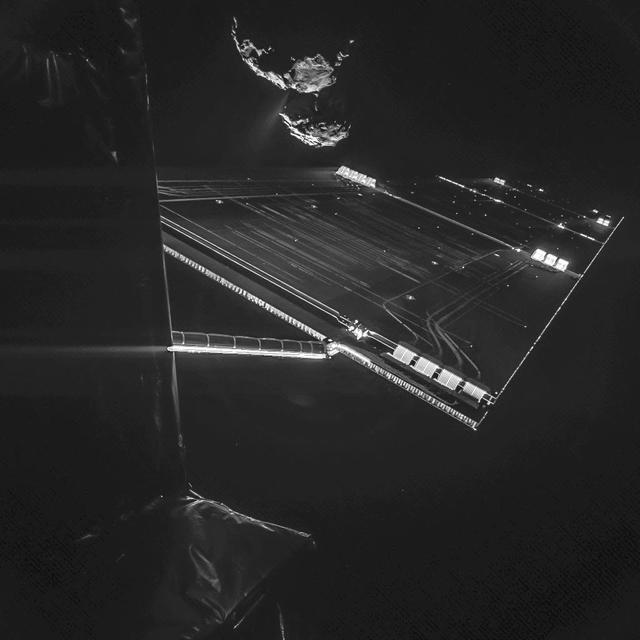
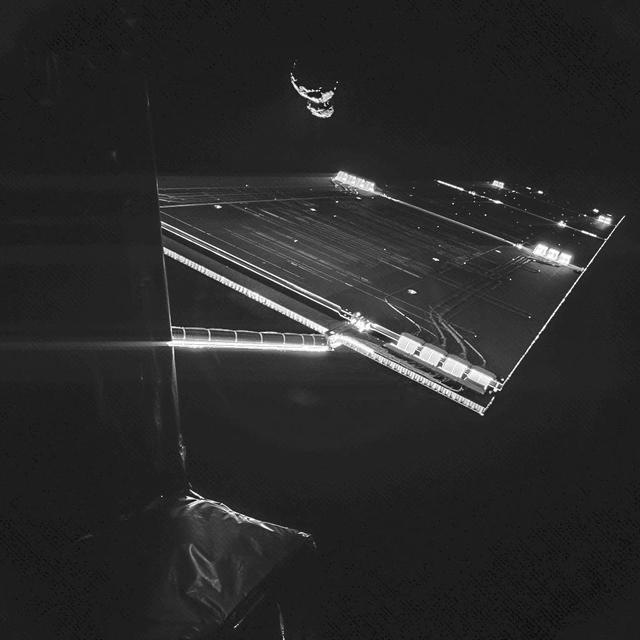
The Philae lander of the European Space Agency Rosetta mission took this self-portrait of the spacecraft on Sept. 7, 2014, at a distance of about 10 miles 16 kilometers from comet 67P/Churyumov-Gerasimenko.
Rosetta Mission Selfie at 10 Miles
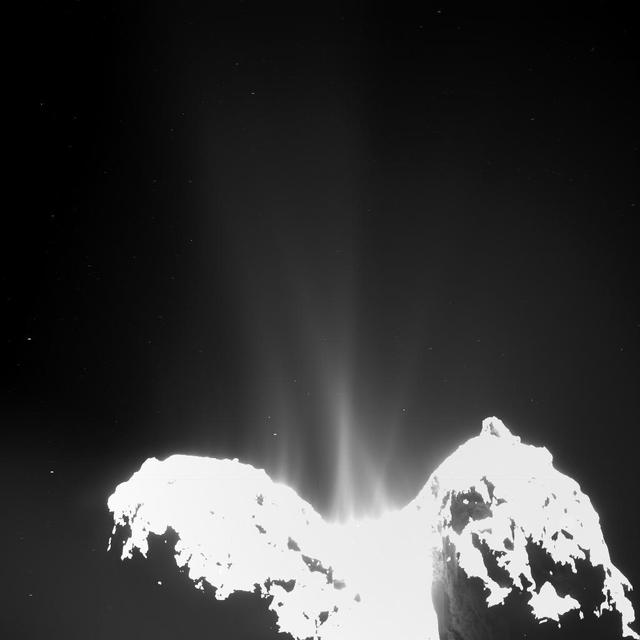
This image was taken by the Optical, Spectroscopic, and Infrared Remote Imaging System, Rosetta main onboard scientific imaging system, on Sept. 10, 2014. Jets of cometary activity can be seen along almost the entire body of the comet.  htt…
Rosetta Comet Spreads its Jets
A composite image from a camera on ESA Rosetta mission Philae comet lander shows a solar array, with comet 67P/Churyumov-Gerasimenko in the background.
Rosetta Selflessly Offers Beautiful Comet Selfie
This image was taken by the Optical, Spectroscopic, and Infrared Remote Imaging System, Rosetta main onboard scientific imaging system, on Sept. 10, 2014. Jets of cometary activity can be seen along almost the entire body of the comet.
Rosetta Comet Spreads its Jets
The Philae lander of the European Space Agency Rosetta mission is safely on the surface of Comet 67P/Churyumov-Gerasimenko, as these first two images from the lander CIVA camera confirm. One of the lander three feet can be seen in the foreg…
Welcome to a Comet, from Lander on Surface
This image of comet 67P/Churymov-Gerasimenko was taken on March 20, 2014, by the wide-angle camera of the Rosetta spacecraft Optical, Spectroscopic and Infrared Remote Imaging System OSIRIS.
Rosetta Images its Target
This image of comet 67P/Churyumov-Gerasimenko marks the first touchdown point of the Philae lander of the European Space Agency Rosetta mission. The image was taken by on Sept. 14, 2104, nearly two months before Philae Nov. 12 landing.
First Touchdown Site of Comet Lander
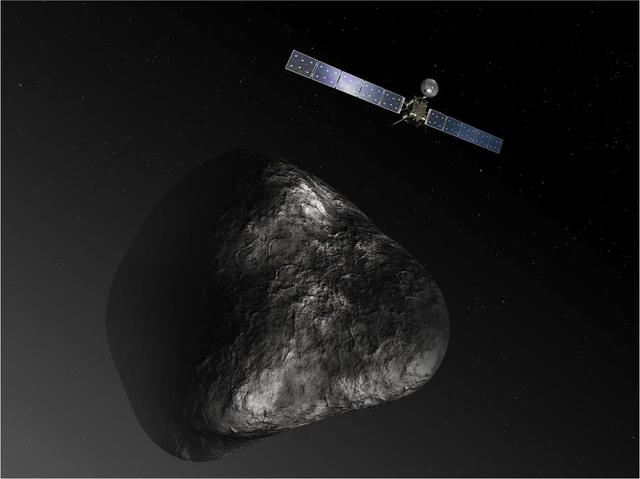
Artist impression of the Rosetta orbiter at comet 67P/Churyumova-Gerasimenko. The image is not to scale.
Rosetta at Comet
Three of NASA contributions to the ESA Rosetta mission are pictured here: an ultraviolet spectrometer called Alice top, the Ion and Electron Sensor IES bottom left, and the Microwave Instrument for Rosetta Orbiter MIRO bottom right.
U.S. Instruments Aboard Rosetta
This annotated image depicts two of the five potential landing sites for ESA Rosetta mission Philae lander.
Two Small-Lobe Landing Sites for Rosetta
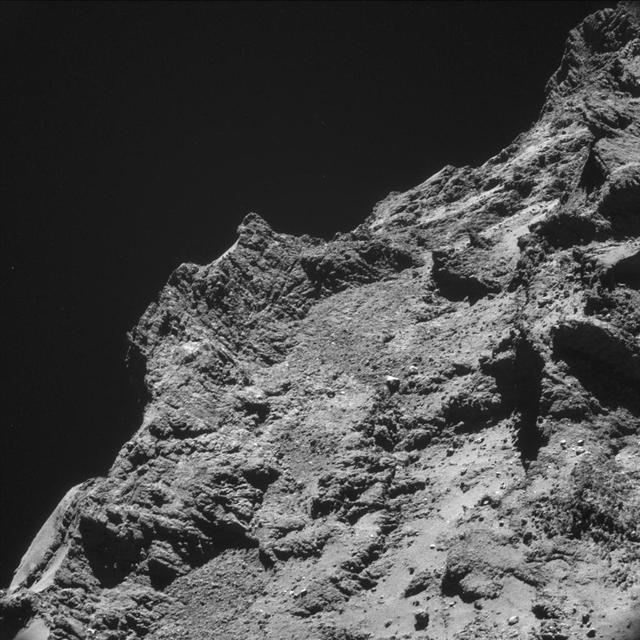
Some relatively rough terrain on the nucleus of comet 67P/Churyumov-Gerasimenko appears in this image taken by the navigation camera on the European Space Agency Rosetta spacecraft in the second half of October 2014.
Rough Terrain on Rosetta Destination Comet
This view from the OSIRIS instrument onboard ESA Rosetta spacecraft shows the nucleus of comet 67P/Churyumov-Gerasimernko from a distance of 1,210 miles 1950 kilometers.
Comet 67P from 1,200 Miles Away
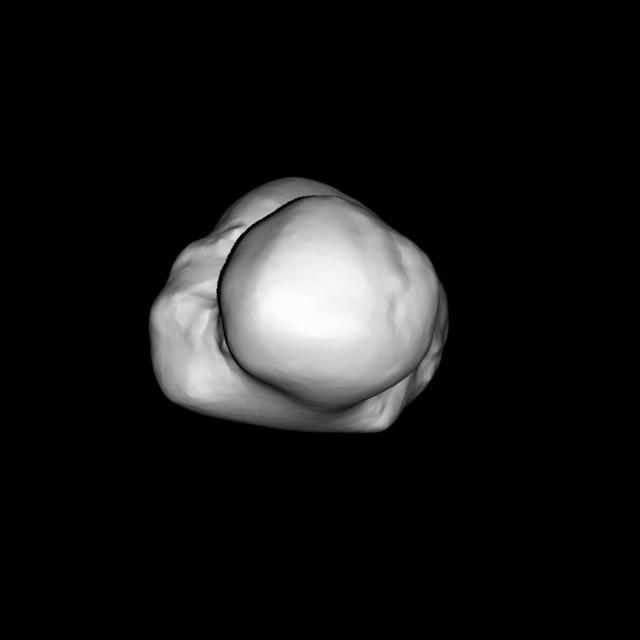
Images of comet 67P/Churyumov-Gerasimenko taken on July 14, 2014, by the OSIRIS imaging system aboard ESA Rosetta spacecraft have allowed scientists to create this three-dimensional shape model of the nucleus.
Rotating Shape Model of Rosetta Comet Target
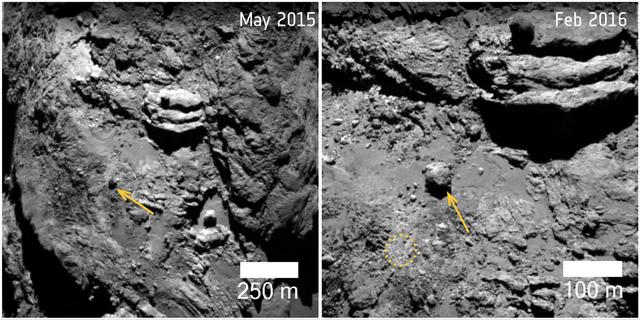
A 100 foot-wide (30 meter), 28-million-pound (12.8-million-kilogram) boulder, was found to have moved 460 feet (140 meters) on comet 67P/Churyumov-Gerasimenko in the lead up to perihelion in August 2015, when the comet's activity was at its…
Rosetta Moving Cometary Boulder
This annotated image depicts the two potential landing sites for ESA Rosetta Philae lander that are on the comet larger lobe.
Two Large-Lobe Landing Sites for Rosetta
This mosaic of images from the navigation camera on the ESA Rosetta spacecraft shows the nucleus of comet 67P/Churyumov-Gerasimenko as it appeared at in the early morning, Universal Coordinated Time, of Dec. 17, 2014 evening of Dec. 16, PST…
December 2014 View of Comet 67P/Churyumov-Gerasimenko
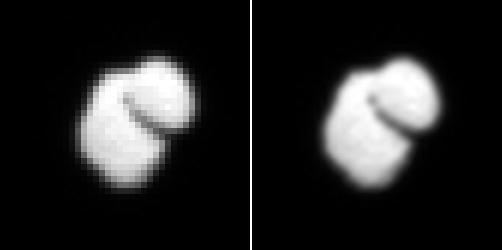
This observation from ESA Rosetta spacecraft shows that comet 67P/Churyumov-Gerasimenko has a two-part shape. The image on the left is from OSIRIS; the image on the right is enhanced with interpolated data.
Rosetta Mission Destination: Comet 67P/Churnyumov-Gerasimenko
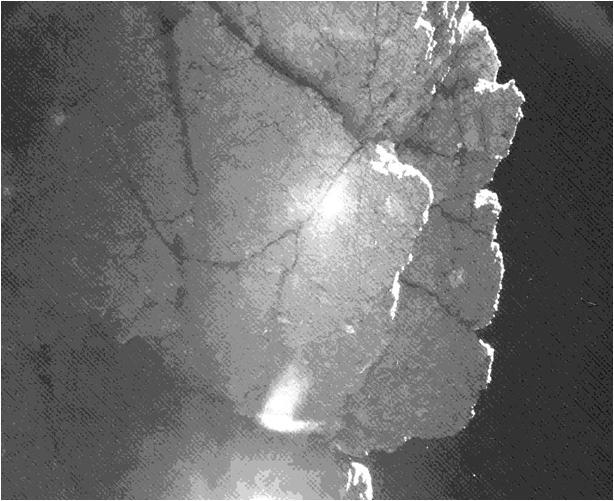
From the location where it came to rest after bounces, the Philae lander of the European Space Agency Rosetta mission captured this view of a cliff on the nucleus of comet 67P/Churyumov-Gerasimenko. The feature is called Perihelion Cliff.
Philae Lander View of Perihelion Cliff on Comet Surface
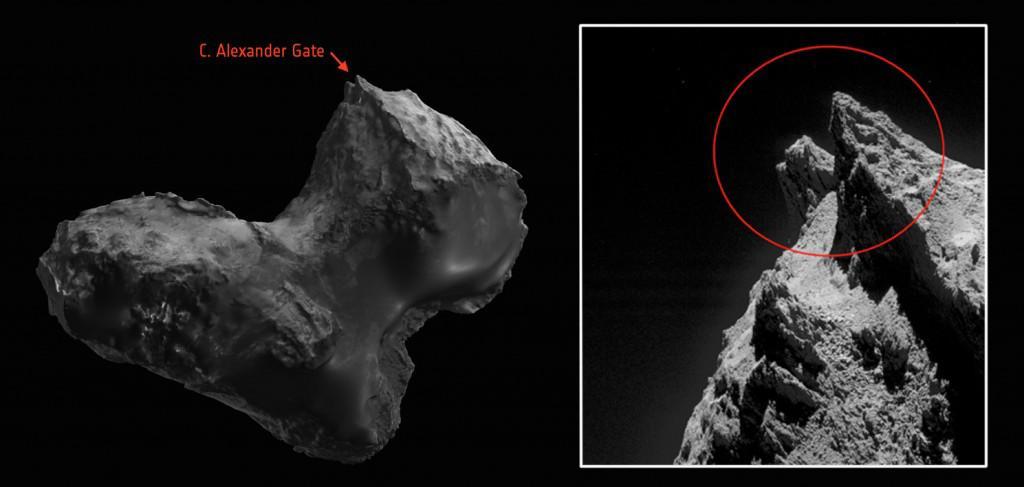
Scientists from the European Space Agency Rosetta team have honored two late team members by naming comet features after them. The comet is 67P/Churyumov-Gerasimenko, where the mission successfully landed a probe.  One of the features is sh…
Comet Scientists Honor Colleagues
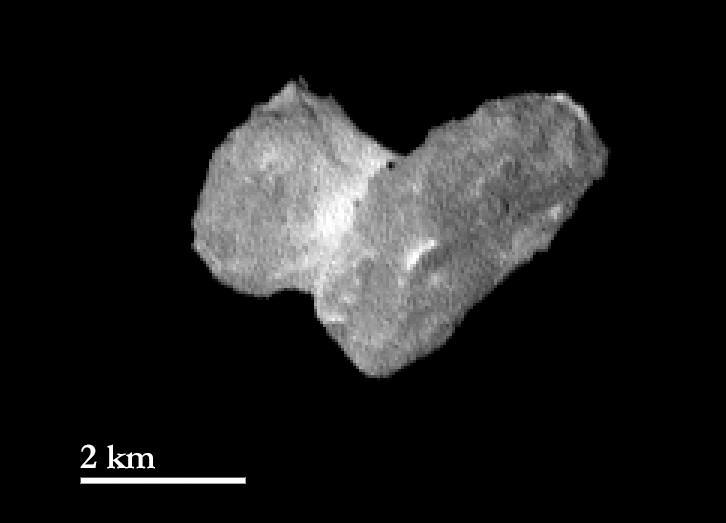
This image shows the most recent observations of the 2-mile-wide 4-kilometer-wide comet 67P/Churyumov-Gerasimenko, which is the upcoming target of the European Space Agency Rosetta mission.
Comet 67P/Churyumov-Gerasimenko on Oct. 5, 2013
A 3D image shows what it would look like to fly over the surface of comet 67P/Churyumov-Gerasimenko. The image was generated by data collected by ESA Philae spacecraft during the decent to the spacecraft initial touchdown on the comet Nov.…
Rosetta Comet in 3-D
This image of comet 67P/Churymov-Gerasimenko was taken on March 21, 2014, by the narrow-angle camera of the Rosetta spacecraft Optical, Spectroscopic and Infrared Remote Imaging System OSIRIS.
Rosetta Target
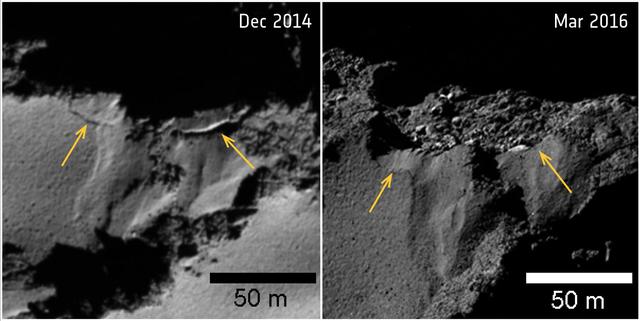
Several sites of cliff collapse on comet 67P/Churyumov-Gerasimenko were identified during Rosetta's mission. The yellow arrows mark the fractures where the detachment occurred. The collapsed sections are about 50 feet (15 meters) long for t…
Cliff Collapses on Rosetta Comet
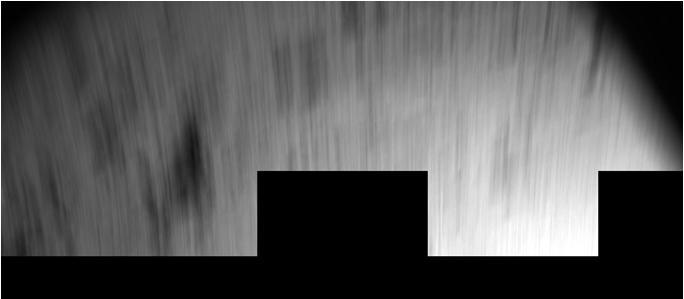
The Philae lander of the European Space Agency Rosetta mission captured this view during its first bounce after hitting the surface of comet 67P/Churyumov-Gerasimenko on Nov. 12, 2014, with blurring as a result of the lander own motion. The…
Comet Lander View During First Bounce
The Philae lander of Europe Rosetta mission has returned the first panoramic image from the surface of a comet. The unprocessed panorama from the lander CIVA-P camera shows a 360-degree view around the point of final touchdown.
First Panoramic View from Comet Lander
This annotated image depicts the backup landing site Site C chosen for ESA Rosetta spacecraft Philae lander.
Rosetta Lander Backup Landing Site
This image showcases changes identified in high-resolution images of Comet 67P/Churyumov-Gerasimenko during more than two years of monitoring by ESA's Rosetta spacecraft.  The approximate locations of each feature are marked on the central…
Comet 67P Changes
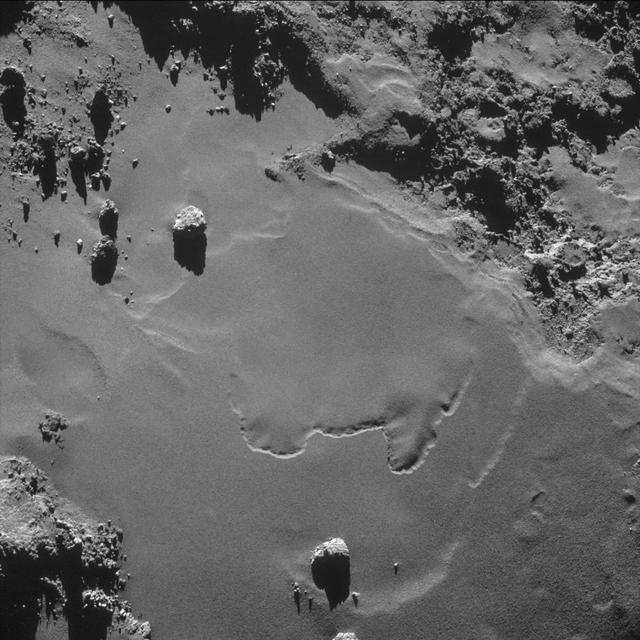
A patch of relatively smooth ground on the nucleus surface of comet 67P/Churyumov-Gerasimenko appears in this image taken by the navigation camera on the European Space Agency Rosetta spacecraft in October 2014.
Smooth Ground on Rosetta Destination Comet
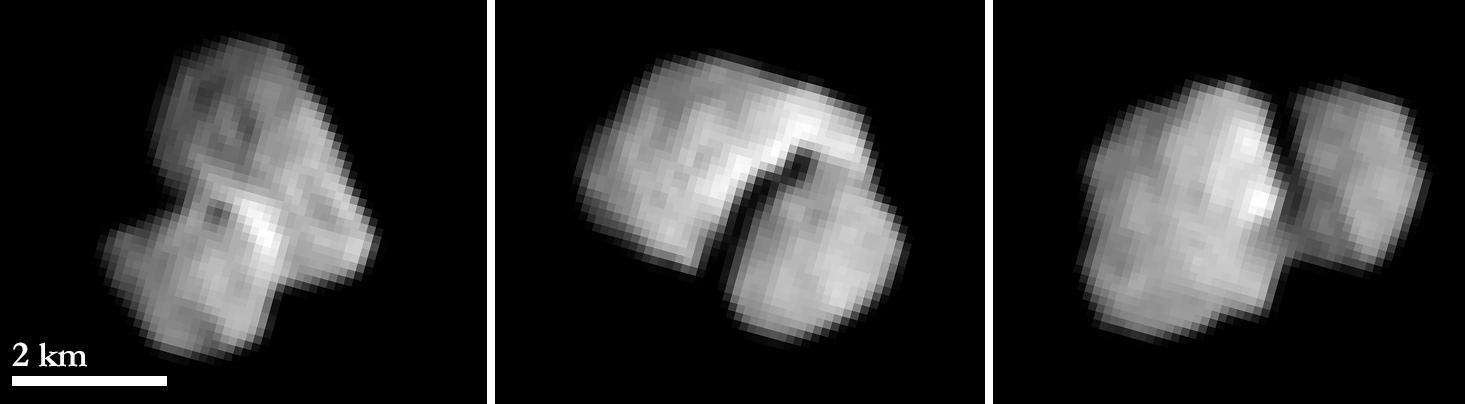
Comet 67P/Churyumov-Gerasimenko was imaged by ESA Rosetta spacecraft on July 20, 2014, from a distance of approximately 3,400 miles 5,500 kilometers. These three images were taken two hours apart.
Rosetta Approach Tripych: Comet 67P
The Philae lander of the European Space Agency Rosetta mission took this self-portrait of the spacecraft on Sept. 7, 2014, at a distance of about 30 miles 50 kilometers from comet 67P/Churyumov-Gerasimenko.
Rosetta Mission Selfie at 30 Miles
Image of the southern polar regions of comet 67P/Churyumov-Gerasimenko taken by Rosetta Optical, Spectroscopic, and Infrared Remote Imaging System OSIRIS on September 29, 2014, when the comet was still experiencing the long southern winter.…
Taking a Comet Temperature
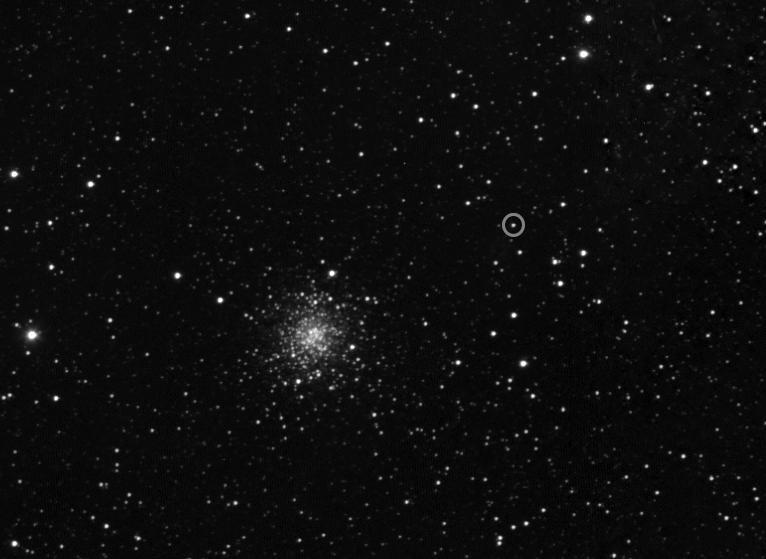
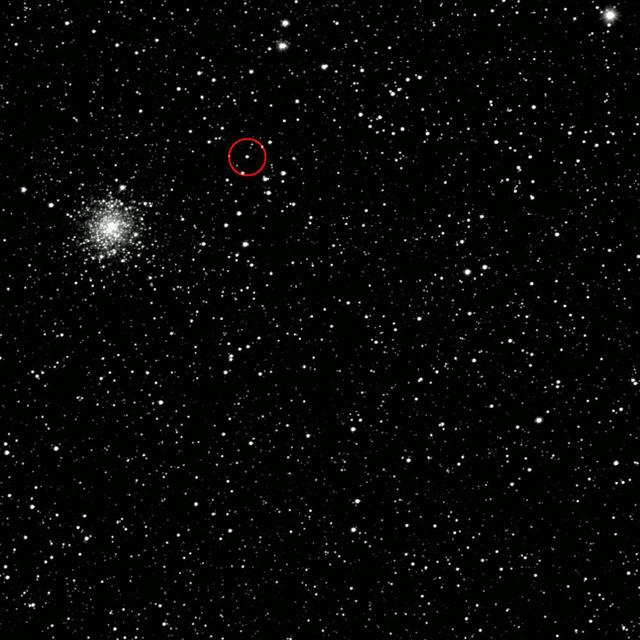
This still from a sequence of images shows comet 67P/Churyumov-Gerasimenko moving against the background star field.
Rosetta Comet Comes Alive
This graphic depicts the position of the Philae lander of the European Space Agency Rosetta mission, and a nearby cliff photographed by the lander, in the context of topographic modeling of the surface of comet 67P/Churyumov-Gerasimenko nuc…
Philae Lander Setting on Comet, with Cliff-Image Inset
This composite is a mosaic comprising four individual Rosetta NAVCAM images taken from 19 miles 31 kilometers from the center of comet 67P/Churyumov-Gerasimenko on Nov. 20, 2014.
Rosetta Comet
This image of comet 67P/Churyumov-Gerasimenko was obtained on October 30, 2014 by the OSIRIS scientific imaging system on the Rosetta spacecraft. The right half is obscured by darkness.
Dark Side of Comet 67P/Churyumov-Gerasimenko
This view of the belly and part of the head of comet 67P/Churyumov-Gerasimenko indicates several morphologically different regions as seen by ESA Rosetta spacecraft.
Distinct Terrains on Rosetta Comet
Four images taken by the ESA Rosetta spacecraft create a montage showing jets of dust and gas escaping from the nucleus of comet 67P/Churyumov–Gerasimenko.
Rosetta Comet Fires Its Jets
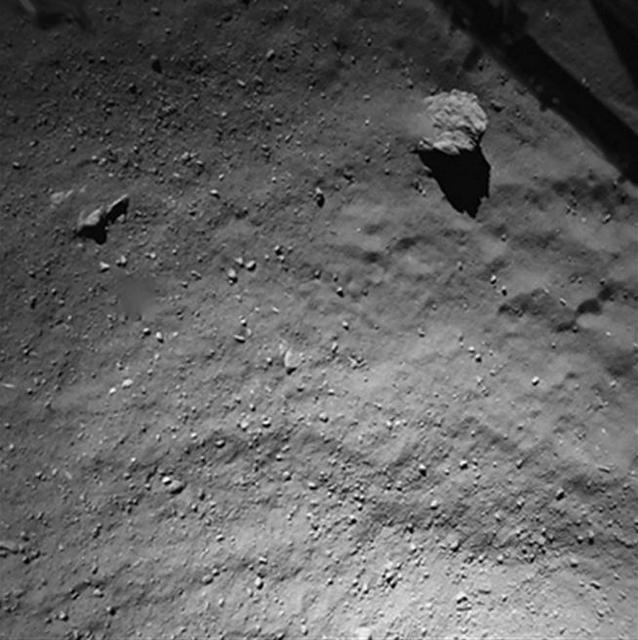
This image was taken by the Philae lander of the European Space Agency Rosetta mission when it was about 130 feet 40 meters above the surface of comet 67P/Churyumov-Gerasimenko during descent to the surface on Nov. 12, 2014.
Comet from 40 Meters
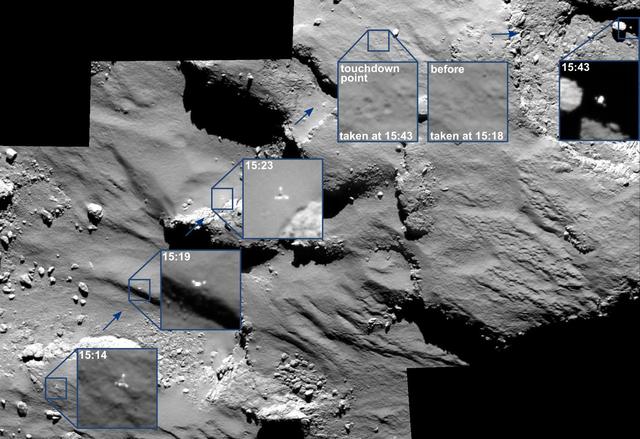
The descent of its comet lander Philae was captured by ESA Rosetta spacecraft main camera as the lander approached -- and then rebounded off -- the comet surface.
Rosetta Lander Captured Before/After Bounce
This frame from an animated sequence shows the Rosetta mission Philae lander descending toward comet 67P/Churyumov-Gerasimenko not in frame on Nov. 12, 2014. The images are from the OSIRIS narrow-angle camera on the ESA Rosetta orbiter.
Descent to the Surface of a Comet