
NASA's Cassini spacecraft zoomed in on Saturn's A ring, revealing narrow, detailed structures that get even finer as the cameras' resolution increases. Even at this level of detail, it is still not fine enough to resolve the individual part…
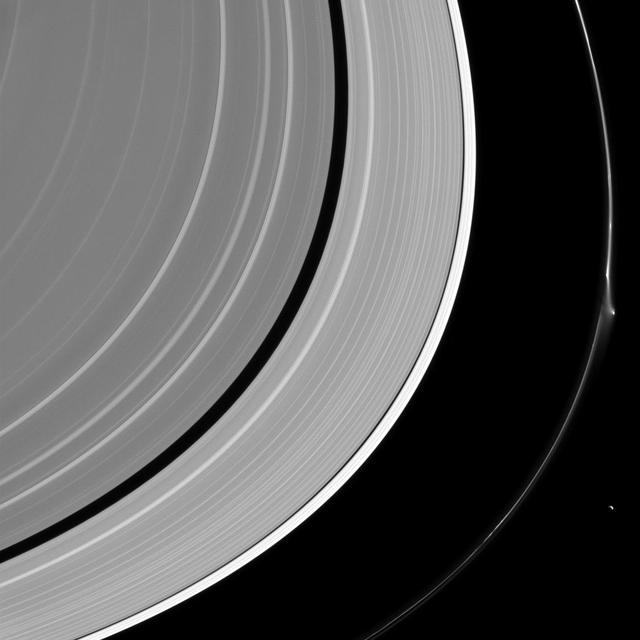
A bright disruption in Saturn's narrow F ring suggests it may have been disturbed recently. This feature was mostly likely not caused by Pandora (50 miles or 81 kilometers across) which lurks nearby, at lower right. More likely, it was crea…
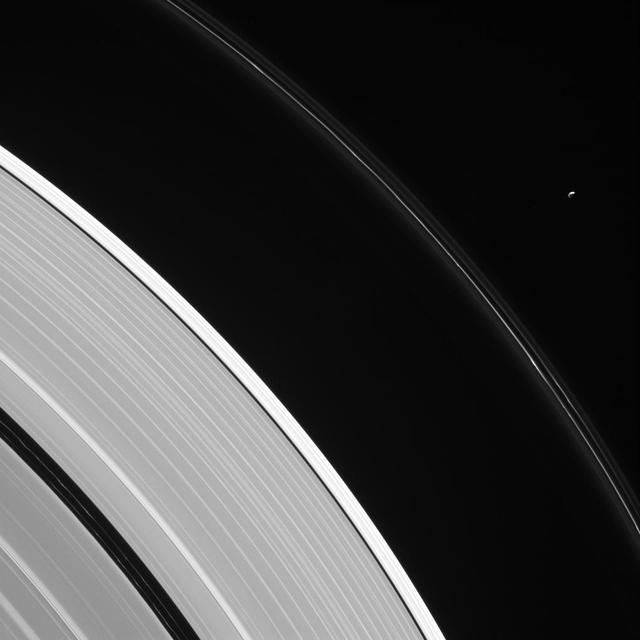
Pandora is seen here, in isolation beside Saturn's kinked and constantly changing F ring. Pandora (near upper right) is 50 miles (81 kilometers) wide. The moon has an elongated, potato-like shape (see PIA07632). Two faint ringlets are vis…

Rings Against a Dark Planet
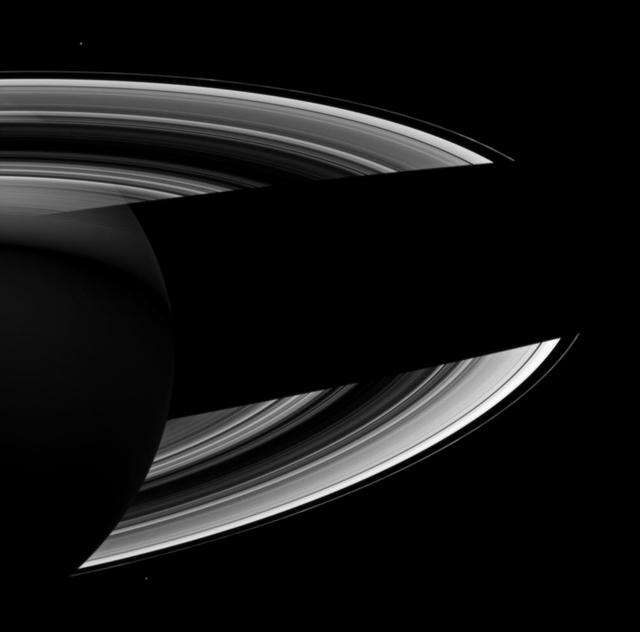
Saturn casts a wide shadow across its rings in view from NASA Cassini spacecraft which looks toward the darkened southern hemisphere of the night side of the planet.
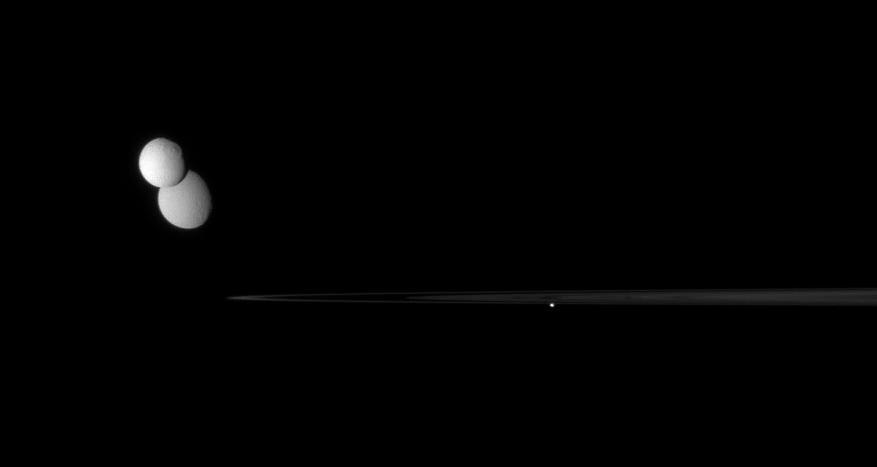
Parade of Moons
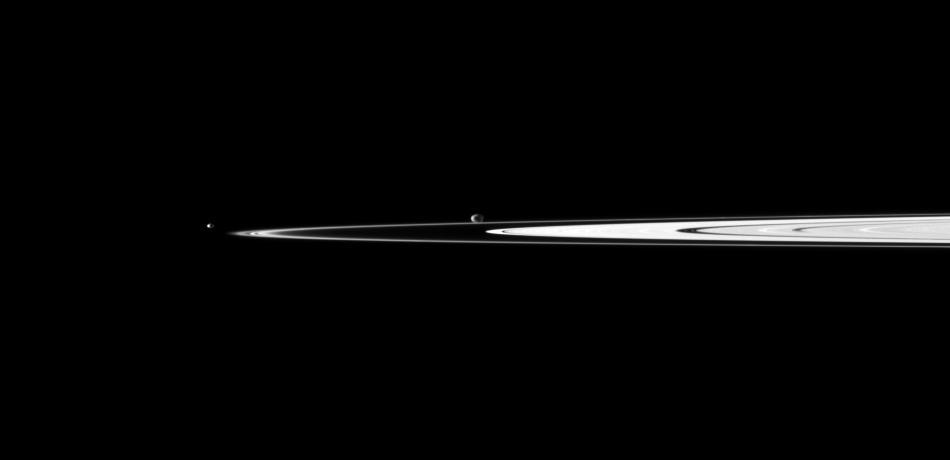
A pair of Saturn small moons orbit near the planet rings, which appear well illuminated in this view captured by NASA Cassini spacecraft. Janus is near the center of the image and Pandora is on the left.
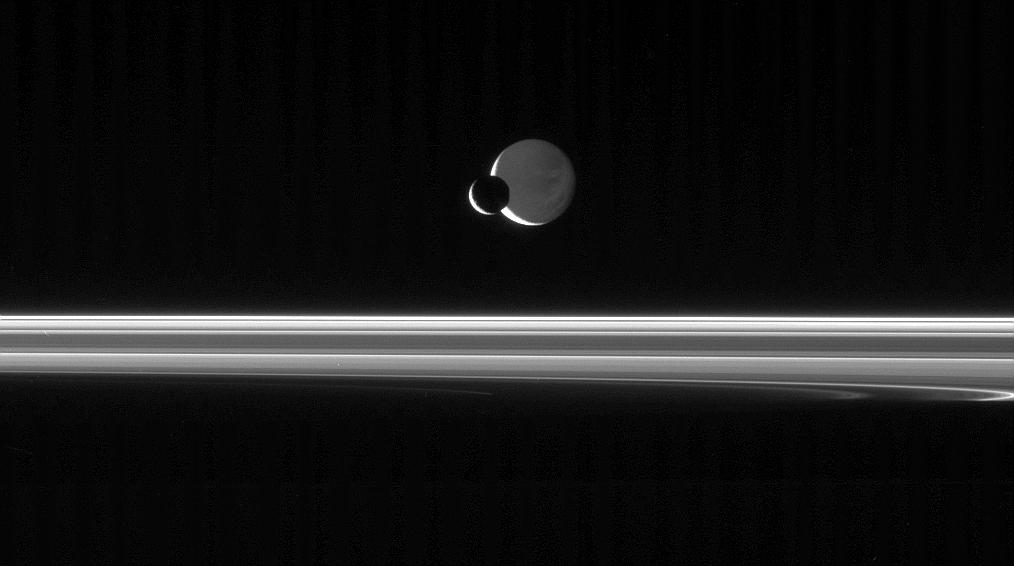
The Cassini spacecraft looks across the unlit ringplane as Mimas glides silently in front of Dione

Two Kinds of Wave
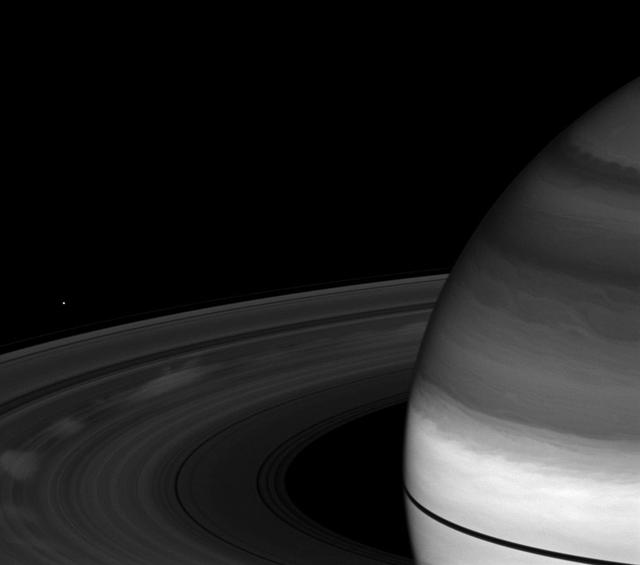
Bright Spokes, Dark Rings

Faint Spokes on a Ring
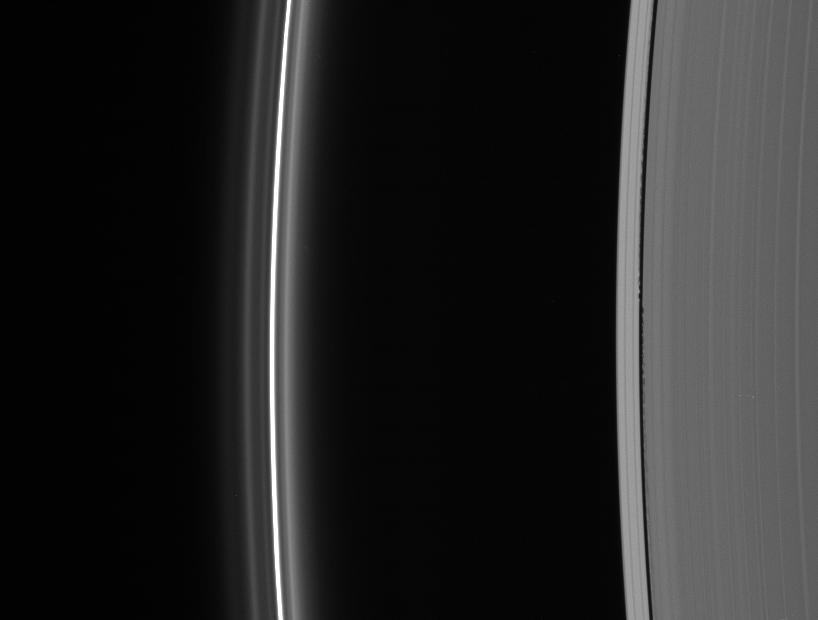
Edge waves in the Keeler Gap betray the presence of the embedded moon Daphnis. At left lies the brilliant F ring with its flanking strands
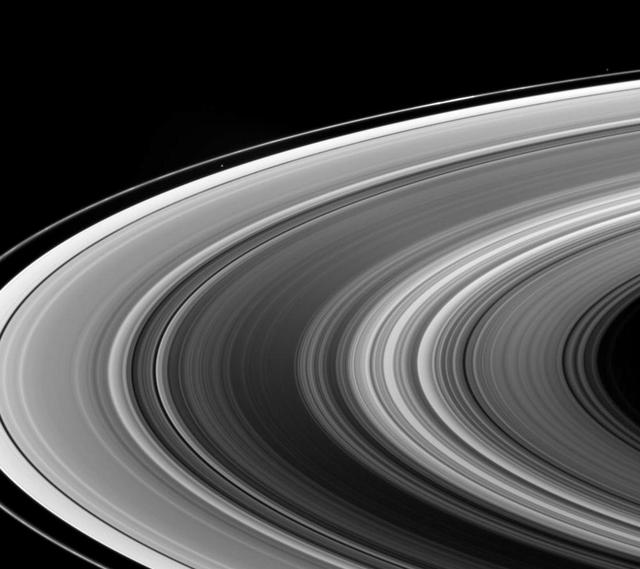
This view looks down onto the unlit side of Saturn ringplane. It nicely shows a near-arm/far-arm brightness asymmetry in the B ring: The near arm of the B ring is notably darker from this viewing geometry than is the far arm

Jovian Ring System Mosaic
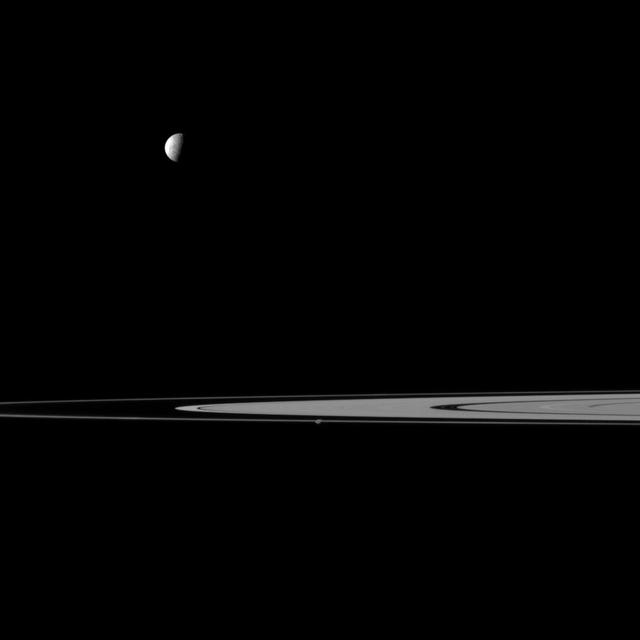
Saturn rings lie between a pair of moons in this view from NASA Cassini spacecraft that features Mimas and Prometheus. Mimas is the more noticeable of the two moons at top left, Prometheus is near the center of image and closest to Cassini.
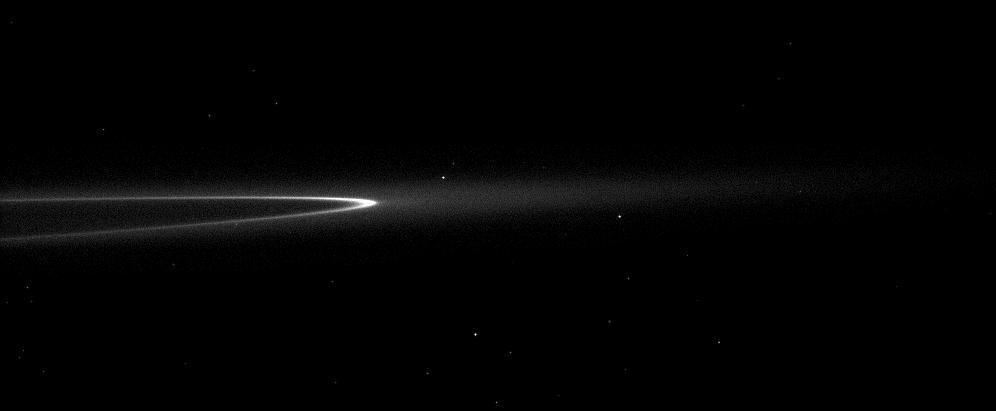
In this image taken by NASA Cassini spacecraft, the bright arc in Saturn faint G ring contains a little something special. Although it cant be seen here, the tiny moonlet Aegaeon orbits within the bright arc.
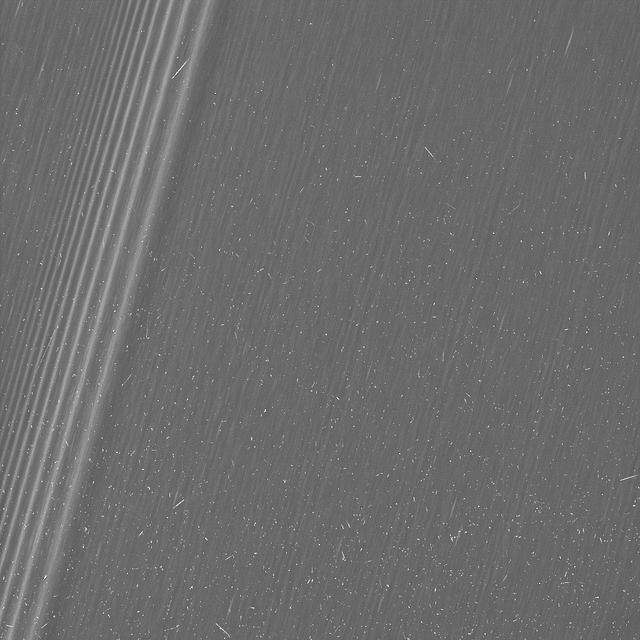
This image from NASA's Cassini mission shows a region in Saturn's A ring. The level of detail is twice as high as this part of the rings has ever been seen before. The view contains many small, bright blemishes due to cosmic rays and charge…
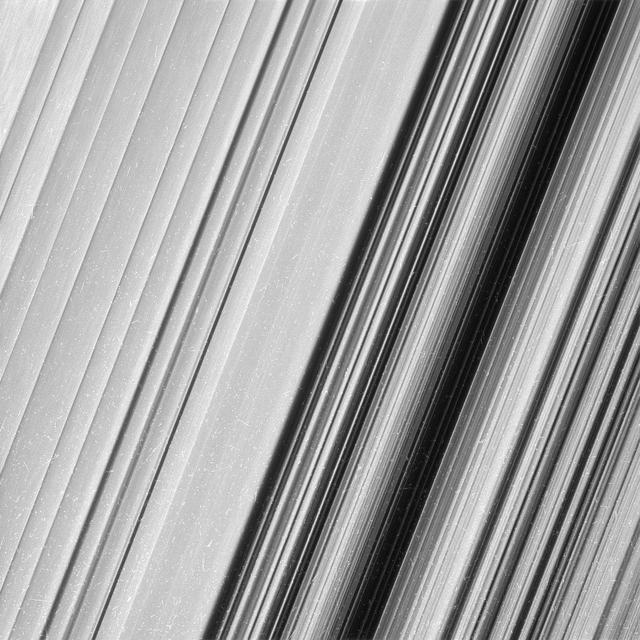
This image shows a region in Saturn's outer B ring. NASA's Cassini spacecraft viewed this area at a level of detail twice as high as it had ever been observed before. And from this view, it is clear that there are still finer details to unc…

As Cassini watches the rings pass in front of the bright red giant star Aldebaran, the star light fluctuates, providing information about the concentrations of ring particles within the various radial features in the rings
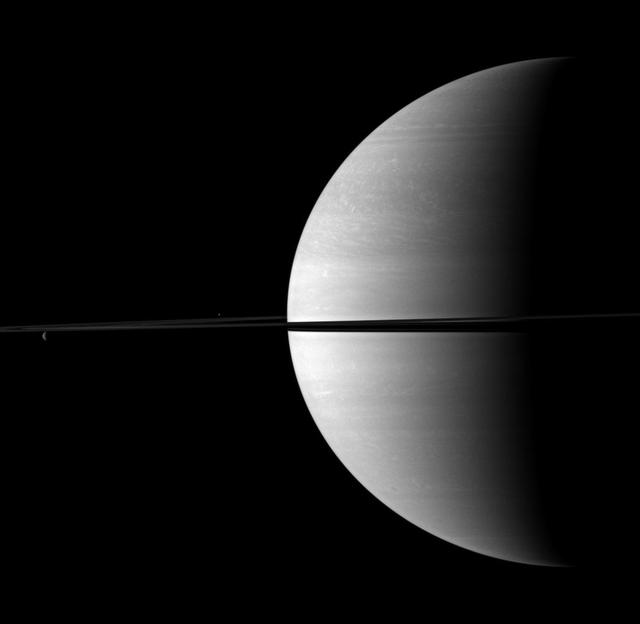
Rhea and Enceladus appear above and below the rings on the left of this image, serving to visually offset the dominance of Saturn in this image taken by NASA Cassini spacecraft.
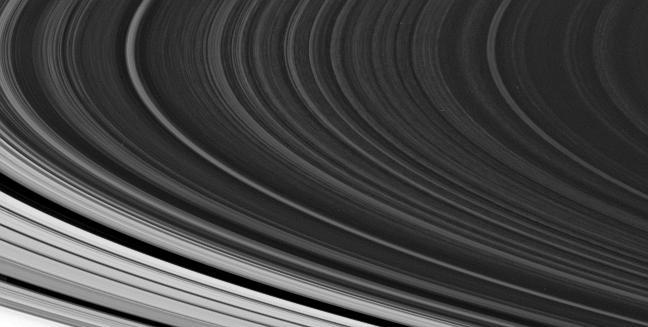
B Ring Irregularities
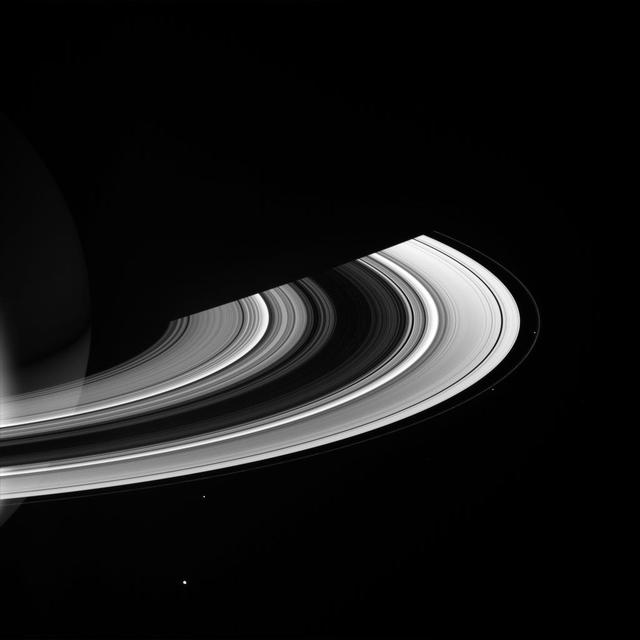
<p> The Cassini spacecraft looks toward the unilluminated side of Saturn rings to spy on the moon Pan as it cruises through the Encke Gap. </p> <p> This view looks toward the rings from about 13 degrees above the ringplane. At the top o…
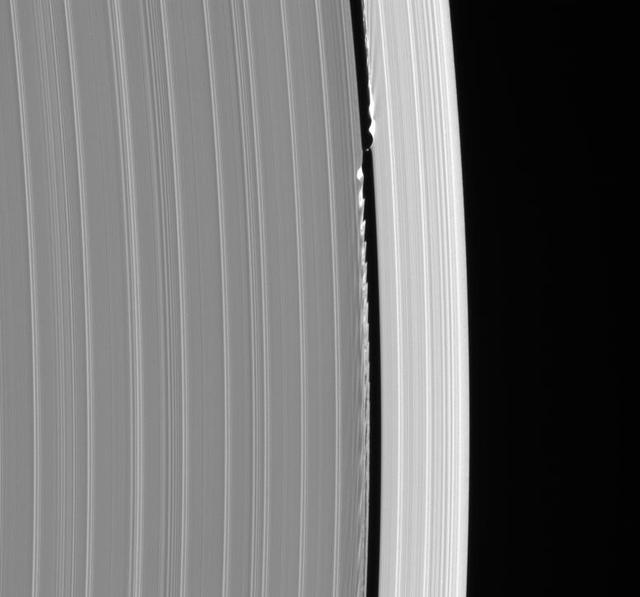
Daphnis At Work
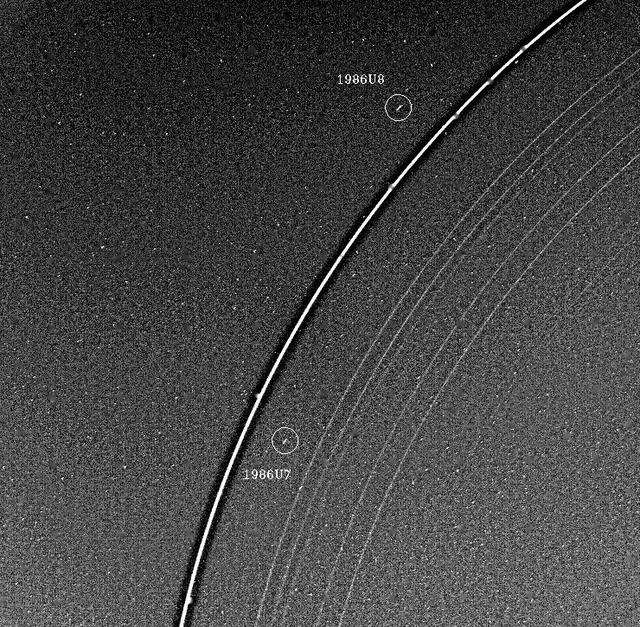
Voyager 2 has discovered two hepherd satellites associated with the rings of Uranus. The two moons, designated 1986U7 and 1986U8, are seen here on either side of the bright epsilon ring; all nine of the known Uranian rings are visible.
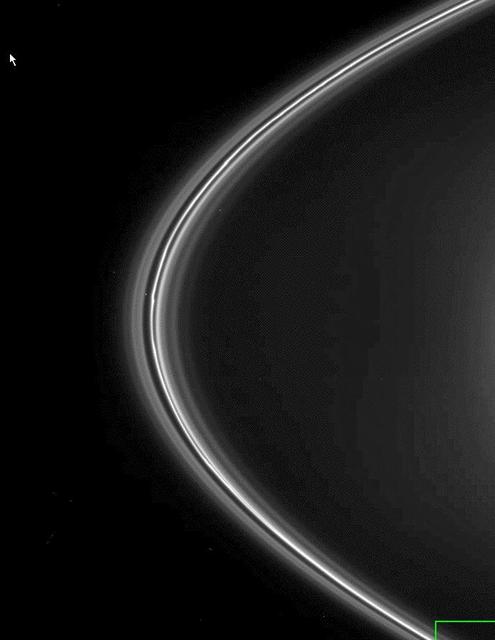
Unidentified F Ring Objects
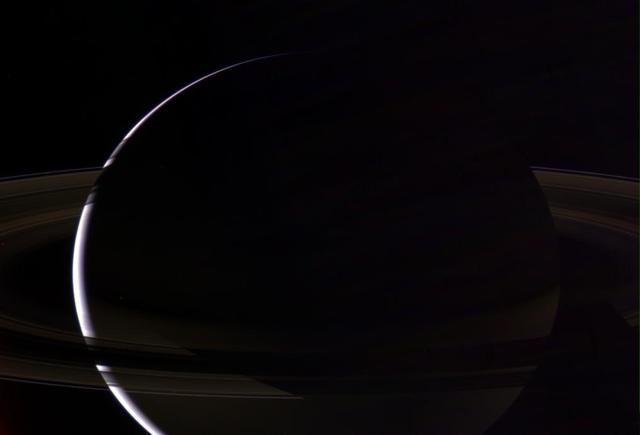
With its dazzling rings, Saturn radiates a beauty and splendor like no other known world. Here, Cassini has captured the cool crescent of Saturn from above the ringplane, with the planet shadow cutting neatly across the many lanes of ice
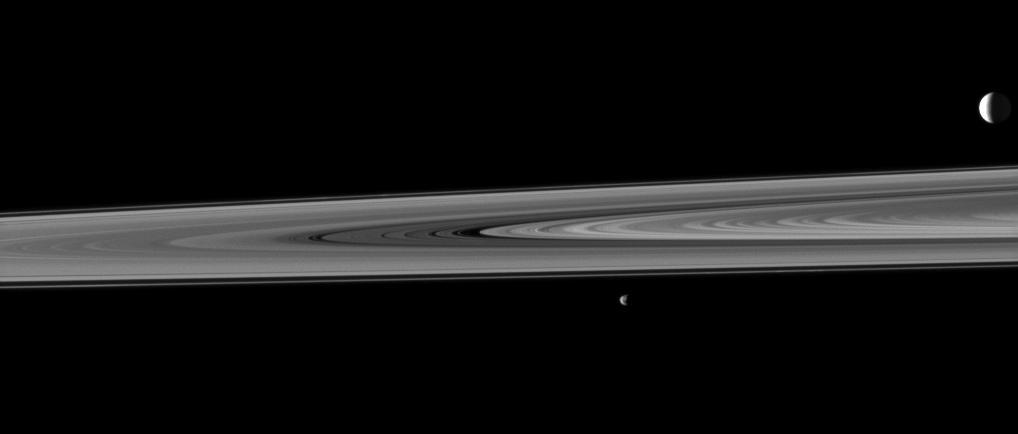
Saturn rings occupy the space between two of the planet moons in this image, taken by NASA Cassini spacecraft, which shows the highly reflective moon Enceladus in the background and the smaller moon Janus in the fore.
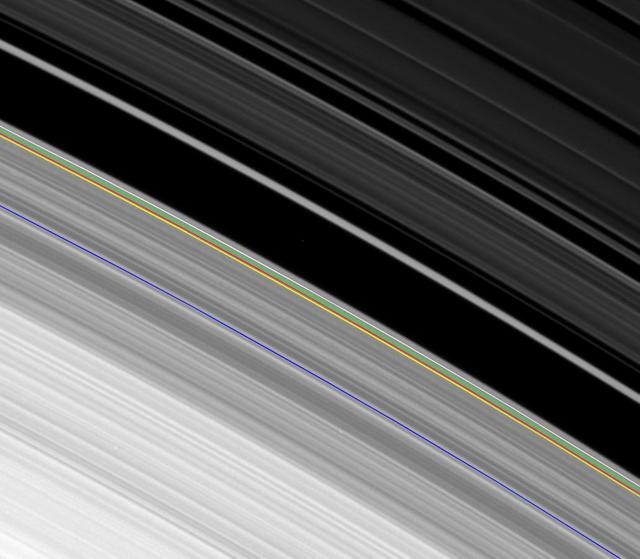
This image obtained by NASA Cassini spacecraft of the outer edge of Saturn?s B ring, reveals the combined effects of a tugging moon and oscillations that can naturally occur in disks like Saturn rings and spiral galaxies.
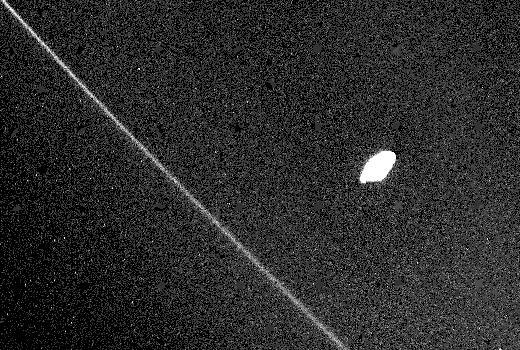
Saturn F-ring and Inner Satellite
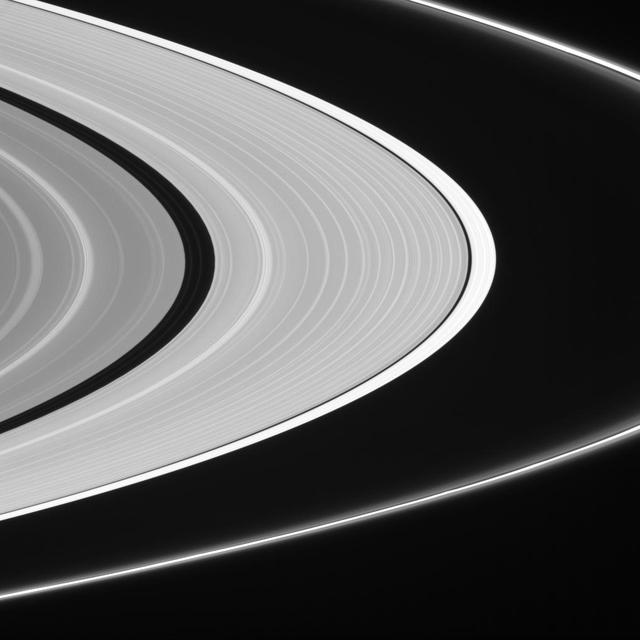
Ringlets in the Encke Gap and flanking the bright F ring core are clearly visible here
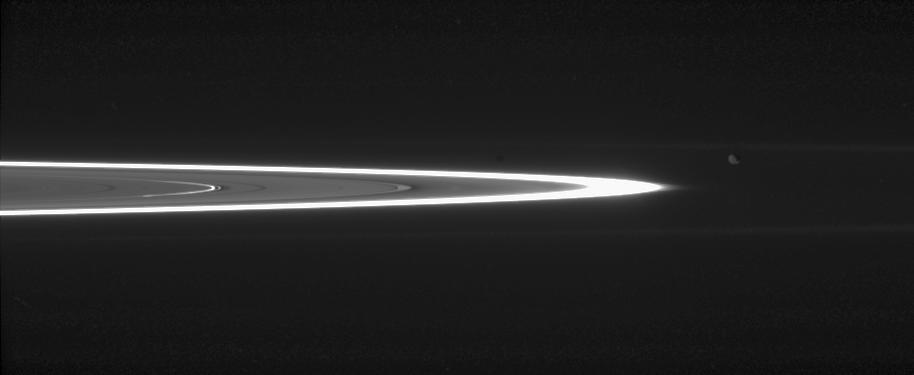
Tiny, dust-sized particles in Saturn rings become much easier to see at high phase angle -- the angle formed by the Sun, the rings and the spacecraft. The brightest ring is the F ring; the next feature to the left is the outer edge of the A…
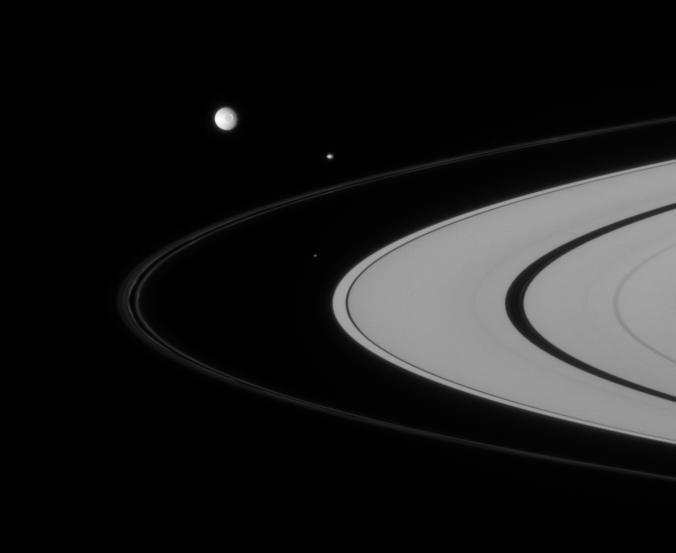
Cluster of Moons
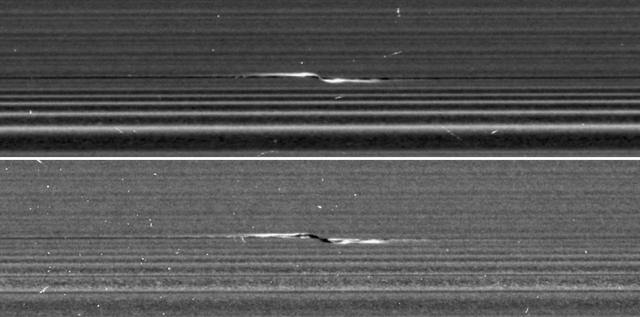
NASA's Cassini spacecraft captured these remarkable views of a propeller feature in Saturn's A ring on Feb. 21, 2017. These are the sharpest images taken of a propeller so far, and show an unprecedented level of detail. The propeller is nic…
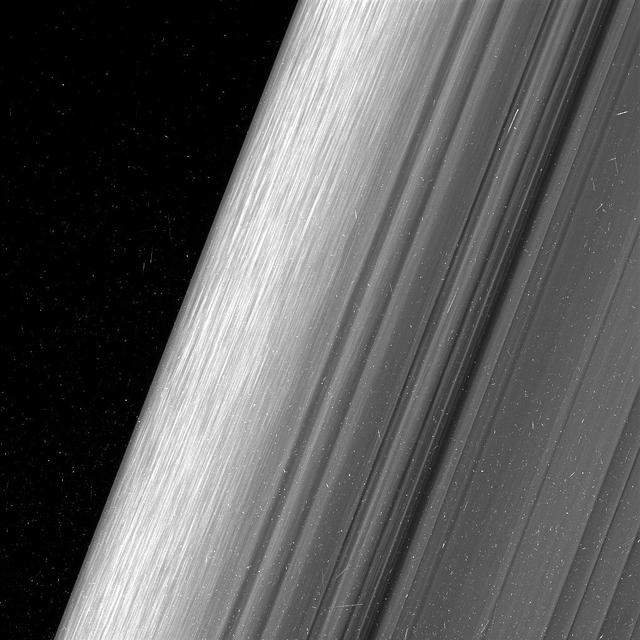
This image shows a region in Saturn's outer B ring. NASA's Cassini spacecraft viewed this area at a level of detail twice as high as it had ever been observed before. The view here is of the outer edge of the B ring, at left, which is pert…
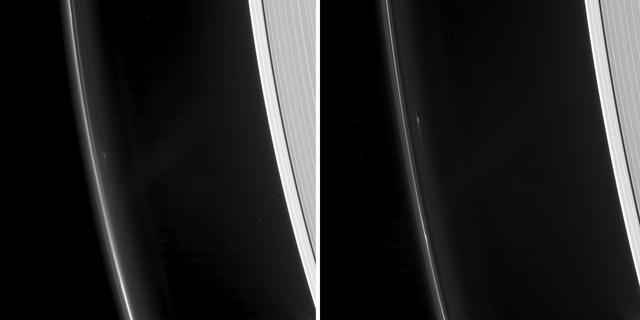
As NASA's Cassini spacecraft continues its weekly ring-grazing orbits, diving just past the outside of Saturn F ring, it is tracking several small, persistent objects there. These images show two such objects that Cassini originally detect…
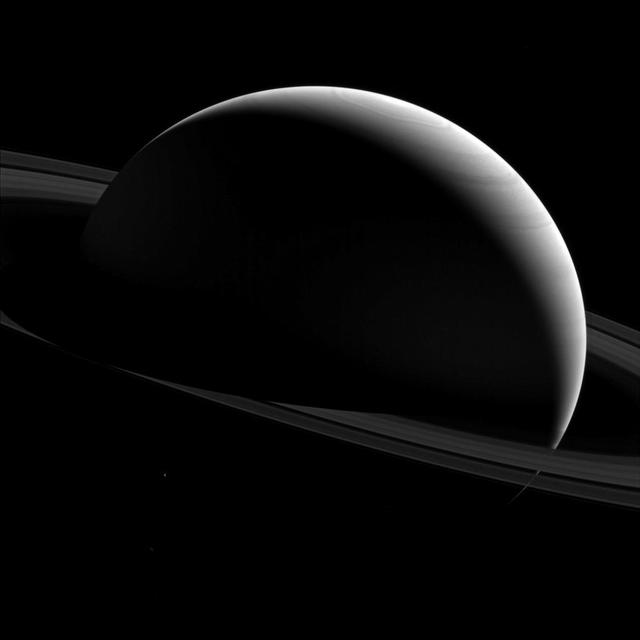
The night sides of Saturn and Tethys are dark places indeed. We know that shadows are darker areas than sunlit areas, and in space, with no air to scatter the light, shadows can appear almost totally black. Tethys (660 miles or 1,062 kilo…
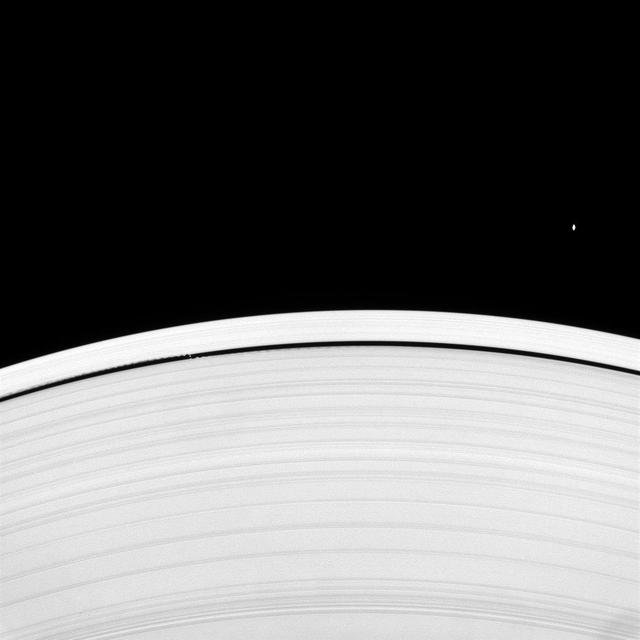
Looking upward from beneath the ringplane, the Cassini spacecraft spies Saturn's "wave maker" and "flying saucer" moons. Daphnis (8 kilometers, or 5 miles across at its widest point) and its gravitationally induced edge waves are seen at l…
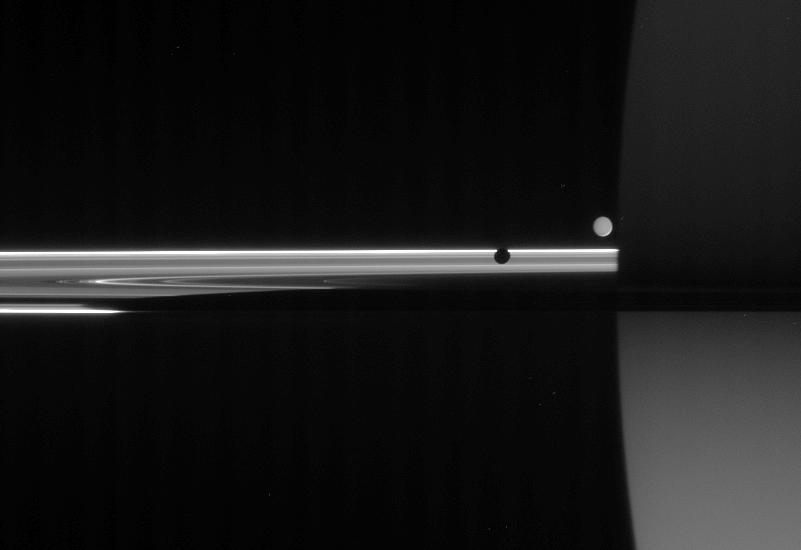
Light from Many Paths
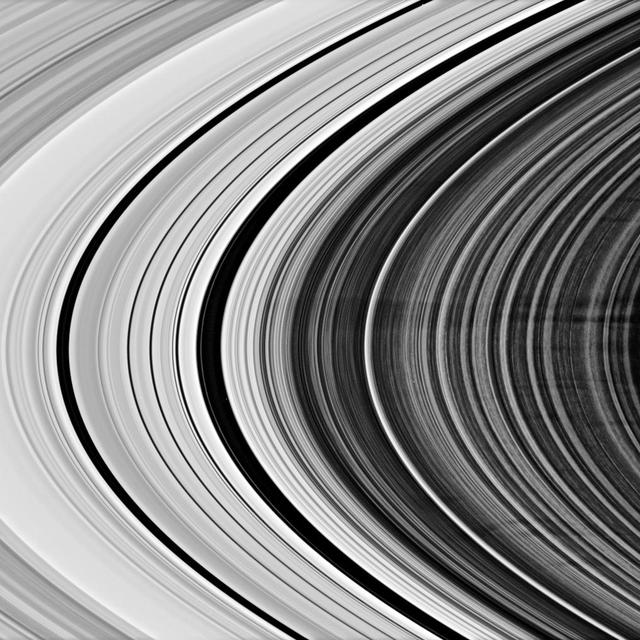
This Cassini spacecraft view shows a group of more than a dozen spokes in Saturn outer B ring. The B ring displays the azimuthal asymmetry, or variation with longitude around the planet, that is characteristic of the spoke-forming region

Pulchritudinous Perturbations
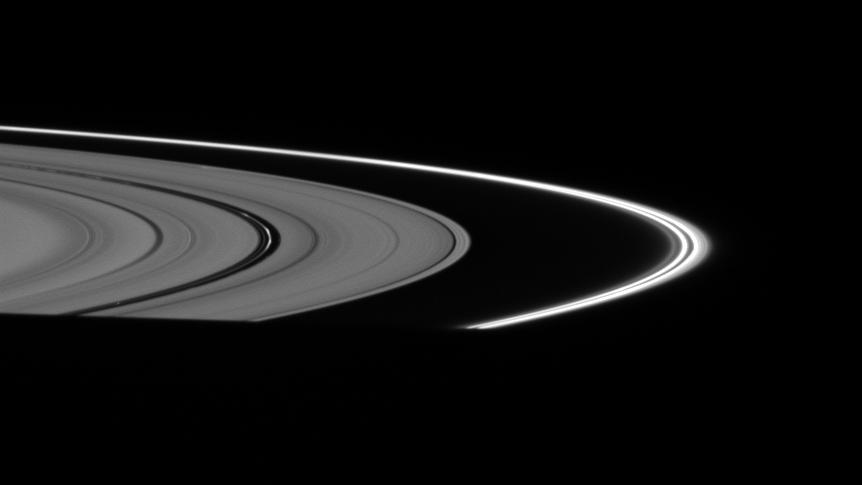
Bright Dust
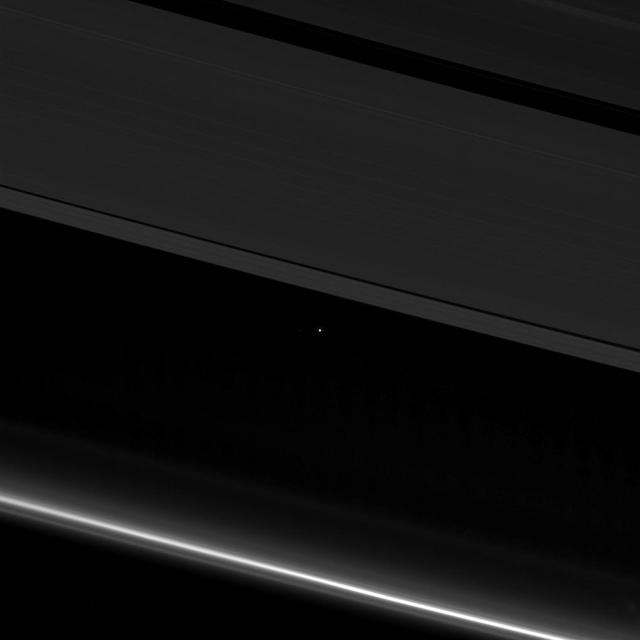
This view from NASA's Cassini spacecraft shows planet Earth as a point of light between the icy rings of Saturn. The spacecraft captured the view on April 12, 2017 at 10:41 p.m. PDT (1:41 a.m. EDT). Cassini was 870 million miles (1.4 billi…

Softly Glowing Scene

Recent images of features in Saturn's C ring called "plateaus" have deepened the mystery surrounding them. It turns out that these bright bands have a streaky texture that is very different from the textures of the regions around them. Th…
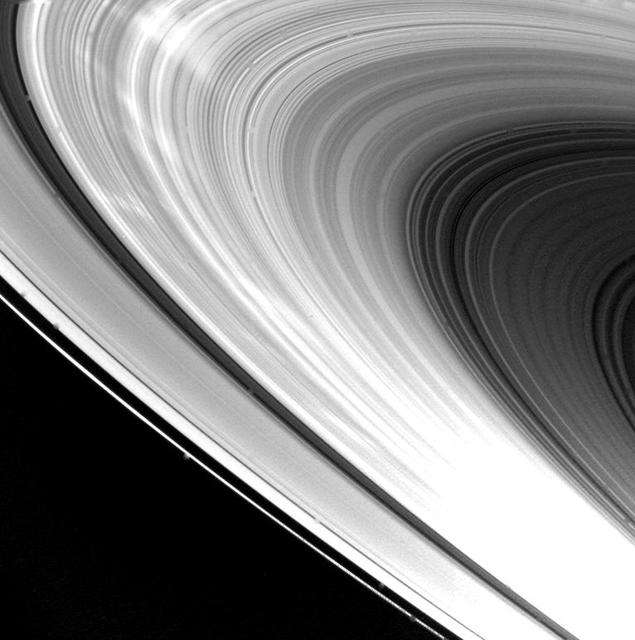
Saturn Ring System
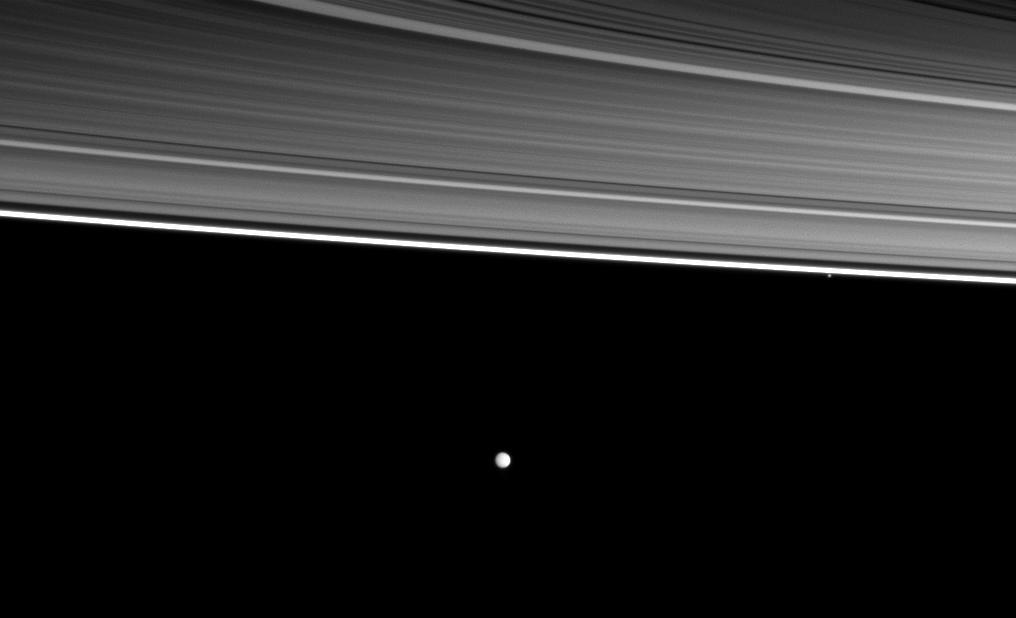
Two of Saturn moons orbit beyond four of the planet rings in this image from NASA Cassini spacecraft. From the top right of the picture are the C, B , A, and thin F rings, the small moon Pandora and, near the middle of the image, the moon E…

Fascinating F Ring
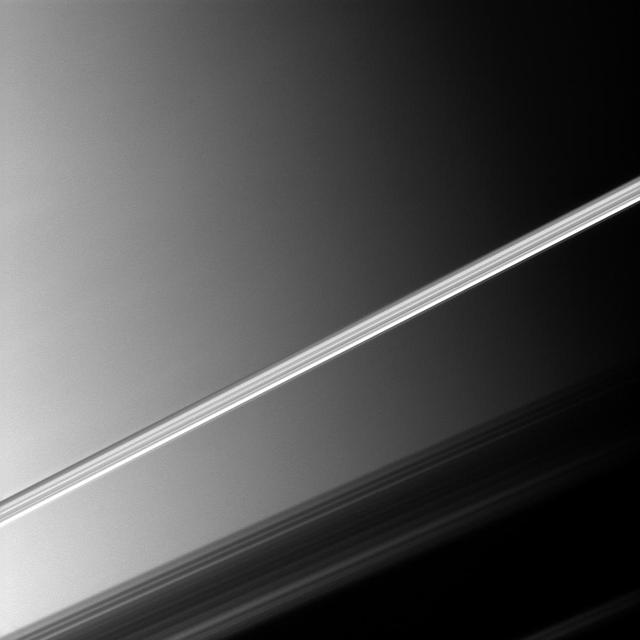
Saturn brightly lit rings slice across this NASA Cassini spacecraft picture taken before a backdrop of the planet clouds.