
Computer generated image of Apex high-altitude research sailplane in flight

Apex wing section undergoing loading test preparation by Mark Nunnelee and Eliseo Sanchez

CID (Controlled Imact Demonstrator) Aircraft prior to wing cutter impact during lakebed skid.

Apex wing section undergoing loading test.
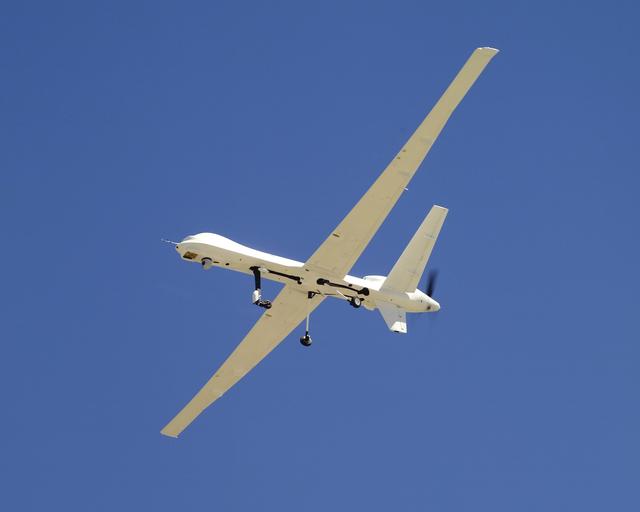
The long wings of General Atomics Altair UAV are in evidence during a series of environmental monitoring missions for NOAA and NASA in the spring of 2005.

Dryden Flight Research Center's Piper PA-30 Twin Commanche, which helped validate the RPRV concept, descends to a remotely controlled landing on Rogers Dry Lake, unassisted by the onboard pilot. A Piper PA-30 Twin Commanche, known as NASA 8…

Terrence Hertz, Deputy Associate Administrator for Technology, NASA Aeronautics Research Mission Directorate, at the NOAA/NASA Altair flight demo kickoff.

The Hyper III was a full-scale lifting-body remotely piloted research vehicle (RPRV) built at what was then the NASA Flight Research Center located at Edwards Air Force Base in Southern California.

First Captive Flight of DAST Mated to B-52 - Close-up from Below

DAST Mated to B-52 on Ramp - Close-up

CID (Controlled Imact Demonstrator) Aircraft fireball after wing cutter impact.

CID (Controlled Imact Demonstrator) Aircraft lakebed skid.

Apex high-altitude research sailplane mock-up

Oblique Wing Research Aircraft in flight

An ocean color senor, a passive microwave vertical sounder and an electro-optical sensor were mounted on the Altair UAV for the NOAA-NASA flight demonstration.

A satellite antenna, electro-optical/infrared and ocean color sensors (front) were among payloads installed on the Altair for the NOAA-NASA flight demonstration

Controlled Impact Demonstration instrumented test dummies installed in plane.

A high-tech infrared imaging sensor in its underbelly pod, the Altair UAS flew repeated passes over the Esperanza fire to aid firefighting efforts.

The Hyper III was a low-cost test vehicle for an advanced lifting-body shape. Like the earlier M2-F1, it was a "homebuilt" research aircraft, i.e., built at the Flight Research Center (FRC), later redesignated the Dryden Flight Research Cen…

CID (Controlled Imact Demonstrator) Aircraft in practice flight above target impact site with wing cutters.

CID (Controlled Imact Demonstrator) Aircraft skid after wing cutter impact.

CID (Controlled Imact Demonstrator) Aircraft fireball after wing cutter impact.

This 1976 photograph of the Oblique Wing Research Aircraft was taken in front of the NASA Flight Research Center hangar, located at Edwards Air Force Base, California. In the photograph the noseboom, pitot-static probe, and angles-of-attack…

Technicians check instrumentation and systems on NASA 808, a PA-30 aircraft, prior to a research flight. The aircraft was used as the testbed in development of control systems for remotely piloted vehicles that were "flown" from the ground.…

A pilot for General Atomics guides the Altair remotely operated aircraft from a ground control station using both visual and telemetered data.

This photograph shows NASA's 3/8th-scale remotely piloted research vehicle landing on Rogers Dry Lakebed at Edwards Air Force Base, California, in 1975.

Equipped with a pod-mounted infrared imaging sensor, the Altair UAS aided fire mapping efforts over wildfires in central and southern California in late 2006.

DAST in Flight. Last Flight