NASA Mars Underwater Rover Phantom 2 TROV (Telepresences Controlled Remotely Operated Vehicle)
ARC-1992-AC92-0007-7
NASA Mars Underwater Rover Phantom 2 TROV (Telepresences Controlled Remotely Operated Vehicle) -  helmet head piece
ARC-1992-AC92-0007-9
NASA Mars Underwater Rover Phantom 2 TROV (Telepresences Controlled Remotely Operated Vehicle) cameras
ARC-1992-AC92-0007-10
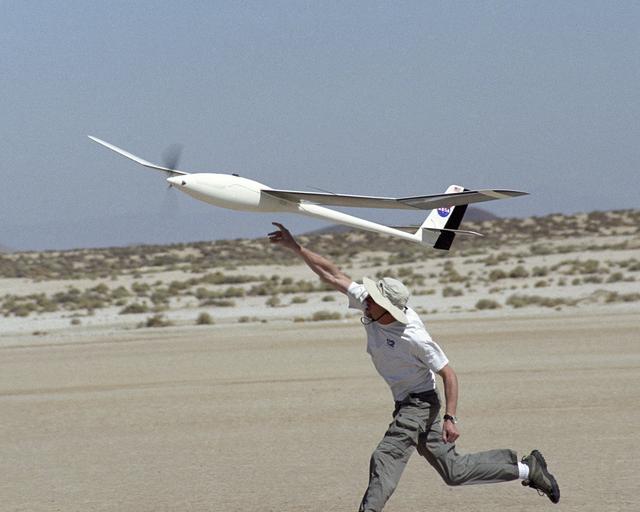
NASA Dryden aerospace engineer Michael Allen hand-launches a model motorized sailplane during a study validating the use of heat thermals to extend flight time.
EC05-0198-11
CID (Controlled Imact Demonstrator) Aircraft skid after wing cutter impact.
EC84-31806
CID (Controlled Imact Demonstrator) Aircraft fireball after wing cutter impact.
EC84-31809
Dryden Flight Research Center's Piper PA-30 Twin Commanche, which helped validate the RPRV concept, descends to a remotely controlled landing on Rogers Dry Lake, unassisted by the onboard pilot. A Piper PA-30 Twin Commanche, known as NASA 8…
PA-30 Twin Comanche - NASA 808 in flight
Controlled Impact Demonstration instrumented test dummies installed in plane.
EC84-28307
With a laser beam centered on its panel of photovoltaic cells, a lightweight model plane makes the first flight of an aircraft powered by a laser beam inside a building at NASA Marshall Space Flight Center.
With a laser beam centered on its panel of photovoltaic cells, a model plane makes the first flight of an aircraft powered by a laser beam inside a building at NASA Marshall.
This photograph shows NASA's 3/8th-scale remotely piloted research vehicle landing on Rogers Dry Lakebed at Edwards Air Force Base, California, in 1975.
F-15 RPRV landing on lakebed
NASA Mars Underwater Rover Phantom 2 TROV (Telepresences Controlled Remotely Operated Vehicle) with Dr. Carol Stoker and Owen Gwynne
ARC-1992-AC92-0007-1
NASA Mars Underwater Rover Phantom 2 TROV (Telepresences Controlled Remotely Operated Vehicle) with Dr. Carol Stoker
ARC-1992-AC92-0007-5
NASA image acquired October 23, 2009.  At NASA’s Dryden Research Center in California, a group of engineers, scientists, and aviation technicians have set up camp in a noisy, chilly hangar on Edwards Air Force base. For the past two weeks,…
Global Hawk, NASA's New Remote-Controlled Plane
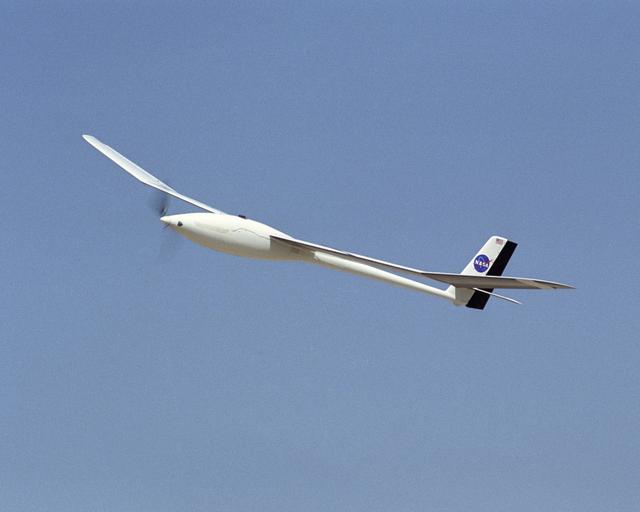
A NASA model motorized sailplane catches a thermal during one of 17 flights to demonstrate that updrafts can extend flight time and save energy for small UAVs.
EC05-0198-12
CID (Controlled Imact Demonstrator) Aircraft fireball after wing cutter impact.
EC84-31808
CID (Controlled Imact Demonstrator) Aircraft lakebed skid.
EC84-31803
STS035-12-015 (2-11 Dec 1990) --- Astronaut Jeffrey A. Hoffman, STS 35 mission specialist, uses a manual pointing controller (MPC) for the Astro-1 mission's Instrument Pointing System (IPS).   By using the MPC,  Hoffman and other crewmember…
STS-35 MS Hoffman operates ASTRO-1 MPC on OV-102's aft flight deck
Technicians check instrumentation and systems on NASA 808, a PA-30 aircraft, prior to a research flight. The aircraft was used as the testbed in development of control systems for remotely piloted vehicles that were "flown" from the ground.…
PA-30 Twin Comanche - NASA 808 in hangar
STS057-31-030 (25 June 1993) --- Astronaut Nancy J. Sherlock operates Endeavour's remote manipulator system (RMS) during the June 25 extravehicular activity of two crewmates. At one point, astronaut G. David Low, while his feet were anchore…
STS-57 MS2 Sherlock operates RMS THC on OV-105's aft flight deck
NASA Dryden project engineer Dave Bushman carefully aims the optics of a laser device at a solar cell panel on a model aircraft during the first flight demonstration of an aircraft powered by laser light.
NASA Dryden's Dave Bushman aims the optics of a laser device at a panel on a model aircraft during the first flight demonstration of an aircraft powered by laser light.
With a laser beam centered on its solar panel, a lightweight model aircraft is checked out by technician Tony Frakowiak and researcher Tim Blackwell before its power-beamed demonstration flight.
With a laser beam centered on its solar panel, a model aircraft is checked out by technician Tony Frakowiak and researcher Tim Blackwell before its power-beamed demonstration flight.
NASA Mars Underwater Rover Phantom 2 TROV (Telepresences Controlled Remotely Operated Vehicle)
ARC-1992-AC92-0007-3
NASA Mars Underwater Rover Phantom 2 TROV (Telepresences Controlled Remotely Operated Vehicle) cameras
ARC-1992-AC92-0007-8
STS039-27-016 (28 April-6 May 1991) --- The Space Shuttle Discovery fires reaction control subsystem (RCS) thrusters in this 35mm frame, taken from inside the crew cabin.  Seen in Discovery's payload bay are the tops of cannisters on the ST…
STS-39 OV-103 reaction control system (RCS) jets fire during onorbit maneuver
STS064-05-028 (9-20 Sept. 1994) --- On the space shuttle Discovery's aft flight deck, astronaut Susan J. Helms handles controls for the Remote Manipulator System (RMS). The robot arm operated by Helms, who remained inside the cabin, was use…
Astronaut Susan Helms on aft flight deck with RMS controls
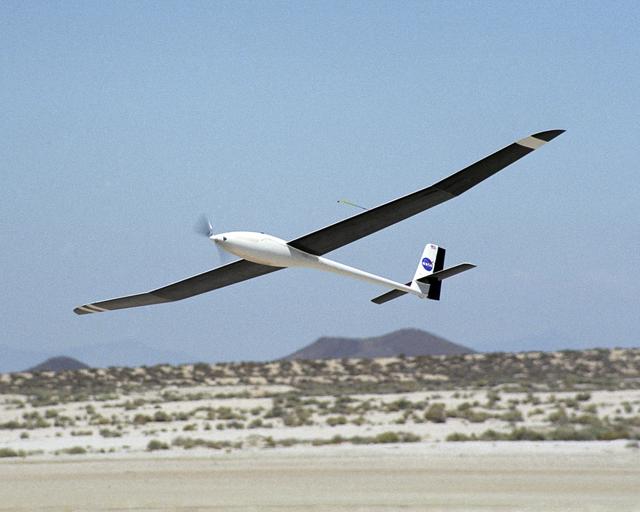
A NASA remote-controlled model motorized sailplane lies over Rogers Dry Lake to test the theory that catching heat thermals extends flight time for small UAVs.
EC05-0198-08
CID (Controlled Imact Demonstrator) Aircraft in practice flight above target impact site with wing cutters.
EC84-31672A
CID (Controlled Imact Demonstrator) Aircraft prior to wing cutter impact during lakebed skid.
EC84-31805
STS035-10-011 (2-10 Dec 1990) --- STS-35 Mission Specialist (MS) Robert A.R. Parker operates Astronomy Laboratory 1 (ASTRO-1) manual pointing controller (MPC) on the aft flight deck of Columbia, Orbiter Vehicle (OV) 102. Parker monitors a c…
STS-35 Mission Specialist Parker operates ASTRO-1 MPC on OV-102's flight deck
STS061-77-102 (7 Dec 1993) --- Astronauts Jeffrey A. Hoffman (left) and F. Story Musgrave are partially silhouetted against the Indian Ocean as they work to install the Magnetic Sensing System (MSS) on the Hubble Space Telescope (HST).  Mus…
Astronauts Hoffman and Musgrave install the Magnetic Sensing System on HST
Powered by a laser beam directed at it from a center pedestal, a lightweight model plane makes the first flight of an aircraft powered by laser energy inside a building at NASA's Marshall Space Flight Center.
Powered by a laser beam directed at it from a pedestal, a model plane makes the first flight of an aircraft powered by laser energy inside a building at NASA Marshall.
No more images