
he left solid rocket booster (SRB) for the STS-5 mission is shown in this photograph at the moment of splashdown after its separation from the external tank. This view was photographed from a Cast Glance aircraft. After impact to the ocean,…

Researcher checks model of Project Fire Reentry package to be tested in Unitary Plan Wind Tunnel. Project FIRE (Flight Investigation Reentry Environment) studied the effects of reentry heating on spacecraft materials. It involved both wind…

STS064-06-028 (9-20 Sept. 1994) --- On the space shuttle Discovery's flight deck, two thirds of the crew prepare for one of four hard efforts (in a two-day period) to de-orbit and complete the extended spaceflight. Manning the commander's…

S64-03506 (1964) --- Diagrams shows Gemini spacecraft functions of the thrusters in the Gemini spacecraft's re-entry control system. Thrusters may be fired in various combinations to cause yaw, roll and pitch.

Air Force Major Peter Hoag stands in front of the HL-10 Lifting Body. Maj. Hoag joined the HL-10 program in 1969 and made his first glide flight on June 6, 1969. He made a total of 8 flights in the HL-10. They included the fastest lifting-b…

The HL-10 lifting body is seen here in flight over Rogers Dry Lake at Edwards AFB. After the vehicle's fins were modified following its first flight, the HL-10 proved to be the best handling of the heavy-weight lifting bodies flown at Edwar…
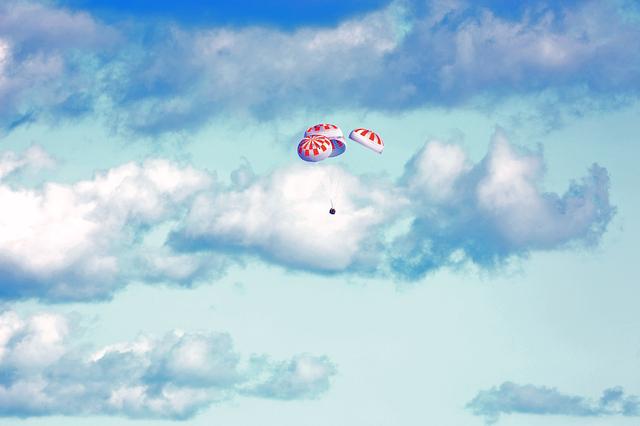
SpaceX’s Crew Dragon is guided by four parachutes toward the Atlantic Ocean on March 8 after returning from the International Space Station on the Demo-1 mission. The uncrewed spacecraft docked to the orbiting laboratory on March 3, followi…

SpaceX’s Crew Dragon is retrieved by the company’s recovery ship, Go Searcher, in the Atlantic Ocean, about 200 miles off the east coast of Florida March 8, 2019, after its return to Earth on the Demo-1 mission. The uncrewed spacecraft dock…

The HL-10 Lifting Body completes its first research flight with a landing on Rogers Dry Lake. Due to control problems, pilot Bruce Peterson had to land at a higher speed than originally planned in order to keep the vehicle under control. Th…

SpaceX’s Crew Dragon is guided by four parachutes toward the Atlantic Ocean on March 8 after returning from the International Space Station on the Demo-1 mission. The uncrewed spacecraft docked to the orbiting laboratory on March 3, followi…
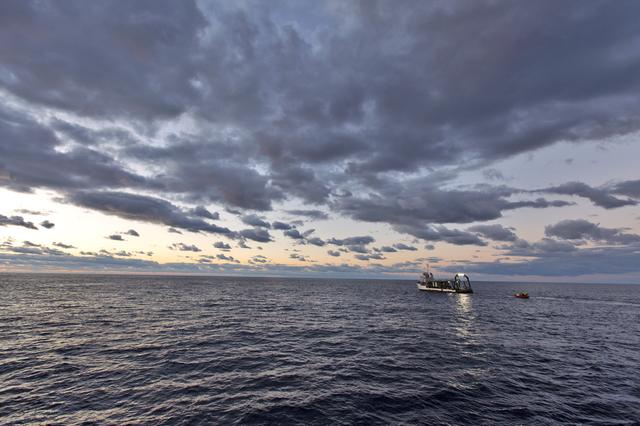
SpaceX’s recovery ship, Go Searcher, sails in the Atlantic Ocean off the east coast of Florida March 8, 2019, in preparation to retrieve the company’s Crew Dragon upon its return to Earth on the Demo-1 mission. The uncrewed spacecraft docke…

As part of the project FIRE study, technicians ready materials to be subjected to high temperatures that will simulate the effects of re-entry heating. Tests of various space capsule materials for Project FIRE were conducted. Photographed i…

SpaceX’s Crew Dragon is guided by four parachutes as it splashes down in the Atlantic Ocean about 200 miles off Florida’s east coast on March 8, 2019, after returning from the International Space Station on the Demo-1 mission. The uncrewed…

SpaceX’s Crew Dragon is loaded onto the company’s recovery ship, Go Searcher, in the Atlantic Ocean, about 200 miles off Florida’s east coast, on March 8, after returning from the International Space Station on the Demo-1 mission. The uncre…

SpaceX’s Crew Dragon approaches the International Space Station during the Demo-1 mission on Sunday, March 3, 2019. The uncrewed spacecraft docked to the orbiting laboratory following a 2:49 a.m. EST liftoff aboard a SpaceX Falcon 9 rocket…

The right solid rocket booster (SRB) for the STS-5 mission, with one chute opened, falls after its separation from the external tank (ET). This view was photographed from a Cast Glance aircraft. After impact to the ocean, it was retrieved a…

S74-24677 (June 1974) --- A close-up view of the descent vehicle of the Soyuz spacecraft training mock-up on display at the Cosmonuat Training Center (Star City) near Moscow. The open hatch reveals the interior arrangement of the middle sec…

STS075-322-012 (9 March 1996) --- Seated at the pilot's station, astronaut Scott J. Horowitz uses a mirror to monitor the vertical stabilizer and the aft cargo bay area during the entry phase of the flight. Horowitz, pilot, joined four othe…

STS062-41-025 (18 March 1994) --- Astronaut Andrew M. Allen monitors Columbia's systems from the pilot's station during the entry phase of the STS-62 mission. The fast-speed 35mm film highlights the many controls and displays and the cath…

61C-01-007 (12-17 Jan 1986)--- Astronaut Charles F. Bolden STS 61-C pilot, mans the pilot's station on Columbia's flight deck prior to re-entry.

The four principal HL-10 pilots are seen here with the lifting body aircraft. They are, left to right; Air Force Major Jerauld R. Gentry, Air Force test pilot Peter Hoag, and NASA pilots John A. Manke and Bill Dana. All are wearing the pres…

The HL-10 Lifting Body is seen here parked on Rogers Dry Lake, the unique location where it landed after research flights. This 1968 photo shows the vehicle after the fins were modified to remove instabilities encountered on the first fligh…

SpaceX’s recovery ship, Go Searcher, prepares to retrieve the company’s Crew Dragon from the Atlantic Ocean, about 200 miles off the east coast of Florida, March 8, 2019. The uncrewed spacecraft docked to the orbiting laboratory on March 3,…

SpaceX’s recovery ship, Go Searcher, sails in the Atlantic Ocean off the east coast of Florida March 8, 2019, in preparation to retrieve the company’s Crew Dragon upon its return to Earth on the Demo-1 mission. The uncrewed spacecraft docke…

SpaceX’s Crew Dragon is guided by four parachutes toward the Atlantic Ocean on March 8, 2019, after returning from the International Space Station on the Demo-1 mission. The uncrewed spacecraft docked to the orbiting laboratory on March 3,…

This photo shows the HL-10 in flight, turning to line up with lakebed runway 18. The pilot for this flight, the 29th of the HL-10 series, was Bill Dana. The HL-10 reached a peak altitude of 64,590 feet and a top speed of Mach 1.59 on this p…

John Manke is shown here on the lakebed next to the HL-10, one of four different lifting-body vehicles he flew, including the X-24B, which he flew 16 times. His final total was 42 lifting-body flights.

SpaceX’s Crew Dragon is carried by the company’s recovery ship, Go Searcher, in the Atlantic Ocean, about 200 miles off Florida’s east coast, on March 8, after returning from the International Space Station on the Demo-1 mission. The uncrew…

The HL-10, seen here parked on the ramp, was one of five lifting body designs flown at NASA's Dryden Flight Research Center, Edwards, California, from July 1966 to November 1975 to study and validate the concept of safely maneuvering and la…

SpaceX’s Crew Dragon floats in the Atlantic Ocean, about 200 miles off Florida’s east coast, March 8, 2019, after returning from the International Space Station on the Demo-1 mission. The uncrewed spacecraft docked to the orbiting laborator…

SpaceX’s Crew Dragon spacecraft arrives in Port Canaveral, Florida, aboard the company’s recovery ship, Go Searcher, on Saturday, March 9, 2019. Crew Dragon splashed down in the Atlantic Ocean, about 200 miles off Florida’s east coast, at 8…

SpaceX’s recovery ship, Go Searcher, enters Port Canaveral in Florida on Saturday, March 9, 2019, with the company’s Crew Dragon spacecraft on its main deck. Crew Dragon splashed down in the Atlantic Ocean, about 200 miles off Florida’s eas…

ISS040-E-098545 (17 Aug. 2014) --- One of the Expedition 40 crew members aboard the International Space Station recorded this image of the Orbital Sciences Corporation's Cygnus cargo carrier spacecraft breaking up in Earth's atmosphere afte…

G61-00030 (4 Nov. 1959) --- Launch of Little Joe-2 from Wallops Island carrying Mercury spacecraft test article. The suborbital test flight of the Mercury capsule was to test the escape system. Vehicle functioned perfectly, but escape rocke…

Disant view of 53P Progress burn up over the Earth's surface as seen by the Expedition 40 crew.

The HL-10 Lifting Body completes its first research flight with a landing on Rogers Dry Lake at Edwards AFB, California, on December 22, 1966. The HL-10 suffered from buffeting and poor control during the flight. Pilot Bruce Peterson was ab…

The HL-10 Lifting Body is seen here in flight over Rogers Dry lakebed. Like the other lifting bodies, the HL-10 made a steep descent toward the lakebed, followed by a high-speed landing. This was due to the vehicle's low lift-over-drag rati…

Not every moment of a test pilot's day is serious business. In a moment of levity, NASA pilots Bill Dana (left) and John A. Manke try to drag Air Force test pilot Peter Hoag away from the HL-10 lifting body while Air Force Major Jerauld R.…

The HL-10 Lifting Body is seen here in powered flight shortly after launch from the B-52 mothership. When HL-10 powered flights began on October 23, 1968, the vehicle used the same basic XLR-11 rocket engine that powered the original X-1s.…

SpaceX’s Crew Dragon is loaded onto the company’s recovery ship, Go Searcher, in the Atlantic Ocean, about 200 miles off Florida’s east coast, on March 8, after returning from the International Space Station on the Demo-1 mission. The uncre…

SpaceX’s Crew Dragon is loaded onto the company’s recovery ship, Go Searcher, in the Atlantic Ocean, about 200 miles off Florida’s east coast, on March 8, after returning from the International Space Station on the Demo-1 mission. The uncre…

NASA research pilot Bill Dana stands in front of the HL-10 Lifting Body following his first glide flight on April 25, 1969. Dana later retired as Chief Engineer at NASA's Dryden Flight Research Center, (called the NASA Flight Research Cente…

The HL-10 was one of five heavyweight lifting-body designs flown at NASA's Flight Research Center (FRC--later Dryden Flight Research Center), Edwards, California, from July 1966 to November 1975 to study and validate the concept of safely m…

SpaceX’s Crew Dragon is loaded onto the company’s recovery ship, Go Searcher, in the Atlantic Ocean, about 200 miles off Florida’s east coast, on March 8, after returning from the International Space Station on the Demo-1 mission. The uncre…

The HL-10, seen here parked on the ramp at NASA's Flight Research Center in 1966, had a radically different shape from that of the M2-F2/F3. While the M2s were flat on top and had rounded undersides (giving them a bathtub shape), the HL-10…

As shown in this photo of the HL-10 flight simulator, the lifting-body pilots and engineers made use of early simulators for both training and the determination of a given vehicle's handling at various speeds, attitudes, and altitudes. This…

SpaceX’s Crew Dragon is guided by four parachutes as it approaches splashdown in the Atlantic Ocean about 200 miles off Florida’s east coast on March 8, 2019, after returning from the International Space Station on the Demo-1 mission. The u…

The SpaceX Crew Dragon spacecraft is offloaded from the company’s recovery ship, Go Searcher, in Florida’s Port Canaveral on Saturday, March 9, 2019. Crew Dragon splashed down in the Atlantic Ocean, about 200 miles off Florida’s east coast,…