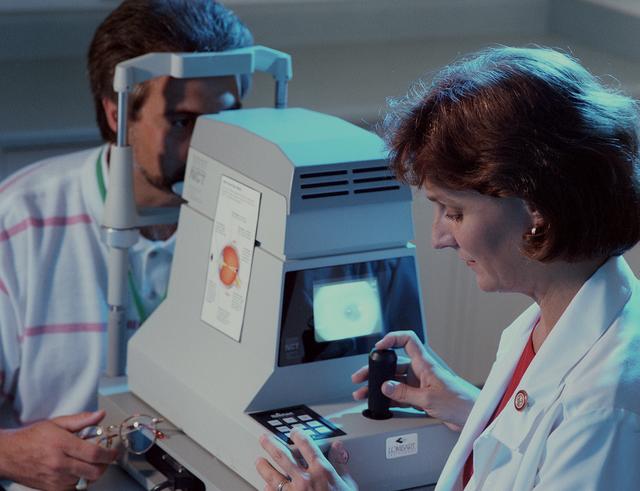
Nurse performs tonometry examination, which measure the tension of the eyeball, during an employee's arnual physical examination given by MSFC Occupational Medicine Environmental Health Services under the Center Operations Directorate.

Still photographs taken over 16 hours on Nov. 13, 2001, on the International Space Station have been condensed into a few seconds to show the de-mixing -- or phase separation -- process studied by the Experiment on Physics of Colloids in Sp…

Student-designed and -built apparatus for the second Dropping in a Microgravity Environment (DIME) competition held April 23-25, 2002, at NASA's Glenn Research Center. Competitors included two teams from Sycamore High School, Cincinnati, OH…

This is the hardware that will contain the AVATAR chips during the Artemis II flight. The AVATAR (A Virtual Astronaut Tissue Analog Response) investigation will use organ-on-a-chip devices, or organ chips, to study a effects of increased ra…

The AVATAR (A Virtual Astronaut Tissue Analog Response) investigation will use organ-on-a-chip devices, or organ chips, to study a effects of increased radiation and microgravity on human health. Artemis II AVATAR is a small experiment flyi…

The AVATAR (A Virtual Astronaut Tissue Analog Response) investigation will use organ-on-a-chip devices, or organ chips, to study a effects of increased radiation and microgravity on human health. Artemis II AVATAR is a small experiment flyi…
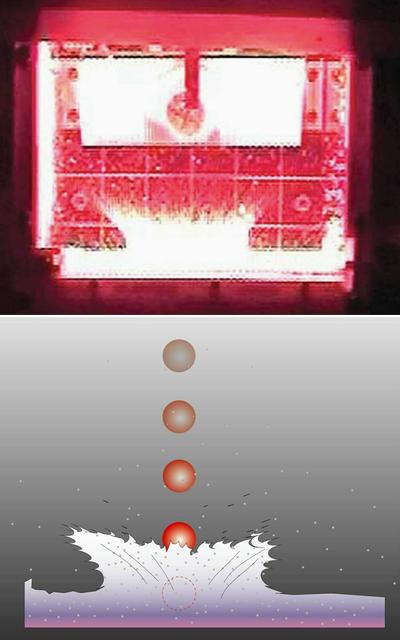
Clues to the formation of planets and planetary rings -- like Saturn's dazzling ring system -- may be found by studying how dust grains interact as they collide at low speeds. To study the question of low-speed dust collisions, NASA sponsor…

New Horizons Mission Operations Manager Alice Bowman of the Johns Hopkins University Applied Physics Laboratory is seen during a press conference after the team received confirmation from the New Horizons spacecraft that it has completed th…
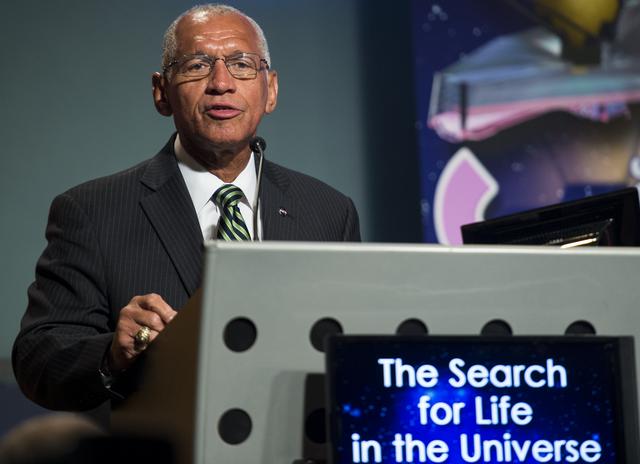
NASA Administrator Charles Bolden delivers opening remarks during a panel discussion on the search for life beyond Earth in the James E. Webb Auditorium at NASA Headquarters on Monday, July 14, 2014 in Washington, DC. The panel discussed ho…

New Horizons co-investigator Kelsi Singer of the Southwest Research Institute (SwRI), Boulder, CO, and New Horizons science team affiliate Kirby Runyon of John Hopkins discuss the various instruments on the New Horizons spacecraft, Monday,…

New Horizons principal investigator Alan Stern of the Southwest Research Institute (SwRI), Boulder, CO, along with other mission team members, waves American flags as he enters the main auditorium for a press conference, Tuesday, Jan. 1, 20…

STS050-21-035 (25 June- 9 July 1992) --- Astronaut Ellen S. Baker, mission specialist, works out on the bicycle ergometer on the mid-deck of the Earth-orbiting Space Shuttle Columbia. Baker was joined by four other astronauts and two scien…

NASA’s Double Asteroid Redirection Test (DART) command team at Johns Hopkins University, Applied Physics Laboratory monitoring the DART spacecraft’s impact into the asteroid Dimorphos. The operation is the first of its kind test to redirect…

New Horizons principal investigator Alan Stern of the Southwest Research Institute (SwRI), Boulder, CO, speaks during an overview of the New Horizons Mission, Monday, Dec. 31, 2018 at Johns Hopkins University Applied Physics Laboratory (APL…

NASA’s Double Asteroid Redirection Test (DART) command team at Johns Hopkins University, Applied Physics Laboratory monitoring the DART spacecraft’s impact into the asteroid Dimorphos. The operation is the first of its kind test to redirect…
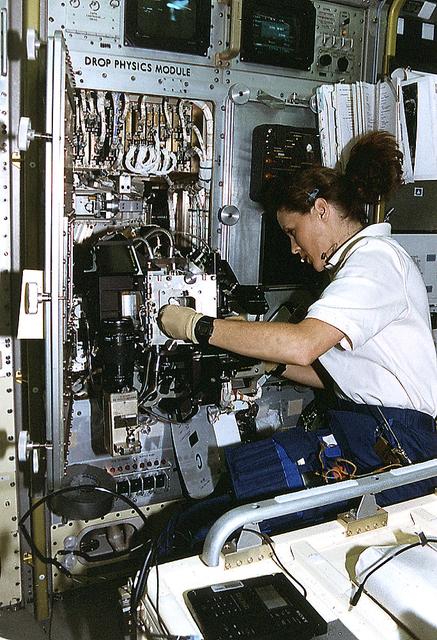
Onboard Space Shuttle Columbia (STS-73) Payload Commander Kathryn Thornton works with the Drop Physics Module (DPM) in the United States Microgravity Laboratory 2 (USML-2) Spacelab Science Module cleaning the experiment chamber of the DPM.
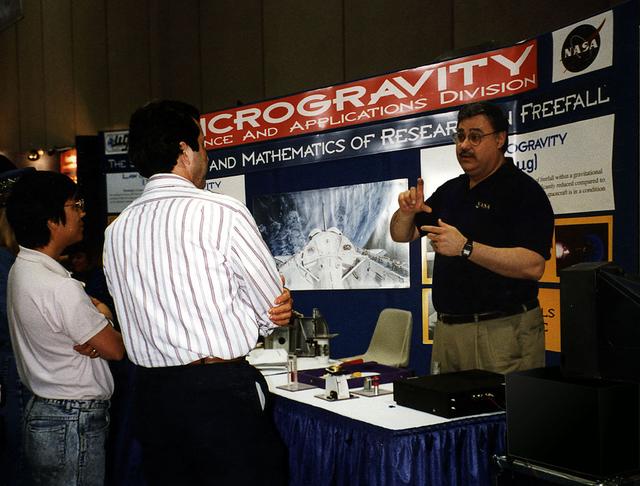
Dr. Michael Wargo, program scientist for materials science at NASA headquarters, explains the math and physics principles associated with freefall research to attendees at the arnual conference of the National Council of Teachers of Mathema…

Colored oil flow toy was part of a student-designed apparatus used in the second Dropping in a Microgravity Environment (DIME) competition held April 23-25, 2002, at NASA's Glenn Research Center. Competitors included two teams from Sycamore…

The first United States Microgravity Laboratory (USML-1) was one of NASA's science and technology programs that provided scientists an opportunity to research various scientific investigations in a weightlessness environment inside the Spac…

The AVATAR (A Virtual Astronaut Tissue Analog Response) investigation will use organ-on-a-chip devices, or organ chips, to study a effects of increased radiation and microgravity on human health. Artemis II AVATAR is a small experiment flyi…

STS064-09-026 (9-20 Sept. 1994) --- Astronaut L. Blaine Hammond, STS-64 pilot, gets microgravity exercise on the rowing machine. This area of the space shuttle Discovery's middeck was also used for the treadmill exercising device. Blaine a…

The AVATAR (A Virtual Astronaut Tissue Analog Response) investigation will use organ-on-a-chip devices, or organ chips, to study a effects of increased radiation and microgravity on human health. Artemis II AVATAR is a small experiment flyi…

STS056-91-050 (8-17 April 1993) --- This 70mm frame shows the cargo bay of the Earth-orbiting Space Shuttle Discovery backdropped against clouds. Most of the elements of the ATLAS-2 payload can be seen, but missing is the SPARTAN-201 satel…

Mike Buckley, senior public information officer at the Johns Hopkins University Applied Physics Laboratory is seen during a press conference after the team received confirmation from the New Horizons spacecraft that it has completed the fly…

David Grinspoon, senior scientist at the Planetary Science Institute discusses Pluto and the Human Imagination, Monday, Dec. 31, 2018 at Johns Hopkins University Applied Physics Laboratory (APL) in Laurel, Maryland. Photo Credit: (NASA/Bill…

NASA’s Double Asteroid Redirection Test (DART) command team at Johns Hopkins University, Applied Physics Laboratory monitoring the DART spacecraft’s impact into the asteroid Dimorphos. The operation is the first of its kind test to redirect…

New Horizons deputy project scientist John Spencer of the Southwest Research Institute (SwRI), Boulder, CO discusses what they hope to learn from the flyby of Ultima Thule, Monday, Dec. 31, 2018 at Johns Hopkins University Applied Physics L…

STS032-03-021 (9-20 Jan. 1990) --- Three crew members aboard the Space Shuttle Columbia enjoy one of the lighter moments of the 11-day mission on the flight deck. Astronaut G. David Low "runs" on a treadmill device while astronauts Daniel C…
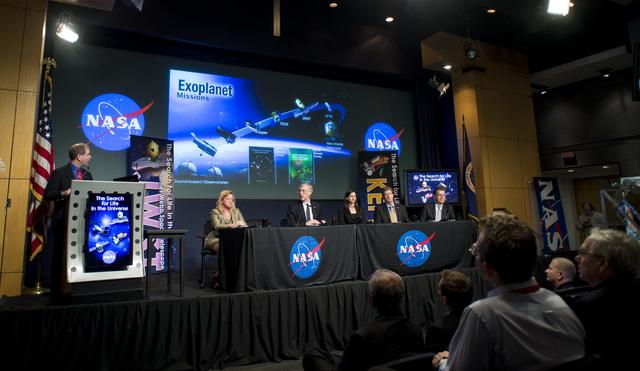
John Grunsfeld, Associate Administrator for NASA's Science Mission Directorate, far left, speaks during a panel discussion on the search for life beyond Earth in the James E. Webb Auditorium at NASA Headquarters on Monday, July 14, 2014 in…

NASA Chief Scientist Ellen Stofan, far left, asks the members of the panel a question during a discussion of the search for life beyond Earth in the James E. Webb Auditorium at NASA Headquarters on Monday, July 14, 2014 in Washington, DC. T…
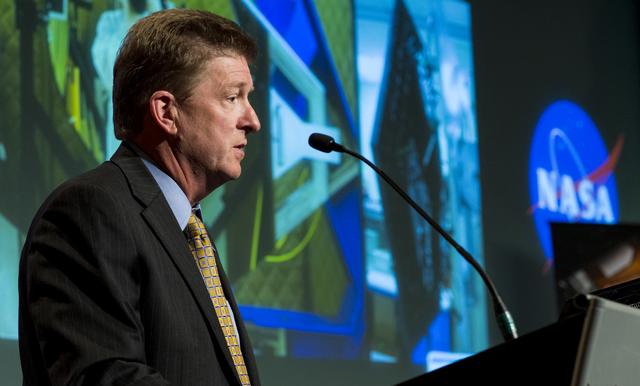
Dave Gallagher, Director of Astronomy, Physics, and Space Technology at NASA's Jet Propulsion Laboratory speaks during a panel discussion on the search for life beyond Earth in the James E. Webb Auditorium at NASA Headquarters on Monday, Ju…

New Horizons principal investigator Alan Stern of the Southwest Research Institute (SwRI), Boulder, CO, right, along with other mission team members and guest watch as Brian May, lead guitarist of the rock band Queen and astrophysicist show…

John Grunsfeld, Associate Administrator for NASA's Science Mission Directorate, second from left, answers a question from the audience during a panel discussion on the search for life beyond Earth in the James E. Webb Auditorium at NASA Hea…

S64-14883 (1962) --- Astronaut John H. Glenn Jr., pilot of the Mercury-Atlas 6 mission, participates in a strict physical training program, as he exemplifies by frequent running. Here he pauses during an exercise period on the beach near Ca…

Test tubes to hold different types of fluids while in free-fall were among the student-designed items for the second Dropping in a Microgravity Environment (DIME) competition held April 23-25, 2002, at NASA's Glenn Research Center. Competit…
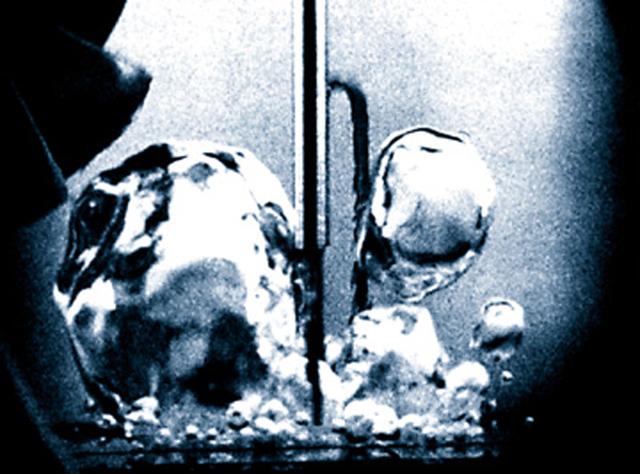
Fluid Physics is study of the motion of fluids and the effects of such motion. When a liquid is heated from the bottom to the boiling point in Earth's microgravity, small bubbles of heated gas form near the bottom of the container and are c…

ISS038-E-002210 (14 Nov. 2013) --- Japan Aerospace Exploration Agency astronaut Koichi Wakata, Expedition 38 flight engineer, equipped with a bungee harness, exercises on the Combined Operational Load Bearing External Resistance Treadmill (…

Organ chips are roughly the size of a USB drive and could be used to predict how an individual might respond to a variety of stressors, such as radiation or medical treatments, including pharmaceuticals. Made with human cells, the chips mim…

The AVATAR (A Virtual Astronaut Tissue Analog Response) investigation will use organ-on-a-chip devices, or organ chips, to study a effects of increased radiation and microgravity on human health. Artemis II AVATAR is a small experiment flyi…
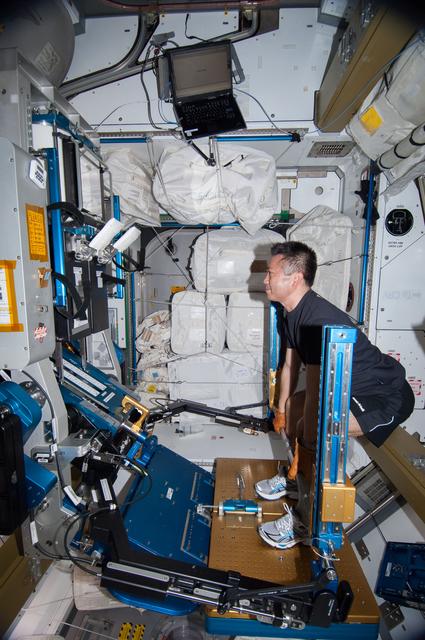
View of Koichi Wakata, Expedition 38 Flight Engineer (FE), exercising on the Advanced Resistive Exercise Device (aRED), in the Node 3. Photo was taken during Expedition 38. Image was released by astronaut on Twitter.

New Horizons co-investigator John Spencer of the Southwest Research Institute (SwRI), Boulder, CO, uses a pen to demonstrate how Ultima Thule might be rotating during a press conference prior to the flyby of the Kuiper Belt object by the Ne…

NASA’s Double Asteroid Redirection Test (DART) command team at Johns Hopkins University, Applied Physics Laboratory monitoring the DART spacecraft’s impact into the asteroid Dimorphos. The operation is the first of its kind test to redirect…

New Horizons project scientist Hal Weaver of the Johns Hopkins University Applied Physics Laboratory speaks about new data received from the New Horizons spacecraft during a press conference after the team received confirmation from the New…

New Horizons principal investigator Alan Stern of the Southwest Research Institute (SwRI), Boulder, CO gives remarks about the New Horizons mission during a briefing discussing small bodies missions, Monday, Dec. 31, 2018 at Johns Hopkins U…

Guests celebrate New Years, Tuesday, Jan. 1, 2019 at Johns Hopkins University Applied Physics Laboratory (APL) in Laurel, Maryland. Photo Credit: (NASA/Bill Ingalls)

Guests celebrate New Years, Tuesday, Jan. 1, 2019 at Johns Hopkins University Applied Physics Laboratory (APL) in Laurel, Maryland. Photo Credit: (NASA/Bill Ingalls)

ISS040-E-006091 (31 May 2014) --- NASA astronaut Reid Wiseman, Expedition 40 flight engineer, equipped with a bungee harness, exercises on the Combined Operational Load Bearing External Resistance Treadmill (COLBERT) in the Tranquility node…

Four STS 51-G crewmembers huddle in a corner of the Discovery's middeck area. Daniel C. Brandenstein, mission commander, assists Steven R. Nagel with the treadmill device while John O. Creighton and Shannon W. Lucid look on.