STS061-73-040 (4 Dec 1993) --- Backdropped against the blackness of space, the Hubble Space Telescope (HST) nears the Space Shuttle Endeavour.  With the aid of the Remote Manipulator System (RMS), the STS-61 crew members later grappled the…
Hubble Space Telescope nears Shuttle Endeavour
STS075-351-022 (22 Feb.- 9 March 1996) --- The space shuttle Columbia's vertical stabilizer appears to point to the four stars of the Southern Cross. The scene was captured with a 35mm camera just prior to a sunrise.  The seven member crew…
View of Southern Cross, Alpha and Beta Centauri
S66-54656 (13 Sept. 1966) --- Nose of Gemini-11 spacecraft and Agena Target Vehicle while docked as photographed by astronaut Richard F. Gordon Jr., pilot, during his stand-up extravehicular activity (EVA). Taken with a modified 70mm Hassel…
Nose of Gemini 11 spacecraft and Agena Target Vehicle as seen during EVA
AS11-43-6439 (July 1969) --- An Apollo 11 oblique view of the lunar farside.  The linear group of small craters is located within the large International Astronomical Union crater No. IX, and is centered at 139.5 degrees east longitude and…
Apollo 11 oblique view of lunar farside
AS11-43-6422 (July 1969) --- An Apollo 11 oblique view of the lunar farside.  These two odd-shaped craters are located midway between International Astronomical Union craters 218 and 220, and are centered at 155 degrees east longitude and 3…
Apollo 11 oblique view of lunar farside
AS11-42-6237 (20 July 1969) --- An Apollo 11 oblique view of the large crater Theophilus located at the northwest edge of the Sea of Nectar on the lunar nearside. Theophilus is about 60 statute miles in diameter. The smooth area is Mare Nec…
Oblique view of crater Theophilus at northwest edge of Sea of Nectar
AS08-12-2052 (21-27 Dec. 1968) --- This near-vertical photograph from the Apollo 8 spacecraft covers an area of approximately 50 x 50 statute miles within a 250-statute-miles-in-diameter crater on the lunar farside. The center of this large…
View of lunar surface taken from Apollo 8 spacecraft
SL3-28-059 (July-September 1973) --- A vertical view of the Lake Mead and Las Vegas, Nevada area as photographed from Earth orbit by one of the six lenses of the Itek-furnished S190-A Multispectral Photographic Facility Experiment aboard th…
View of Lake Mead and Las Vegas, Nevada area from Sklyab
AS08-14-2383 (24 Dec. 1968) --- The rising Earth is about five degrees above the lunar horizon in this telephoto view taken from the Apollo 8 spacecraft near 110 degrees east longitude. The horizon, about 570 kilometers (350 statute miles)…
Apollo 8 Mission image, Earth over the horizon of the moon
STS063-712-017 (6 Feb. 1995) --- Russia's Mir Space Station during rendezvous operations with the Space Shuttle Discovery.  Docked at the bottom of the Mir facility is a Soyuz spacecraft.  On the opposite end (almost cropped out of frame at…
Mir space station as seen from STS-63 Discovery
AS11-36-5337 (16 July 1969) --- This view of Earth showing clouds over its surface was photographed from the Apollo 11 spacecraft during its translunar journey toward the moon. The spacecraft was already about 10,000 nautical miles from Ear…
View of Earth taken by Apollo 11 crewmembers
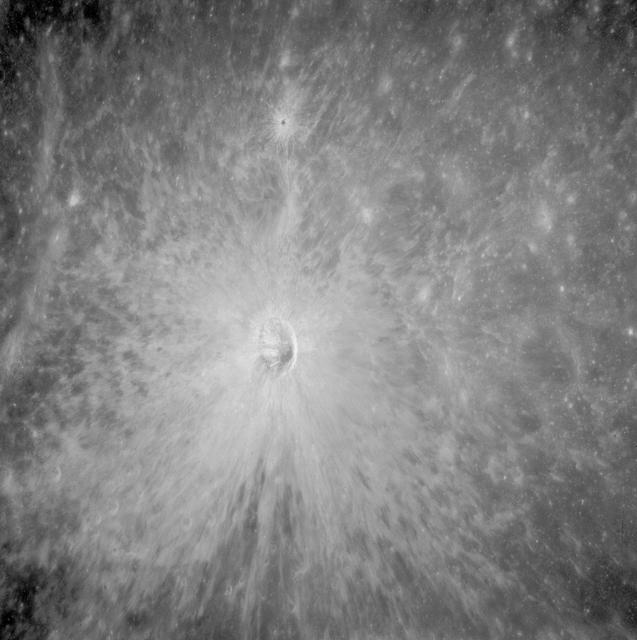
AS13-60-8675 (April 1970) --- This bright-rayed crater on the lunar farside was photographed from the Apollo 13 spacecraft during its pass around the moon. This area is northeast of Mare Marginus. The bright-rayed crater is located at about…
View of the crater on lunar farside from Apollo 13
AS12-50-7362 (14 Nov. 1969) --- A view of one-third of Earth, with Australia on the horizon, as photographed by the three-man crew of Apollo 12. The Command and Service Modules, mated to the Lunar Module (yet to be removed and transposition…
View of the Earth seen from the Apollo 12 spacecraft
AS07-05-1644 (13 Oct. 1968) --- Remarkable cloud patterns as seen from the Apollo 7 spacecraft during its 34th revolution of Earth. Note break in two adjacent decks of strato-cumulus cloud formations. Sea can be seen through holes in clouds…
Cloud patterns as seen from the Apollo 7 spacecraft
S65-63826 (5 Dec. 1965) --- Oriente Province, eastern end of Cuba, as seen from the National Aeronautics and Space Administration's Gemini-7 spacecraft during its 14th revolution of Earth. Guantanamo Bay is in the center of the picture on t…
Orienete Province, eastern end of Cuba as seen from Gemini 7 spacecraft
AS13-60-8588 (17 April 1970) --- This photograph of Earth was taken from the National Aeronautics and Space Administration's (NASA) Apollo 13 spacecraft during its trans-Earth journey home. The most visible land mass includes southwestern U…
Photograph of Earth taken from Apollo 13 spacecraft during transearth journey
S77-E-5109 (26 May 1996) --- Astronaut John H. Casper, commander, pauses during a photography session on the aft flight deck of the Space Shuttle Endeavour.  The scene was recorded with an Electronic Still Camera (ESC).
Casper points camera out of aft flight deck window
AS13-60-8703 (11-17 April 1970) --- This outstanding view of a near full moon was photographed from the Apollo 13 spacecraft during its trans-Earth journey homeward. Though the explosion of the oxygen tank in the Service Module (SM) forced…
View of near full Moon photographed by Apollo 13 during transearth journey
STS061-65-015 (9 Dec 1993) --- A fish-eye lens was used to capture the Hubble Space Telescope (HST), a spherical Earth and Australian landmass with a bit of distortion during the final extravehicular activity (EVA) on the STS-61 HST-servici…
Fisheye view of HST, spherical Earth and Australian landmass
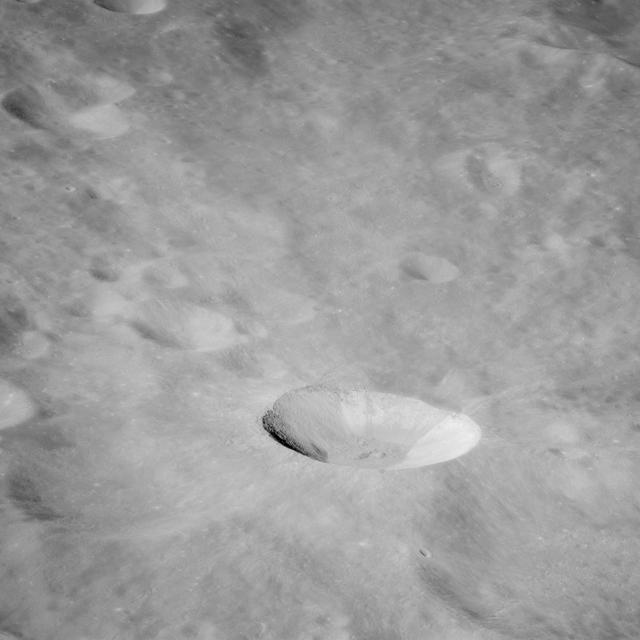
AS11-43-6412 (July 1969) --- This is a northeasterly, low-oblique view of an unmanned crater and highland area on the lunar farside, as photographed from Apollo 11. The center of the picture is located at the 167 degrees east longitude and…
Northeasterly, low-oblique view of unnamed crater on lunar farside
AS11-44-6609 (16-24 July 1969) --- An oblique of the Crater Daedalus on the lunar farside as seen from the Apollo 11 spacecraft in lunar orbit. The view looks southwest. Daedalus (formerly referred to as I.A.U. Crater No. 308) is located at…
Oblique view of lunar farside photographed from orbit looking southwest
AS11-42-6285 (July 1969) --- An Apollo 11 view of a bright rayed crater on the lunar farside.  The crater is unnamed.  The center of this photograph is located at 100 degrees southeast longitude and 4 degrees 30 minutes north latitude.  Thi…
View of bright-rayed crater on lunar farside
AS8-15-2561 (21-27 Dec. 1968) --- View of Earth as photographed by the Apollo 8 astronauts on their return trip from the moon. Note that the terminator is straighter than on the outbound pictures. The terminator crosses Australia. India is…
View of earth during return from moon taken from Apollo 8 spacecraft
SL3-111-1505 (July-September 1973) --- View of scientist-astronaut Owen K. Garriott, Skylab 3 science pilot, in his sleep restraints in the crew quarters of the Orbital Workshop (OWS). Photo credit: NASA
View of Astronaut Owen Garriott in sleep restraints
AS17-148-22742 (7-19 Dec. 1972) --- Most of Australia (center) and part of Antarctica are visible in this photo of a three-quarters Earth, recorded with a 70mm handheld Hasselblad camera using a 250mm lens. The three astronauts aboard the C…
View of the Earth seen by the Apollo 17 crew traveling toward the moon
AS10-34-5026 (18-26 May 1969) --- An Apollo 10 photograph of Earth taken from 100,000 miles away. Visible are many areas of Europe and Africa. Among the features and countries identifiable are Portugal, Spain, Italy, the Mediterranean Sea,…
Apollo 10 view of the Earth
AS10-32-4845 (18-26 May 1969) --- An Apollo 10 southwest oblique view of the crater Censorinus which is located in the highland terrain bordering the Sea of Tranquility. HOLD PICUTRE WITH WINDOW FRAME AT LOWER LEFT. Censorinus is the bright…
Apollo 10 southwest view of Censorinus crater
AS8-17-2744 (21-27 Dec. 1968) --- Oblique view of the lunar surface taken from the Apollo 8 spacecraft looking westward showing typical lunar farside terrain. (HOLD PICTURE SO THAT DARK IRREGULAR AREA SURROUNDED BY LIGHT SPOTS IS IN THE LOW…
Oblique view of lunar surface taken from Apollo 8 spacecraft
S66-46025 (18 July 1966) --- Astronaut Michael Collins, Gemini-10 pilot, photographed this MSC-8 color patch outside the spacecraft during the Gemini-10/Agena docking mission. The experiment was for the purpose of showing what effect the en…
Photograph of MSC-8 color patch outside spacecraft during docking
AS07-07-1832 (15 Oct. 1968) --- Toba, Kakar, Fort Sandeman, Sulaiman Range area in (West) Pakistan, as seen from the Apollo 7 spacecraft during its 84th revolution of Earth. Note geological features such as folded mountain structures, antic…
Mountain ranges in western Pakistan as seen from the Apollo 7 spacecraft
AST-30-2601 (20 July 1975) --- An area of the Cascade Mountains southeast of Seattle in the State of Washington, as photographed from the Apollo spacecraft in Earth orbit during the joint U.S.-USSR Apollo-Soyuz Test Project mission. The vie…
Area of Cascade Mountains southeast of Seattle in State of Washington
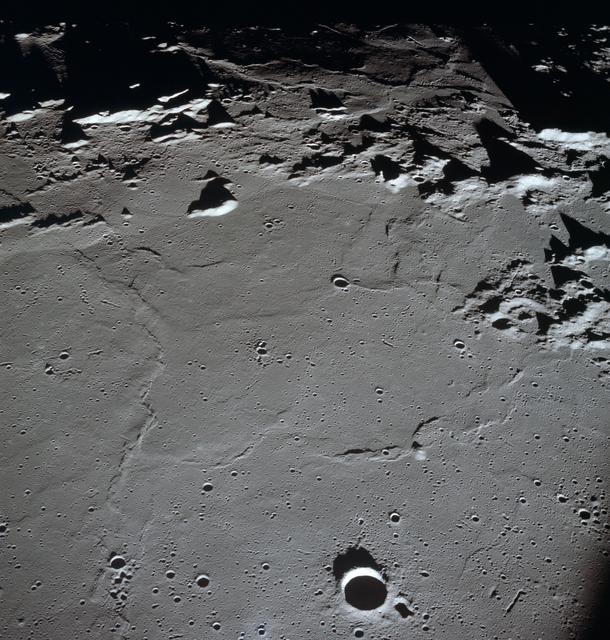
AS10-27-3907 (18-26 May 1969) --- Apollo 10 westward view across Apollo Landing Site 3 in the Central Bay. Apollo Landing Site 3 is in the middle distance at the left margin of the pronounced ridge in the left half of the photograph. Bruce,…
Apollo 10 view across Apollo Landing Site 3 in the Central Bay
41D-32-14 (30 Aug 1984) --- A rainbow-like sunrise over the Philippine Sea greeted the six crew members aboard the Earth-orbiting Space Shuttle Discovery on its first day in space.  A 70mm camera was used to record the scene at 3:08:14 p.m.…
Sunrise over the Philippine Sea
AS11-37-5437 (20 July 1969) --- The approach to Apollo Landing Site 2 in southwestern Sea of Tranquility is seen in this photograph taken from the Apollo 11 Lunar Module (LM) in lunar orbit. When this picture was made, the LM was still dock…
View of approach to Apollo Landing Site 2 in southwestern Sea of Tranquility
STS064-310-005 (16 Sept. 1994) --- Astronaut Richard N. Richards, STS-64 commander, looks through one of the space shuttle Discovery's overhead flight deck windows to view the Extravehicular Activity (EVA) activities of astronauts Carl J. M…
Astronaut Richard Richards looks out of Discovery's flight deck window
AS11-37-5458 (20 July 1969) --- This excellent view from the right-hand window of the Apollo 11 Lunar Module (LM) shows the surface of the moon in the vicinity of where the LM touched down. Numerous small rocks and craters can be seen betwe…
View form Lunar Module of surface of the moon near where LM touched down
SL3-28-009 (July-September 1973) --- A near vertical view of the Minneapolis-St. Paul, Minnesota area, as photographed from Earth orbit by one of the six lenses of the Itek-furnished S190-A Multispectral Photographic Facility Experiment in…
View of Minneapolis-St.Paul, Minnesota area
AS11-42-6248 (July 1969) --- An Apollo 11 oblique view of the lunar farside in the area of International Astronomical Union crater No. 312, which is about 30 statute miles in diameter.  The center of the photograph is located at 164 degrees…
Oblique view of lunar farside in area of IAU crater no. 312
AS8-17-2704 (21-27 Dec. 1968) --- Near vertical view of the lunar farside as photographed from the Apollo 8 spacecraft. This crater, which is about 22 statute miles in diameter, is located at 167 degrees east longitude and 11 degrees south…
Near vertical view of lunar farside taken from Apollo 8 spacecraft
A small piece of thermal insulation tile floats in space near the Shuttle Columbia. The cloudy surface of the earth is used as a background.
Piece of thermal insulation tile floats near the Shuttle Columbia
AST-02-130 (20 July 1975) --- An oblique view of a portion of Libya and the Arab Republic of Egypt, as photographed from the Apollo spacecraft in Earth orbit during the joint U.S.-USSR Apollo-Soyuz Test Project mission. The geological featu…
View of portion of Libya and Arab Republic of Egypt
SL4-140-4110 (January 1974) --- View of the USSR, Siberia area from Skylab 4. Other areas seen are Ozero, Kanka, Ussiriysk, the Sea of Japan and Kavalerovo (45.5N, 135.5E). Photo credit: NASA
View of USSR, Siberia, Ozero, Kanka, Ussiriysk, Sea of Japan and Kavalerovo
AS08-13-2344 (21-27 Dec. 1968) --- This oblique photograph looks generally northwest from the Apollo 8 spacecraft into the Sea of Tranquility. (HOLD PICTURE WITH LARGE TRIANGLE FORMED BY DARK SKY AT UPPER LEFT). The three prominent craters…
Oblique photograph looking northwest into Sea of Tranquility
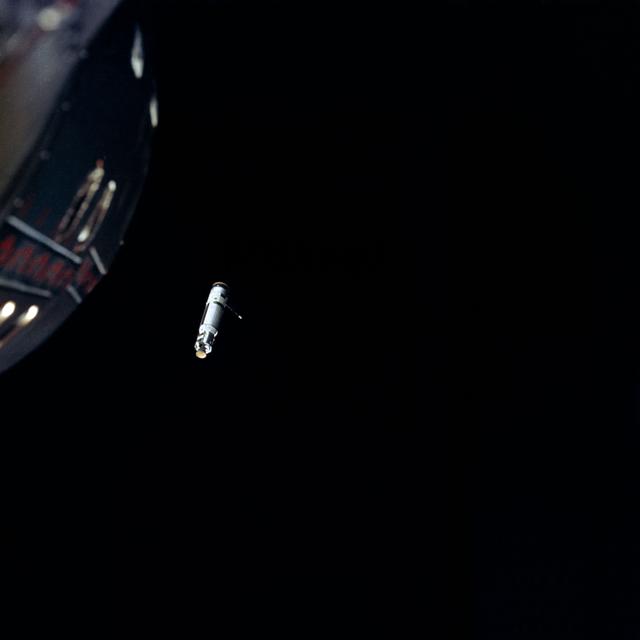
S66-25778 (16 March 1966) --? The Agena Target Docking Vehicle seen from the National Aeronautics and Space Administration?s Gemini-8 spacecraft during rendezvous in space. The Agena is approximately 260 feet away from the nose of the space…
Agena Target Docking vehicle seen from Gemini 8 spacecraft
AS08-12-2196 (21-27 Dec. 1968) --- An oblique view from the Apollo 8 spacecraft looking eastward across the lunar surface from about 115 degrees east longitude to the horizon near 180 degrees east longitude. The crater Tsiolkovsky in the ce…
View of crater Tsiolkovsky taken from Apollo 8 spacecraft
AS10-32-4819 (18-26 May 1969) --- An Apollo 10 northwestward oblique view of Triesnecker crater, centered near 3.6 degrees east longitude, and 4 degrees north latitude. HOLD PICTURE WITH SKY AT UPPER RIGHT. This picture, taken from the Comm…
Apollo 10 northwestward view of Triesnecker crater
SL3-121-2371 (July-September 1973) --- A pattern of downstream eddies in the stratocumulus clouds over the Pacific Ocean west of Baja California, as photographed by the crewmen of the second Skylab manned mission (Skylab 3) from the space s…
Pattern of downstream eddies in stratocumulus clouds over Pacific Ocean
AS07-04-1593 (21 Oct. 1968) --- This Earth observation photograph shows Argentina, Chile, Bolivia, Salar de Atacama, the Andes Mountains, and Gran Chaco. The coordinates for the center of this photograph are 23.00 degrees south and 67.30 de…
Northwestern Argentina as seen from the Apollo 7 spacecraft