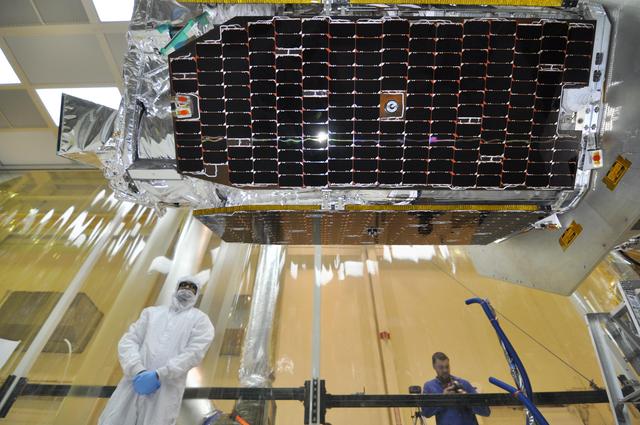
NASA Nuclear Spectroscopic Telescope Array, or NuSTAR, mission is lowered into its shipping container at Orbital Sciences Corporation in Dulles, Va. It is scheduled to launch from Kwajalein Atoll in the Marshall Islands on March 14, 2012.
Beginning the Journey to the Launch Pad
NASA Nuclear Spectroscopic Telescope Array, or NuSTAR, at Orbital Sciences Corporation in Dulles, Va., January 2012.
NuSTAR Poses for the Camera
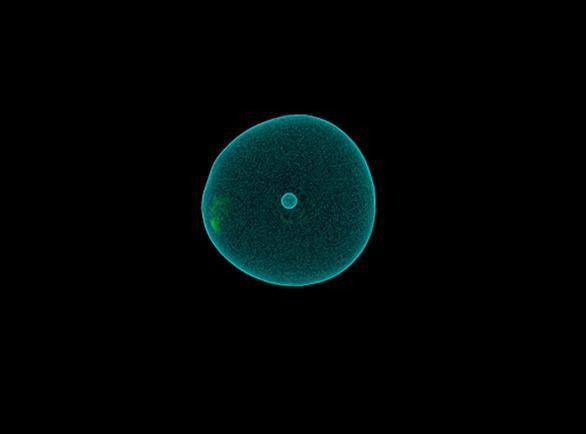
Nicknamed the Hand of God, this object is called a pulsar wind nebula, imaged by NASA NuSTAR. It powered by the leftover, dense core of a star that blew up in a supernova explosion.
High-Energy X-ray View of Hand of God
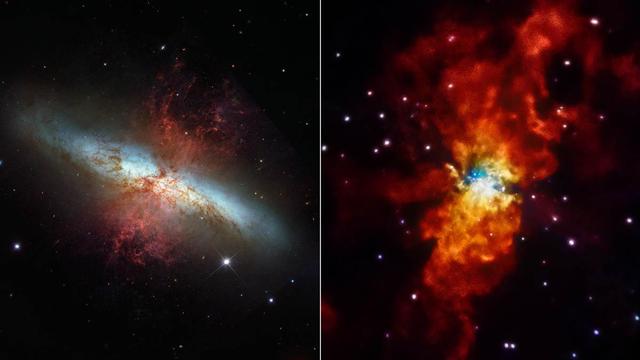
The comparison from NASA Hubble telescope and Chandra X-ray Observatory highlights how different the universe can look when viewed in other wavelengths of light. M82 is located 12 million light-years away in the Ursa Major constellation.
Galaxy in Different Lights
Magenta spots in this image from NASA NuSTAR show two black holes in the Circinus galaxy, located 13 million light-years from Earth in the Circinus constellation.
Black Holes of the Circinus Galaxy
The brightest pulsar detected to date is shown in this frame from an animation that flips back and forth between images captured by NASA NuSTAR. A pulsar is a type of neutron star, the leftover core of a star that exploded in a supernova.
NuSTAR Captures the Beat of a Dead Star Animation
NASA NuSTAR will be able to identify individual black holes making up the diffuse X-ray glow, also called the X-ray background. At bottom right is a simulated view of what NuSTAR will see.
Bringing Black Holes Into Focus
The carrier plane, L-1011 Stargazer, that will give NASA NuSTAR and its rocket a lift to their airborne launch site is seen here at sunrise on Kwajalein Atoll in the Pacific Ocean.
NuSTAR on Coral Island of Kwajalein
This artist's impression depicts the accretion disc surrounding a black hole, in which the inner region of the disc precesses. "Precession" means that the orbit of material surrounding the black hole changes orientation around the central o…
Black Hole with Wobbling Disk Artist Concept
This image shows a neutron star -- the core of a star that exploded in a massive supernova. This particular neutron star is known as a pulsar because it sends out rotating beams of X-rays that sweep past Earth like lighthouse beacons.
Beacons of X-ray Light Animation
Engineers in the final stages of assembling NASA Nuclear Spectroscopic Telescope Array, or NuSTAR, at Orbital Sciences Corporation in Dulles, Va., January 2012.
Integrating NuSTAR
This photo shows the Orbital Sciences Corporation Pegasus XL rocket with NASA NuSTAR spacecraft after attachment to the L-1011 carrier aircraft known as Stargazer.
NuSTAR Hitches a Ride on the Stargazer
This chart illustrates relative masses of super-dense cosmic objects, ranging from white dwarfs to supermassive black holes encased in the cores of most galaxies. The first three dead stars left all form when stars more massive than our sun…
Mass Chart for Dead Stars and Black Holes
X-rays stream off the sun in this first picture of the sun, overlaid on a picture taken by NASA Solar Dynamics Observatory SDO, taken by NASA NuSTAR. The field of view covers the west limb of the sun.
Sun Shines in High-Energy X-rays
This composite image of the Sun includes high-energy X-ray data from NASA's Nuclear Spectroscopic Telescope Array (NuSTAR) shown in blue; lower energy X-ray data from the X-ray Telescope (XRT) on the Japanese Aerospace Exploration Agency's…
Three-Telescope View of the Sun
Bright green sources of high-energy X-ray light captured by NASA's NuSTAR mission are overlaid on an optical-light image of the Whirlpool galaxy (the spiral in the center of the image) and its companion galaxy, M51b (the bright greenish-whi…
A Hard X-ray Look at M51
This data plot captured by NASA Nuclear Spectroscopic Telescope Array, or NuSTAR, shows X-ray light streaming from regions near a supermassive black hole known as Markarian 335.
Big, Spinning Black Hole Blurs Light
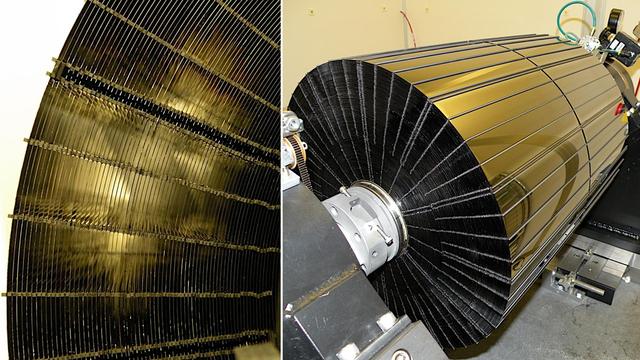
NASA Nuclear Spectroscopic Telescope Array, or NuSTAR, has a complex set of mirrors, or optics, that will help it see high-energy X-ray light in greater detail than ever before.
NuSTAR Russian Doll-like Mirrors
A range of supermassive black holes lights up this new image from NASA NuSTAR. All of the dots are active black holes tucked inside the hearts of galaxies, with colors representing different energies of X-ray light.
Different Flavors of Black Holes
At Vandenberg Air Force Base processing facility in California, the separation ring on the aft end of NASA Nuclear Spectroscopic Telescope Array NuSTAR, at right, inches its way toward the third stage of an Orbital Sciences Pegasus XL rocke…
NuSTAR Inches Toward its Rocket
Two rivers of hot gas are siphoned onto the surface of a neutron star (the collapsed remains of a dead star) in this illustration. Neutron stars pack roughly the mass of our Sun into an area about 10 miles (6 kilometers) across. The gravity…
Magnetic Fields Around an Ultraluminous X-ray Source (Illustration)
Neutron stars, or cores leftover from exploded stars, are some of the densest objects in the universe. There are several types of neutron stars, including magnetars and pulsars.  https://photojournal.jpl.nasa.gov/catalog/PIA23863
Different Types of Neutron Stars (Illustration)
An Orbital Sciences technician completes final checks of NASA Nuclear Spectroscopic Telescope Array, or NuSTAR, before the Pegasus payload fairing is secured around it.
Wrapping NuSTAR in Its Rocket Nose Cone
A supermassive black hole is depicted in this artist's concept, surrounded by a swirling disk of material falling onto it. The purplish ball of light above the black hole, a feature called the corona, contains highly energetic particles tha…
Shifting Coronas Around Black Holes Artist Concept
The magenta spots in this image from NASA NuSTAR show two black holes in the spiral galaxy called NGC 1313, or the Topsy Turvy galaxy, located about 13 million light-years away in the Reticulum constellation.
Topsy Turvy Black Holes
This illustration shows the object known as SS 433, located in the Milky Way galaxy and only about 20,000 light-years from Earth. Researchers think SS 433 is an ultraluminous X-ray source, or ULX, a compact cosmic object that must have an X…
The Changing X-ray Brightness of SS 433 (Illustration)
NASA NuSTAR has captured these first, focused views of the supermassive black hole at the heart of our Milky Way galaxy in high-energy X-ray light.
Pointing X-ray Eyes at our Resident Supermassive Black Hole
These images, taken by NASA black-hole hunter, NuSTAR, are the first, focused high-energy X-ray views of the area surrounding the supermassive black hole, called Sagittarius A*, at the center of our galaxy.
First Look at Milky Way Monster in High-Energy X-ray Light
The Sculptor galaxy is seen in a new light, in this composite image from NASA Nuclear Spectroscopic Telescope Array NuSTAR and the European Southern Observatory in Chile.
Sculptor Galaxy Shines with X-rays
VANDENBERG AIR FORCE BASE, Calif. -- At Vandenberg Air Force Base in California, the third stage of the Pegasus XL rocket that will launch the Nuclear Spectroscopic Telescope Array (NuSTAR) to orbit arrives at Building 1555 for processing.…
KSC-2010-5267
This artist concept illustrates a supermassive black hole with millions to billions times the mass of our sun. Supermassive black holes are enormously dense objects buried at the hearts of galaxies.
Black Holes: Monsters in Space Artist Concept
This visible-light image of the Fireworks galaxy (NGC 6946) comes from the Digital Sky Survey and is overlaid with data from NASA's NuSTAR observatory (shown in blue and green). Blue light indicates X-rays captured during the first of two o…
NASA Telescope Spots Mystery in Fireworks Galaxy
The bulk of a galaxy called Messier 82 M82, or the Cigar galaxy, is seen in visible-light data captured by the National Optical Astronomy Observatory 2.1-meter telescope at Kitt Peak in Arizona.
NuSTAR Finds a Pulse in Cigar Galaxy
Inside an environmental enclosure at Vandenberg Air Force Base processing facility in California, technicians complete the final steps in mating NASA Nuclear Spectroscopic Telescope Array NuSTAR and its Orbital Sciences Pegasus XL rocket.
Final Steps in Mating NuSTAR to its Rocket
Inside an environmental enclosure at Vandenberg Air Force Base processing facility in California, solar panels line the sides of NASA Nuclear Spectroscopic Telescope Array NuSTAR, which was just joined to the Orbital Sciences Pegasus XL roc…
Uniting of NuSTAR Spacecraft and Rocket
This diagram illustrates why NASA NuSTAR can see radioactivity in the remains of exploded stars for the first time. The observatory detects high-energy X-ray photons that are released by a radioactive substance called titanium-44.
The Creation of Titanium in Stars
NASA NuSTAR serendipitous discovery in this field lies to the left of a galaxy, called IC751, at which the telescope originally intended to look.
Black Holes Shine for NuSTAR
Artist concept of NASA Nuclear Spectroscopic Telescope Array, managed by JPL. It will expand our understanding of the origins and destinies of stars and galaxies.
Nuclear Spectroscopic Telescope Array NuSTAR Artist concept
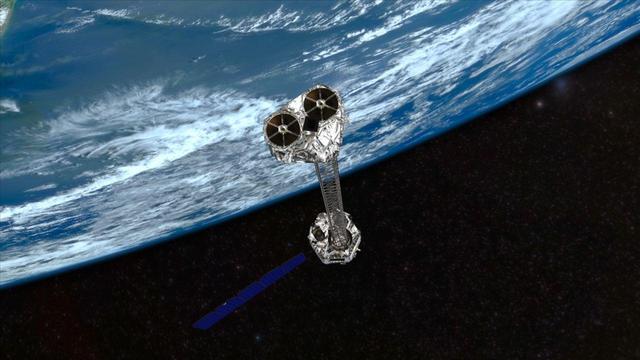
This artist concept shows NASA NuSTAR mission orbiting Earth. NuSTAR will hunt for hidden black holes and other exotic cosmic objects.
NuSTAR Orbits Earth Artist Concept
A disk of hot gas swirls around a black hole in this illustration. Some of the gas came from a star that was pulled apart by the black hole, forming the long stream of hot gas on the right, feeding into the disk. These events are formally k…
A Black Hole Destroys a Star (Illustration)
These four images show an artist's impression of gas accreting onto the neutron star in the binary system MXB 1730-335, also known as the "Rapid Burster."  In such a binary system, the gravitational pull of the dense neutron star is strippi…
The Rapid Burster
The plot of data from NASA's Nuclear Spectroscopic Telescope Array, or NuSTAR (right), amounts to a "smoking gun" of evidence in the mystery of how massive stars explode. The observations indicate that supernovae belonging to a class called…
Tracing Titanium Escape
This new view of spiral galaxy IC 342, also known as Caldwell 5, includes data from NASA Nuclear Spectroscopic Telescope Array, or NuSTAR. IC 342 lies 7 million light-years away in the Camelopardalis constellation.
Blazing Black Holes Spotted in Spiral Beauty
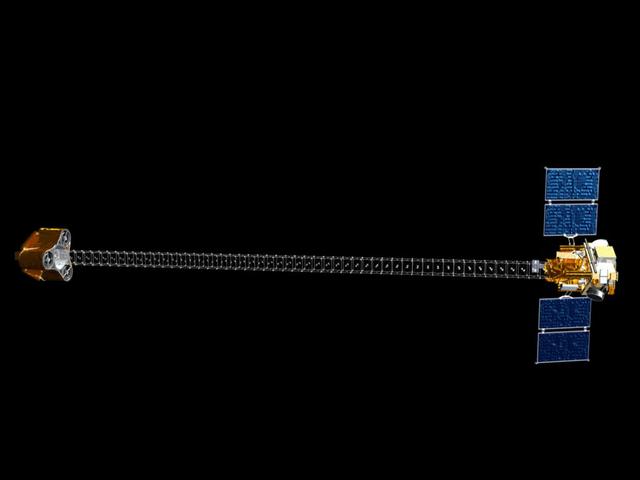
This is an artist concept of NASA NuSTAR spacecraft which has a 10-meter mast that deploys after launch to separate the optics modules right from the detectors in the focal plane left.
Artist Concept of NuSTAR
A spacecraft technician is performing closeout work inside the fairing that will be installed around NASA Nuclear Spectroscopic Telescope Array NuSTAR spacecraft in a processing facility at Vandenberg Air Force Base in California.
Inside NuSTAR Nose Cone
NuSTAR has provided the first observational evidence in support of a theory that says exploding stars slosh around before detonating. That theory, referred to as mild asymmetries, is shown here in a simulation by Christian Ott.
Sloshing Star Goes Supernova
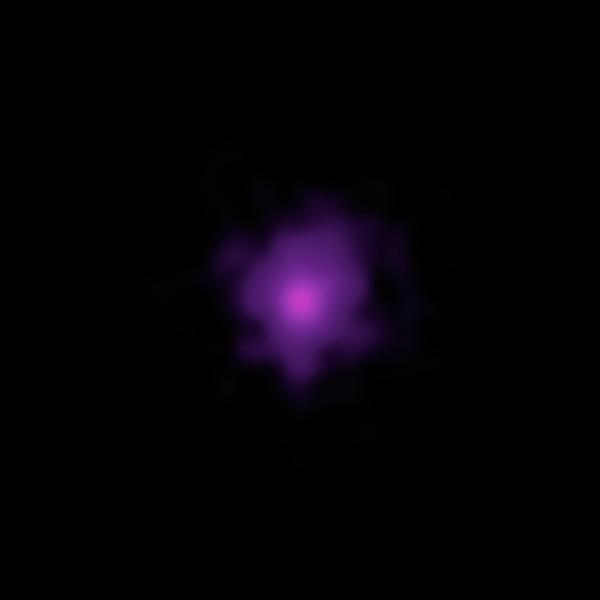
The areas where high-energy X-rays were detected by NASA's NuSTAR (Nuclear Spectroscopic Telescope Array) from the auroras near Jupiter's north and south poles are shown in purple in this graphic. The emissions are the highest-energy light…
High-Energy X-rays Detected From Jupiter's Auroras