CAPE CANAVERAL, Fla. – Space shuttle Atlantis roars into the cloudy sky above Launch Pad 39A at NASA's Kennedy Space Center in Florida on the STS-125 mission.  Blue cones of light, mach diamonds, can be seen beneath the engine nozzles. The…
KSC-2009-3088
Former NACA test pilot Scott Crossfield at the 1998 "Men of Mach 2" symposium, an event celebrating his work in the 1950's on the D-558-II Skyrocket aircraft.
Former NACA test pilots Scott Crossfield, Stan Butchart, Robert Champine, and John Griffith gathered at the NASA Dryden Flight Research Center for the "Men of Mach 2" symposium, an event celebrating their work in the 1950's on the D-558-II…
Former NACA test pilots Scott Crossfield, Stan Butchart, Robert Champine, and John Griffith gathered at NASA DFRC for the "Men of Mach 2" symposium.
The third X-43A hypersonic research aircraft and its modified Pegasus booster rocket accelerate after launch from NASA's B-52B launch aircraft over the Pacific Ocean on November 16, 2004. The mission originated from the NASA Dryden Flight R…
A modified Pegasus rocket ignites moments after release from the B-52B, beginning the acceleration of the X-43A over the Pacific Ocean on Nov. 16, 2004
The third X-43A hypersonic research aircraft and its modified Pegasus booster rocket drop away from NASA's B-52B launch aircraft over the Pacific Ocean on November 16, 2004. The mission originated from the NASA Dryden Flight Research Center…
A modified Pegasus rocket drops away after release from NASA's B-52B before accelerating the X-43A over a Pacific Ocean test range on Nov. 16, 2004
The second X-43A hypersonic research aircraft and its modified Pegasus booster rocket accelerate after launch from NASA's B-52B launch aircraft over the Pacific Ocean on March 27, 2004. The mission originated from the NASA Dryden Flight Res…
A modified Pegasus rocket ignites moments after release from the B-52B, beginning the acceleration of the X-43A over the Pacific Ocean on March 27, 2004
The second X-43A hypersonic research aircraft and its modified Pegasus booster rocket drop away from NASA's B-52B launch aircraft over the Pacific Ocean on March 27, 2004. The mission originated from the NASA Dryden Flight Research Center a…
A modified Pegasus rocket drops steadily away after release from NASA's B-52B, before accelerating the X-43A over the Pacific Ocean on March 27, 2004
NASA engineers monitor mission progress from a Dryden control room prior to launch of the X-43A scramjet and its booster from NASA's B-52B mothership.
NASA engineers monitor mission progress from a Dryden control room prior to launch of the X-43A scramjet and its booster from NASA's B-52B mothership
The third X-43A hypersonic research aircraft, attached to a modified Pegasus booster rocket, was taken to launch altitude by NASA's B-52B launch aircraft from the NASA Dryden Flight Research Center at Edwards Air Force Base, California, on…
NASA's B-52B launch aircraft cruises to a test range over the Pacific Ocean carrying the third X-43A vehicle attached to a Pegasus rocket on November 16, 2004
NASA Dryden's new in-house designed Propulsion Flight Test Fixture (PFTF) flew mated to a specially-equipped supersonic F-15B research aircraft during December 2001 and January 2002.
The second X-43A hypersonic research aircraft and its modified Pegasus booster rocket left the runway, carried aloft by NASA's B-52B launch aircraft from the NASA Dryden Flight Research Center at Edwards Air Force Base, Calif., on March 27,…
NASA's B-52B launch aircraft takes off carrying the second X-43A hypersonic research vehicle attached to a modified Pegasus rocket, on March 27, 2004
Scott Crossfield talks to newsmen in front of NACA South Base hangar after his first flight to Mach 2 in the Douglas D-558-2.
E53-1109
The second X-43A hypersonic research aircraft and its modified Pegasus booster rocket left the runway, carried aloft by NASA's B-52B launch aircraft from the NASA Dryden Flight Research Center at Edwards Air Force Base, Calif., on March 27,…
NASA's B-52B launch aircraft takes off carrying the second X-43A hypersonic research vehicle attached to a modified Pegasus rocket, on March 27, 2004
NASA personnel in a control room during the successful second flight of the X-43A aircraft. front row, left to right: Randy Voland, LaRC Propulsion; Craig Christy, Boeing Systems; Dave Reubush, NASA Hyper-X Deputy Program Manager; and Vince…
NASA personnel in a control room during the successful second flight of the X-43A aircraft
NASA's F-15B Research Testbed aircraft recently flew in the supersonic shock wave of a U.S. Navy F-5E in support of the F-5 Shaped Sonic Boom Demonstration (SSBD) project, part of the Defense Advanced Research Projects Agency's (DARPA) Quie…
NASA's F-15B Research Testbed aircraft flies in the supersonic shock wave of a U.S. Navy F-5E as part of the F-5 Shaped Sonic Boom Demonstration (SSBD) project.
The flexwall section of NASA Glenn’s 10x10 supersonic wind tunnel is made up of two movable flexible steel sidewalls. These powerful hydraulic jacks move the walls in and out to control supersonic air speeds in the test section between Mach…
10' x 10' Supersonic Wind Tunnel Flexwall
NASA's F-15B Research Testbed aircraft flew instrumentation in June 2004 called the Local Mach Investigation (LMI), designed to gather local airflow data for future research projects using the aircraft's Propulsion Flight Test Fixture (PFTF…
NASA's F-15B conducts a local Mach investigation flight over California's Mojave Desert.
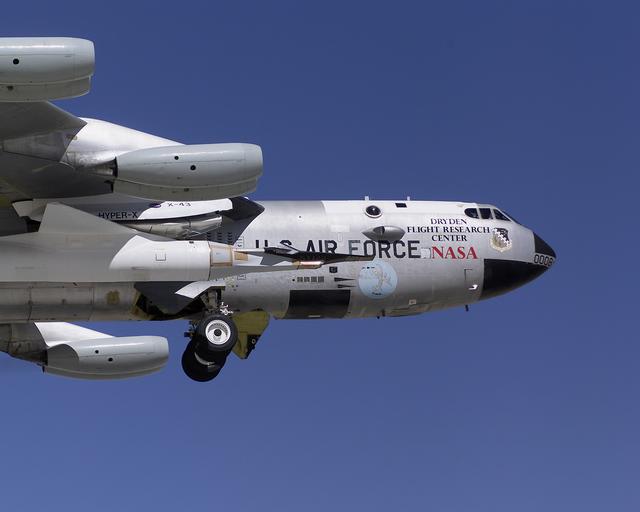
Attached to the same B-52B mothership that once launched X-15 research aircraft in the 1960s, NASA's third X-43A performed a captive carry evaluation flight from Edwards Air Force Base, California on September 27, 2004. The X-43 remained ma…
NASA's B-52B launch aircraft takes off carrying the third X-43A hypersonic research vehicle on a captive carry evaluation flight September 27, 2004
The second X-43A hypersonic research aircraft and its modified Pegasus booster rocket left the runway, carried aloft by NASA's B-52B launch aircraft from the NASA Dryden Flight Research Center at Edwards Air Force Base, Calif., on March 27,…
NASA's B-52B launch aircraft takes off carrying the second X-43A hypersonic research vehicle attached to a modified Pegasus rocket, on March 27, 2004
The small size of the X-43A scramjet is evident in this nose-on view while mounted to its modified Pegasus booster under the wing of NASA's B-52B mothership.
The small size of the X-43A scramjet is evident in this nose-on view while mounted to its modified Pegasus booster under the wing of NASA's B-52B mothership
NASA's B-52B launch aircraft at sunset with the second X-43A hypersonic research vehicle attached to a modified Pegasus rocket under its right wing.
NASA's B-52B launch aircraft at sunset with the second X-43A hypersonic research vehicle attached to a modified Pegasus rocket under its right wing
The second X-43A hypersonic research aircraft, attached to a modified Pegasus booster rocket and followed by a chase F-18, was taken to launch altitude by NASA's B-52B launch aircraft from the NASA Dryden Flight Research Center at Edwards A…
NASA's B-52B launch aircraft cruises to a test range over the Pacific Ocean carrying the second X-43A vehicle attached to a Pegasus rocket on March 27, 2004
NACA pilot A. Scott Crossfield next to the D-558-2 after first Mach 2 flight.
E53-1113
Scott Crossfield in cockpit of the Douglas D-558-2 after first Mach 2 flight.
E53-1090
The second X-43A hypersonic research vehicle, mounted under the right wing of the B-52B launch aircraft, viewed from the B-52 cockpit. The crew is working on closing out the research vehicle, preparing it for flight.
The second X-43A hypersonic research vehicle, mounted under the right wing of the B-52B launch aircraft, viewed from the B-52 cockpit
NASA's B-52B mothership, escorted by two F-18s, makes a final flyover after its last research mission that launched the X-43A on its record Mach 9.6 flight.
NASA's B-52B mothership, escorted by two F-18s, makes a final flyover after its last research mission that launched the X-43A on its record Mach 9.6 flight
The third X-43A hypersonic research aircraft and its modified Pegasus booster rocket left the runway, carried aloft by NASA's B-52B launch aircraft from the NASA Dryden Flight Research Center at Edwards Air Force Base, California, on Novemb…
NASA's B-52B launch aircraft takes off carrying the third X-43A hypersonic research vehicle attached to a modified Pegasus rocket, on November 16, 2004
The second X-43A hypersonic research aircraft and its modified Pegasus booster rocket left the runway, carried aloft by NASA's B-52B launch aircraft from the NASA Dryden Flight Research Center at Edwards Air Force Base, Calif., on March 27,…
NASA's B-52B launch aircraft takes off carrying the second X-43A hypersonic research vehicle attached to a modified Pegasus rocket, on March 27, 2004
NASA's F-15B Research Testbed aircraft recently flew in the supersonic shock wave of a U.S. Navy F-5E in support of the F-5 Shaped Sonic Boom Demonstration (SSBD) project, part of the Defense Advanced Research Projects Agency's (DARPA) Quie…
NASA's F-15B Research Testbed aircraft flies in the supersonic shock wave of a U.S. Navy F-5E as part of the F-5 Shaped Sonic Boom Demonstration (SSBD) project.
High-Speed Research Station Director Walter C. Williams, NACA pilot A. Scott Crossfield, and Director of Flight Operations Joe Vensel in front of the Douglas D-558-2 after the first Mach 2 flight.
E53-1096
CAPE CANAVERAL, Fla. – On Launch Pad 39A at NASA's Kennedy Space Center in Florida, space shuttle Atlantis rises past the fixed service structure as it races toward space on the STS-125 mission. Atlantis will rendezvous with NASA's Hubble S…
KSC-2009-3087
NASA's F-15B Research Testbed aircraft flew instrumentation in June 2004 called the Local Mach Investigation (LMI), designed to gather local airflow data for future research projects using the aircraft's Propulsion Flight Test Fixture (PFTF…
NASA's F-15B conducts a local Mach investigation flight over California's Mojave Desert.
NASA Staff Dr.Darden, Mach 3 Sonic Boom Model Wind Tunnel
Sonic Boom Model
Attached to the same B-52B mothership that once launched X-15 research aircraft in the 1960s, NASA's third X-43A performed a captive carry evaluation flight from Edwards Air Force Base, California on September 27, 2004. The X-43 remained ma…
NASA's B-52B launch aircraft takes off carrying the third X-43A hypersonic research vehicle on a captive carry evaluation flight September 27, 2004
NASA avionics technicians Randy Wagner and Terry Bishop make final adjustments on the scramjet-powered X-43A before its record Mach 9.6 flight.
NASA avionics technicians Randy Wagner and Terry Bishop make final adjustments on the scramjet-powered X-43A before its record Mach 9.6 flight
NASA's B-52B aircraft over the Dryden Flight Research Center after the successful launch of the second X-43A hypersonic research vehicle.
NASA's B-52B aircraft over the Dryden Flight Research Center after the successful launch of the second X-43A hypersonic research vehicle
Orbital Sciences Corp. technicians remove protective shrouds from the modified Pegasus booster before takeoff on the X-43A's Mach 9.6 record scramjet flight.
Orbital Sciences Corp. technicians remove protective shrouds from the modified Pegasus booster before takeoff on the X-43A's Mach 9.6 record scramjet flight
Employees atop NASA Dryden's main building celebrate the return flyby of the B-52B aircraft after it launched the second X-43A aircraft on its successful flight.
Employees atop DFRC's main building celebrate the return flyby of the B-52B aircraft after it launched the second X-43A aircraft on its successful flight
NASA X-43A Monitor Station Operator Brad Neal performs final checks and pre-flight preparations aboard the B-52 for the third X-43A research vehicle Mach 10 flight on November 16, 2004. Takeoff of the B-52B mothership carrying the X-43A too…
NASA's Brad Neal, X-43A Monitor Station Operator aboard NASA's B-52B mothership, performing pre-flight checks on November 16, 2004
The Pegasus rocket that powered NASA's X-43A scramjet to almost Mach 10 test conditions leaves a bright arc in the Pacific sky during the boost phase.
The Pegasus rocket that powered NASA's X-43A scramjet to almost Mach 10 test conditions leaves a bright arc in the Pacific sky during the boost phase
NASA Staff Dr.Darden, Matthew Overhold, Kathy Needleman, Robert Mack. Mach 3 Sonic Boom Model Wind Tunnel
Sonic Boom Model
NASA Dryden's new in-house designed Propulsion Flight Test Fixture (PFTF), carried on an F-15B's centerline attachment point, underwent flight envelope expansion in order to verify its design and capabilities.
The second X-43A hypersonic research aircraft and its modified Pegasus booster rocket accelerate after launch from NASA's B-52B launch aircraft over the Pacific Ocean on March 27, 2004. The mission originated from the NASA Dryden Flight Res…
he second X-43A and its modified Pegasus booster rocket accelerate after launch from NASA's B-52B launch aircraft over the Pacific Ocean
The Hyper-X X-43A project team in front of NASA's B-52B launch aircraft with the Pegasus booster and X-43A vehicle attached.
The Hyper-X X-43A project team
With the X-43A and its booster rocket tucked under its right wing, NASA's venerable B-52B mothership climbs out after takeoff on its final research mission.
With the X-43A and its booster rocket tucked under its right wing, NASA's venerable B-52B mothership climbs out after takeoff on its final research mission
This photo shows a head-on view of NASA's SR-71B, used for pilot proficiency and training, on the ramp at the Air Force's Plant 42 in Palmdale, California, shortly before delivery to the Ames-Dryden Flight Research Facility (later, Dryden F…
This photo shows a head-on view of NASA's SR-71B on the ramp at the Air Force's Plant 42 in Palmdale, California, shortly before delivery to DFRC
NASA Staff Dr.Darden, Matthew Overhold, Kathy Needleman, Robert Mack. Mach 3 Sonic Boom Model Wind Tunnel
Sonic Boom Model