
Key persornel in the Mechanics of Granular Materials (MGM) experiment at the University of Colorado at Boulder include Tawnya Ferbiak (software engineer), Susan Batiste (research assistant), and Christina Winkler (graduate research assistan…

Candidate Solar Array Materials

Candidate Solar Array Materials

NASA AMES HAZMAT (Hazardous Materials) Suit & PLSS pack

Candidate Solar Array Materials

Engineering bench system hardware for the Mechanics of Granular Materials (MGM) experiment is tested on a lab bench at the University of Colorado in Boulder. This is done in a horizontal arrangement to reduce pressure differences so the tes…

OVERVIEW OF THE MATERIALS DIAGNOSTIC LABORATORY. THE NEAR END SHOWS THE SURFACE ANALYSIS INSTRUMENTS SUCH AS THE SECONDARY ION MASS SPECTROSCOPE (CLOSEST) AND THE TWO ELECTRON SPECTROSCOPY INSTRUMENTS, WHILE THE FAR END SHOWS THE NEW SCANNI…

Sand boil or sand volcano measuring 2 m (6.6 ft.) in length erupted in median of Interstate Highway 80 west of the Bay Bridge toll plaza when ground shaking transformed loose water-saturated deposit of subsurface sand into a sand-water slur…

Key persornel in the Mechanics of Granular Materials (MGM) experiment include Khalid Alshibli, project scientist at NASA's Marshall Space Flight Center (MSFC). Sand and soil grains have faces that can cause friction as they roll and slide a…

On Earth when scientists melt metals, bubbles that form in the molten material can rise to the surface, pop and disappear. In microgravity -- the near-weightless environment created as the International Space Station orbits Earth -- the lig…

Phillip Steele (EM42/ESSSA) examines composite material gears printed with Marshall’s MarkForged® 3D Printer (background).

Materials and Structures Laboratory, Building 49

Pores and voids often form in metal castings on Earth (above) making them useless. A transparent material that behaves at a large scale in microgravity the way that metals behave at the microscopic scale on Earth, will help show how voids f…

What appear to be boulders fresh from a tumble down a mountain are really grains of Ottawa sand, a standard material used in civil engineering tests and also used in the Mechanics of Granular Materials (MGM) experiment. The craggy surface s…

Materials with a smaller mean atomic mass, such as lithium (Li) hydride and polyethylene, make the best radiation shields for astronauts. The materials have a higher density of nuclei and are better able to block incoming radiation. Also, t…

CT scans of the spcimens on STS-79 reveal internal cone-shaped features and radial patterns not seen in specimens processed on the ground. The lighter areas are the densest in these images. CT scans produced richly detailed images allowing…

Dr. Richard Grugel, a materials scientist at NASA's Marshall Space Flight in Huntsville, Ala., examines the furnace used to conduct his Pore Formation and Mobility Investigation -- one of the first two materials science experiments to be co…

NASA AMES HAZMAT (Hazardous Materials) PLSS pack with Doug Smith

Astronaut James Reilly uses a laptop computer monitor the Mechanics of Granular Materials (MGM) experiment during STS-89. Sand and soil grains have faces that can cause friction as they roll and slide against each other, or even cause stick…

Paula Crawford (assisted by an American Sign Language interpreter) lectures students about materials science research in space during the U.S. Microgravity Payload-4 mission (STS-87, Nov. 19 - Dec. 5, 1997) in the visitor's center set up by…

NASA AMES HAZMAT (Hazardous Materials) PLSS pack with Doug Smith at FMC test ground

Astronaut Jay Apt installs Mechanics of Granular Materials (MGM0 test cell on STS-79. Sand and soil grains have faces that can cause friction as they roll and slide against each other, or even cause sticking and form small voids between gra…

NASA AMES HAZMAT (Hazardous Materials) Suit

CT scans of the specimens on STS-79 reveal internal cone-shaped features and radial patterns not seen in specimens processed on the ground. The lighter areas are the densest in these images. CT scans produced richly detailed images allowing…

Key persornel in the Mechanics of Granular Materials (MGM) experiment are Mark Lankton (Program Manager at University Colorado at Boulder), Susan Batiste (research assistance, UCB), and Stein Sture (principal investigator). Sand and soil gr…

An automobile lies crushed under the third story of this apartment building in the Marina District after the Oct. 17, 1989, Loma Prieta earthquake. The ground levels are no longer visible because of structural failure and sinking due to liq…

Impact test results and 22 caliber gun set-up.

A test cell for Mechanics of Granular Materials (MGM) experiment is tested for long-term storage with water in the system as plarned for STS-107. This view shows the compressed sand column with the protective water jacket removed. Sand and…

What appear to be boulders fresh from a tumble down a mountain are really grains of Ottawa sand, a standard material used in civil engineering tests and also used in the Mechanics of Granular Materials (MGM) experiment. The craggy surface s…

A test cell for the Mechanics of Granular Materials (MGM) experiment is shown in its on-orbit configuration in Spacehab during preparations for STS-89. The twin locker to the left contains the hydraulic system to operate the experiment. San…

A test cell for Mechanics of Granular Materials (MGM) experiment is tested for long-term storage with water in the system as plarned for STS-107. This view shows the compressed sand column with the protective water jacket removed. Sand and…

NASA AMES HAZMAT (Hazardous Materials) PLSS pack with Doug Smith

NASA AMES HAZMAT (Hazardous Materials) PLSS pack with Doug Smith

Matthew Koss lectures middle-school students about materials science research in space during the U.S. Microgravity Payload-4 (USMP-4) mission (STS-87, Nov. 19 - Dec. 5, 1997) in the visitor's center set up by the Isothermal Dendritic Growt…

NASA AMES HAZMAT (Hazardous Materials) Suit & PLSS pack

Candidate Solar Array Materials

NASA AMES HAZMAT (Hazardous Materials) Suit & PLSS pack

Pratima Rao lectures students about materials science research in space during the U.S. Microgravity Payload-4 (USMP-4) mission (STS-87, Nov. 19 - Dec. 5, 1997) in the visitor's center set up by the Isothermal Dendritic Growth Experiment (I…
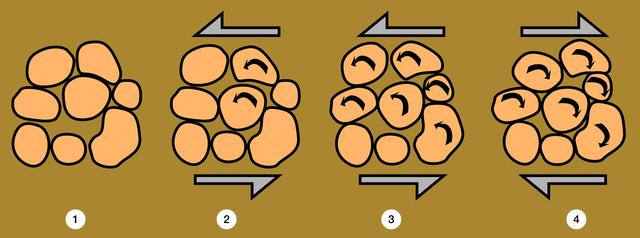
The packing of particles can change radically during cyclic loading such as in an earthquake or when shaking a container to compact a powder. A large hole (1) is maintained by the particles sticking to each other. A small, counterclockwise…

One of three Mechanics of Granular Materials (MGM) test cells after flight on STS-79 and before impregnation with resin. Note that the sand column has bulged in the middle, and that the top of the column is several inches lower than the top…

Ground shaking triggered liquefaction in a subsurface layer of water-saturated sand, producing differential lateral and vertical movement in a overlying carapace of unliquified sand and slit, which moved from right to left towards the Pajar…

The M512 Materials Processing Facility (MPF) with the M518 Multipurpose Electric Facility (MEF) tested and demonstrated a facility approach for materials process experimentation in space. It also provided a basic apparatus and a common inte…

A test cell for Mechanics of Granular Materials (MGM) experiment is tested for long-term storage with water in the system as plarned for STS-107. This view shows the top of the sand column with the metal platten removed. Sand and soil grain…
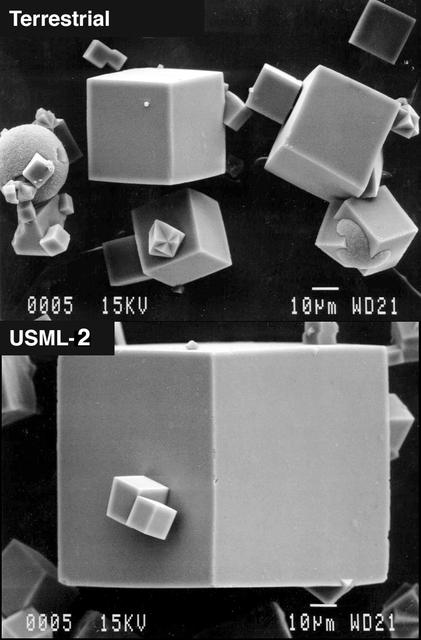
The Center for Advanced Microgravity Materials Processing (CAMMP), a NASA-sponsored Research Partnership Center, is working to improve zeolite materials for storing hydrogen fuel. CAMMP is also applying zeolites to detergents, optical cable…

RHONDA LASH, A MATERIALS ENGINEER, PREPARES A SAMPLE CARTRIDGE FOR X-RAY. THE CARTRIDGE WAS TESTED ON THE MATERIAL SCIENCE RESEARCH RACK

On STS-89, three Mechanics of Granular Materials (MGM) test cells were subjected to five cycles of compression and relief (left) and three were subjected to shorter displacement cycles that simulate motion during an earthquake (right). In t…

A test cell for Mechanics of Granular Materials (MGM) experiment is shown approximately 20 and 60 minutes after the start of an experiment on STS-89. Sand and soil grains have faces that can cause friction as they roll and slide against eac…

In this photograph, James Carden uses a NASA-developed prosthesis to moved planks around his home. Derived from foam insulation technology used to protect the Space Shuttle External Tank from excessive heat, FAB/CAD, a subsidiary of the Har…