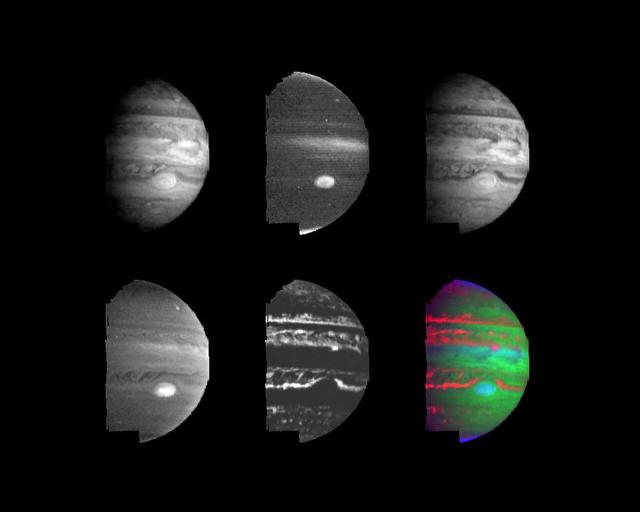
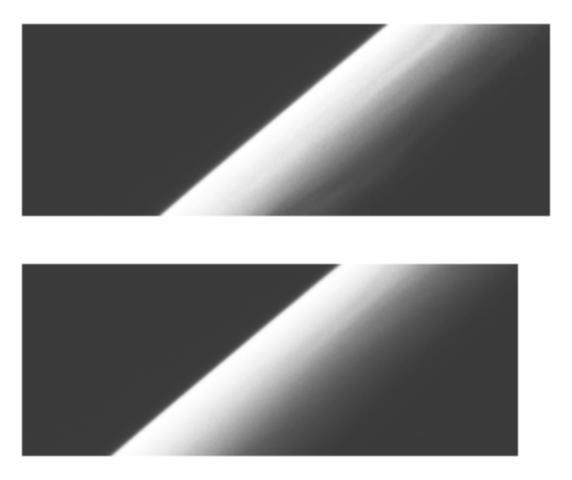
Sensitive to Jupiter's stratospheric temperatures, these infrared images were recorded by the Cooled Mid-Infrared Camera and Spectrograph (COMICS) at the Subaru Telescope on the summit of Mauna Kea, Hawaii. Scientists used red, blue and yel…
Jupiter Poles: Hot from Solar Wind
This amateur-processed image was taken on Dec. 11, 2016, at 9:27 a.m. PST (12:27 p.m. EST), as NASA's Juno spacecraft performed its third close flyby of Jupiter. At the time the image was taken, the spacecraft was about 15,200 miles (24,400…
Jupiter Pearl and Swirling Cloud Tops
Winds Near Jupiter Belt-Zone Boundary
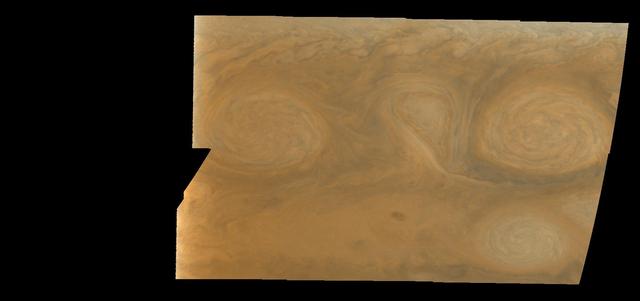
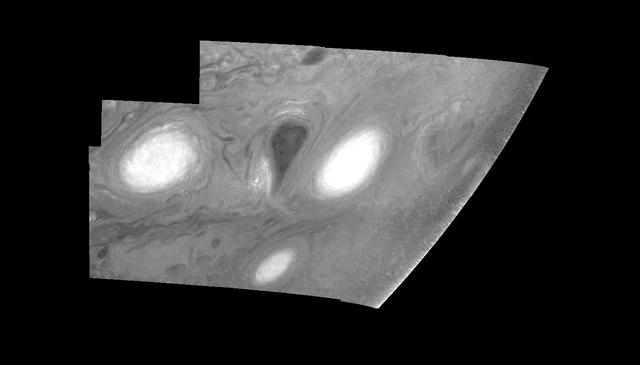
These images, taken on February 19, 1997 by NASA Galileo orbiter, show two of the three long-lived White Ovals that formed to the south of the Jupiter Great Red Spot.
Jupiter Long-lived White Ovals in True Color Time Set 2
This photo illustration of Jupiter and the three Jovian moons NASA's Juno mission has flown past was generated from data collected by the spacecraft's JunoCam imager.  Ganymede, the moon furthest to the left, was imaged by JunoCam as it fle…
Jovian Family Portrait
Citizen scientist Thomas Thomopoulos created this enhanced-color image using raw data from the JunoCam instrument. At the time the raw image was taken, the Juno spacecraft was about 44,000 miles (71,000 kilometers) above Jupiter's cloud top…
Juno Captures Moon Shadow on Jupiter
Jupiter Equatorial Region in the Near-Infrared Time Set 3
Jupiter Southern Hemisphere in the Near-Infrared Time Set 3
Three dimensional Visualization of Jupiter Equatorial Region
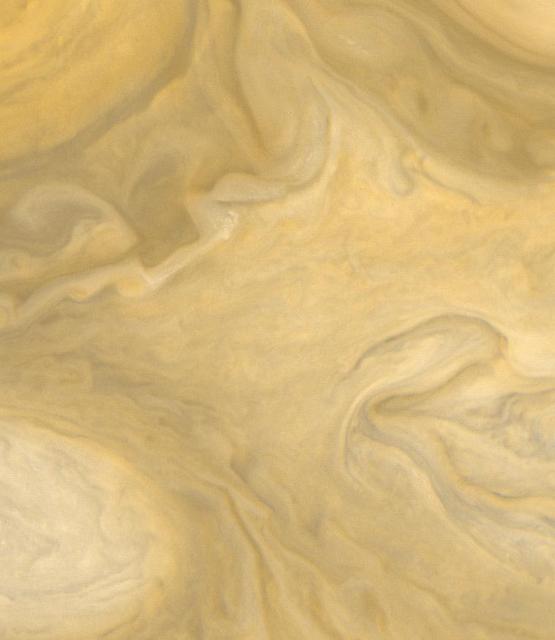
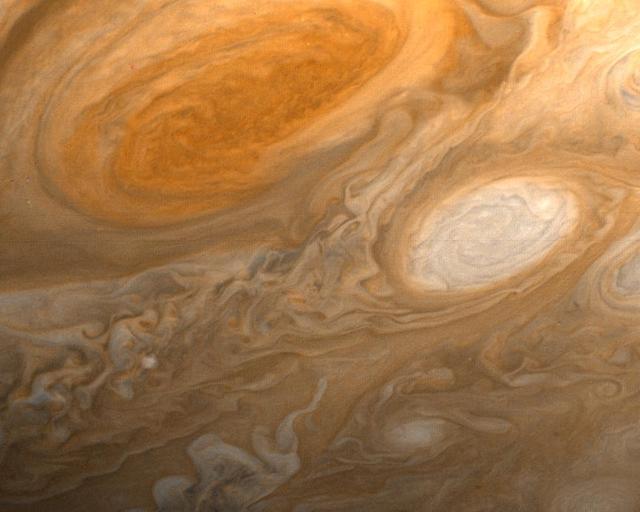
This view of the region just to the Southeast of the Great Red Spot was taken by NASA Voyager 1 on March 4, 1979 at a distance of 1,100,000 miles 1,800,000 km.  http://photojournal.jpl.nasa.gov/catalog/PIA00017
Cloud Layers Southeast of the Great Red Spot
Jupiter's zonal winds, going in opposite directions, generate eddies of all sizes that manifest in storms swirling in the atmosphere. At the highest level "pop-up clouds," the small, bright clouds that amass at the edge of one of these fron…
Jupiter Swirling Storms
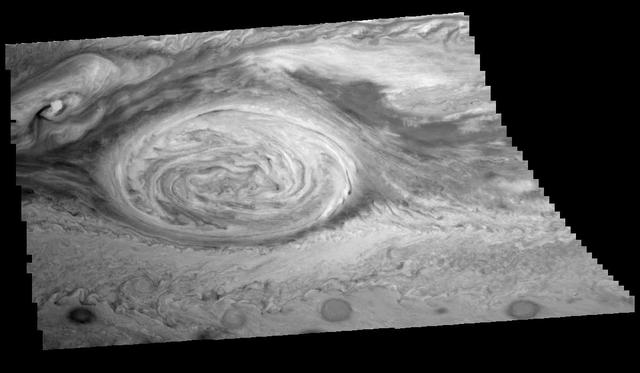
The mosaic of the Great Red Spot on Jupiter from NASA Galileo orbiter was taken over an 80 second interval beginning at universal time 14 hours, 30 minutes, 23 seconds, on June 26, 1996.
Mosaic of Jupiter Great Red Spot in the near infrared
Clouds and hazes at various altitudes within the dynamic Jovian atmosphere are revealed by multi-color imaging taken during the second orbit G2 on September 5, 1996 by Galileo spacecraft.
Jupiter Multi-level Clouds
Jupiter Northern Hemisphere in True Color Time Set 3
This computer-generated image depicts the Jovian Infrared Auroral Mapper (JIRAM) instrument aboard NASA's Juno spacecraft. The JIRAM instrument measures heat radiated from the planet at an infrared wavelength of around 5 microns.  https://p…
Juno's JIRAM Instrument
The south pole of Jupiter is seen in this annotated image of data from the ultraviolet spectrograph (UVS) instrument aboard NASA's Juno spacecraft. Bands of bright white and blue near the south pole are Jupiter's southern aurora. But resear…
Possible Jupiter Sprite
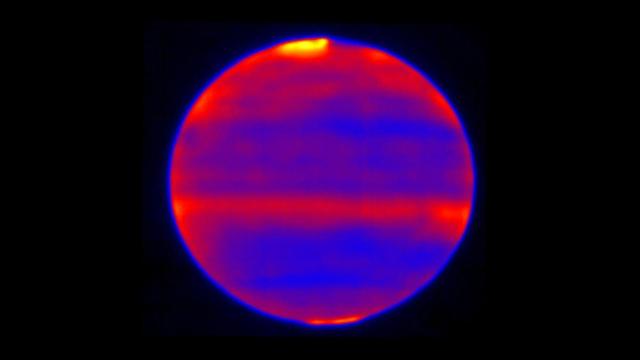
Sensitive to Jupiter's stratospheric temperatures, these infrared images were recorded by the Cooled Mid-Infrared Camera and Spectrograph (COMICS) at the Subaru Telescope on the summit of Mauna Kea, Hawaii. Areas of the atmosphere that are…
Heating Up Jupiter's Atmosphere
On Nov. 29, 2021, NASA's Juno mission completed its 38th close flyby of Jupiter. As the spacecraft sped low over the giant planet's cloud tops, its JunoCam instrument captured this look at two of Jupiter's largest moons.  In the foreground,…
NASA's Juno Mission Spots Two Jovian Moons
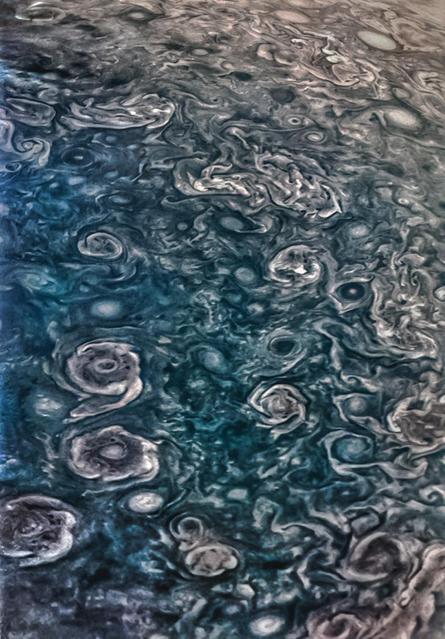
This mosaic combines color-enhanced images taken over Jupiter's north pole when the lighting was excellent for detecting high bands of haze. The images were taken in the final hours of Juno's perijove 12 approach on April 1, 2018. Citizen s…
High-Altitude Bands of Haze over Jupiter's north pole
Jupiter Equatorial Region in a Methane Band Time Set 1
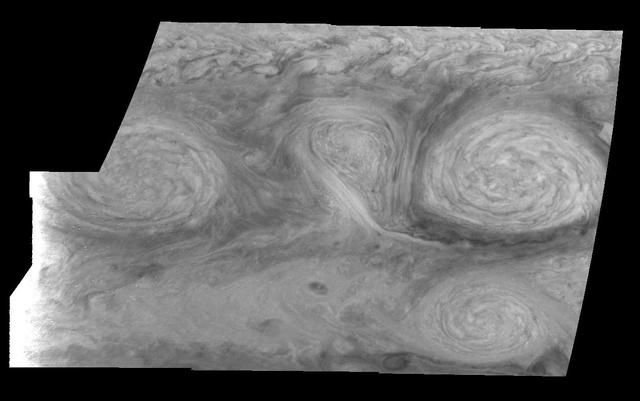
Jupiter atmospheric circulation is dominated by alternating eastward and westward jets from equatorial to polar latitudes. This image was taken on April 3, 1997, by NASA Galileo spacecraft.
Jupiter Northern Hemisphere in the Near-Infrared Time Set 1
Jupiter Northern Hemisphere in False Color Time Set 2
Juno's Radiation Monitoring Investigation used the Stellar Reference Unit (SRU) star camera to collect this image of Jupiter's ring -- half in Jupiter's shadow -- during Juno's 13th science orbit on July 16, 2018. The image was collected fr…
Jupiter's Ring
This image of Jupiter's norther polar region was processed by citizen scientist Emma Wälimäki. The data for the image was collected during Juno's 29th perijove (PJ) pass on Sept. 16, 2020.  https://photojournal.jpl.nasa.gov/catalog/PIA24239
Jupiter North Pole Detail
Jupiter Great Red Spot and White Ovals
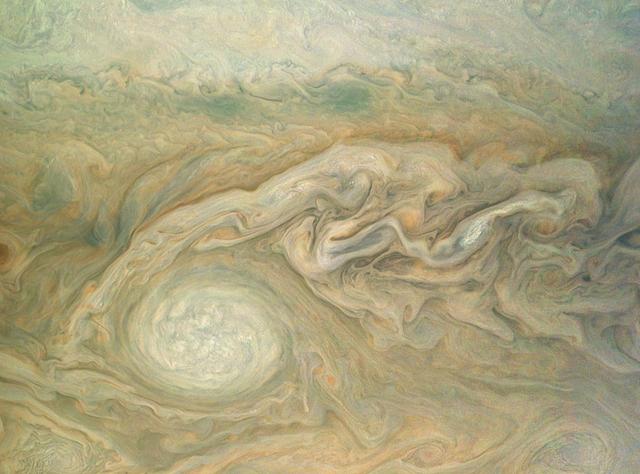
This enhanced color view of Jupiter's cloud tops was processed by citizen scientist Bjorn Jonsson using data from the JunoCam instrument on NASA's Juno spacecraft. The image highlights a massive counterclockwise rotating storm that appears…
Jovian Cloud Tops
Historic Merger of Storms on Jupiter
Jupiter System Montage
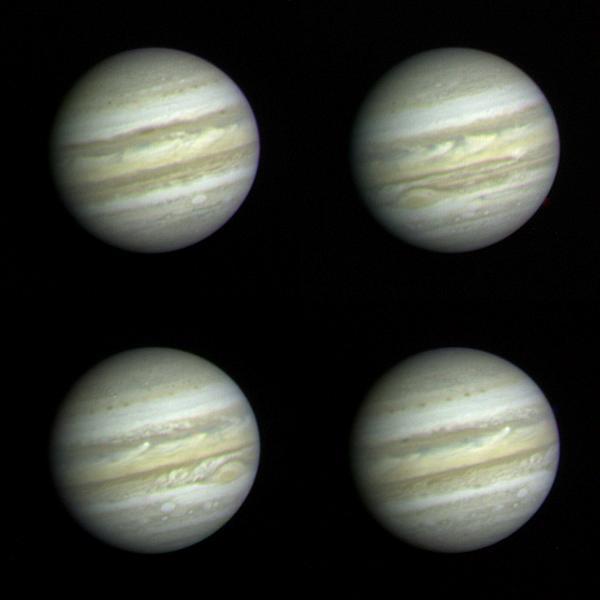
These Jupiter photographs are part of a set taken by NASA Voyager 1 on December 10 and 11, 1978 from a distance of 83 million km 52 million miles or more than half the distance from the Earth to the sun. At this range, Voyager 1 is able to…
Early Voyager 1 Images of Jupiter
This mosaic shows the features of Jupiter main visible cloud deck and upper-tropospheric haze, with higher features enhanced in brightness over lower features as seen by  NASA Galileo orbiter on February 19, 1997.
Jupiter Long-lived White Ovals in a Methane Time Set 4
This enhanced-color image of Jupiter's bands of light and dark clouds was created by citizen scientists Gerald Eichstädt and Seán Doran using data from the JunoCam imager on NASA's Juno spacecraft. Three of the white oval storms known as th…
Jupiter's Bands of Clouds
Jupiter's banded appearance is created by the cloud-forming "weather layer." In this composite image, the image on the left show's Jupiter's thermal energy being emitted in infrared light, with dark cloudy bands appearing as silhouettes aga…
Jupiter's Bands
Time Series of Jupiter Aurora
Jupiter Equatorial Region in a Methane Band Time Set 3
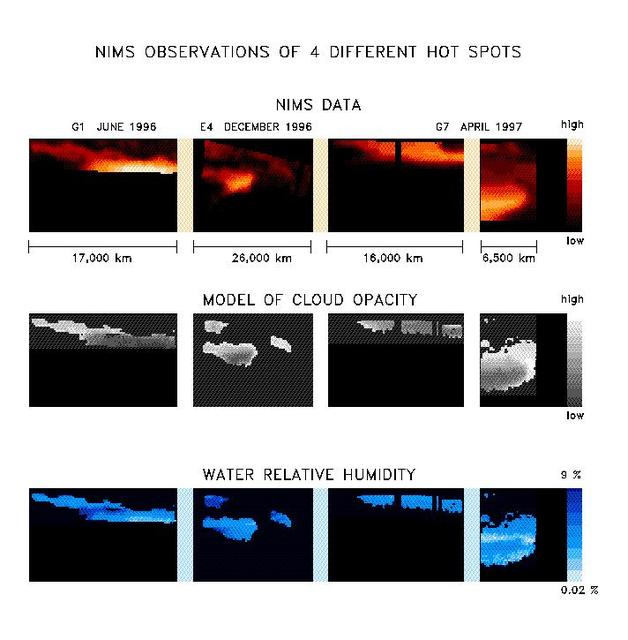
With the NIMS instrument high quality observations are being obtained from all parts of Jupiter. The images in the upper panel are taken at a wavelength of 4.8 microns. At this wavelength thermal radiation from about 100 km deep below the v…
NIMS Observes the Structure and Composition of Jupiter Clouds
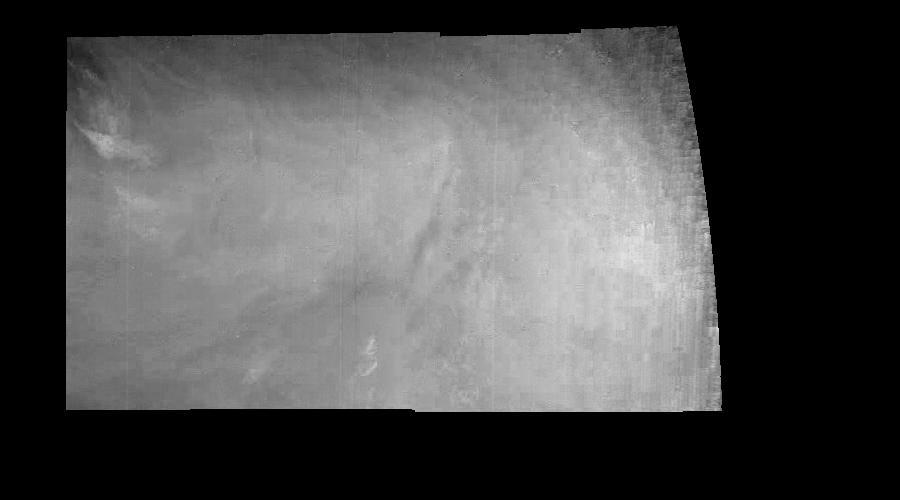
Haze observations near Jupiter Limb 60 degrees North, 295 degrees West
Jupiter Great Red Spot
This annotated composite image depicts the movement of the polar and circumpolar cyclones of Jupiter's south pole between 2016 (left) and 2021 (right) as seen by the Jovian Infrared Auroral Mapper (JIRAM) instrument aboard NASA's Juno space…
Jupiter's Polar Vortices Over Five Years
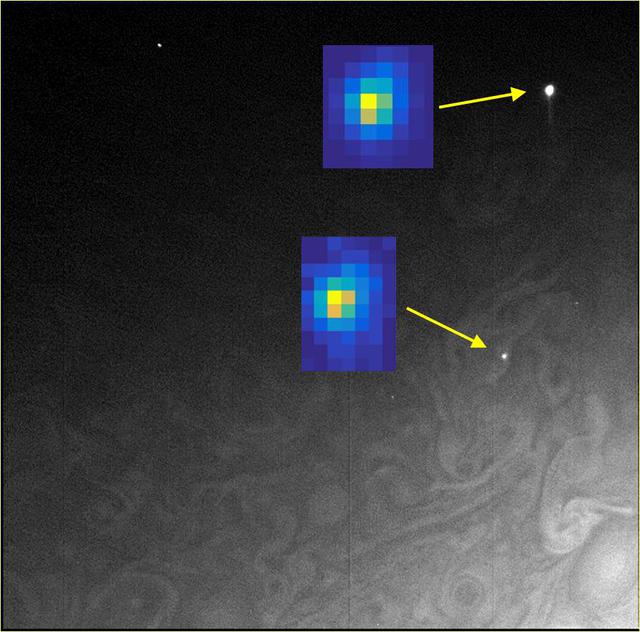
In this composite image taken by Juno's Stellar Reference Unit, the arrows point to small lightning flashes observed on Jupiter's cloud tops; the magnified insets show how they appeared in the science imager. The small size is evidence that…
Jovian Flashes Close Up
This is one of the highest resolution images ever recorded of Jupiter temperature field. It was obtained by NASA Galileo mission, with its Photopolarimeter-Radiometer PPR experiment, during the seventh of its 10 orbits around Jupiter to dat…
Jupiter Temperatures--Broad Latitude
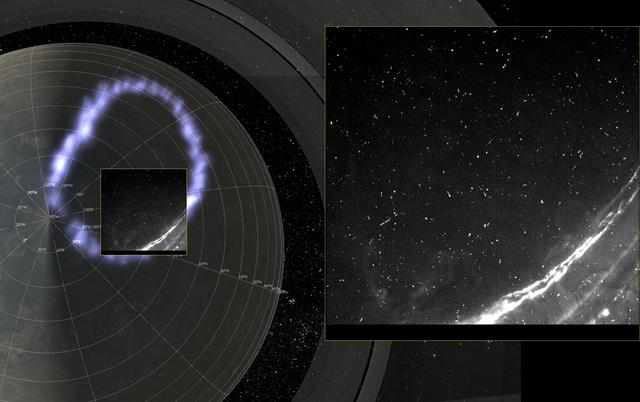
Juno's Radiation Monitoring Investigation used the Stellar Reference Unit (SRU) star camera to collect this high-resolution image Jupiter's northern auroral oval on May 24, 2018 (Perijove 13). Also present in the image are several small bri…
Juno's SRU Captures Jupiter Lightning
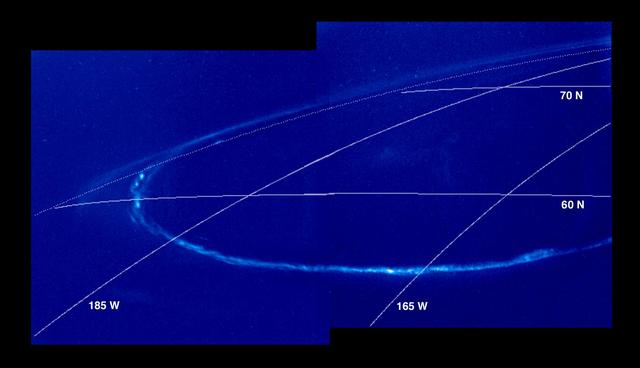
Night Side Jovian Aurora
This animation depicts Jupiter's planet wrapping cloud structure, commonly referred to as "belts" and "zones," and the jet streams that encompass them. The belts (white bands) and zones (reddish bands) are separated by strong east-west wind…
Jets at Jupiter
This high-resolution image of Jupiter's main dust ring was collected by the Stellar Reference Unit (SRU) navigation camera aboard NASA's Juno spacecraft. The image was taken from inside the ring looking out as Juno flew between Jupiter and…
Jupiter's Main Dust Ring
These images, taken on February 19, 1997 by NASA Galileo orbiter, show two of the three long-lived White Ovals that formed to the south of the Jupiter Great Red Spot.
Jupiter Long-lived White Ovals in the Near-Infrared Time Set 2
Three dimensional Visualization of Jupiter Equatorial Region
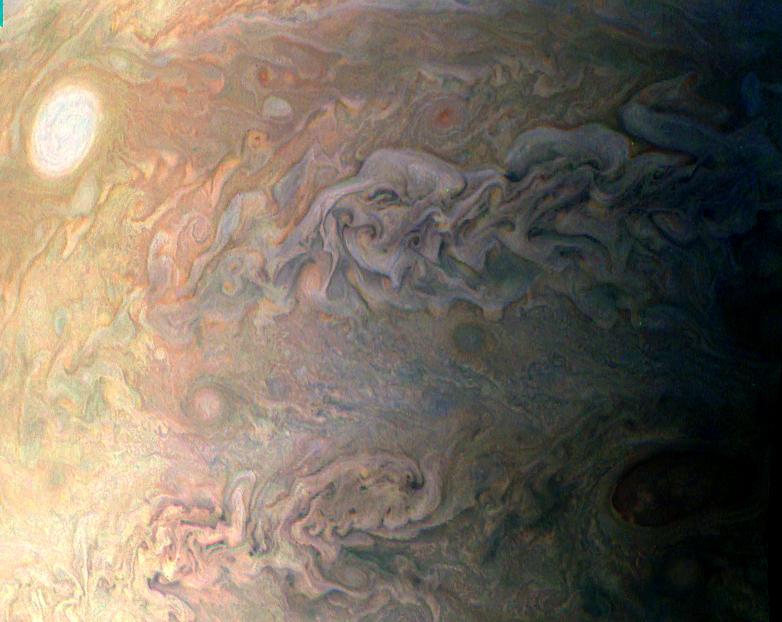
A "brown barge" in Jupiter's South Equatorial Belt is captured in this color-enhanced image from NASA's Juno spacecraft.  This color-enhanced image was taken at 10:28 p.m. PDT on July 15, 2018 (1:28 a.m. EDT on July 16), as the spacecraft p…
Juno Sees South Equatorial Belt 'Brown Barge'
Detailed structure in the clouds of Jupiter's South Equatorial Belt brown barge is visible in this color-enhanced image taken at 10:28 p.m. PDT on July 15, 2018 (1:28 a.m. EDT on July 16), as the spacecraft performed its 14th close flyby of…
South Equatorial Belt Brown Barge Close-up