
Workmen inspect a J-2 engine at Rocketdyne's Canoga Park, California production facility. The J-2, developed under the direction of the Marshall Space Flight Center, was propelled by liquid hydrogen and liquid oxygen. A single J-2 engine wa…

Workmen secure a J-2 engine onto the S-IVB (second) stage thrust structure. As part of Marshall Space Center's "building block" approach to the Saturn development, the S-IVB was utilized in the Saturn IBC launch vehicle as a second stage an…

Smokeless flame juts from the diffuser of a unique vacuum chamber in which the upper stage rocket engine, the hydrogen fueled J-2, was tested at a simulated space altitude in excess of 60,000 feet. The smoke you see is actually steam. In op…
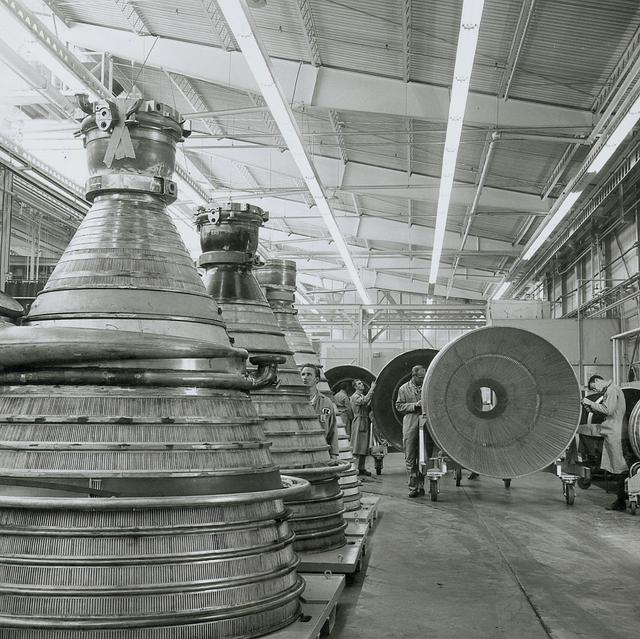
J-2 engines for the Saturn IB/Saturn V launch vehicles are lined up in the assembly area at Rocketdyne's manufacturing plant in Canoga Park, California. Five J-2 engines provided more than 1,000,000 pounds of thrust to accelerate the second…
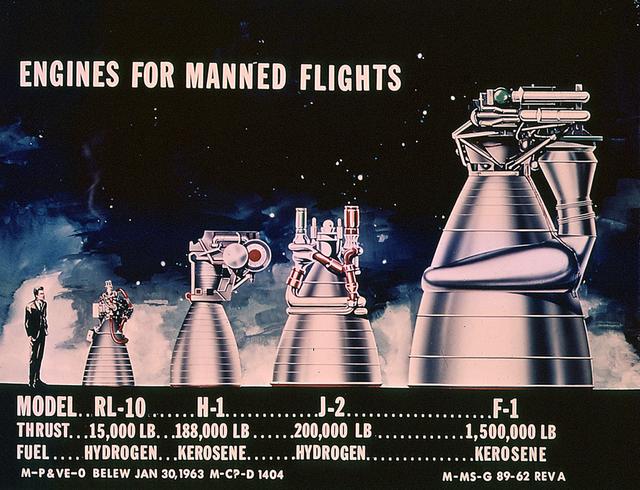
This drawing clearly shows the comparative sizes of the rocket engines used to launch the Saturn vehicles. The RL-10 and the H-1 engines were used to launch the Saturn I rockets. The J-2 engine was used on the second stage of Saturn IB and…

On May 25, 2012, NASA recorded another first during a 40-second test of the next-generation J-2X engine on the A-2 Test Stand at Stennis Space Center. Test conductors fired the J-2X in both the secondary and primary modes of operation. Prev…

NASA's test of the J-2X rocket engine on the A-2 Test Stand at Stennis Space Center on July 13 was picture perfect in more ways than one. Not only did the test provide a breathtaking view from atop the nearby A-1 Test Stand, and with the ce…
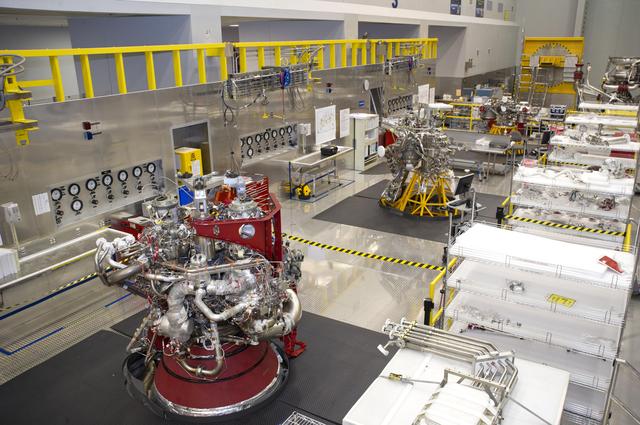
Two J-2X engines and a powerpack, developed for NASA by Pratt and Whitney Rocketdyne, sit side-by-side Oct. 11 at Stennis Space Center as work continues on the Space Launch System. Engine 10001 (far left) has been removed from the A-2 Test…

NASA engineers at Stennis Space Center conducted a 260-second test of the next-generation J-2X rocket engine June 13, 2012. As in a previous test, NASA engineers fired the engine at both secondary and primary modes to collect performance da…

With the Washington Monument as a stirring background, a space shuttle main engine and J-2 engine from Stennis Space Center offer Washington Mall visitors a close-up look at the power of spaceflight

John C. Stennis Space Center employees remove one-half of the A-2 Test Stand clamshell used for testing space shuttle main engines. Space shuttle main engine testing concluded July 2009; the A-2 stand now is being prepared for testing the n…

D-558-2 Aircraft on lakebed

Wing chord extension on D-558-2

This figure is a line drawing of the J-2 engine with callouts of the major components and the engine characteristics.

Pictured is a J-2 engine being processed at Marshall Space Flight Center (MSFC). A single J-2 engine was utilized on the S-IVB stage, the second stage of the Saturn IB and the third stage of the Saturn V vehicles, while a cluster of five J-…

This image depicts an overall view of the vertical test stand for testing the J-2 engine at Rocketdyne's Propulsion Field Laboratory, in the Santa Susana Mountains, near Canoga Park, California. The J-2 engines were assembled and tested at…

NASA Administrator Charles Bolden (r) takes an up-close look at the first development J-2X rocket engine on the A-2 Test Stand at Stennis Space Center during an April 20, 2012, visit. Pictured with Bolden is A-2 Test Stand Director Skip Rob…
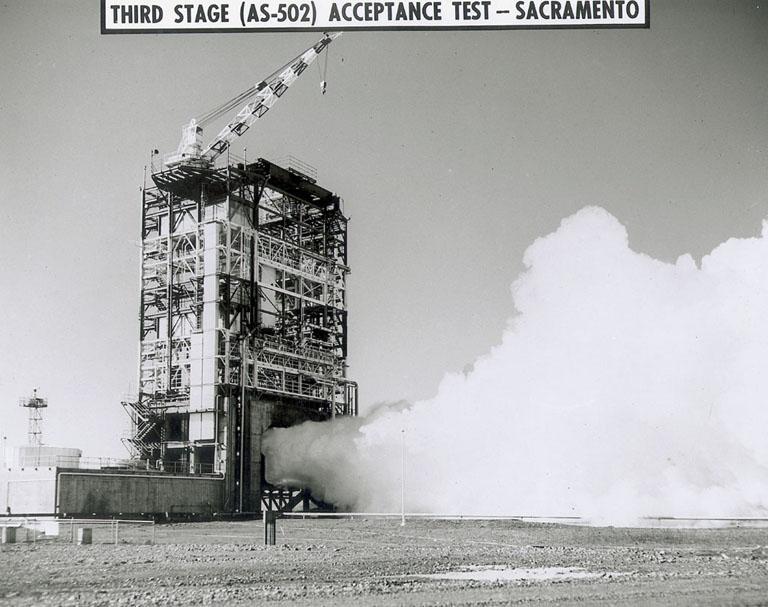
The J-2 engine for Saturn V S-IVB (third) stage blasted from the test stand at Douglas Aircraft Co., Sacramento Test Operation (SACTO) facility in California. This third stage was used on the unmarned Saturn V flight of Apollo 6 in April 19…
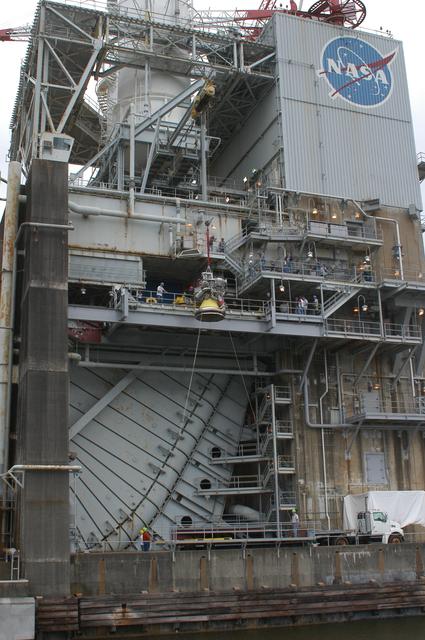
J-2X engine No. 10001 is returned March 8, 2012, to the A-2 Test Stand at Stennis Space Center for its second round of tests. The developmental engine underwent an initial series of tests last year. The J-2X engine is being built for NASA b…

On May 16, 2012, engineers at Stennis Space Center conducted a test of the next-generation J-2X engine that will help power NASA's new Space Launch System, moving NASA even closer to a return to deep space.

A J-2X next-generation rocket engine is lifted onto the A-2 Test Stand at Stennis Space Center. Testing of the engine began the following month. The engine is being developed for NASA by Pratt & Whitney Rocketdyne and could help carry human…

John C. Stennis Space Center employees remove space shuttle main engine run ducts from the A-2 Test Stand engine deck Oct. 25, 2010. Testing of space shuttle main engines concluded in July 2009. Stennis is preparing the A-2 Test Stand for t…
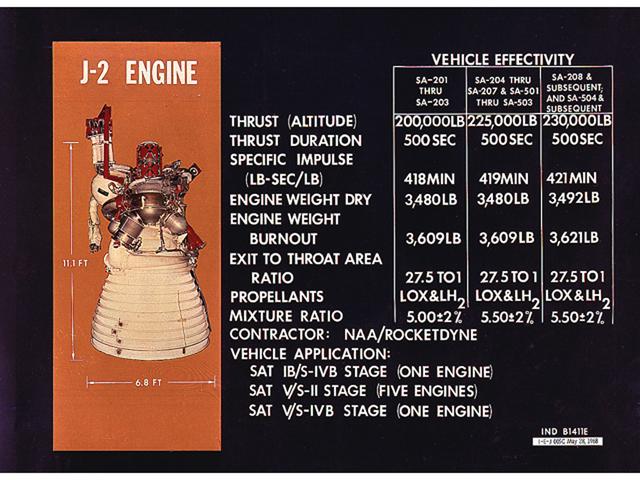
This chart is an illustration of J-2 Engine characteristics. A cluster of five J-2 engines powered the Saturn V S-II (second) stage with each engine providing a thrust of 200,000 pounds. A single J-2 engine powered the S-IVB stage, the Satu…

D-558-2 being mounted to P2B-1S launch aircraft in hangar.

D558-2 #143 LOX jettison with P2BS in background
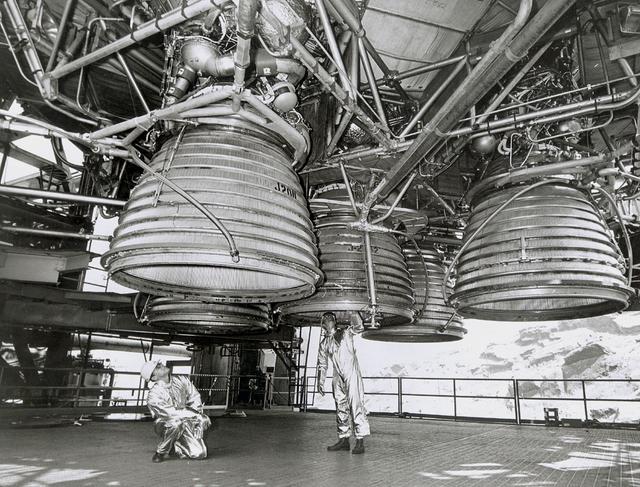
Two workers are dwarfed by the five J-2 engines of the Saturn V second stage (S-II) as they make final inspections prior to a static test firing by North American Space Division. These five hydrogen -fueled engines produced one million poun…

This image depicts the test firing of a J-2 engine in the S-IVB Test Stand at the Marshall Space Flight Center (MSFC). The J-2, developed by Rocketdyne under the direction of MSFC, was propelled by liquid hydrogen and liquid oxygen. A sin…
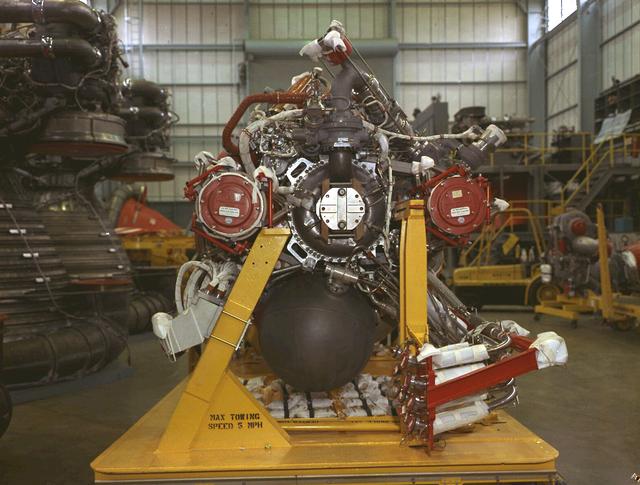
Pictured is a J-2 engine being processed at Marshall Space Flight Center (MSFC). A single J-2 engine was utilized on the S-IVB stage, the second stage of the Saturn IB and the third stage of the Saturn V vehicles, while a cluster of five J-…

NASA Administrator Charles Bolden (r) takes an up-close look at the first development J-2X rocket engine on the A-2 Test Stand at Stennis Space Center during an April 20, 2012, visit. Pictured with Bolden is A-2 Test Stand Director Skip Rob…
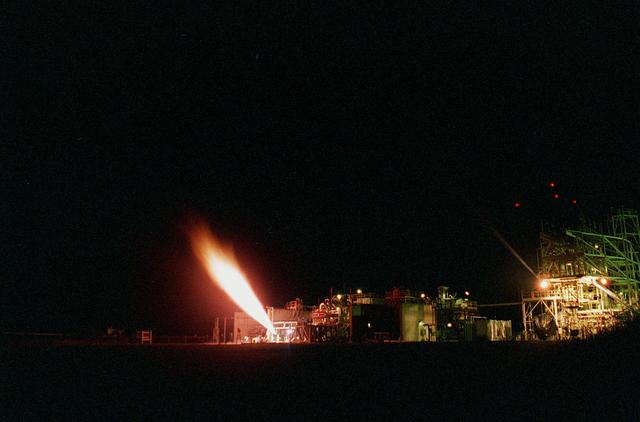
A J-2 Gas Generator (GG) engine's duration test at Marshall's Test Stand-116.

NASA engineers continued to collect test performance data on the new J-2X rocket engine at Stennis Space Center with a 250-second test Sept. 14. The test on the A-2 Test Stand was the 19th in a series of firings to gather critical data for…

NASA engineers continued testing the next-generation J-2X rocket engine at Stennis Space Center with a 250-second test on Sept. 7. The test was the first conducted after the arrival of Hurricane Isaac forced closure of the Stennis facility…

NASA conducted a long-duration test of the J-2X powerpack, 1,261 seconds total, on the A-1 Test Stand at Stennis Space Center on Aug. 16, marking another step in development of the next-generation rocket engine. The powerpack is a system of…

NASA conducted a key stability test firing of the J-2X rocket engine on the A-2 Test Stand at Stennis Space Center on Dec. 1, marking another step forward in development of the upper-stage engine that will carry humans deeper into space tha…

Two J-2X engines and a powerpack, developed for NASA by Pratt and Whitney Rocketdyne, sit side-by-side Oct. 11 at Stennis Space Center as work continues on the Space Launch System. Engine 10001 (far left) has been removed from the A-2 Test…

A photograph of a J-2X rocket engine on the A-2 Test Stand from atop the B Test Stand at Stennis Space Center offers a panoramic view of the A Test Complex. The J-2X engine is being developed for NASA by Pratt & Whitney Rocketdyne to carry…

John C. Stennis Space Center employees install a new master interface tool on the A-2 Test Stand on Oct. 27, 2010. Until July 2009, the stand had been used for testing space shuttle main engines. With that test series complete, employees ar…
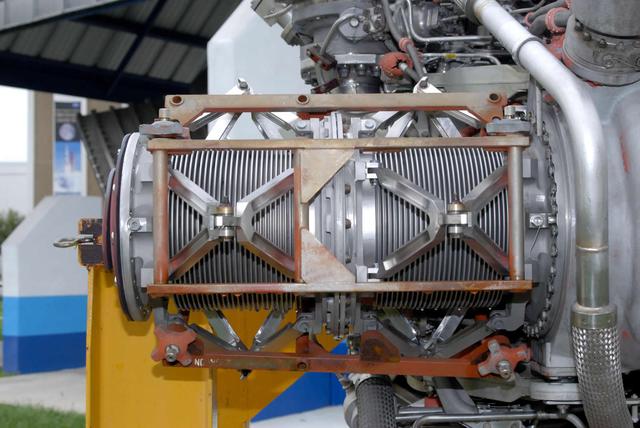
Stennis Space Center engineers are preparing to conduct water tests on an updated version of the scissors duct component of the J-2X engine. Measuring about 2 feet long and about 8 inches in diameter, the duct on the J-2X predecessor, the J…

D-558-2 Aircraft on lakebed