
Date: 8 Nov 2013 - Comet ISON shines in this five-minute exposure taken at NASA's Marshall Space Flight Center on Nov. 8, 2013.. The image was captured using a color CCD camera attached to a 14" telescope located at Marshall. At the ti…
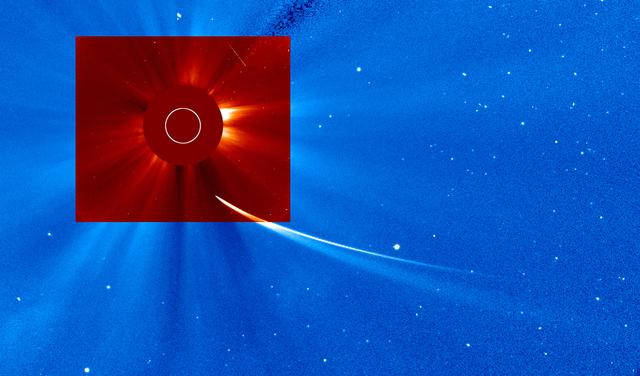
A merger of SOHO LASACO C2 data observed at 12:42 pm and C3 observed at 12:37 pm on November 28, 2013. Credit NASA/Goddard/SOHO
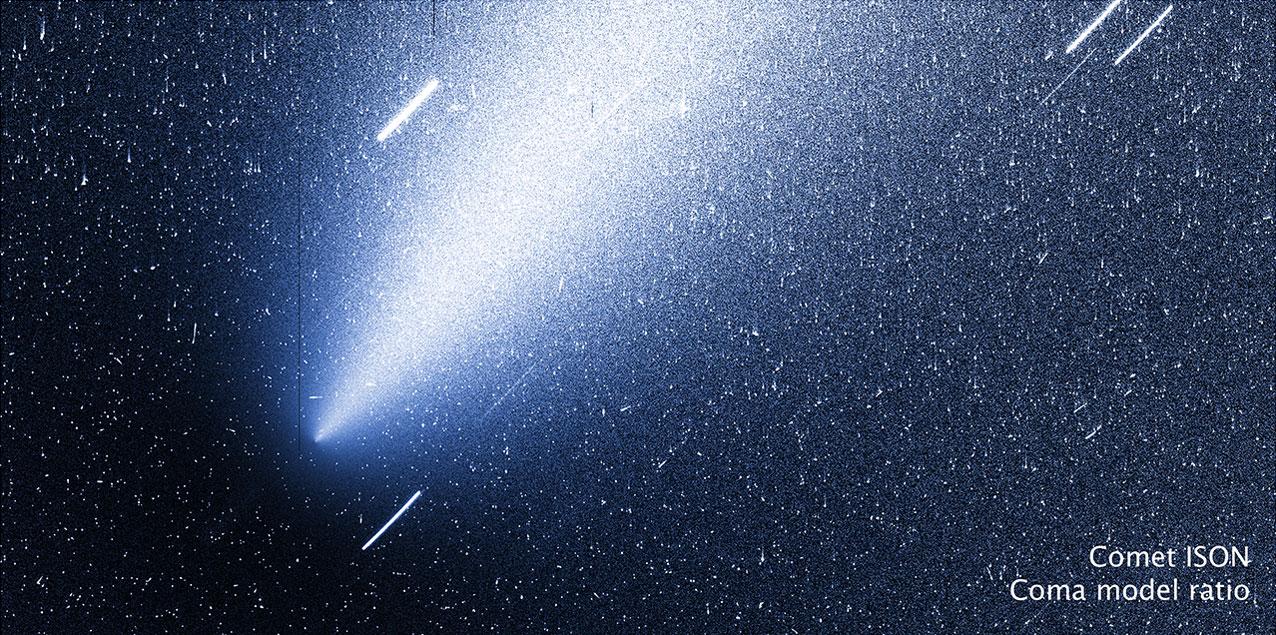
In this modeled image of ISON, the coma has been subtracted, leaving behind the nucleus. Credit: NASA, ESA, the Hubble Heritage Team (AURA/STScI) and Jian-Yang Li (Planetary Science Institute) -------- More details on Comet ISON: Comet…
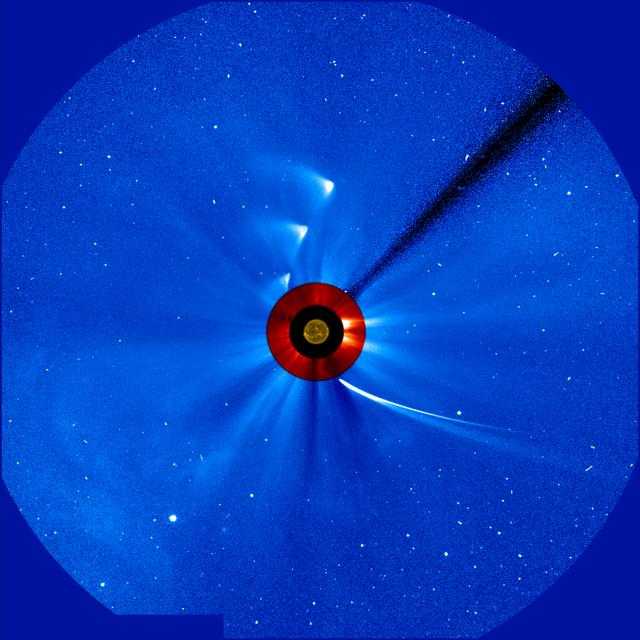
"Timelapse" series of images of comet ISON as viewed by ESA/NASA's Solar and Heliospheric Observatory, or SOHO. This image is a composite, with the sun imaged by NASA's Solar Dynamics Observatory in the center, and SOHO's two coro…

This image from NASA Hubble Space Telescope of the sunward plunging comet ISON suggests that the comet is intact despite some predictions that the fragile icy nucleus might disintegrate as the sun warms it. In this NASA Hubble Space Telesc…
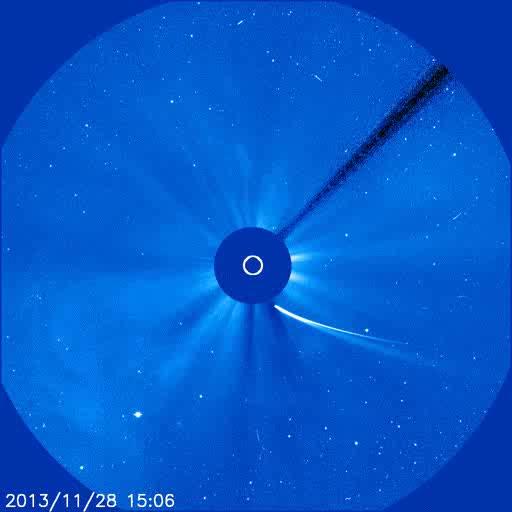
This movie shows Comet ISON orbiting around the sun – represented by the white circle -- on Nov. 28, 2013. ISON looks smaller as it streams away, but scientists believe its nucleus may still be intact. The video covers Nov. 27, 2013, 3:30 p…
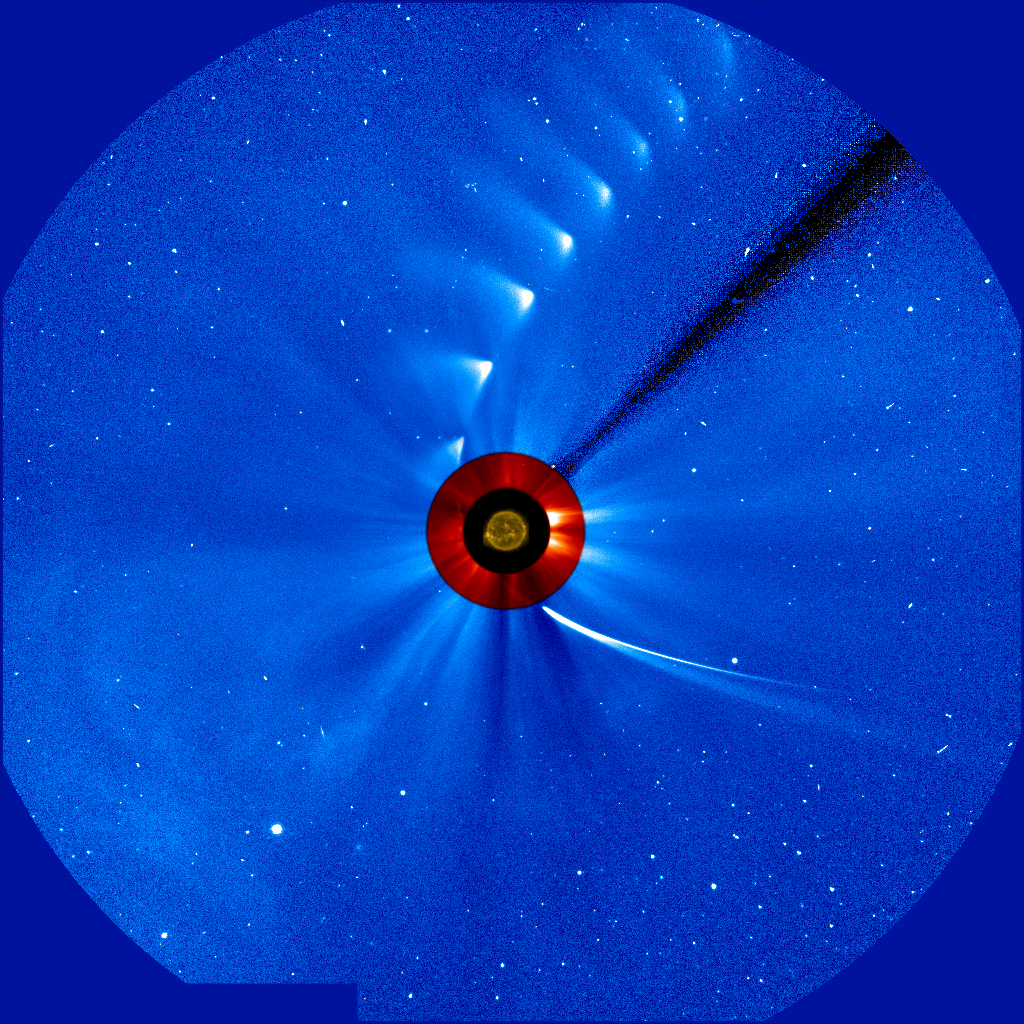
Comet ISON comes in from the bottom right and moves out toward the upper right, growing more faint, in this time-lapse image from the ESA/NASA Solar and Heliospheric Observatory. The image of the sun at the center is from NASA's Solar Dynam…
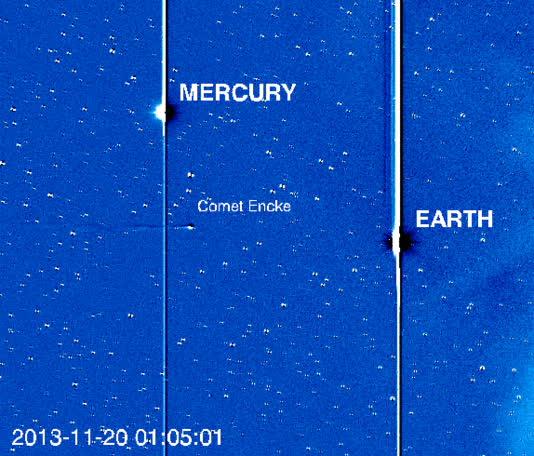
Comet ISON makes its appearance into the higher-resolution HI-1 camera on the STEREO-A spacecraft. The dark "clouds" coming from the right are density enhancements in the solar wind, causing all the ripples in comet Encke's ta…
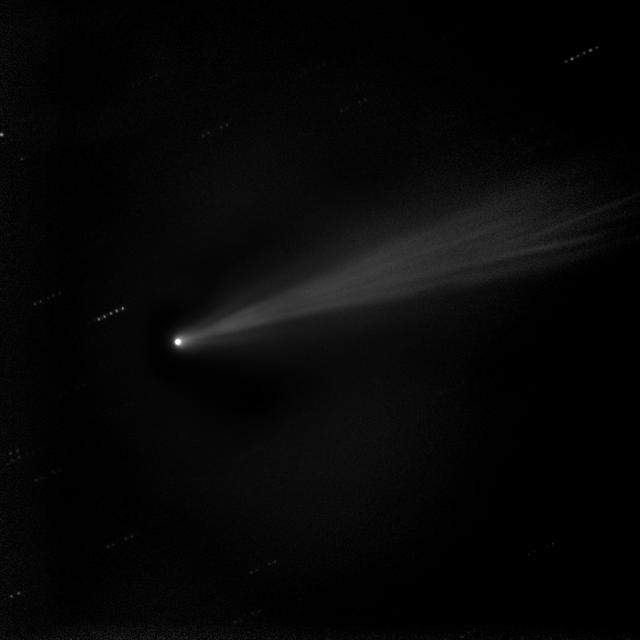
Taken on 19 Nov. 2013, this image shows a composite "stacked" image of comet ISON. These five stacked images of 10 seconds each were taken with the 20" Marshall Space Flight Center telescope in New Mexico. This technique allo…
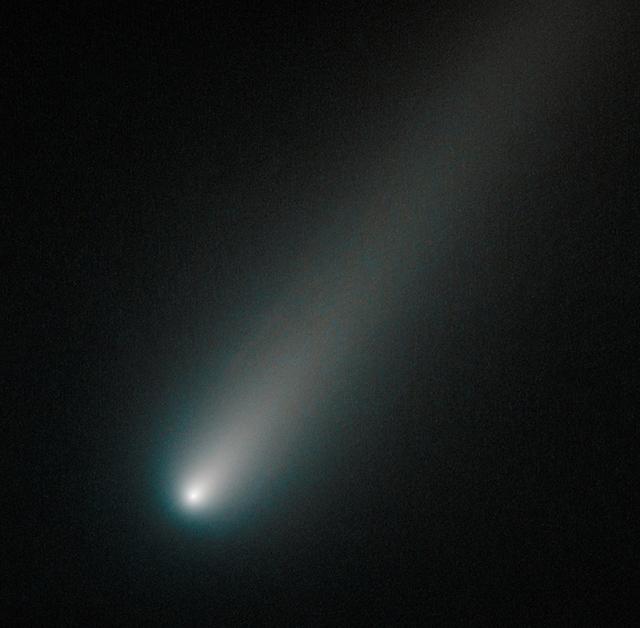
On Oct. 9, 2013, Hubble observed comet ISON once again, when it was inside the orbit of Mars, about 177 million miles from Earth. This image shows that the comet was still intact despite some predictions that the fragile icy nucleus might d…

Date: 19 Nov 2013 Comet ISON shows off its tail in this three-minute exposure taken on 19 Nov. 2013 at 6:10 a.m. EST, using a 14-inch telescope located at the Marshall Space Flight Center. The comet is just nine days away from its close en…
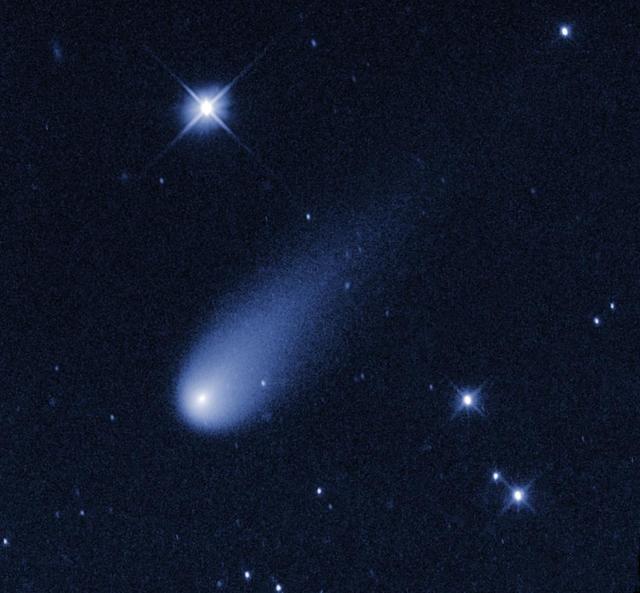
Superficially resembling a skyrocket, Comet ISON is hurtling toward the Sun at a whopping 48,000 miles per hour in this still from a Hubble animation.
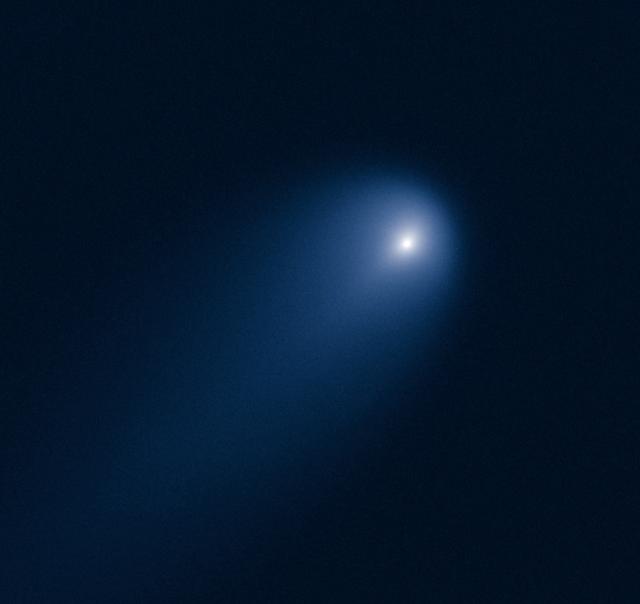
This NASA Hubble Space Telescope image of Comet (C/2012 S1) ISON was photographed on April 10, 2013, when the comet was slightly closer than Jupiter's orbit at a distance of 394 million miles from Earth. Even at that great distance the com…

Release Date: November 25, 2013 MESSENGER image of comet C/2012 S1 (ISON) during its closest approach to Mercury. At that time, ISON was approximately 22.5 million miles (36.2 million kilometers) from MESSENGER and 42.1 million miles (67.8…
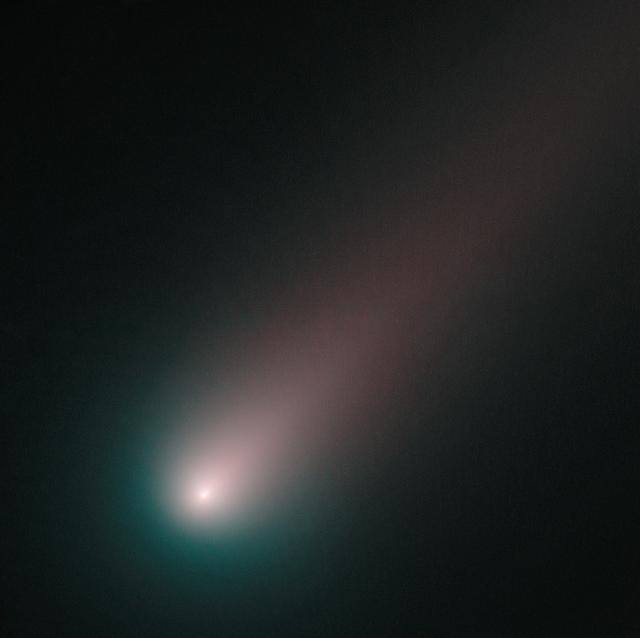
As of mid-November, ISON is officially upon us. Using Hubble, we've taken our closest look yet at the innermost region of the comet, where geysers of sublimating ice are fueling a spectacular tail. Made from observations on November 2nd,…
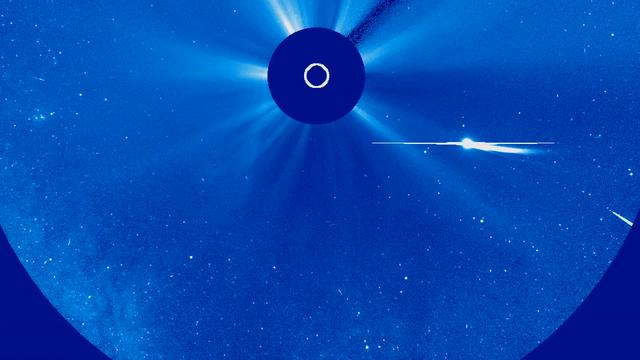
Sungrazing comets are a special class of comets that come very close to the sun at their nearest approach, a point called perihelion. To be considered a sungrazer, a comet needs to get within about 850,000 miles from the sun at perihelion.…

This NASA Hubble Space Telescope image of Comet (C/2012 S1) ISON was photographed on April 10, 2013, when the comet was slightly closer than Jupiter's orbit at a distance of 394 million miles from Earth. Even at that great distance the com…

On April 30, NASA's Hubble Space Telescope observed Comet ISON again. The comet is in the upper middle, showing the long tail. Various galaxies and stars appear behind it. In this image, Hubble trained its telescope on the stars instead o…
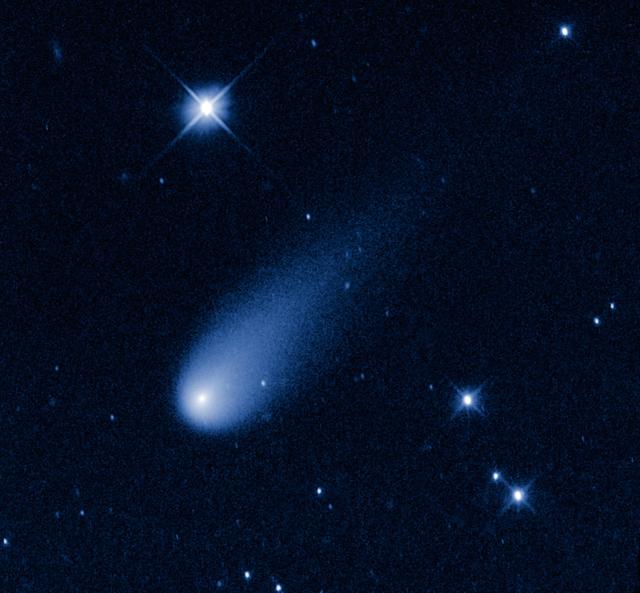
Superficially resembling a skyrocket, Comet ISON is hurtling toward the Sun at a whopping 48,000 miles per hour. Its swift motion is captured in this image taken May 8, 2013, by NASA's Hubble Space Telescope. At the time the image was take…
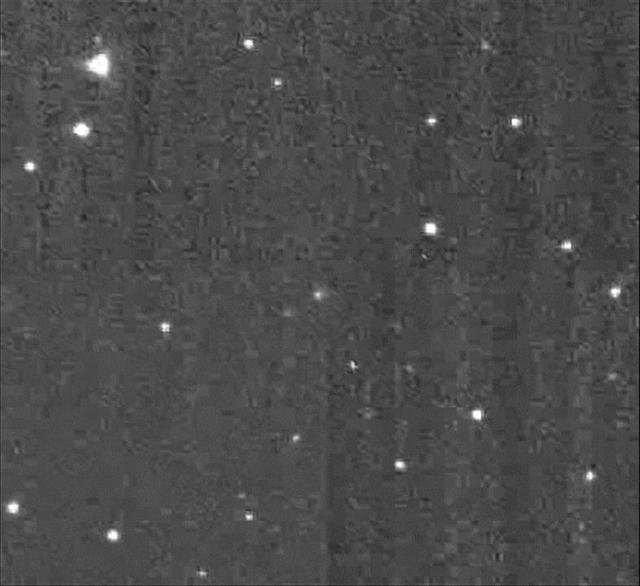
This frame from an animation series of images of comet C/2012 S1 ISON was taken by the Medium-Resolution Imager of NASA Deep Impact spacecraft over a 36-hour period on Jan. 17 and 18, 2013.
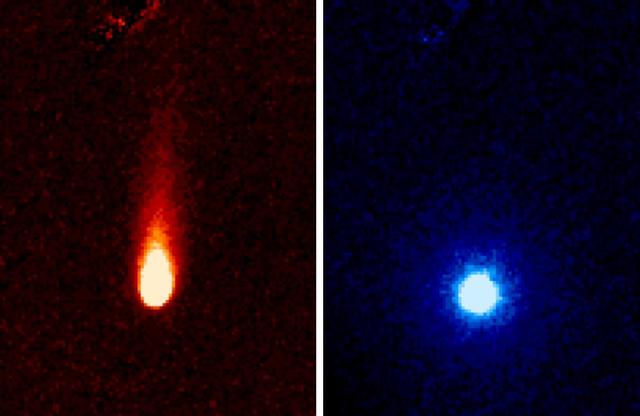
These images from NASA Spitzer Space Telescope of C/2012 S1 Comet ISON were taken on June 13, when ISON was 310 million miles about 500 million kilometers from the sun.

This movie from NASA’s STEREO spacecraft's Heliospheric Imager shows Comet ISON, Mercury, Comet Encke and Earth over a five-day period from Nov. 20 to Nov. 25, 2013. The sun sits right of the field of view of this camera. Comet ISON, which…

Comet ISON swoops around the sun and through Scorpius. This composite merges an SDO AIA 171 sun image (Nov. 28, 2214 UT), SOHO C2 (2036 UT) and C3 (2030 UT) images, and a DSS view of the sky in northern Scorpius. Credit: NASA/ESA/SOHO, NA…
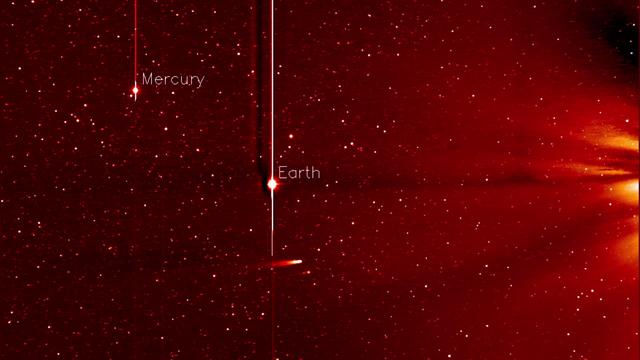
This movie from NASA’s STEREO spacecraft's Heliospheric Imager shows Comet ISON, Mercury, Comet Encke and Earth over a five-day period from Nov. 20 to Nov. 25, 2013. The sun sits right of the field of view of this camera. Comet ISON, which…

This view captures the transformation of Comet ISON as it rounded the sun. It combines 60 SOHO C2 frames in which ISON appears (Nov. 28, 1248 UT, to Nov. 29, 0316 UT) with stars, noise and particle tracks removed, plus an SDO AIA 171 image…