This illustration shows the major components of the instrument unit (IU). Developed and manufactured by International Business Machines, the IU is 3 feet high and 21 feet in diameter and mounted atop an S-IVB, between the third stage and th…
This is a view of the Saturn V instrument unit (IU) being manufactured in the east high bay at International Business Machines (IBM) in Huntsville, Alabama. IBM is a prime contractor for development and fabrication of the IU. The IU is vita…
The instrument unit for the Saturn V launch vehicle, AS-506, used to propel the Apollo 11 lunar landing mission, is lowered into place atop the third (S-IVB) stage in the vehicle assembly building at the NASA Kennedy Space Center (KSC). Des…
The primary objective of the STS-35 mission was round the clock observation of the celestial sphere in ultraviolet and X-Ray astronomy with the Astro-1 observatory which consisted of four telescopes: the Hopkins Ultraviolet Telescope (HUT);…
The OTE (Optical Telescope Element) Simulator or OSIM wrapped in a silver blanket on a platform, being lowered down into a vacuum chamber (called the Space Environment Simulator, or SES) by a crane to be tested to withstand the cold tempera…
BioSentinel spacecraft enters a lunar flyby trajectory into a heliocentric orbit. BioSentinel will detect and measure the impact of space radiation on living organisms over long durations beyond low-Earth orbit (LEO). Illustration by Daniel…
The BioSentinel spacecraft enters a heliocentric orbit. BioSentinel will detect and measure the impact of space radiation on living organisms over long durations beyond low-Earth orbit (LEO). Illustration by Daniel Rutter.
BioSentinel spacecraft enters a lunar flyby trajectory into a heliocentric orbit. BioSentinel will detect and measure the impact of space radiation on living organisms over long durations beyond low-Earth orbit (LEO). Illustration by Daniel…
Pete Steigner, and Mike Golob (middle and right) assist an Chris Kolos in carefully moving a TIRS component across the clean room at Goddard. On the far right Robin Knight holds the component's 'grounding strap.' It's used to make sure that…
This photograph was taken during the final assembly operation of the Saturn V launch vehicle for the Apollo 4 (SA 501) mission. The instrument unit (IU) was hoisted to be mated to the S-IC/S-II assembly in the Vehicle Assembly Building high…
The TIRS instrument in the foreground with its shipping container waits in the background. The copper-color of TIRS is due to the gold-colored foil that coats the Multi-Layer Insulation blankets. The Thermal Infrared Sensor (TIRS) will fly…
This view depicts engineers conducting a system test on the Saturn V instrument unit (IU) at International Business Machines (IBM) in Huntsville, Alabama. IBM is a prime contractor for development and fabrication of the IU. The IU is vital…
This undated chart provides a description of the Saturn IB and Saturn V's Instrument Unit (IU) and its major components. Designed by NASA at the Marshall Space Flight Center (MSFC), the Instrument Unit, sandwiched between the S-IVB stage an…
This photograph shows the Instrument Pointing System (IPS) for Spacelab-2 being deployed in the cargo bay of the Space Shuttle Orbiter Challenger. The European Space Agency (ESA) developed this irnovative pointing system for the Spacelab pr…
This photograph was taken during the final assembly operation of the Saturn V launch vehicle for the Apollo 4 (SA 501) mission. The instrument unit (IU) was mated atop the S-IC/S-II assembly in the Vehicle Assembly Building high bay at the…
From left, Wayne Arrington, a Boeing Company technician, and Steve Presti, a mechanical technician at NASA's Marshall Space Flight Center in Huntsville, Ala., install Developmental Flight Instrumentation Data Acquisition Units in Marshall's…
Aleksandra Bogunovic (left) and Veronica Otero (right) look on while Pete Steigner (in the middle) adds a flow tube that will make sure that nitrogen gas flows through the instrument while it's being shipped. The gas will keep contaminating…
Engineers Tom Huber (behind MIRI) and Mick Wilks (inside black ISIM Structure) check that MIRI is integrated precisely. The engineers have to make sure that MIRI, the only instrument on the Webb telescope that 'sees' mid-infrared light, is…
As the construction continued on the International Space Station (ISS), STS-118 Astronaut Dave Williams, representing the Canadian Space Agency, participated in the fourth and final session of Extra Vehicular Activity (EVA). During the 5 ho…
S70-56721 (December 1970) --- A close-up view of the Lunar Portable Magnetometer (LPM), which will be used by the crew of the Apollo 14 lunar landing mission during the second extravehicular activity (EVA). The LPM's components, a tripod-mo…
This image depicts a high angle view of technicians working on the instrument unit (IU) component assembly for the SA-8 mission in Marshall Space Flight Center's building 4705. A thin, circular structure, only 1-meter high and 7.6 meters in…
Goddard scientist David Harding and Goddard technologist Tony Yu are developing a lidar system that could meet an ambitious requirement of the proposed LIST mission. ---------- In 2007, the National Research Council threw down a challenge…
The BioSentinel spacecraft enters a heliocentric orbit. BioSentinel will detect and measure the impact of space radiation on living organisms over long durations beyond low-Earth orbit (LEO). Illustration by Daniel Rutter.
BioSentinel spacecraft enters a lunar flyby trajectory into a heliocentric orbit. BioSentinel will detect and measure the impact of space radiation on living organisms over long durations beyond low-Earth orbit (LEO). Illustration by Daniel…
BioSentinel spacecraft leaves Earth and enters a lunar flyby trajectory into a heliocentric orbit. BioSentinel will detect and measure the impact of space radiation on living organisms over long durations beyond low-Earth orbit (LEO). Illus…
This photograph shows the Instrument Pointing System (IPS) for Spacelab-2 being deployed in the cargo bay of the Space Shuttle Orbiter Challenger. The European Space Agency (ESA) developed this irnovative pointing system for the Spacelab pr…
The large air intakes for its powerful engine are obvious as NASA's high-flying ER-2 #806 Earth resources aircraft taxies out for another science mission.
The Thermal Infrared Sensor (TIRS) will fly on the next Landsat satellite, the Landsat Data Continuity Mission (LDCM). The right side of the instrument is what's called the 'nadir side,' that's the side that points toward Earth when the ins…
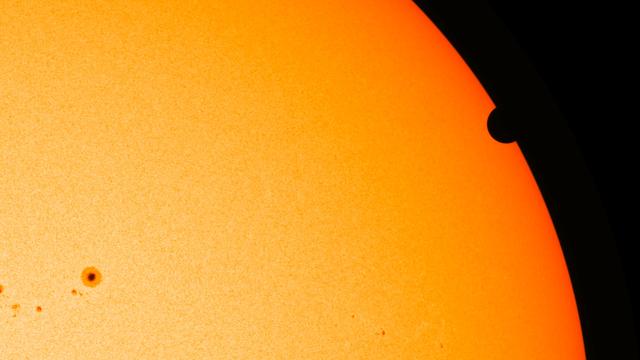
NASA image captured June 6, 2012. On June 5-6 2012, SDO is collecting images of one of the rarest predictable solar events: the transit of Venus across the face of the sun. This event happens in pairs eight years apart that are separated…
STS066-14-021 (3-14 Nov 1994) --- On the Space Shuttle Atlantis' mid-deck, astronaut Curtis L. Brown, Jr., pilot, works with the Space Acceleration Measurement System (SAMS), which is making its eleventh Shuttle flight. This system support…